
GS8100-O2 Process Oxygen Analyzer
High-accuracy paramagnetic O₂ measurement for process optimization
- Range
- 0-25 %vol O₂
- Accuracy
- ±0.05 %vol
- Response
- <5s T90
- Output
- 4-20mA, Modbus, HART
Overview
The GS8100-O2 delivers precise oxygen measurement using paramagnetic sensing technology, ideal for combustion control, inerting verification, and quality assurance in chemical and petrochemical processes.
- Dual-sensor option (paramagnetic + zirconia)
- Auto-calibration with internal reference
- SIL 2 rated for safety applications
- Heated sample path prevents condensation
Full Technical Specifications
Key Performance
| Metric | Value | Status |
|---|---|---|
| Range | 0-25%vol O₂ | confirmed |
| Accuracy | ±0.05%vol | confirmed |
| Response | <5s T90 | conditional* |
| Output | 4-20mA, Modbus, HART | confirmed |
* Response: full-system vs cell-only basis pending Phase E clarification
Measurement
| Specification | Value |
|---|---|
| Measuring Principle | Paramagnetic (thermomagnetic wind) / Zirconia oxide |
| Measurement Range | 0–25 %vol O₂ (configurable to 0–100 %vol) |
| Accuracy | ±0.05 %vol (paramagnetic); ±0.1 %vol (zirconia) |
| Repeatability | ≤0.02 %vol |
| Response Time (T90) | <5 s (paramagnetic); <3 s (zirconia) |
Physical
| Specification | Value |
|---|---|
| Dimensions (W×H×D) | 483 × 177 × 420 mm (19″ rack) |
| Weight | 14.5 kg |
| Housing Material | Powder-coated aluminum, SS316L wetted parts |
| Mounting | 19″ rack (4U) / wall-mount / field enclosure |
Electrical
| Specification | Value |
|---|---|
| Power Supply | 100–240 VAC, 50/60 Hz, 80 W max |
| Analog Output | 2 × 4–20 mA (isolated, configurable) |
| Digital Output | Modbus RTU/TCP, HART 7, OPC-UA |
| Relay Outputs | 4 × SPDT (alarm, fault, maintenance, range) |
| Display | 5″ color TFT touchscreen |
Environmental
| Specification | Value |
|---|---|
| Operating Temperature | -20 °C to +50 °C |
| Storage Temperature | -40 °C to +70 °C |
| Humidity | 0–95 % RH (non-condensing) |
| Sample Temperature | Up to 200 °C (with heated inlet) |
| Sample Pressure | -50 to +500 mbar |
Certifications
| Specification | Value |
|---|---|
| Hazardous Area | ATEX II 2G Ex d IIB+H2 T4 Gb |
| Functional Safety | SIL 2 per IEC 61508 / IEC 61511 |
| Ingress Protection | IP66 (field enclosure) |
| EMC | EN 61326-1:2021 |
| Quality | ISO 9001:2015 manufactured |
Where This Analyzer Fits
This model is mapped to the following industry applications and process duties.
Deployment Environments
Common process environments where this model is evaluated.
Certification Scope
Standards are listed with scope and status so engineering review can verify the applicable enclosure, area, and safety case.
| Standard | Scope | Variant | Status | Document |
|---|---|---|---|---|
| CE (EU declaration of conformity) | Field enclosure variant | Project variant | approved | On request |
| SIL 2 per IEC 61508 / IEC 61511 | Functional safety for safety-instrumented oxygen control | Project variant | approved | On request |
| ATEX II 2G Ex d IIB+H₂ T4 Gb | Field enclosure variant for Zone 1 hazardous areas (gases up to and including hydrogen) | Project variant | approved | On request |
Request Documentation
Request technical datasheets, user manuals, certificates, and application notes for this model.
Evidence Notes
Combustion-air control on chemical and petrochemical cracker trains
Architecture-level note describing how dual paramagnetic/zirconia sensing supports tight combustion-air control across high-temperature exhaust without drift-driven shutdown patterns. Customer-specific outcomes excluded; site results vary with sample conditions and calibration cadence.
Technical & Engineering Details
Secondary engineering detail — expand each topic for the full measurement, envelope, sample-system, calibration, integration, maintenance and application evidence.
01 Measurement Principle and Limits
How the measurement is bounded
Paramagnetic / Zirconia dual-sensor — paramagnetic measures O₂ via its unique magnetic susceptibility; zirconia measures O₂ partial pressure at high temperature.
Rejects
- Most non-magnetic gases under stated matrix
- Background drift handled by auto-calibration
Requires
- Heated sample path to prevent condensation
- Stated process and ambient conditions
Interferents and Limits
- Strongly paramagnetic gases (NO, NO₂) when present at high concentration
- High-humidity stack gas above stated dew-point margin
- Process temperatures outside zirconia operating range
02 Operating Envelope
Use these limits as selection inputs, then confirm sample condition, ambient exposure, and materials before quotation.
- Continuous service above stated zirconia process temperature
- Sample below dew point without heated line
03 Sample System Boundary
Sampling mode, conditioning components, and exclusions define where the analyzer responsibility ends and the sample system begins.
- heated sample path
- GS-SCS-600 conditioning system
- Wet stack without dew-point margin
04 Calibration & Validation
Calibration method, interval, traceability, and audit support are shown only when structured data is available.
Zero / Span Method
Auto-calibration with internal reference; manual span check supported
Interval
6 months between manual span checks; quarterly verification recommended for SIL 2 service
Linearity Check
Multi-point linearity check supported via span gas
Span Gas Traceability
Site-specific traceable span gas required
Audit Support
- IEC 61511 proof-test alignment
05 I/O & Integration
Signal outputs and communication interfaces shown from the published specification fields on this product page.
Output
4-20mA, Modbus, HART
Analog Output
2 × 4–20 mA (isolated, configurable)
Digital Output
Modbus RTU/TCP, HART 7, OPC-UA
Relay Outputs
4 × SPDT (alarm, fault, maintenance, range)
DAHS Review Note
Confirm protocol map, channel naming, alarm states, and reporting format during project integration review.
06 Maintenance & Spares site-specific
Tasks, consumables, and access items are shown only when structured maintenance data is available.
- Manual span check per stated interval
- Sample-line and filter inspection per site cadence
- Sensor cell condition review per site cadence
- Sample-line filter elements
- Span gas cylinders
07 Application Evidence
Application context from complex industrial environments.
Application Context
Ethylene-cracker furnace operators routinely face oxygen-analyzer drift in high-temperature exhaust, where inaccurate combustion control leads to fuel inefficiency and risk of unplanned shutdown — the kind of pattern that drives multi-train CAPEX reviews.
Architecture Response
A 16-unit GS8100-O2 deployment with dual paramagnetic/zirconia sensors and auto-calibration delivers ±0.05% O₂ accuracy at 1,200°C exhaust conditions, so combustion-air can be controlled tightly across the cracker train without drift-driven shutdown patterns.
Frequently Asked Questions
What is the recommended calibration interval for the GS8100-O2?
With auto-calibration enabled, the GS8100-O2 maintains accuracy for 6 months between manual span checks. For SIL 2 safety applications, quarterly verification per IEC 61511 proof-test requirements is the recommended planning cadence.
Can I install the GS8100-O2 in an ATEX Zone 1 area?
Yes. The GS8100-O2 in its field enclosure is certified ATEX II 2G Ex d IIB+H2 T4 Gb for Zone 1 installation. The flameproof enclosure is rated for gases up to and including hydrogen.
What is the difference between paramagnetic and zirconia measurement?
Paramagnetic sensing measures O₂ based on its unique magnetic properties — delivering high accuracy in clean, conditioned sample gas where cross-gas effects are managed by the sample system. Zirconia measures oxygen partial pressure at high temperature — giving faster response for combustion applications. The GS8100-O2 offers both in a dual-sensor configuration.
What sample conditioning is required?
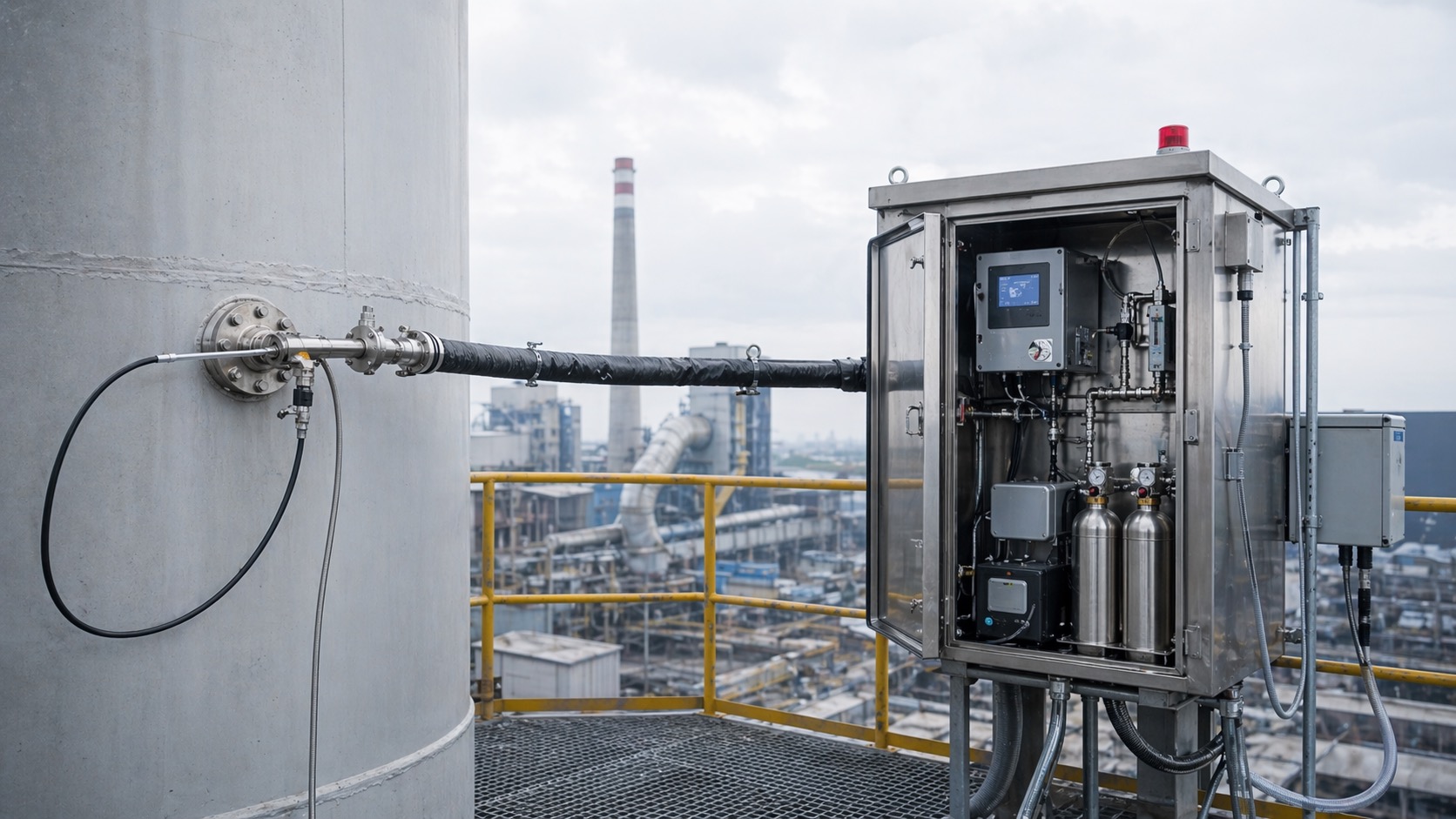
The paramagnetic sensor requires a clean, dry sample; GS-SCS-600 Cool-Dry conditioning is the typical pairing. The zirconia option accepts hot, wet gas directly. Both paths include integrated particulate filters and are compatible with GS-SCS-800 Heated Sampling System.
Does the GS8100-O2 support integration with SCADA/DCS systems?
Yes. The analyzer provides 4–20 mA analog outputs, Modbus RTU/TCP, HART 7 protocol, and OPC-UA for Industry 4.0 integration. All outputs are fully configurable via the touchscreen or remote interface.
What is the expected sensor lifetime and replacement cost?
The paramagnetic sensor does not use a consumable sensing element and typically lasts 10+ years with scheduled checks. The optional zirconia cell has a 3–5 year service life depending on application conditions. Both are field-replaceable in under 30 minutes without special tools.
Related & Alternatives
Alternative Solutions


Related Measurement Technologies
Measuring more than just oxygen? Explore complementary analytical categories.
 CO / CO₂
CO/CO₂ Analyzers
Non-dispersive infrared (NDIR) analyzers for carbon monoxide and carbon dioxide measurement in combustion control, emission monitoring, and indoor air quality applications.
View Products Multi
Multi
Multi-Gas Analyzers
Simultaneous multi-component gas analysis using FTIR, NDIR, and combined-sensor platforms for complex process streams, comprehensive CEMS, and research applications.
View ProductsCompare GS8100-O2 with adjacent options
Review neighboring models by technology, range, accuracy basis, and form factor before moving to quotation.
When this model is preferred
Select GS8100-O2 when its measurement principle, range, and form factor match the process duty and certification scope.
When to consider an alternative technology
Consider another analyzer when the gas matrix, sample temperature, hazardous-area scope, or reporting requirement falls outside the stated envelope.
Review GS8100-O2 against site conditions
Send gas range, sample temperature, pressure, moisture, and certification needs before final model selection.