
Hydrogen Fluoride Analyzers — TDLAS Process Monitoring for Corrosive HF Duty
Non-contact TDLAS measurement with Monel/PFA wetted parts — aluminum smelter FTC/GTC, HF alkylation, semiconductor acid-etch, and incineration CEMS under EU BAT.
HF is among the most corrosive and toxic industrial gases — consuming electrochemical sensor cells, adsorbing onto sample-line surfaces, and lagging under conventional extractive measurement. TDLAS avoids reagent contact in the optical cell and pairs with Monel 400 and PTFE/PFA wetted parts to preserve sample integrity from probe tip to detector. The result is a defensible, low-maintenance approach for low-ppm fugitive monitoring at aluminum smelters and EU BAT compliance reporting at incineration stacks.
How TDLAS Works for Hydrogen Fluoride
Tunable Diode Laser Absorption Spectroscopy (HF Line-Selected)
A tunable diode laser is driven across a single HF ro-vibrational absorption line in the near-infrared. The fraction of photons absorbed is proportional to HF mole fraction via Beer–Lambert law. Laser-line selection places the measurement on an HF feature separated from H₂O, CO₂, SO₂, and HCl background — the defining reason TDLAS is defensible for aluminum smelter FTC/GTC compliance and incineration CEMS under EU BAT.
- Laser-line selection separates HF from H₂O / CO₂ / SO₂ / HCl background after matrix review
- No reagent in the optical cell; heated Monel/PTFE/PFA sample path resists HF attack and reduces wall adsorption
- Pairs with ZS-SCS-800 Hastelloy C-276 heated sampling for stack and CEMS deployments
- In-house platform with range, accuracy, and certification scope confirmed per project
TDLAS Sensing Principle for HF
HF Measurement Paths at a Glance
TDLAS is the primary catalogue path for HF process and CEMS duty. A long-path / UV-DOAS HF engineering option is available by project review for long-path stack geometry. NDIR and electrochemical HF are conditional engineering-review paths only.
TDLAS (ZS8100-HF)
Primary Process Standard
In-line TDLAS with Monel 400 / PTFE / PFA wetted parts — single-line HF laser absorption. Default for smelter FTC/GTC fugitive monitoring, alkylation tracking, semiconductor etch, and incineration CEMS.
UV-DOAS (Long-Path)
Long-Path Stack Alternative
Long-path / UV-DOAS HF engineering option for long-path CEMS stacks where optical access spans the duct. Multi-component option alongside SO₂ / NO₂ / HCl. Available by project review when duct geometry makes TDLAS extractive sampling impractical.
NDIR (Conditional)
Budget Dry-Process Only
Considered for budget duty on dry, stable streams where compliance reporting is not required. Not recommended for HF compliance or smelter pot-line duty. Routed through engineering review per project.
Electrochemical HF (Conditional)
ppm Leak Detection Only
HF-selective EC cell for fixed-point or portable ppm-level leak detection. Conditional path only; not a current GESHINE self-owned SKU. EC cells are consumed by HF exposure over time.
Extractive Rack vs Heated Probe vs CEMS-Module Mounting for HF
TDLAS Rack Process Analyzer (ZS8100-HF)
A heated Monel/PTFE/PFA sample line draws process gas above the HF dew point, preventing condensation and adsorption loss before the TDLAS optical cell. The ZS-SCS-800 Hastelloy C-276 heated sampling system handles the most demanding acid-gas duty from probe tip to detector — the standard architecture for smelter FTC/GTC, alkylation, and incineration CEMS.
Heated Monel/PTFE probe + heated transfer line (above HF dew point, typically 60–120 °C), particulate filter upstream. Monel 400 or Hastelloy C-276 on all wetted surfaces; no stainless steel on low-ppm HF contact.
- Primary aluminum smelter potroom and FTC/GTC fugitive HF monitoring
- HF alkylation catalyst tracking and refinery perimeter leak response
- Semiconductor acid-etch exhaust and glass etching concentration control
Portable EC HF Detection
Electrochemical cell-based portable detectors for ppm-level HF leak detection at refinery alkylation unit perimeters, semiconductor cleanroom exits, and fluorochemical storage areas. This is a conditional engineering-review path — EC cells are consumed by HF exposure over time and require regular replacement.
Built-in pump pulls ambient air sample. Requires regular EC cell replacement due to HF consumption. Not recommended for continuous process-control duty or compliance reporting.
- Alkylation perimeter walk-around HF leak detection
- Semiconductor etch area personnel safety monitoring
- Fluorochemical storage safety spot checks
Incineration CEMS Module (EU BAT / EPA Method 13)
ZS8100-HF configured for continuous emission monitoring at waste incineration and hazardous waste stacks under EU BAT (≤1 mg/m³ HF) alongside HCl, alongside the ZS-SCS-800 heated Hastelloy sampling system. Target scope for MCERTS (UK) and US EPA Method 13A/B; certification scope confirmed per project and per hardware sign-off.
ZS-SCS-800 Hastelloy C-276 heated sampling train from stack probe to analyzer. Shares CEMS rack with SO₂, NOₓ, HCl, CO slots. Daily auto-zero + span via internal solenoid manifold; weekly external gas verification.
- Waste-to-energy and hazardous waste incinerator HF CEMS
- EU Industrial Emissions Directive BAT compliance (≤1 mg/m³ HF)
- Glass furnace and fluorochemical plant multi-component emission reporting
TDLAS with Monel/PTFE sample lines: higher corrosion-resistant material cost offset by accurate low-ppm response and low maintenance versus conventional extractive paths.
TDLAS + ZS-SCS-800 extractive system: low per-measurement cost over 3-year alkylation and glass etching duty; Monel 400 / PTFE / PFA wetted parts reduce unplanned downtime from corrosion events.
Hastelloy sampling CEMS: certification cost amortized across compliance lifecycle; Monel/PFA wetted internals extend service intervals versus SS-based systems in acid-gas duty.
Why TDLAS for HF Measurement
HF corrodes electrochemical cells, adsorbs onto stainless steel sample lines, and lags under conventional extractive methods. TDLAS with Monel/PFA wetted parts is the non-contact, corrosion-resistant path that delivers defensible low-ppm readings at aluminum smelter FTC/GTC and incineration CEMS duty — not an upgrade option, the primary method.
| Dimension | Extractive EC Cell | Conventional Extractive | TDLAS (ZS8100-HF) — Chosen |
|---|---|---|---|
Best-fit duty | Ambient safety, ppm spot check | Non-corrosive gas CEMS | HF process, fugitive, and CEMS — primary method |
★HF corrosion resistance | HF consumes EC cell over time; frequent replacement | 316SS corrodes; Hastelloy C-276 required | Monel 400 / PTFE / PFA wetted path — resists HF attack |
★HF adsorption & lag | High adsorption on cell internals; slow response at ppb | HF sticks to SS surfaces; undercounts for minutes | Monel/PFA lined path + heated line reduces adsorption lag |
H₂O / CO₂ / SO₂ / HCl background | No spectral selectivity; cross-gas susceptibility | Broadband IR — H₂O overlap constrains wet-gas accuracy | Single-line HF laser separates from H₂O / CO₂ / SO₂ / HCl after matrix review |
Detection limit for fugitive duty | 1–5 ppm typical EC floor | NDIR limited by H₂O cross-sensitivity on wet gas | <0.05 ppm (fugitive-useful; smelter FTC/GTC scope) |
★CEMS compliance (EU BAT) | Not suitable for EU BAT incineration HF CEMS | Not recommended for HF compliance on wet stack gas | Target scope EU IED BAT (≤1 mg/m³ HF); MCERTS / EPA Method 13 scope per project |
Maintenance | EC cell replacement at regular intervals | SS corrosion events; probe and sample line replacement | Optical cell no reagent; Monel/PTFE/PFA extends service intervals |
★Long-path CEMS alternative | Not applicable | Long-path / UV-DOAS HF engineering option available for long-path stack geometry | Default extractive TDLAS; long-path / UV-DOAS HF engineering option for long-path stacks |
★ marks the four dimensions most likely to determine HF measurement approach selection. TDLAS is the primary choice for HF; alternatives are conditional engineering-review paths.
Hydrogen Fluoride Analyzer Selection by Application, Concentration Range and Compliance Duty
Three questions narrow most HF analyzer specifications: what is the duty point (fugitive monitoring vs process control vs CEMS), what is the concentration range required, and what are the sample path material requirements given HF corrosivity and adsorption.
Fugitive HF Monitoring at Aluminum Smelter FTC/GTC
Primary-aluminum smelters running 400 kA-class potlines need continuous fugitive-HF data in the potroom and at the gas-treatment-center exhaust to meet OSHA PEL 3 ppm 8-hr TWA and fugitive emission limits. Lab-return measurement workflows leave operators without anode-effect HF visibility for days at a time. The ZS8100-HF TDLAS analyzer with Monel 400 + PTFE/PFA wetted parts and ZS-SCS-800 heated Monel-lined sample lines provides continuous low-ppm HF data for potroom and gas-treatment-center control. Detection limit <0.05 ppm covers FTC/GTC fugitive duty. See the TDLAS vs extractive comparison for why TDLAS is the specified method.
HF Alkylation Tracking and Perimeter Leak Response
Petroleum refinery HF alkylation units require both in-process catalyst concentration monitoring and perimeter fence-line fugitive tracking to respond to potential HF release events. The ZS8100-HF TDLAS handles the in-process monitoring duty with Monel/PFA wetted parts and multi-range firmware spanning low-ppm fugitive to process concentration ranges. Monel and PTFE/PFA lined sample paths are critical: conventional 316SS sample lines suppress HF readings for minutes at ppb-to-ppm concentrations due to surface adsorption. For perimeter EC-based portable safety detection, this is a conditional engineering-review path routed on explicit demand.
HF CEMS for Incineration and Glass — EU BAT / EPA Method 13
Waste incineration and hazardous waste facilities must report HF at stack under EU BAT (≤1 mg/m³ HF alongside HCl ≤10 mg/Nm³). Glass furnace and fluorochemical plant stacks may carry similar acid-gas reporting requirements. The ZS8100-HF TDLAS configured with ZS-SCS-800 Hastelloy C-276 heated sampling targets this CEMS duty, with MCERTS (UK) and US EPA Method 13A/B as the planned certification scope confirmed per project and per hardware sign-off. A long-path / UV-DOAS HF engineering option is the alternative configuration for long-path stack geometry where optical access spans the full duct diameter, available by project review.
Browse Hydrogen Fluoride Analyzers
1 primary SKU — ZS8100-HF TDLAS process analyzer with Monel/PFA HF-resistant wetted parts. A long-path / UV-DOAS HF engineering option is available for long-path stack geometry on request.
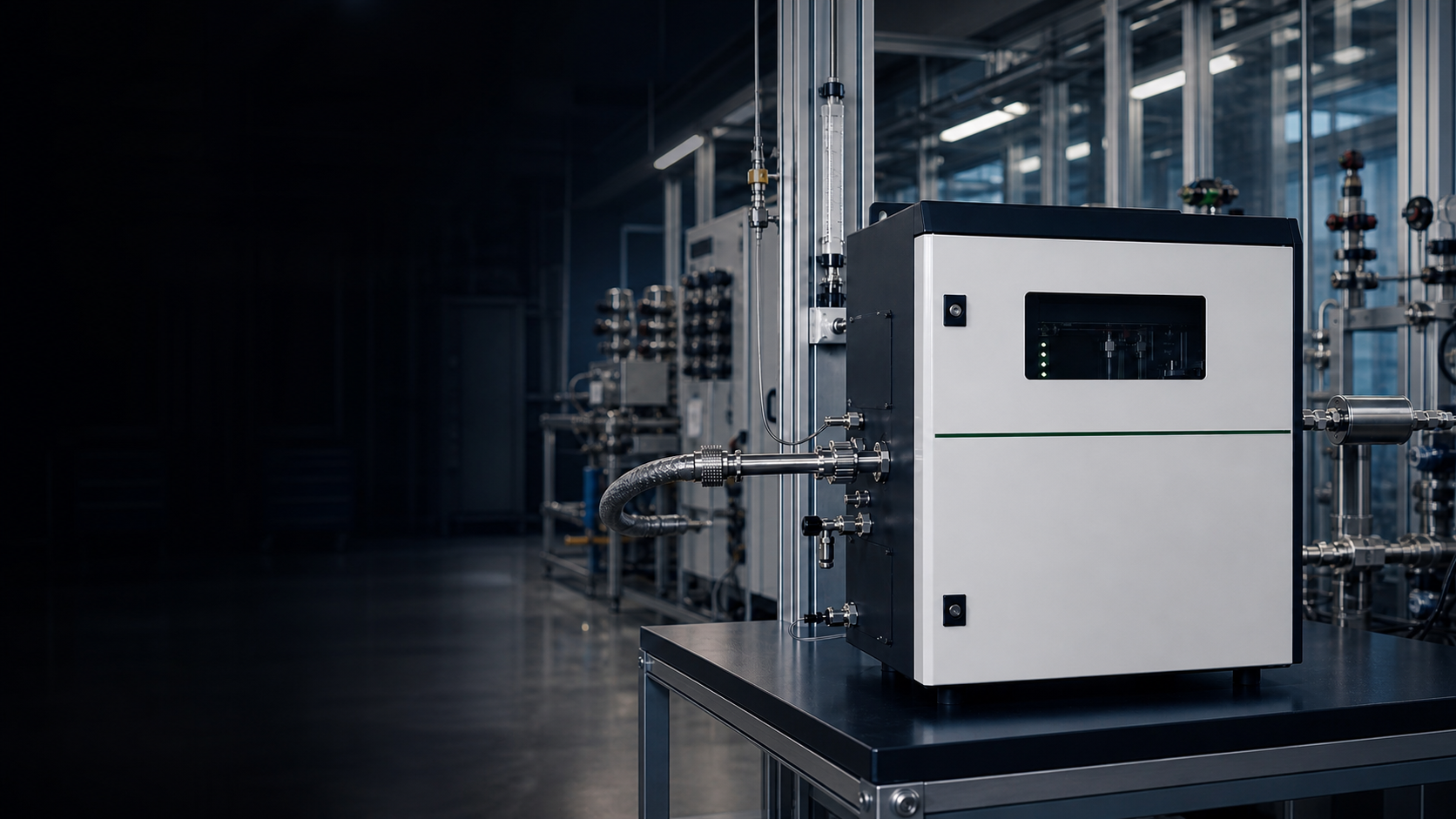 In-line Process
ZS8100-HF · TDLAS (Tunable Diode Laser Absorption Spectroscopy)
ZS8100-HF Process Hydrogen Fluoride Analyzer
TDLAS diode-laser hydrogen fluoride analyzer for aluminum smelter FTC/GTC, HF alkylation, semiconductor acid-etch, glass etching, and incineration CEMS under EU BAT ≤1 mg/m³
- Range
- 0–10 ppm / 0–50 ppm / 0–500 ppm (multi-range)
- Accuracy
- ±2 % FS or ±0.1 ppm (whichever greater)
- Response (T90)
- <10 s
- Detection Limit
- <0.05 ppm (fugitive-useful)
- Wetted Parts
- Monel 400 / PTFE / PFA (HF-resistant sample path)
- Output
- 4–20 mA / RS-485 Modbus / HART
Where Hydrogen Fluoride Measurement Lives in the Plant
From potroom fugitive monitoring to alkylation catalyst tracking and incineration CEMS — HF appears in three distinct industrial contexts, each demanding corrosion-resistant measurement architecture.
Primary Aluminum Smelting
Fugitive HF monitoring at Fume Treatment Center and Gas Treatment Center scrubber loops for 400 kA-class potlines. Continuous low-ppm TDLAS measurement keeps operators ahead of anode-effect HF events and provides the continuous data needed to demonstrate OSHA PEL 3 ppm 8-hr TWA compliance. Monel 400 + PTFE/PFA sample lines are essential for reliable potroom duty.
See metallurgy applicationsSemiconductor & Glass Etching
Scrubber inlet and outlet HF monitoring for optical, display-glass, and semiconductor acid-etch lines where colorimetric methods respond too slowly for closed-loop etch control. Low-ppm TDLAS provides the sub-10 s T90 response needed for scrubber efficiency verification and exhaust compliance on CVD and wet etch tools. ZS8100-HF with PTFE/PFA lines is the standard architecture for semiconductor etch exhaust monitoring.
See semiconductor applicationsEnvironmental & Incineration CEMS
Continuous HF reporting at waste-to-energy and hazardous-waste incinerator stacks under EU BAT (≤1 mg/m³ HF) alongside HCl ≤50 mg/m³. ZS8100-HF TDLAS with ZS-SCS-800 Hastelloy C-276 heated sampling provides the certified measurement path for permit reporting. MCERTS and US EPA Method 13A/B scope confirmed per project. A long-path / UV-DOAS HF engineering option is available for long-path duct geometry.
See environment applicationsWhy GESHINE for Hydrogen Fluoride Analyzers
TDLAS measurement, Monel/PFA corrosion-resistant wetted parts, and application engineering support for the most demanding HF process and CEMS duty points.
Monel/PFA HF-Resistant Wetted Parts
Monel 400 wetted parts and PTFE/PFA internal tubing on the ZS8100-HF resist HF attack and reduce wall adsorption at low-ppm concentrations — addressing the two failure modes that make conventional SS extractive systems unreliable for HF service.
Application Engineering Support
From feasibility study through CEMS commissioning — GESHINE engineers assist with HF sample path material selection, ZS-SCS-800 heated sampling specification, DCS integration, laser-line matrix review, and MCERTS / EPA Method 13 certification scope definition.
Hastelloy ZS-SCS-800 Heated Sampling
The ZS-SCS-800 Hastelloy C-276 heated sampling system, shared with the sister HCl category, is the proven sample conditioning architecture for acidic-gas stack CEMS duty. From probe tip to analyzer inlet, the fully heated and corrosion-resistant sample train preserves HF sample integrity for both process and compliance measurement.
Manufacturer Direct
Direct access to the engineering team that specified and built your analyzer. HF-specific material selection guidance, sample system scoping, and factory-level technical support with spare parts and field service — no distributor intermediary on technical decisions.
Hydrogen Fluoride Analyzer Questions, Answered
From TDLAS measurement technology and sample path material selection to EU BAT compliance and HF safety monitoring.
Why is TDLAS the primary measurement method for hydrogen fluoride?
Three properties of HF make conventional extractive methods problematic: (1) HF corrodes and consumes electrochemical sensor cells, requiring frequent replacement; (2) HF adsorbs strongly onto stainless steel and most metal surfaces at low-ppm concentrations, causing measured values to lag and undercount for several minutes; (3) HF spectral overlap with H₂O, CO₂, SO₂, and HCl makes broadband IR (NDIR) unreliable on wet stack gas without extensive compensation. TDLAS addresses all three: the optical cell has no reagent contact with HF, the Monel 400 / PTFE / PFA sample path resists attack and reduces adsorption, and single-line laser selection separates the HF absorption feature from background species after matrix review.
Why must sample lines be Monel or PTFE/PFA for HF service? Can I use 316SS?
Hydrogen fluoride adsorbs onto stainless steel surfaces with high affinity, particularly at low ppm concentrations. A short 316SS section in the sample line will absorb HF from the sample stream and suppress readings for several minutes — making accurate low-ppm fugitive monitoring impossible. Over time, HF corrodes SS welds and fittings, creating additional leak paths and contamination sites. Monel 400 is substantially more resistant to HF attack than SS alloys; PTFE and PFA are essentially inert to HF at typical process conditions. The ZS8100-HF specifies Monel 400 on wetted metal surfaces and PTFE/PFA internal tubing throughout the sample path. Hastelloy C-276 (ZS-SCS-800 sampling system) is specified for the most demanding wet acid-gas CEMS duty.
What HF concentration ranges does the ZS8100-HF cover?
The ZS8100-HF uses multi-range firmware configured at project specification stage: 0–10 ppm (smelter FTC/GTC fugitive duty, below OSHA PEL 3 ppm 8-hr TWA), 0–50 ppm (alkylation process monitoring), and 0–500 ppm (glass etching process control and higher-concentration process streams). The detection limit is <0.05 ppm under fugitive monitoring conditions. EU BAT incineration CEMS duty (≤1 mg/m³ HF) typically uses the 0–10 ppm range with mg/m³ output conversion.
What is EU BAT for HF at waste incineration stacks?
The EU Industrial Emissions Directive (IED) Best Available Techniques (BAT) conclusion for waste incineration sets a daily average emission limit of ≤1 mg/m³ HF at the stack, alongside an HCl daily-average ELV of ≤10 mg/Nm³ (IED Annex VI; the tighter Waste Incineration BAT-AEL is 2–8 mg/Nm³ daily average). Continuous monitoring at these concentrations requires a CEMS with demonstrated accuracy at low mg/m³ levels — achievable with TDLAS and Hastelloy heated sampling. In the UK, MCERTS certification defines the type-approval scope for continuous HF monitoring; in the US, EPA Methods 13A and 13B define HF reference measurement, and EPA Method 320 covers extractive FTIR as an alternative. MCERTS and EPA Method 13 certification scope for the ZS8100-HF are confirmed per project pending hardware sign-off.
How does the ZS-SCS-800 heated sampling system work for HF CEMS?
The ZS-SCS-800 is a Hastelloy C-276 heated sampling system that maintains the sample gas above the HF dew point from probe tip to the analyzer inlet, preventing HF condensation and adsorption loss in the sample path. For typical incineration stack duty, the probe and sample line are heated to 160–180 °C. The system shares its architecture with the sister HCl category application. Particulate filtration is integrated at the heated probe; flow control and pressure regulation are downstream. The ZS-SCS-800 does not use a cool-dry chiller — TDLAS does not require gas drying, and maintaining elevated temperature preserves HF sample integrity throughout the transfer path.
When is a long-path / UV-DOAS HF engineering option a better choice than TDLAS for HF?
A long-path / UV-DOAS HF engineering option is preferred when the duct geometry allows long-path optical access across the full stack diameter and installing an extractive sample line is impractical. Long-path DOAS measures across the flue-gas column in-situ, removing the need for a heated extractive sample system. It also provides multi-component measurement alongside SO₂, NO₂, and HCl from a single optical path. The trade-off is that the UV spectral window for HF has narrower design margin than TDLAS single-line selection in complex acid-gas matrices — TDLAS line selection provides better spectral separation in HCl + SO₂ + HF mixtures. The long-path / UV-DOAS HF option is available by project review; the preferred path for most extractive duty remains TDLAS (ZS8100-HF).
What are the main HF applications at aluminum smelters?
Primary aluminum smelters require HF monitoring at two points: (1) potroom fugitive monitoring in the pot-tending aisles and at roof extraction points to verify worker exposure remains below OSHA PEL 3 ppm 8-hr TWA; (2) Gas Treatment Center (GTC) or Fume Treatment Center (FTC) exhaust monitoring to verify that dry-scrubbing efficiency is removing HF from pot gas before atmospheric discharge. GTC/FTC compliance emissions limits vary by jurisdiction but typically require continuous low-ppm HF data demonstrating fugitive emission factor ≤1 kg HF per tonne of aluminum produced. The ZS8100-HF TDLAS with Monel/PTFE/PFA sample lines is the architecture specified for both duty points.
Is electrochemical HF detection reliable for process monitoring?
Electrochemical (EC) HF cells are suitable for personal safety monitoring (TWA and STEL alarm functions) and portable area monitoring at refinery perimeter and semiconductor cleanroom exits. They are not reliable for process control or compliance reporting duty for two reasons: HF reacts with and consumes the EC cell electrolyte at higher concentrations, requiring regular replacement; and EC cells typically have a floor of 1–5 ppm with limited cross-gas rejection. For continuous process monitoring and CEMS duty, TDLAS remains the specified method. EC HF monitoring is a conditional engineering-review path for GESHINE and is sourced from partner suppliers on explicit project demand.
Request a Quote for Hydrogen Fluoride Analyzers
HF analyzer specifications depend heavily on application and matrix. To configure the right system, please have these details ready:
- HF concentration range required (ppm or mg/m³) — fugitive, process, or CEMS duty
- Sample point: stack, potroom, process duct, or perimeter fence — temperature, pressure, moisture
- Background matrix: H₂O content, SO₂, HCl, CO₂ levels (for TDLAS laser-line matrix review)
- Existing sample path material: confirm Monel/PFA wetted parts required, or describe current system
- Compliance regime: EU BAT/IED (incineration), OSHA PEL (smelter), MCERTS, EPA Method 13, or internal
- Installation type: extractive rack, CEMS module, or long-path optical (UV-DOAS alternative)
- Output protocols required: 4–20mA, RS-485 Modbus, HART, OPC-UA
- Hazardous area classification (ATEX/IECEx zone) — Conditional scope confirmed per project

Get HF Application Expert Consultation
Our application engineers specialize in TDLAS HF measurement, Monel/PFA sample path specification, ZS-SCS-800 heated sampling configuration, and EU BAT / MCERTS / EPA Method 13 CEMS scope definition.