
Industrial Ammonia Analyzer & NH₃ Monitoring Solutions
Sub-ppm ammonia slip detection with TDLAS — optimize DeNOx efficiency and protect downstream equipment.
TDLAS and UV-DOAS ammonia analyzers for ammonia slip monitoring at SCR/SNCR outlets, stack emission compliance, and process control in power, cement, and incineration applications.
Why Ammonia Monitoring Fails — And How Multi-Technology Analyzers Solve It
Nearly all ammonia monitoring failures originate from one fundamental failure: choosing one measurement principle and trying to force it into other operations. Electrochemical sensors run into the hot, wet walls of an SCR stack — the wrong tool for that high-temperature duty, where the cell degrades and the reading can drift far enough to trigger false compliance alarms. NDIR analyzers measuring power-plant flue gas suffer cross-interference from overlapping H₂O and CO₂ absorption bands near the NH₃ detection wavelength, which can produce significant measurement errors in real working conditions.
Traditional wet-chemistry titrimetric methods (indophenol blue, Nessler reagent) generate lab-accurate ammonia concentration samples but are not capable of supplying the perpetually-on, automatic monitoring that are mandated by current emissions regulation. A single grab sample can reveal what was, but not inform what is. Today’s controlled gas feedstocks operate on fast timelines, and the analyzer’s response time has to match — a fast continuous reading, not a snapshot.
GESHINE’s approach corrects this mistake. Instead of forcing every application onto a single measurement principle, we match the measurement to the duty. The NH₃ measurement landscape includes TDLAS, NDIR, DOAS, and electrochemical methods; GESHINE’s product fit on this page is the ZS8100-NH3 (TDLAS) for in-situ ammonia slip, with an extractive UV-DOAS CEMS configuration available by project review for multi-gas CEMS. Your process conditions dictate the technology selection, not the other way around.
TDLAS ammonia analyzers operate by the Beer-Lambert law: I = I₀ e^(−C·L). A narrow tunable diode laser scans an NH₃ absorption line near 1.53 µm, a region chosen to sit away from the main H₂O and CO₂ bands of typical combustion flue gas — though real matrices still call for deliberate line selection and a matrix review rather than assuming blanket immunity. Measuring directly at the process line minimizes sampling losses; the achievable accuracy, response time, and operating temperature are confirmed against the specific GESHINE analyzer and the site matrix.
Knowing why single-world technology solutions break down informs you how to proceed with this next question: which model of GESHINE analyzer is optimal for your process conditions?
Exposure & Safety Thresholds
Public ammonia exposure and refrigeration-alarm limits that drive alarm set-points and define the monitoring scope — not analyzer accuracy or product performance.
8-hour permissible exposure limit (29 CFR 1910.1000, Table Z-1).
25 ppm 8-hour TWA; 35 ppm 15-minute short-term exposure limit.
Immediately Dangerous to Life or Health — evacuate.
Closed-circuit ammonia refrigeration alarm thresholds: 25 ppm alert, 150 ppm danger.
Presented as exposure and safety context that drives alarm set-points and monitoring scope. Site-specific confined-space permit limits override general regulations.
How TDLAS & UV-DOAS Work for NH₃
Tunable Diode Laser & UV Differential Optical Absorption
TDLAS targets a specific NH₃ absorption line in the near-infrared for selective measurement at sub-ppm levels within the stated SCR/SNCR matrix. UV-DOAS provides a complementary approach for higher concentration ranges and multi-component capability in CEMS applications.
- Sub-ppm detection limit on the selected TDLAS line
- H₂O and SO₂ matrix effects handled through line selection and application review
- In-situ option reduces sample-conditioning hardware
- Dual-technology platform for full-range coverage
TDLAS Sensing Principle
Four NH₃ Sensing Paths at a Glance
In-situ TDLAS is the default for sub-ppm ammonia slip. UV-DOAS extractive is the multi-gas CEMS path. Chemiluminescence with a converter is the reference / validation method, and a heated extractive TDLAS retrofit is an engineering path where optical access is limited.
TDLAS In-Situ
Default Slip Standard
Sub-ppm ammonia slip at the SCR/SNCR outlet — in-situ cross-stack, T90 < 2 s, ±0.5 ppm or ±2% of reading, no sample conditioning required.
UV-DOAS Extractive
Multi-Gas CEMS
NH₃ alongside SO₂ and NOₓ on one optical platform — heated sample path at 180 °C prevents adsorption, 0–500 ppm, rack-mount CEMS reporting.
Chemiluminescence + Converter
Reference / Validation
NH₃ catalytically converted to NO and measured by difference — reference-grade method validation where chemiluminescence NOₓ analyzers are already installed. Indirect, slower T90.
Heated Extractive TDLAS
Engineering / Retrofit Path
Heated extractive TDLAS for retrofit loops where in-situ optical access on both duct walls is limited. Scoped per project via application review.
NH₃ Measurement Technologies Compared — TDLAS / NDIR / DOAS / Electrochemical
Each principle imparts a unique characteristic which can be used as a reference point to determine the most appropriate detection scheme for your measurements. The table below offers actual real-world data against which you can make your comparison rather than subjective claims.
| Parameter | TDLAS | NDIR | DOAS | Electrochemical |
|---|---|---|---|---|
| Detection Limit | 0.2 ppm | 0.5 ppm | 0.07 µg/m³ | ~5 ppm |
| Accuracy | ±1–2% FS | ±2% FS | ±3% rdg | ±5% rdg |
| Response T90 | <2 s | <30 s | 60 s | <60 s |
| Operating Temp | Up to 500 °C (matrix-reviewed) | Up to 200 °C | −20 ~ 50 °C | −20 ~ 50 °C |
| Sensor Life | >10 years | >10 years | >10 years | 2–3 years |
| Maintenance Cycle | 12 months | 6 months | 12 months | 6 months |
| Cross-Interference | Low — line-selected | H₂O, CO₂ | Low — differential | H₂S, HCl, SO₂ |
| Relative Cost | Higher | Lower | Higher | Lowest |
This comparison is educational. NDIR, open-path DOAS and electrochemical sensing are reference methods that describe the NH₃ measurement landscape — GESHINE’s product fit on this page is TDLAS (ZS8100-NH3), with an extractive UV-DOAS CEMS configuration available by project review.
When to Select Which Technology
TDLAS is the technology of choice for a fast response (T90 < 2 s), in-situ measurement at high temperatures, or critical regulatory-compliance duty where interference must be avoided — e.g. SCR NH₃ slip or NH₃ CEMS. NDIR provides the lowest cost-to-performance platform for general process monitoring, where a response time in minutes is adequate and sample handling is used to neutralize humidity effects. DOAS is the technology of choice for field or fence-line monitoring, where long open-path measurements provide the required concentration averaging and path-averaged ambient detection limits. The electrochemical ammonia sensor remains the lowest-cost fixed-point detector for safety-alarm applications, proven in hard service at many cold-storage, freezer and refrigeration plants — a reference-method safety layer, not a GESHINE NH₃ product. This application came from the right combination of cost-effective fixed-point measurement and a known, reliable sensor.
Laser TDLAS vs Photometric NH₃ — When to Choose Which
For ammonia slip, the practical split is between laser TDLAS and photometric (NDIR / DOAS) NH₃ measurement, and it usually tracks whether you run SCR or SNCR. Laser TDLAS measures NH₃ in-situ across the duct with a fast (T90 < 2 s) response and no wet reagent, so it suits the tight slip window of a high-dust SCR catalyst where fast closed-loop reagent trim matters and the target slip is project-specific. Photometric methods — extractive NDIR for a clean conditioned sample, or open-path DOAS for fence-line averaging — fit slower duties and lower CapEx, but add sample handling or path-averaging that blurs a fast slip transient. SNCR, with its higher and more variable slip, tolerates a slower photometric channel more readily than a sharp SCR control loop does. Rule of thumb: SCR closed-loop trim points to in-situ TDLAS, while SNCR trend and fence-line duty can use photometric NH₃ in the prevailing flue matrix.
Having established the fundamental capabilities of each technology the next section explores the largest single application segment of ammonia analyzers: SCR/SNCR emission control.
In-Situ vs Extractive vs Sample-Conditioned Mounting for NH₃
TDLAS Cross-Stack Analyzer
A tunable diode laser measures NH₃ directly across the duct — sub-ppm ammonia slip at the SCR/SNCR outlet with T90 < 2 s, no sample line to adsorb ammonia, and purge air to keep the optics clear in high-dust stacks.
Optical access on both sides of the duct (transmitter + receiver flanges) and a purge air supply sized to the dust loading. No heated sample line or conditioning cabinet required.
- Sub-ppm ammonia slip at SCR/SNCR catalyst outlets
- Closed-loop urea/ammonia dosing trim needing fast response
UV-DOAS Rack Analyzer
A 19-inch rack-mount UV-DOAS analyzer measures NH₃ alongside SO₂ and NOₓ on one optical platform — the multi-gas path for continuous emission monitoring where in-situ mounting is not feasible.
Heated sample path at 180 °C to prevent NH₃ adsorption, automatic span and zero gas cylinders, and CEMS rack integration. Heated probe and transfer line above the adsorption threshold.
- Multi-gas CEMS reporting (NH₃ + SO₂ + NOₓ) in one rack
- Higher concentration ranges where in-situ mounting is impractical
- Power, cement, and waste-to-energy stack compliance
Heated Extractive Path
For cold or wet stacks where ammonia adsorption must be controlled end to end, a fully heated extractive train presents conditioned sample to the analyzer — the retrofit path when in-situ optical access is unavailable.
Heated probe, heated transfer line above the NH₃ adsorption threshold, particulate filtration, and conditioning sized for the stack matrix. Application review confirms wet-stack handling.
- Retrofit loops without in-situ optical access on the duct
- Cold or wet-stack duty where adsorption must be controlled
- Sites standardizing on extractive sampling infrastructure
In-situ TDLAS: no sample conditioning to maintain and the fastest slip response — fits SCR/SNCR dosing-trim retrofits.
Extractive UV-DOAS CEMS: higher upfront for heated sampling, but multi-gas NH₃ + SO₂ + NOₓ reporting consolidated in one rack.
Sample-conditioned path: heated-line service amortized across the compliance lifecycle when in-situ access is unavailable.
Technical Specifications and Measurement Ranges
Specifications for the two GESHINE NH₃ analyzers, taken from real product fields. Our applications team confirms the right configuration for your duty.
ZS8100-NH3 — In-Situ TDLAS Process / Slip Analyzer
| Measurement | |
|---|---|
| Measuring Principle | TDLAS (tunable diode laser absorption) |
| Measurement Range | 0–50 ppm NH₃ (configurable to 500 ppm) |
| Accuracy | ±0.5 ppm or ±2% of reading |
| Response Time (T90) | <2 s |
| Sampling & Outputs | |
| Sampling Mode | In-situ cross-duct optical path + purge air; optional heated extractive retrofit |
| Auto-Validation | Internal NH₃ reference cell |
| Outputs | 4–20 mA, Modbus, HART |
| Certification Scope | |
| CE | Self-declared (LVD / EMC Declaration of Conformity) |
| ATEX / Ex | Available — certificate scope & zone confirmed per project (CNEX Ex-proof for in-situ family) |
| CEMS / Stack Reporting | Conditional — method & reporting scope confirmed per project |
Extractive UV-DOAS CEMS Configuration — available by project review (NH₃ + SO₂ + NOₓ)
| Measurement | |
|---|---|
| Measuring Principle | UV-DOAS (multi-component optical) |
| Components | NH₃ + SO₂ + NOₓ on one optical platform |
| Measurement Range | 0–500 ppm NH₃ (configurable to 2000 ppm) |
| Accuracy | ±2% of reading or ±1 ppm |
| Response Time (T90) | <10 s |
| Sampling & Outputs | |
| Sampling Mode | Extractive, rack-mount; heated sample path 180 °C prevents NH₃ adsorption |
| Outputs | 4–20 mA, Modbus TCP, OPC-UA |
| Certification Scope | |
| CE | Applicable — confirmed per project |
| TÜV | Method alignment — confirmed per project |
| EN 15267 / EN 14181 QAL1 | CEMS method-alignment support — scope confirmed per project |
ZS8100-NH3 values reflect real product fields; the extractive UV-DOAS CEMS configuration is an engineering reference available by project review, with performance confirmed per application. Ranges above the configurable limits, high-moisture or acid-gas stack matrices, and the final hazardous-area zone are confirmed per application review. “Up to 500 °C” process gas is application context subject to a site matrix review, not a published key spec.
When Does In-Situ TDLAS Become Worth It for NH₃?
Extractive UV-DOAS CEMS and chemiluminescence-with-converter cover multi-gas reporting and reference validation for ammonia. In-situ TDLAS is the engineering path for sub-ppm slip, sub-2-second closed-loop dosing trim, and cross-stack mounting without sample conditioning.
| Dimension | Chemiluminescence + Converter | UV-DOAS Extractive | TDLAS In-Situ (Engineering) |
|---|---|---|---|
Best-fit duty | Reference / lab validation, existing NOₓ analyzers | Multi-gas CEMS (NH₃+SO₂+NOₓ), higher ranges | Sub-ppm slip at SCR/SNCR outlet, in-situ, fast trim |
★Response time (T90) | < 60 s (converter) | < 10 s | < 2 s |
★NH₃ adsorption handling | Heated extractive + converter | Heated path 180 °C prevents adsorption | In-situ — no heated sample line to adsorb NH₃ |
Installation format | Extractive rack + converter | Extractive 19″ rack CEMS | In-situ cross-stack or heated extractive |
Sample conditioning | Heated extractive + converter | Heated path + span/zero gases | Optional — cross-stack removes conditioning |
★Sub-ppm NH₃ slip sensitivity | Indirect; cannot resolve reduced-N species | ±2% of reading or ±1 ppm; less sensitive sub-ppm | ±0.5 ppm or ±2%; sub-ppm on selected line |
Certification / reporting | Reference-method grade | EN 15267 / EN 14181 QAL1 — method alignment / confirmed per project (UV-DOAS CEMS configuration) | CE / ATEX; CEMS package confirmed per project |
★Maintenance burden | Converter replacement; slow indirect response | Heated-path service + span/zero gas supplies | No wet parts — purge air + periodic optics check |
★ marks the four dimensions most likely to push an NH₃ application from extractive / reference methods toward an in-situ TDLAS feasibility review.
Ammonia Analyzer Selection by Range, Mounting and Multi-Gas Need
Three questions narrow most NH₃ analyzer specs: what concentration range you measure, whether you mount in-situ or extractive, and whether you need multi-gas CEMS alongside ammonia.
By Concentration Range
Sub-ppm ammonia slip at the SCR/SNCR outlet calls for the ZS8100-NH3 TDLAS analyzer (0–50 ppm, configurable to 500 ppm) with ±0.5 ppm sensitivity on a selected absorption line. Higher process and CEMS ranges are better served by an extractive UV-DOAS CEMS configuration (0–500 ppm, configurable to 2000 ppm), available by project review. Confirm the expected normal and maximum NH₃ concentration before specifying the range.
By Mounting: In-Situ vs Extractive
In-situ cross-stack TDLAS measures NH₃ directly in the duct — no sample line to adsorb ammonia, T90 < 2 s for closed-loop dosing trim, and purge air for high-dust stacks. Extractive UV-DOAS uses a heated sample path at 180 °C to control adsorption and is the path where in-situ optical access is not feasible. See the in-situ TDLAS upgrade decision table for trigger criteria.
By Multi-Gas Need
If ammonia slip is the only measurement, in-situ TDLAS (ZS8100-NH3) is the leanest path. If you need NH₃ reported alongside SO₂ and NOₓ on one optical platform for CEMS compliance, an extractive UV-DOAS CEMS configuration consolidates the channels in a single 19-inch rack with EN 15267 / EN 14181 QAL1 method alignment, available by project review. A project-specific spectral matrix review confirms multi-gas performance.
Ammonia Slip Monitoring for SCR / SNCR Emission Control
Escape of un-reacted ammonia through SCR (Selective Catalytic Reduction) and SNCR (Selective Non-Catalytic Reduction) catalysts creates a range of operational and environmental concerns. Excessive NH₃ slip over 2–5 ppm accelerates catalyst deactivation, deposits corrosive ammonium bisulfate on downstream heat exchangers and triggers increasingly expensive emissions violations due to tighter air quality standards. The cause is often simply a matter of measurement: without fast, accurate ammonia data, injection rates of urea or aqueous ammonia cannot be properly titrated to keep ammonia slip in the target window.
The ZS8100-NH3 provides in-situ cross-duct measurement of NH₃ slip directly in the flue gas duct — no extractive sample handling, no wet reagent. A T90 of less than 2 seconds feeds your DCS with the speed needed for closed-loop injection control, holding in-situ slip inside the project-specific target window on HP and LP SCR catalysts. Slip targets are operating targets set by the local permit and process design — not a universal limit imposed by a single standard.
Fine control of urea injection in response to real-time ammonia slip feedback has been proven to cost-effectively reduce reagent consumption 10–15% in other applications, while maintaining NOₓ emissions compliance. This can translate into significant annual operating cost savings on a 600 MW coal-fired plant consuming around 2,000 tons/year of urea solution, in addition to more cost-effective operation of downstream flue exhaust handling systems.
Illustrative planning example based on other applications, not a performance guarantee. Actual savings depend on baseline control, load profile, NOₓ permit limits, and dosing hardware — confirmed per project.
Relevant Standards & Slip Targets
- ISO 21877:2019 — manual reference method for the mass concentration of ammonia in stationary source emissions, used to validate continuous analyzers.
- Ammonia slip targets are project- and permit-specific operating targets set by the plant’s NOₓ permit, catalyst design and SO₃ conditions — not a universal limit imposed by a measurement standard.
Zaps to five primary industries with distinct ammonia analyzer requirements are addressed by the same analyzer platform.
GESHINE NH₃ Analyzer Series — Models & Selection Guide
ZS8100-NH3 in-situ TDLAS slip analyzer, with an extractive UV-DOAS CEMS configuration available by project review.
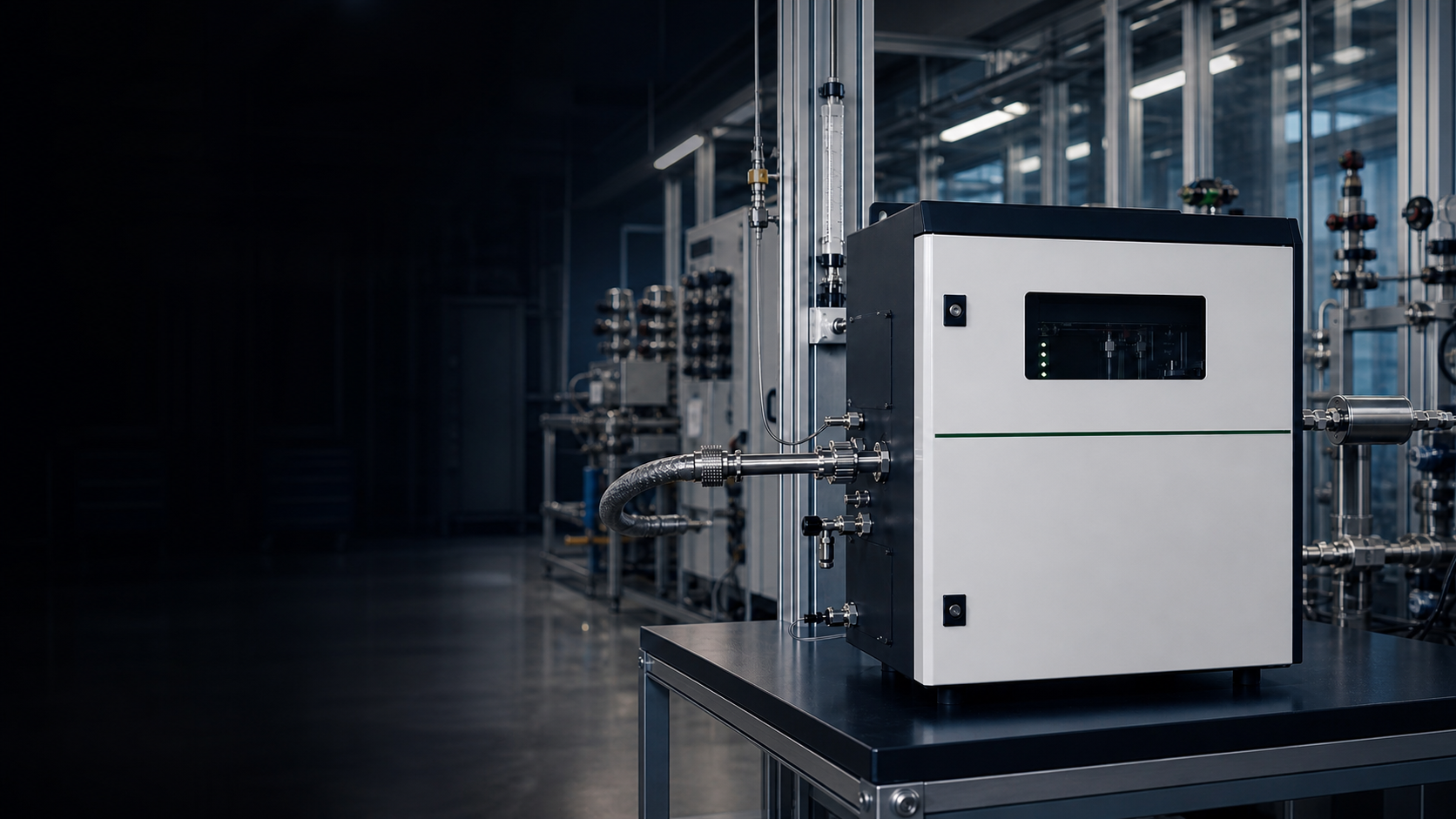 In-Situ Process
ZS8100-NH3 · TDLAS
ZS8100-NH3 Process Ammonia Analyzer
TDLAS ammonia slip analyzer for SCR/SNCR optimization and emission control.
- Range
- 0–50 ppm (to 500)
- Accuracy
- ±0.5 ppm or ±2%
- Response
- <2s T90
- Output
- 4-20mA · Modbus · HART
Certifications, Compliance, and Standards
GESHINE NH₃ analyzers are supplied with the certification documentation your procurement and compliance teams need. The certification scope and hazardous-area documentation are confirmed per project against the target installation — the scopes below describe the certification type, not a blanket affirmation.
Hazardous Area & Reporting Scope, Explained
- Zone 0 — an explosive gas atmosphere is present continuously or for long periods.
- Zone 1 — an explosive gas atmosphere is likely to occur during normal operation.
- Zone 2 — an explosive atmosphere is unlikely, and if it occurs, only for short periods.
Hazardous-area documentation, ingress protection and CEMS reporting scope are matched to the site classification and permit before quoting. There is no universal performance specification mandating an NH₃ slip limit; the reporting method, slip targets and any certificate numbers are confirmed per project and against local regulation. Each analyzer ships with calibration documentation referencing traceable standards to support your plant’s audit and installation review.
Industry Applications — From Power Plants to Cold Storage
From SCR/SNCR ammonia slip control to CEMS reporting and ABS prevention — one molecule across three different control loops.
Power Generation
Ammonia slip monitoring at SCR catalyst outlets in coal and gas-fired power plants — optimizing urea/ammonia injection to minimize both NOₓ and NH₃ emissions.
See power applicationsCement & Building Materials
NH₃ measurement at SNCR injection points and baghouse inlets in cement kilns — preventing ammonium-bisulfate formation that clogs filters and heat exchangers.
See cement applicationsWaste Incineration
Continuous NH₃ monitoring in waste-to-energy plants for SNCR/SCR control and emission compliance — preventing ammonia plume formation at the stack.
See environment applicationsMatching NH₃ Measurement to the Application
Each environment has differing concentration levels, temperature conditions, response time needs and safety issues. The following summarizes the key parameters to match specific application challenges with the corresponding GESHINE solution.
Chemical Processing
ZS8100-NH3 / UV-DOAS CEMSMonitoring NH₃ across wide, batch-varying concentrations in process streams containing mixed gas matrices.
An extractive UV-DOAS CEMS configuration with a heated sample line for mixed-matrix process streams, or ZS8100-NH3 TDLAS for high-temperature reactor off-gas. Ranges beyond the configurable limits are confirmed per application review.
Two complementary platforms — in-situ TDLAS and extractive UV-DOAS — cover batch process variation, with configuration confirmed per application review.
Cold Storage & Refrigeration
Reference MethodDetecting ammonia leaks in refrigeration facilities before they reach dangerous concentrations — worker safety is the primary concern.
Fixed electrochemical gas-detector networks with relay alarms at IIAR-2 thresholds — 25 ppm (alert) and 150 ppm (danger) — are the typical safety layer. GESHINE does not present an electrochemical NH₃ detector in this lineup; for process and stack NH₃ we supply TDLAS and UV-DOAS analyzers.
An electrochemical safety layer is the lowest per-point cost for area leak alarms — complementing, rather than replacing, process NH₃ analysis.
Wastewater Treatment
Reference / EducationalMeasuring ammonia off-gas and ambient NH₃ around aeration basins and sludge-processing areas.
Extractive NDIR for process-exhaust monitoring and electrochemical sensors for worker-safety zones are the common reference methods around enclosed treatment stages. Where continuous stack reporting is required, GESHINE’s extractive UV-DOAS CEMS configuration applies; ambient and safety layers use established reference instruments.
Continuous monitoring supports aeration control by correlating NH₃ with treatment efficiency — helping reduce energy use.
Environmental Monitoring
Reference MethodMeasuring ambient NH₃ at the fence-line boundaries of agricultural and industrial facilities at µg/m³ resolution.
Open-path DOAS provides path-averaged concentration over 10–200 m without sample infrastructure — a reference method for large-area surveillance. GESHINE’s extractive UV-DOAS CEMS configuration is a stack-CEMS platform rather than an open-path fence-line system, so fence-line duty is scoped per project.
0.07 µg/m³ path-averaged detection over a 200 m path (open-path reference method) needs no sample infrastructure for area air-quality surveillance.
Choosing the right type of ammonia analyzer for your application is only part of the issue. The next step is to translate accurate, repeatable raw data into government-compliant reports.
Why GESHINE for Ammonia Analyzers
Two measurement platforms, a multi-gas CEMS path, and application engineering for SCR/SNCR ammonia slip control.
Two NH₃ Platforms
In-situ TDLAS for sub-ppm slip and extractive UV-DOAS for multi-gas CEMS — one supplier covering closed-loop dosing trim and stack emission reporting.
Application Engineering Support
From SCR/SNCR slip duty review through commissioning — GESHINE engineers assist with TDLAS vs UV-DOAS selection, heated-sampling specification, DCS integration, and CEMS reporting.
Multi-Gas CEMS Path
An extractive UV-DOAS CEMS configuration measures NH₃ alongside SO₂ and NOₓ on one optical platform, with EN 15267 / EN 14181 QAL1 method alignment for power, cement, and waste-to-energy emission compliance — available by project review.
Manufacturer Direct
Direct access to the engineering team that designed and built your analyzer. Shorter lead times, competitive pricing, and factory-level technical support including spare parts and field service.
Ammonia Analyzer Pricing: Key Cost Factors
Price of ammonia analyzers widely depends on measurement method, detection range, protection code and communications option. The tiers below give a sense of how cost scales by analyzer class — a GESHINE sales engineer prepares an individual budgetary quotation after reviewing your application.
Fixed Electrochemical Detector
Safety leak-alarm — market context
Fixed-point electrochemical detectors are the lowest-cost option for leak-alarm safety duty — shown here as market landscape only. GESHINE does not present an NH₃ electrochemical detector in this lineup.
Extractive UV-DOAS CEMS
Available by project review
Rack-mount multi-component optical CEMS configuration measuring NH₃ with SO₂ and NOₓ. Cost scales with the heated sample-conditioning system and CEMS method-alignment scope.
In-Situ TDLAS Process Analyzer
ZS8100-NH3
In-situ laser slip analyzer for closed-loop dosing. The laser and optical components, in-situ duct access and purge design carry the highest engineering content.
What Drives the Price
Beyond the measurement technology, the widest swing is in application engineering. The laser and optical components in TDLAS and DOAS systems are costly because they perform in-situ or open-path measurement; NDIR extractive analyzers are less costly, and electrochemical fixed detectors are the lowest-cost market option — though sensor replacement over a 2–3 year service life should be added in. Changing the enclosure to an ATEX rating, extending the temperature and pressure measurement ranges, and custom analog-output requirements all add to final pricing. Contact us for a budgetary quote matched to your configuration.
- Standard configuration2–4 weeks from order confirmation
- Custom / ATEX enclosure6–8 weeks (incl. third-party certification lead time)
- MOQ1 unit as sample / evaluation; 5+ units volume pricing on request
Warranty, Calibration, and Long-Term Support
We provide full lifetime support to keep your NH₃ analyzers reading accurately for years. Post-installation services are designed to minimize maintenance overhead and total cost of ownership.
A 24-month warranty is standard on all models, with extended warranty options available on request.
On Modbus TCP / Ethernet-equipped units, a communications link lets our engineers carry out remote troubleshooting and firmware upgrades without a site visit.
Factory-trained engineers are dispatched for commissioning and scheduled maintenance visits, with NH₃ reference-cell and span-gas validation as applicable to each technology.
Critical components — laser modules and optical windows — are held in stock and shipped within 48 hours to keep downtime short.
TDLAS systems typically need only a routine service visit about once every 12 months, keeping ongoing maintenance costs predictable.
Frequently Asked Questions About Ammonia Analyzers
From TDLAS vs UV-DOAS selection and heated sampling to SCR/SNCR slip control and ABS prevention.
When should I choose in-situ TDLAS over extractive UV-DOAS for NH₃?
Three signals favor in-situ TDLAS: (1) a closed-loop dosing trim loop that needs sub-2-second T90 response; (2) sub-ppm ammonia slip that must be held below the ammonium-bisulfate formation threshold; (3) a site that wants to remove the heated sample line from the architecture by measuring directly across the duct. TDLAS (ZS8100-NH3) reads sub-ppm NH₃ in-situ with no sample conditioning to adsorb ammonia. Choose an extractive UV-DOAS CEMS configuration instead when you need NH₃ reported alongside SO₂ and NOₓ, higher concentration ranges, or where in-situ optical access is not feasible — this UV-DOAS NH₃-slip monitoring option is available by project review, with performance confirmed per application.
How does chemiluminescence-with-converter compare to TDLAS for ammonia slip?
Chemiluminescence catalytically converts NH₃ to NO and derives ammonia from the difference between total NOₓ and NO. It is a reference-grade method — useful for lab validation or where chemiluminescence NOₓ analyzers are already installed — but the measurement is indirect (converter efficiency below 100%), T90 is typically under 60 s, and it cannot distinguish NH₃ from other reduced-nitrogen species. TDLAS measures NH₃ directly on a selected absorption line at sub-ppm sensitivity with T90 < 2 s. Use chemiluminescence for reference validation; use TDLAS for fast in-situ slip control.
What is ammonia slip and why monitor it at the SCR/SNCR outlet?
Ammonia slip is the unreacted NH₃ that passes through an SCR or SNCR catalyst without converting NOₓ. Measuring it at the catalyst outlet lets the dosing controller inject just enough urea or ammonia to meet NOₓ limits without over-dosing — minimizing both NOₓ and NH₃ emissions, cutting reagent cost, and holding slip below the threshold where ammonium bisulfate forms and fouls downstream equipment.
What is the difference between TDLAS and UV-DOAS for NH₃?
TDLAS scans a single NH₃ absorption line in the near-infrared with a tunable diode laser — sub-ppm sensitivity, T90 < 2 s, and an in-situ cross-stack option that needs no sample conditioning. UV-DOAS passes broadband UV light through an extractive sample and extracts NH₃ from its characteristic differential absorption spectrum, which also resolves SO₂ and NOₓ for multi-component CEMS. TDLAS is the slip-control workhorse; UV-DOAS is the multi-gas CEMS path with a heated sample path to prevent adsorption.
Why does an extractive NH₃ analyzer need a heated sample path?
Ammonia is corrosive and highly adsorptive. On cold extractive lines and unheated surfaces, NH₃ sticks to the walls and reacts with moisture and acid gases, so the reading drifts low and responds slowly. A heated sample path — typically around 180 °C on the probe and transfer line — keeps ammonia in the gas phase from duct to analyzer. In-situ TDLAS sidesteps the issue entirely by measuring across the duct with no sample line; wet-stack and acid-gas matrices still warrant an application review.
What is ammonium bisulfate (ABS) and how does NH₃ measurement prevent it?
Ammonium bisulfate (ABS) forms when slipped NH₃ reacts with SO₃ in the flue gas. It condenses as a sticky deposit on air preheaters, ESP plates, and heat exchangers, driving up pressure drop and forcing unplanned cleaning outages. Accurate ammonia-slip measurement at the catalyst outlet lets the dosing controller hold NH₃ below the ABS formation threshold for the local SO₃ and temperature conditions — preventing the fouling rather than reacting to it.
How often does an NH₃ analyzer need calibration?
Calibration cadence is site-specific and depends on technology and reporting duty. As a rule of thumb by technology, in-situ TDLAS holds zero well and is typically serviced around every 12 months; extractive NDIR drifts with optical contamination and is usually checked around every 6 months; electrochemical cells need roughly 6-monthly checks plus sensor replacement every 2–3 years. The ZS8100-NH3 TDLAS analyzer runs auto-validation against an internal NH₃ reference cell, so routine intervention is light. An extractive UV-DOAS CEMS configuration performs automatic span and zero calibration with gas cylinders. For CEMS reporting, daily zero/span drift checks and periodic cylinder-gas audits follow the applicable CEMS QA/QC programme (for example EN 14181 QAL3), and the calibration plan follows the parent station’s QAL3 schedule with periodic verification against a reference method. Confirm the exact interval against your local regulatory regime.
Can a single platform measure NH₃ together with SO₂ and NOₓ?
Yes — an extractive UV-DOAS CEMS configuration resolves NH₃ alongside SO₂ and NOₓ on one shared optical platform, which is the usual reason to choose extractive UV-DOAS over single-gas in-situ TDLAS. SO₂ and NOₓ spectral overlap and H₂O background are handled through a project-specific spectral matrix review, and the heated sample path keeps the channels stable. Very high SO₂ may interfere with NH₃, so confirm peak concentrations and whether continuous NH₃ reporting or slip indication is required before specifying.
What ranges and response times do GESHINE NH₃ analyzers cover?
The ZS8100-NH3 (TDLAS) covers 0–50 ppm NH₃, configurable to 500 ppm, with ±0.5 ppm or ±2% of reading accuracy and T90 < 2 s for closed-loop dosing trim. An extractive UV-DOAS CEMS configuration covers 0–500 ppm, configurable to 2000 ppm, with ±2% of reading or ±1 ppm accuracy and T90 < 10 s for multi-gas CEMS — available by project review. Ranges above the configurable limits, and high-moisture or acid-gas matrices, are confirmed per application review.
What is the best technology for ammonia slip monitoring?
TDLAS is the industry-standard technology for ammonia slip monitoring in SCR/SNCR systems. A T90 < 2 s response, strong rejection of H₂O/CO₂ cross-interference through line selection, and the ability to measure in-situ at gas temperatures up to 500 °C (matrix-reviewed) make it the most reliable choice. The GESHINE ZS8100-NH3 measures sub-ppm slip with ±0.5 ppm or ±2% of reading accuracy via direct cross-duct installation, with no sample conditioning required for the in-situ duty. Where multi-gas CEMS reporting is needed, an extractive UV-DOAS CEMS configuration uses a heated sample path instead.
What is the detection range of a TDLAS ammonia analyzer?
GESHINE NH₃ ranges follow the real product configurations. The ZS8100-NH3 TDLAS analyzer covers 0–50 ppm, configurable to 500 ppm, with sub-ppm slip sensitivity (±0.5 ppm or ±2% of reading) — ideal for low-ppm slip at the catalyst outlet. Where higher process or CEMS ranges are needed, an extractive UV-DOAS CEMS configuration covers 0–500 ppm, configurable to 2000 ppm. Ranges above the configurable limits are confirmed per application review.
Can ammonia analyzers work in high-temperature flue gas?
Yes — but only in-situ technologies handle it well. The ZS8100-NH3 TDLAS analyzer measures directly in gas streams up to 500 °C (matrix-reviewed) because the laser and detector sit outside the duct; only the optical windows face the process. Extractive NDIR and electrochemical approaches need the sample cooled below about 50 °C first, which adds lag time and mechanical complexity. Open-path DOAS also works in-situ but is suited more to ambient fence-line paths than confined duct installations.
What is the difference between an ammonia analyzer and an ammonia detector?
An ammonia gas detector is a safety device providing alarm outputs at preset concentration thresholds (relay contacts). An ammonia analyzer is a precision measurement instrument delivering continuous NH₃ concentration data via analog output (4-20mA) and digital protocols (RS485/Modbus) — enabling process control, emission reporting, and data analysis. Analyzers provide higher accuracy, lower detection limits, and advanced diagnostics.
How to choose between a portable and an online ammonia analyzer?
Portable analyzers suit spot-check scenarios: commissioning, periodic compliance sampling, or troubleshooting. Online (fixed/continuous) analyzers are required for 24/7 process monitoring, CEMS compliance, automatic safety alarm systems, and closed-loop process control. If your application needs real-time data logging or continuous regulatory reporting, an online system is the correct selection.
What certifications are required for ammonia monitoring in power plants?
Requirements depend on the site and duty. For general supply, CE marking applies to both GESHINE NH₃ analyzers. For hazardous areas, the ZS8100-NH3 is offered with ATEX, with the final zone confirmed per installation. For stack CEMS reporting, an extractive UV-DOAS CEMS configuration aligns with TÜV / EN 15267 / EN 14181 QAL1 method requirements, confirmed per project. ISO 21877:2019 is the recognised manual reference method for validating NH₃ measurements. Hazardous-area and CEMS certification scope is confirmed per project against the target installation rather than assumed.
What is the typical response time (T90) for industrial NH₃ analyzers?
T90 varies by technology: in-situ TDLAS achieves < 2 s (direct optical, no sample transport). Extractive NDIR systems: 10–30 s (limited by sample conditioning). Open-path DOAS: 60 s to 5-minute averaging. Electrochemical sensors: 30–60 s (membrane diffusion). For real-time SCR process control, only TDLAS provides a true < 2 s T90 — which is why the ZS8100-NH3 is the slip-control workhorse.
Is a TDLAS laser the same as an ammonia slip analyzer?
Not exactly — a TDLAS laser is the measurement technology, while an ammonia slip analyzer is the instrument built around it for one specific job. Tunable diode laser absorption spectroscopy (TDLAS) is a sensing method that reads NH₃ by laser absorption; an ammonia slip analyzer is the packaged instrument — laser, detector, optics, and signal processing — configured to measure unreacted NH₃ downstream of an SCR or SNCR catalyst. In practice most modern slip analyzers are TDLAS-based because the in-situ, reagent-free measurement holds up in the hot, dusty, water-rich flue matrix at the catalyst outlet, with response fast enough for closed-loop reagent trim (T90 project-specific). But the terms are not interchangeable: TDLAS also serves non-slip duties, and a slip analyzer could in principle use another method.
What is an ammonia slip monitoring system — analyzer alone or with sampling probe?
An ammonia slip monitoring system is the full measurement chain, not the analyzer alone. At minimum it includes the NH₃ analyzer plus the means of presenting flue gas to it: for in-situ TDLAS that is a cross-duct probe pair (transmitter and receiver flanges) with purge air to keep the optics clean; for extractive methods it is a heated probe, heated sample line, conditioning, and pump. The system also covers mounting hardware, alignment, the signal path to the DCS, and the calibration arrangement your CEMS QA programme and reference-method validation expect. Scoping only the analyzer box is the common budgeting gap — the probe, purge, and integration are what make the slip number trustworthy in a high-dust SCR matrix. Specify the system, confirm probe type and purge against your duct conditions, and confirm the reporting interface up front.
References & Transparency
The standards, exposure limits and methods cited across this guide, with a plain statement of the engineering experience behind our NH₃ analyzer recommendations.
Sources & Standards Referenced
- ISO 21877:2019 — manual method for determination of the mass concentration of ammonia in stationary source emissions.
- EPA Method 320 — Measurement of vapor phase organic and inorganic emissions by extractive FTIR spectroscopy.
- EN 14792:2017 — Stationary source emissions — Determination of mass concentration of nitrogen oxides (NOₓ) — Standard reference method (chemiluminescence). Cited in the SCR/NOₓ control context, not as an ammonia method.
- OSHA PEL for Ammonia: 50 ppm TWA (8-hour time-weighted average), 29 CFR 1910.1000 Table Z-1.
- IIAR 2-2021 — Equipment, design and installation of closed-circuit ammonia mechanical refrigerating systems (alarm thresholds: 25 ppm / 150 ppm).
- Beer-Lambert Law — fundamentals of optical absorption spectroscopy as used in tunable diode laser absorption spectroscopy (TDLAS) gas analysis.
Our Engineering Perspective on NH₃ Monitoring
GESHINE’s ammonia analyzer recommendations are based on our engineering team’s hands-on experience with TDLAS ammonia measurement across ammonia-slip (SCR/SNCR) and process duty.
Our chosen TDLAS technology for SCR is based on the Beer-Lambert, wavelength-dependent absorption of ammonia at the 1.53 µm NH₃ absorption line — a region chosen to sit away from the main H₂O and CO₂ bands of typical combustion flue gas, with deliberate line selection and a matrix review confirming performance per site rather than assuming blanket immunity. TDLAS is not a solution for every application and every budget: for safety monitoring such as cold storage, refrigeration rooms and general workplace leak detection, an electrochemical sensor is often the right, far less expensive layer — though GESHINE does not present an electrochemical NH₃ detector in this lineup. Every specification on this page is based on either our production test data or industry-standard third-party verification reports; anything based on a published standard or source is noted above.
Request a Quote for Ammonia Analyzers
To configure the optimal NH₃ analyzer for your slip or CEMS duty, please have these details ready:
- NH₃ measurement range (sub-ppm slip vs 0–500 ppm process/CEMS)
- Mounting preference: in-situ cross-stack (TDLAS) or extractive (UV-DOAS)
- Stack/duct temperature, moisture, and dust loading at the sample point
- Matrix gases present (SO₂, NOₓ, H₂O) and multi-gas reporting need
- Application: SCR/SNCR slip control, CEMS compliance, or process
- Required response time (T90) for closed-loop dosing trim
- Output protocols (4-20mA, Modbus, HART, OPC-UA)
- Certification target (CE, ATEX, EN 15267 / EN 14181 QAL1, if applicable)
Get NH₃ Expert Consultation
Our application engineers specialize in TDLAS vs UV-DOAS selection, heated-sampling specification, and SCR/SNCR ammonia slip integration.