
Hydrogen Analyzers — Process Purity and Safety Detection
TCD bulk %vol for synthesis gas and generator cooling — catalytic bead %LEL for hazardous-area leak alarm
Hydrogen measurement covers two fundamentally different jobs: continuous %vol process purity in synthesis gas, air separation, and chlor-alkali plants using TCD thermal conductivity, and %LEL hazardous-area leak detection for fire-code compliance using catalytic bead detectors. This page is the canonical source for the TCD process-purity path and cross-references the safety-detection path.
How TCD Works for H₂ Process Purity
Thermal Conductivity Detection
A matched pair of thin-film thermal-conductivity sensors in a Wheatstone bridge compares sample and reference cells. Hydrogen’s thermal conductivity is approximately 7× that of air, so any change in H₂ concentration shifts the bridge balance proportionally — providing a clean, reagent-free bulk %vol signal under pressure- and flow-compensated sample delivery.
- Reagent-free TCD sample cell — no flame, no fuel gas consumed in measurement
- Wide dynamic range via multi-range firmware: 0–10 %vol through 0–100 %vol H₂
- H₂ is not IR-active — TCD is the correct physics for bulk process purity measurement
- Clear path boundary: process %vol (TCD) stays separate from safety %LEL (catalytic bead)
TCD Sensing Principle
H₂ Sensing Paths at a Glance
TCD thermal conductivity is the default for bulk H₂ process %vol measurement. Catalytic bead covers %LEL safety detection in hazardous areas — canonical on the combustible-gas-detectors page and cross-referenced here. Electrochemical H₂ and ISO 14687-2 fuel-cell-grade audit are conditional engineering-review paths.
TCD (Thermal Conductivity)
Process %vol — Default
ZS6300-H2: Wheatstone-bridge TCD for continuous bulk H₂ purity in synthesis gas, ASU product headers, and generator cooling. 0–10 %vol through 0–100 %vol via multi-range firmware. Reagent-free extractive measurement.
Catalytic Bead Fixed
Safety %LEL — Hazardous Area
Fixed catalytic-bead LEL detector for H₂ %LEL alarm in Zone 1 / 2. Canonical on combustible-gas-detectors — linked from this page. Not a process purity instrument.
Catalytic Bead Portable
Safety Survey & Spot-Check
Portable combustible-gas detector for H₂ %LEL surveys and hot-work permits. Canonical on combustible-gas-detectors — cross-referenced here. Not a %vol process instrument.
EC / GC — Fuel-Cell Grade
Conditional — ISO 14687-2 Audit
Electrochemical or gas-chromatographic purity audit against ISO 14687-2 (99.97 %vol H₂ with ppm impurity limits). Conditional path — scoped per project; not an off-the-shelf ZS6300-H2 capability.
Extractive Process TCD vs Fixed Safety Detector vs Portable Survey for H₂
TCD Process Analyzer
A cool-dry sample conditioning system draws process gas from the synthesis loop, ASU header, or generator cooling circuit. After moisture knock-out and particulate filtration at regulated flow and pressure, the TCD cell measures bulk H₂ %vol continuously — the workhorse for process purity duty where the matrix is well-characterized and clean sample delivery is maintained.
Particulate filter + moisture knock-out (condenser/dryer). Sample temperature at TCD cell: ambient to +50 °C. Regulated 20–200 mbar g flow at 0.5–1.5 L/min. ZS-SCS-600 cool-dry system recommended (project-dependent).
- Continuous H₂ %vol purity in ammonia / methanol reformer synthesis gas
- Air separation product-header H₂ content monitoring
- Hydrogen-cooled turbine-generator purity and chlor-alkali cell gas H₂ content
Fixed-Point Catalytic Bead LEL Detector
A fixed-point catalytic-bead (pellistor) detector mounts directly in the hazardous area — no sample conditioning system required. When H₂ concentration reaches the set %LEL threshold, the detector triggers an alarm relay for ESD or ventilation activation. Canonical ownership of fixed H₂ LEL detectors is on the combustible-gas-detectors page; this card cross-references that path for completeness.
Diffusion or forced-aspiration direct at-point sampling. No heated line or conditioning cabinet required. Oxygen must be present to sustain catalytic combustion (not suited to inert-blanketed spaces).
- Zone 1 / 2 hazardous-area H₂ leak alarm in hydrogen fueling stations and battery rooms
- Metallurgical furnace and generator room fire-code %LEL compliance
Portable Catalytic Bead %LEL Detector
Battery-powered handheld with pump / diffusion mode and a correction-factor library for H₂ survey duty. Used for hot-work permit checks, confined-space entry, and periodic safety surveys in generator rooms, battery banks, and hydrogen storage areas. Canonical ownership on combustible-gas-detectors; cross-referenced here as the portable counterpart to the fixed safety path.
Pump mode for remote sampling via probe tube. Diffusion mode for personal monitor clip. H₂-specific bump test with calibration gas recommended before each survey campaign.
- Hot-work permit %LEL checks around hydrogen lines and storage vessels
- Confined-space entry survey for hydrogen in battery rooms and electrolyzer bays
ZS6300-H2 TCD extractive: rated for continuous duty with clean, dry sample. Calibration via span gas; scheduled filter and condenser service. Canonical ownership on this page.
Fixed catalytic-bead LEL detector: bump-test and span check per safety program cadence. Canonical on combustible-gas-detectors. Cross-referenced here for completeness.
Portable combustible-gas detector: battery and sensor replacement budget per survey-frequency. H₂ bump-test before each campaign. Canonical on combustible-gas-detectors.
Process (%vol) vs Safety (%LEL) — Two Hydrogen Measurement Jobs
Two hydrogen measurement tasks use fundamentally different sensor physics, have different compliance frameworks, and require different instruments. Selecting the wrong path can result in an instrument that is technically capable of detecting hydrogen but not suited to the actual duty.
| Dimension | Process Purity %vol (TCD) | Safety Detection %LEL (Catalytic Bead) |
|---|---|---|
★Measurement goal | Bulk purity in synthesis gas, ASU headers, generator cooling | Hazardous-area leak alarm and fire-code compliance |
★Target gas range | 0–10 %vol / 0–25 %vol / 0–100 %vol H₂ | 0–100 %LEL (= 0–4 %vol H₂ equiv.) |
★Sensor physics | TCD Wheatstone bridge — thermal conductivity difference | Catalytic combustion on Pt catalyst (pellistor) |
Response time (T90) | <10 s | <5 s (typical catalytic bead) |
H₂ IR activity | H₂ is not IR-active — TCD is the correct physics | H₂ is not IR-active — catalytic bead correct for %LEL |
Compliance scope | Process quality / purity specification; plant-specific H₂ specs | ATEX / IECEx Zone 1/2, fire-code ESD logic |
★Canonical path | ZS6300-H2 (full product card on this page) | Project-reviewed detector path — fixed catalytic-bead LEL / portable combustible-gas detector (combustible-gas-detectors decision path) |
Sample conditioning | Cool-dry extractive SCS (ZS-SCS-600) — clean dry sample required | Direct diffusion or forced-aspiration at point — no SCS |
★ marks the dimensions that most commonly determine which path fits an application. Both paths use non-IR-based sensor physics; the selection is driven by duty type, concentration range, and compliance regime.
Hydrogen Analyzer Selection by Measurement Duty and Application
Three questions narrow the right hydrogen instrument: is the duty process purity or safety detection, what concentration range must be covered, and what is the matrix composition at the sample point.
Process Engineers — Synthesis Gas, Air Separation & Generator Cooling
If your job is tracking bulk H₂ concentration as a process quality indicator — hydrogen content in the outlet of an ammonia reformer, purity in an air separation product header, or H₂ level in a turbine-generator cooling circuit — the TCD process path is the right choice. The ZS6300-H2 is the canonical instrument for this duty: multi-range TCD from 0–10 %vol through 0–100 %vol H₂, extractive measurement with cool-dry sample conditioning via ZS-SCS-600, and 4–20 mA / Modbus / HART output to DCS. See the full product card in the section below. Key spec check: confirm the background matrix at order — helium and other high-TC gases can interfere with TCD readings.
HSE / Safety Engineers — Hazardous Area Leak Detection
If your job is detecting a hydrogen leak before it reaches a dangerous %LEL concentration, protecting a Zone 1 or Zone 2 classified area, or satisfying fire-code ESD interlock requirements — the catalytic-bead safety path is the correct choice. A TCD process analyzer is not designed for hazardous-area leak alarm duty: it runs at bulk %vol concentration ranges and is not calibrated or certified to the %LEL fire-safety compliance framework. The fixed catalytic-bead LEL detector and the portable combustible-gas detector are the canonical instruments for this job. These instruments are described in full on the combustible-gas-detectors page and cross-referenced here for completeness.
Power & Chlor-Alkali Engineers — Generator Cooling & Electrolysis Cell Gas
Hydrogen-cooled turbine generators in large power stations require continuous monitoring of H₂ purity in the cooling circuit — typically above 95 %vol H₂ — to confirm thermal performance and detect air ingress that degrades cooling efficiency. Chlor-alkali membrane-cell plants monitor H₂ content in the cathode cell-gas header to detect membrane crossover early; lab-bench gas-chromatograph cycles typically run on multi-hour intervals, whereas a TCD analyzer on the header gives a continuous reading (<10 s T90 response) so crossover is visible on the operator console hours before it would escalate. Both duties fall squarely in the ZS6300-H2 TCD process-purity range. See the Process vs Safety decision table if the application spans both duty types.
Browse Hydrogen Analyzers
Process purity path: 1 TCD instrument (canonical this page). Safety detection path: cross-referenced to combustible-gas-detectors.
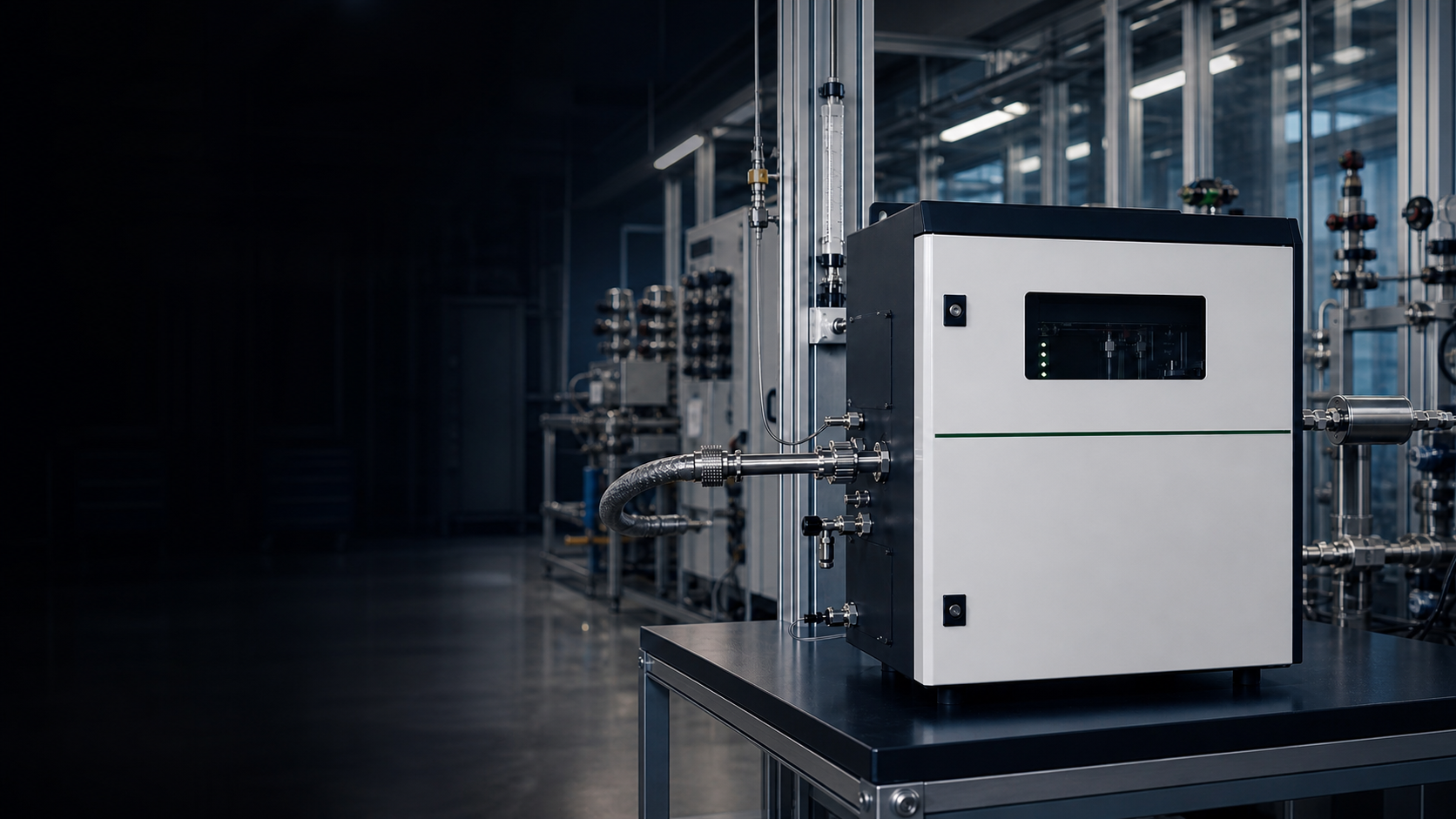 In-line Process
ZS6300-H2 · TCD Thermal Conductivity
ZS6300-H2 Process Hydrogen Analyzer
TCD thermal conductivity hydrogen analyzer for bulk %vol process purity — ammonia / methanol reformers, air separation product headers, chlor-alkali cell gas, and turbine-generator cooling
- Range
- 0–10 %vol / 0–25 %vol / 0–100 %vol H₂ (multi-range)
- Accuracy
- ±1 % FS (bulk %vol)
- Response (T90)
- <10 s
- Detection Limit
- ≈100 ppm H₂ (TCD floor — not a ppm-trace instrument)
- Output
- 4–20 mA / RS-485 Modbus / HART
- Sample Conditioning
- Pressure- and flow-compensated clean / dry sample required
Where H₂ Process Purity Measurement Fits in the Plant
From reformer synthesis gas to generator cooling circuits and chlor-alkali electrolysis — bulk H₂ purity in three key process control loops.
Synthesis Gas Production
H₂ content monitoring in ammonia and methanol reformer synthesis gas outlet and pressure swing adsorption (PSA) purge streams for process control, product-quality verification, and loop efficiency. TCD delivers continuous %vol readings that reflect real-time reformer performance without the multi-hour cycle time of lab-bench gas chromatography — enabling tighter control of hydrogen-to-nitrogen ratio in ammonia synthesis loops.
See chemical process applicationsPower Generation
Hydrogen purity monitoring in hydrogen-cooled turbine-generator cooling circuits, ensuring H₂ content remains above the minimum threshold for proper thermal performance and detecting air ingress that degrades cooling efficiency and increases explosion risk. Continuous TCD monitoring is the standard approach for large power station generators requiring uninterrupted H₂ purity surveillance in line with OEM specifications.
See power applicationsChlor-Alkali & Industrial Electrolysis
Continuous H₂ content analysis in chlor-alkali membrane-cell cathode gas headers for early detection of membrane crossover events. Lab-bench gas chromatography typically runs on multi-hour cycles, while a TCD analyzer on the cathode header provides continuous readings (<10 s T90 response) — making crossover visible on the operator console hours before it escalates. Air separation units also use TCD for product-header H₂ bulk purity monitoring.
See chemical process applicationsWhy GESHINE for Hydrogen Analyzers
TCD process purity path, correct sensor physics for H₂, full process-to-safety path coverage, and direct manufacturer support.
Correct Physics for H₂
Hydrogen is not IR-active, so IR-based analyzers are the wrong tool for H₂ purity measurement. The ZS6300-H2 uses TCD thermal conductivity — the established process standard for bulk H₂ %vol measurement — matched Wheatstone-bridge sensor pair with multi-range firmware from 0–10 %vol through 0–100 %vol H₂.
Application Engineering Support
From duty-point feasibility through matrix confirmation and SCS specification — GESHINE engineers assist with TCD range selection, sample conditioning design (ZS-SCS-600 cool-dry system), DCS output integration (4–20 mA / Modbus / HART), and span gas recommendation for reformer, ASU, and generator-cooling applications.
Full Process-to-Safety Coverage
This page covers the TCD process purity path. The catalytic-bead safety detection path (fixed catalytic-bead LEL detector, portable combustible-gas detector) is described on the combustible-gas-detectors page. Together, the two instrument families cover the full H₂ measurement spectrum from bulk %vol process purity to %LEL fire-code compliance — with clear path boundaries and no instrument misapplication risk.
Manufacturer Direct
Direct access to the engineering team that designed and built your analyzer. Shorter lead times, competitive pricing, and factory-level technical support including spare parts, field service, and span gas specification guidance for H₂ process applications.
Hydrogen Analyzer Questions, Answered
From TCD vs catalytic bead selection and sample conditioning requirements to generator purity standards and hazardous-area classification.
What is the difference between a TCD hydrogen analyzer and a catalytic bead LEL detector?
They are fundamentally different instruments serving different jobs. A TCD (Thermal Conductivity Detector) hydrogen analyzer measures bulk H₂ concentration in %vol — from 0–10 %vol up to 0–100 %vol — using the physical difference in thermal conductivity between hydrogen and the background gas. It is a process purity instrument installed in synthesis gas lines, ASU product headers, or generator cooling circuits. A catalytic-bead LEL detector measures H₂ concentration at lower levels — 0–100 %LEL, equivalent to 0–4 %vol — by catalytic oxidation on a heated platinum pellistor. It is a safety instrument installed in hazardous areas to trigger fire-code alarms and ESD interlocks. Confusing the two leads to instrument misapplication: a TCD is not rated or calibrated for %LEL safety alarm duty, and a catalytic-bead detector does not cover the upper %vol range needed for process purity monitoring.
Why can’t I use an infrared (IR) analyzer to measure hydrogen?
Hydrogen (H₂) is a homonuclear diatomic molecule — it has no permanent dipole moment and does not absorb mid-infrared light. Non-dispersive infrared (NDIR) analyzers work by measuring IR absorption at characteristic wavelengths, so they cannot detect H₂ at all; there is no absorption signal to measure. This is a fundamental physics limitation, not an instrument calibration issue. TCD thermal conductivity is the established process standard for bulk H₂ measurement because hydrogen’s thermal conductivity is approximately 7× that of air — a large, reliable physical property difference that gives a clean bulk %vol signal without any optical absorption requirement.
What does %vol vs %LEL mean for hydrogen measurement?
%vol (percent by volume) is an absolute concentration unit used for process purity monitoring — for example, 95 %vol H₂ in a generator cooling circuit or 60 %vol H₂ in a synthesis gas stream. %LEL (percent of the lower explosive limit) is a relative safety unit scaled to the gas’s flammability threshold — hydrogen’s LEL is approximately 4 %vol, so 100 %LEL = 4 %vol H₂. Safety detectors typically alarm at 10 %LEL (≈ 0.4 %vol) and 25 %LEL (≈ 1 %vol). The two scales serve completely different purposes: %vol for process quality and %LEL for fire-code compliance. Instruments are calibrated and certified for one domain, not both.
Does a TCD hydrogen analyzer require a sample conditioning system (SCS)?
Yes — the ZS6300-H2 is an extractive analyzer that requires clean, dry sample delivery at regulated flow and pressure. A moisture knock-out (condenser or dryer) upstream of the TCD cell prevents liquid carry-over and sensor contamination. A particulate filter protects the sensor bridge from fouling. Sample flow is regulated to 0.5–1.5 L/min at 20–200 mbar g. The ZS-SCS-600 cool-dry conditioning system is the recommended pre-treatment train; exact specification is confirmed per project depending on process gas temperature, pressure, and moisture content at the sample tap.
What is the typical hydrogen purity requirement for turbine-generator cooling?
Large hydrogen-cooled generators typically require H₂ purity above 95–97 %vol in the cooling circuit to maintain specified thermal performance. OEM operating limits vary but commonly set a minimum alert threshold (for example, 93 %vol) and a minimum shutdown threshold below which cooling capacity is insufficient. Air ingress below the minimum purity level reduces thermal conductivity of the coolant gas and can raise winding temperatures above design limits. Continuous TCD monitoring in the 0–100 %vol range allows early detection of any downward trend in H₂ purity before it reaches the OEM alert level. Specific numeric thresholds are set by the generator OEM, not by the analyzer; the ZS6300-H2 multi-range firmware covers the full monitoring window from near-100 %vol down to 0 %vol for purging and charging sequences.
What is ISO 14687-2 and does the ZS6300-H2 cover it?
ISO 14687-2 is an application standard defining purity requirements for hydrogen fuel for fuel-cell vehicles — it specifies 99.97 %vol minimum H₂ purity with per-analyte ppm-level limits on CO, H₂S, NH₃, total hydrocarbons, moisture, and other trace impurities. Meeting ISO 14687-2 requires not just a bulk %vol measurement but also trace-level impurity detection via dedicated electrochemical or gas-chromatographic hardware. The ZS6300-H2 TCD process analyzer covers bulk %vol measurement in the 0–100 %vol range and has a detection floor of approximately 100 ppm H₂ (TCD floor). It is suitable for bulk purity monitoring in synthesis gas, ASU, and generator-cooling contexts. ISO 14687-2 fuel-cell-grade purity audits require additional trace-capable instrumentation and remain a conditional engineering-review path — not an off-the-shelf ZS6300-H2 capability.
What ATEX zone classification is required for hydrogen measurement in hazardous areas?
ATEX classification for hydrogen hazardous areas depends on site-specific risk assessment and area classification by the facility’s safety engineer. Hydrogen falls in Gas Group IIC (highest ignition energy group), meaning flameproof (Ex d) enclosures must be rated to IIC, and intrinsically safe (Ex ia) circuits must meet IIC requirements as well. Zone 0 (continuous presence) requires ia IIC; Zone 1 (likely presence) allows d IIB+H2 or ia IIC; Zone 2 (unlikely presence in normal operation) allows n IIC or d IIC enclosures. ATEX certification for the ZS6300-H2 process analyzer is a conditional engineering-review scope confirmed per project; for hazardous-area H₂ safety detectors, the fixed catalytic-bead LEL detector and the portable combustible-gas detector on the combustible-gas-detectors page carry relevant ATEX ratings for their respective duty types.
Can TCD measure hydrogen in the presence of helium?
Helium has a thermal conductivity close to that of hydrogen — both are significantly higher than air and nitrogen — so helium in the sample matrix causes significant positive cross-interference on a TCD calibrated for H₂ in air or N₂. For applications where helium is present in the gas stream (for example, some leak-test blends or specialty gas mixtures), the matrix composition must be declared at the time of order so the factory can assess whether TCD measurement is viable and how to configure the reference cell. For H₂ / He mixtures specifically, TCD may not be the appropriate measurement principle and alternative analytical methods should be considered. For most industrial process applications — synthesis gas, ASU product, chlor-alkali cell gas, and generator cooling — helium is not present and TCD performs reliably.
Request a Quote for Hydrogen Analyzers
To configure the right H₂ measurement solution for your application, please have these details ready:
- Measurement duty: process purity (%vol) or safety detection (%LEL) — or both
- Expected H₂ concentration range and background matrix composition (especially any He present)
- Sample temperature, pressure, and moisture content at the sample tap
- Application: synthesis gas, air separation, generator cooling, chlor-alkali, or other
- Required response time (T90) and any continuous-duty or spot-check requirement
- Output protocols needed (4–20 mA, Modbus, HART, OPC-UA)
- Area classification (ATEX zone, SIL requirement) if applicable
- Any ISO 14687-2 fuel-cell-grade purity audit requirement (note: this is a conditional engineering-review path)
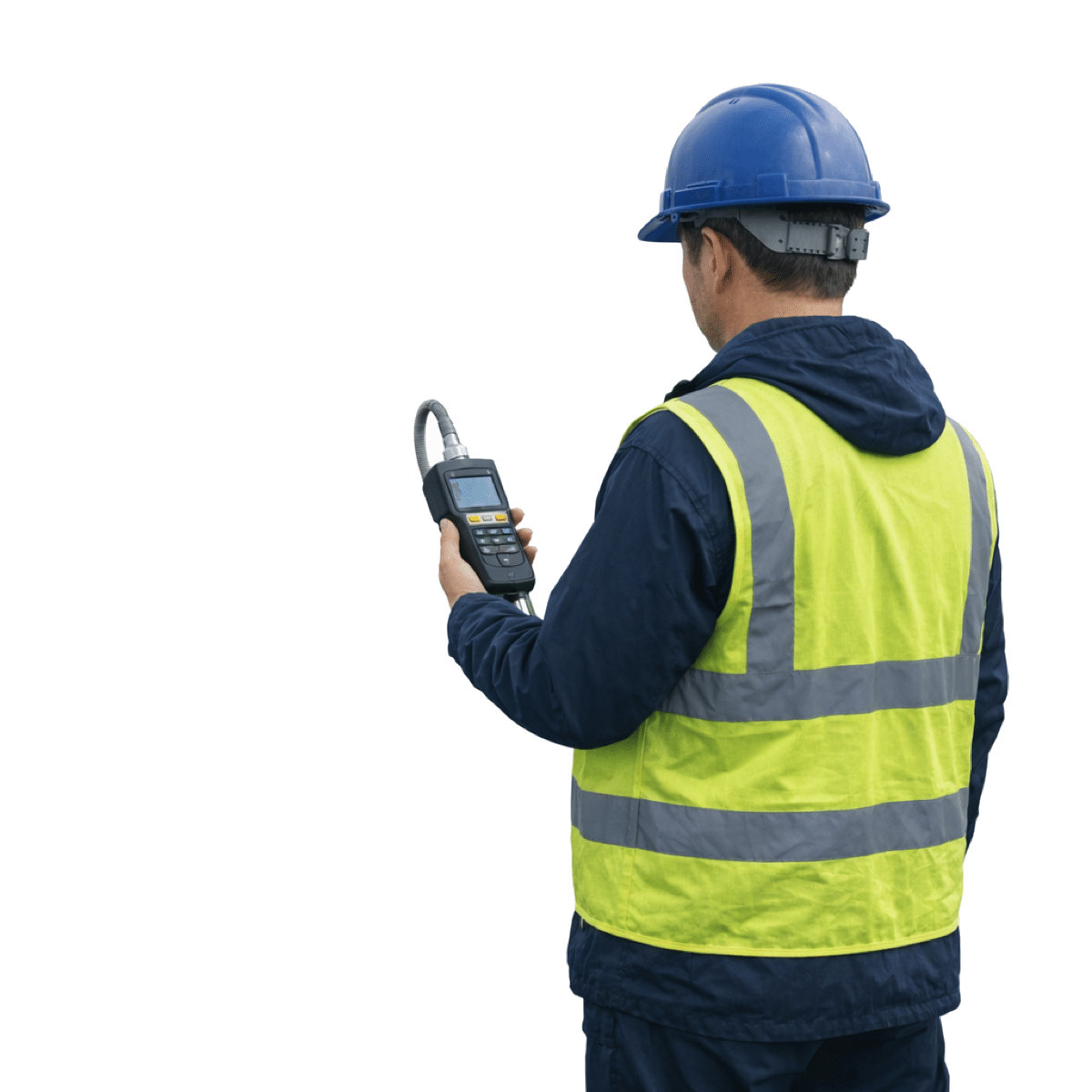
Get H₂ Analyzer Expert Consultation
Our application engineers specialize in TCD process purity selection, matrix compatibility confirmation, sample conditioning specification, and process-to-safety path guidance for hydrogen applications.