
Hydrogen Chloride Analyzers — TDLAS Line-Selected HCl Measurement
Non-contact TDLAS for wet, corrosive HCl duty — incineration CEMS, chlor-alkali, PVC/VCM, and scrubber verification.
TDLAS diode-laser HCl analyzers resolve hydrogen chloride above the H₂O continuum without consumable electrochemical cells or reagents. Hastelloy C-276 heated sampling preserves HCl integrity in hot, wet, acidic stack gas — from EU IED ≤10 mg/Nm³ incineration CEMS to chlor-alkali cell-room process monitoring and semiconductor CVD chlorosilane exhaust.
How TDLAS Works for HCl Measurement
Tunable Diode Laser Absorption Spectroscopy — Single-Line HCl Detection
A narrow-line near-IR diode laser is tuned across a single HCl ro-vibrational absorption line near 1.74 μm. The fraction of light absorbed follows Beer-Lambert law and is proportional to HCl mole fraction — resolving the HCl signal above the H₂O continuum without the spectral overlap that constrains broadband NDIR in wet, corrosive stack gas.
- Laser line selection separates HCl from H₂O continuum, CO₂, SO₂, and HF background after matrix review
- No reagent for the optical cell — heated Hastelloy sample path and optical source remain the primary service items
- Pairs with ZS-SCS-800 Hastelloy C-276 heated sampling (shared with the HF sister category)
- In-house TDLAS platform with range, accuracy, and certification scope confirmed per project
TDLAS HCl Sensing Principle
Four HCl Sensing Paths at a Glance
TDLAS (ZS8100-HCl) is the default for HCl process and CEMS duty. A sister TDLAS form factor on the H₂S-family platform is available by project review. UV-DOAS long-path and electrochemical ppm safety are Conditional engineering-review paths confirmed per project.
TDLAS — ZS8100-HCl
Primary Process + CEMS Path
Near-IR laser line at ≈1.74 μm resolves HCl above the H₂O continuum. Hastelloy C-276 heated sample path. Multi-range 0–50 / 200 / 5000 ppm. CE. Primary path for incineration CEMS, chlor-alkali, PVC/VCM, CVD exhaust.
TDLAS — Sister Form Factor
Alternative TDLAS Geometry
TDLAS on the H₂S-family platform — same measurement principle, alternative form factor for projects where that skid geometry fits better. Available by project review; range and accuracy confirmed per project alongside ZS8100-HCl.
UV-DOAS — Long-Path Option
Long-Path CEMS Extension
Broadband UV DOAS across a long-path CEMS cell; multi-component capability alongside SO₂ and NO₂. Hardware feasibility and QAL1 scope still under review — confirmed per project only.
Electrochemical HCl
ppm Safety Detection
HCl-selective EC cell for fixed-point or portable ppm leak detection at chlor-alkali cell rooms and PVC loading bays. Not a current GESHINE self-owned SKU; partner-sourced on explicit business demand only.
Extractive Process vs. Heated CEMS vs. Portable Monitoring for HCl
TDLAS Extractive Process Analyzer
A Hastelloy C-276 heated probe and transfer line draw HCl above its acid dew point, keeping HCl from adsorbing into condensate or reacting with sample-path walls. The TDLAS optical cell sees a stable, hot, wet HCl gas sample — no cool-dry conditioning needed because the TDLAS laser line resolves HCl above the H₂O continuum at measurement temperature.
Hastelloy C-276 probe + heated transfer line (maintained above HCl dew point, typically 160–180 °C), coalescing filter for particulate, ZS-SCS-800 heated conditioning system. No cool-dry chiller required for TDLAS; PTFE sealing surfaces where compatible.
- Chlor-alkali cell-room and compression-section continuous HCl monitoring
- PVC / VCM / EDC monomer plant process and vent-gas tracking at ppm level
- Wet-scrubber upstream / downstream abatement verification
Heated CEMS for Incineration HCl
Waste-incineration and hazardous-waste stacks require certified continuous HCl emission reporting under EU IED (≤10 mg/Nm³) and EN 14181 QAL1/QAL2 surveillance. The ZS8100-HCl on a ZS-SCS-800 heated Hastelloy CEMS train delivers continuous HCl alongside the HF, SO₂, and NOₓ channels in a shared-rack CEMS architecture — a single heated conditioning system serving multiple analyzer modules.
ZS-SCS-800 Hastelloy C-276 heated CEMS train (shared with HF and SO₂ channels), automatic zero/span solenoid manifold, daily auto-check via span gas, calibration reference gas per EN 14181 QAL3.
- Waste-incineration and hazardous-waste CEMS (EU IED ≤10 mg/Nm³ HCl compliance)
- Semiconductor CVD chlorosilane (TCS / DCS) decomposition exhaust monitoring
- EN 14181 QAL2 compliant emission reporting alongside HF, SO₂, NOₓ, and dust
Portable HCl Leak Detection
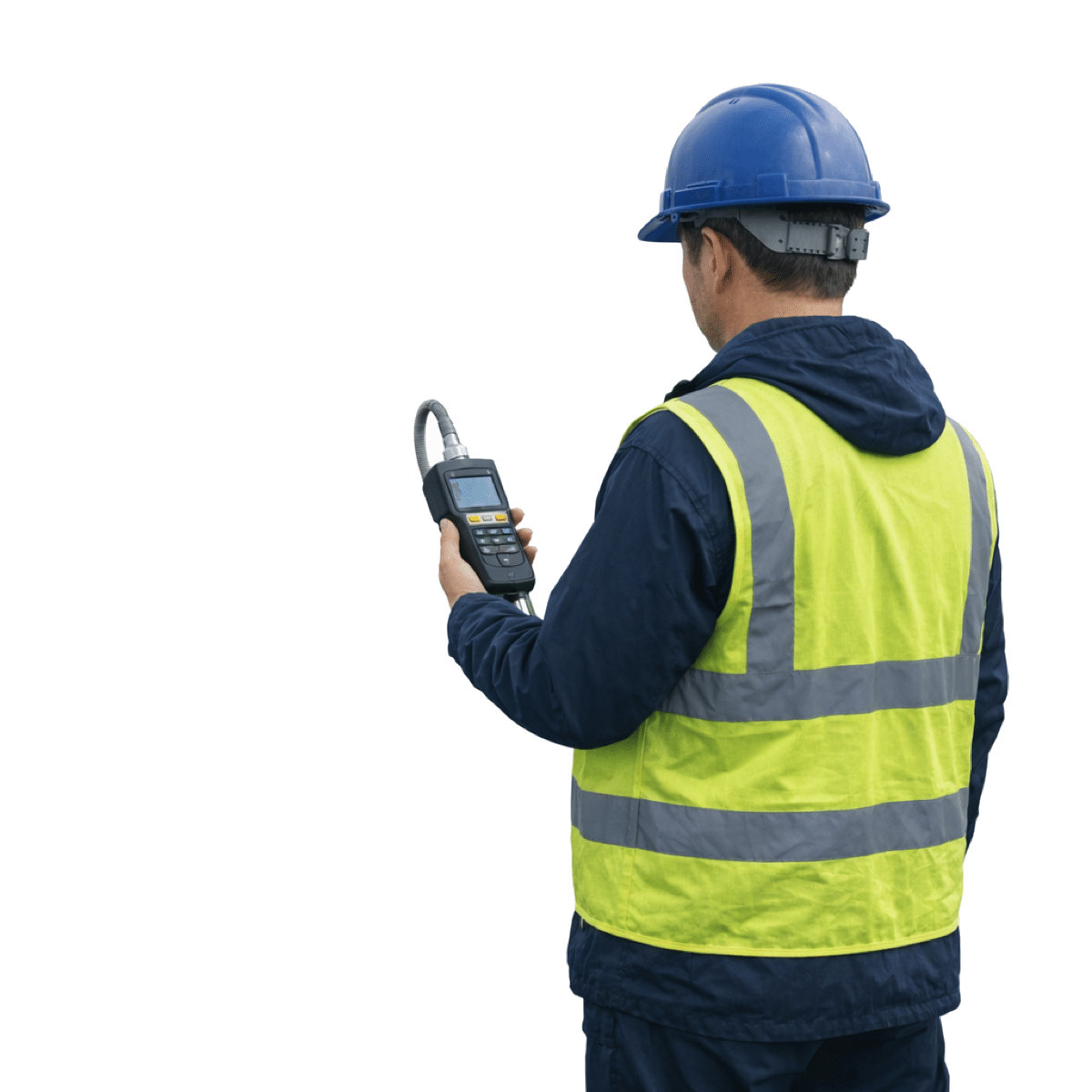
For field HCl leak surveys, perimeter monitoring at chlor-alkali cell rooms and PVC loading bays, and workplace safety checks against OSHA PEL (5 ppm ceiling), electrochemical-based portable detectors or handheld TDLAS units provide ppm-level HCl detection for personnel protection. These are a Conditional path — not a current GESHINE self-owned SKU, partner-sourced per explicit project requirement.
Built-in pump draws sample via probe to EC or miniaturized TDLAS sensor. HCl-compatible wetted materials; sensor replacement on consumption schedule (EC cells: 6–12 month typical life in HCl service).
- Chlor-alkali cell-room perimeter HCl personal safety monitoring
- PVC loading bay and process vent spot-check surveys
- Emergency response and maintenance leak hunts in acid-gas areas
Portable EC safety detector: lowest entry for perimeter safety; consumable cell replacement scheduled at 6–12 months in HCl service.
TDLAS extractive process analyzer: reagent-free optical cell reduces consumable spend; heated Hastelloy sample path is the primary service item over a 3-year cycle.
Heated CEMS train: upfront Hastelloy conditioning cost amortized across compliance lifetime; TDLAS optical cell avoids reagent and EC-sensor replacement costs over the full certification period.
Why TDLAS for HCl Measurement
HCl is corrosive, highly reactive with moisture, and occurs in process matrices with strong spectral backgrounds from H₂O, CO₂, SO₂, and HF. TDLAS resolves HCl at the optical level — without consumable electrochemical cells and without the water-vapor cross-sensitivity that constrains extractive NDIR in wet acid-gas duty.
| Dimension | Extractive EC HCl | Extractive NDIR HCl | TDLAS HCl (ZS8100-HCl) |
|---|---|---|---|
Best-fit duty | Portable / fixed ppm safety detection | Dry-gas process streams, low H₂O | Wet-gas CEMS, process, and incineration duty |
★H₂O cross-sensitivity | Humidity affects EC cell response; correction required | H₂O band overlaps HCl in wet matrices — accuracy constrained above ~10 %vol H₂O | Laser line selected above H₂O continuum — inherent optical resolution |
★Consumable / cell life | 6–12 month EC cell replacement in HCl service | No chemical reagent; optics and filter service | No reagent — heated sample path and optical source are the service items |
★Cross-gas interference | SO₂, NO₂, Cl₂ can cross-react with HCl EC cell | SO₂ / CO₂ / HF spectral overlap — matrix review required | Single-line laser isolates HCl from CO₂ / SO₂ / HF after matrix review |
Wetted materials | Sensor-specific; limited high-temperature compatibility | Standard materials feasible at lower HCl concentrations | Hastelloy C-276 heated sample path — designed for corrosive acid-gas service |
Detection range | ppm safety range; not suited for % process range | ppm to low % range if water interference managed | 0–50 / 200 / 5000 ppm multi-range — spans CEMS to process |
Compliance path | Not certified for CEMS emission reporting | Limited; wet-gas accuracy constraints | Primary path for incineration CEMS EU IED ≤10 mg/Nm³; MCERTS target scope |
★Recalibration frequency | More frequent — EC drift and cross-gas factors accumulate | Scheduled span checks; humidity correction cadence | Periodic optics check; no chemical consumption drift |
★ marks the four dimensions where TDLAS provides the clearest advantage for corrosive, wet-gas HCl measurement applications.
HCl Analyzer Selection by Application, Matrix, and Compliance Duty
Three questions narrow most HCl analyzer specifications: what is the target concentration range and matrix moisture level, is the duty continuous process monitoring or certified CEMS emission reporting, and does the installation involve a hazardous classified area.
Incineration CEMS and EU BAT Compliance
Waste-incineration and hazardous-waste facilities face mandatory HCl emission reporting under the EU Industrial Emissions Directive (IED) daily ELV of ≤10 mg/Nm³ HCl at the stack. This duty requires a continuous measurement system maintained to EN 14181 QAL1/QAL2 quality assurance standards, with documented uncertainty and reference-method cross-checks. TDLAS (ZS8100-HCl) is the primary path because it resolves HCl above the water-vapor continuum in permanently wet flue gas — where broadband NDIR accuracy is constrained by high H₂O content. The heated Hastelloy sampling system (ZS-SCS-800) preserves HCl integrity from probe tip to analyzer cell throughout the measurement cycle. See the TDLAS vs EC vs NDIR comparison for the technical rationale.
Chlor-Alkali, PVC/VCM, and Semiconductor Process Monitoring
Process applications for HCl span a wide concentration range — from low-ppm leak tracking at chlor-alkali cell-room perimeters to percent-level HCl monitoring in PVC / VCM / EDC monomer vent-gas streams and semiconductor CVD chlorosilane (TCS/DCS) decomposition exhaust. All of these involve potentially corrosive, reactive matrices where standard SS316 wetted materials and cool-dry condensation-based sample conditioning would cause HCl loss and measurement error. The ZS8100-HCl multi-range firmware (0–50 / 200 / 5000 ppm) and Hastelloy heated sample path address this full range without optical hardware changes, and the reagent-free TDLAS cell avoids the scheduled EC sensor replacements that accumulate cost in continuous process duty. A sister TDLAS form factor on the H₂S-family platform is available by project review for projects where that skid geometry fits better.
Scrubber Verification and EN 14181 QAL Audit
Wet-scrubber systems installed to abate HCl from incineration, glass, or acid-manufacturing exhausts require both inlet and outlet monitoring to demonstrate abatement efficiency and confirm compliance with stack emission limits. Upstream measurements face the highest HCl concentrations and most corrosive conditions; downstream measurements must detect low-ppm HCl against a background that may still carry H₂O, SO₂, and residual acid aerosol. TDLAS with Hastelloy heated sampling is the technically defensible measurement at both points. For EN 14181 QAL2 audits, the analyzer must demonstrate measurement uncertainty within the allowed tolerance against a reference method — discuss measurement uncertainty targets when specifying the project scope with the application engineering team.
Browse HCl Analyzers
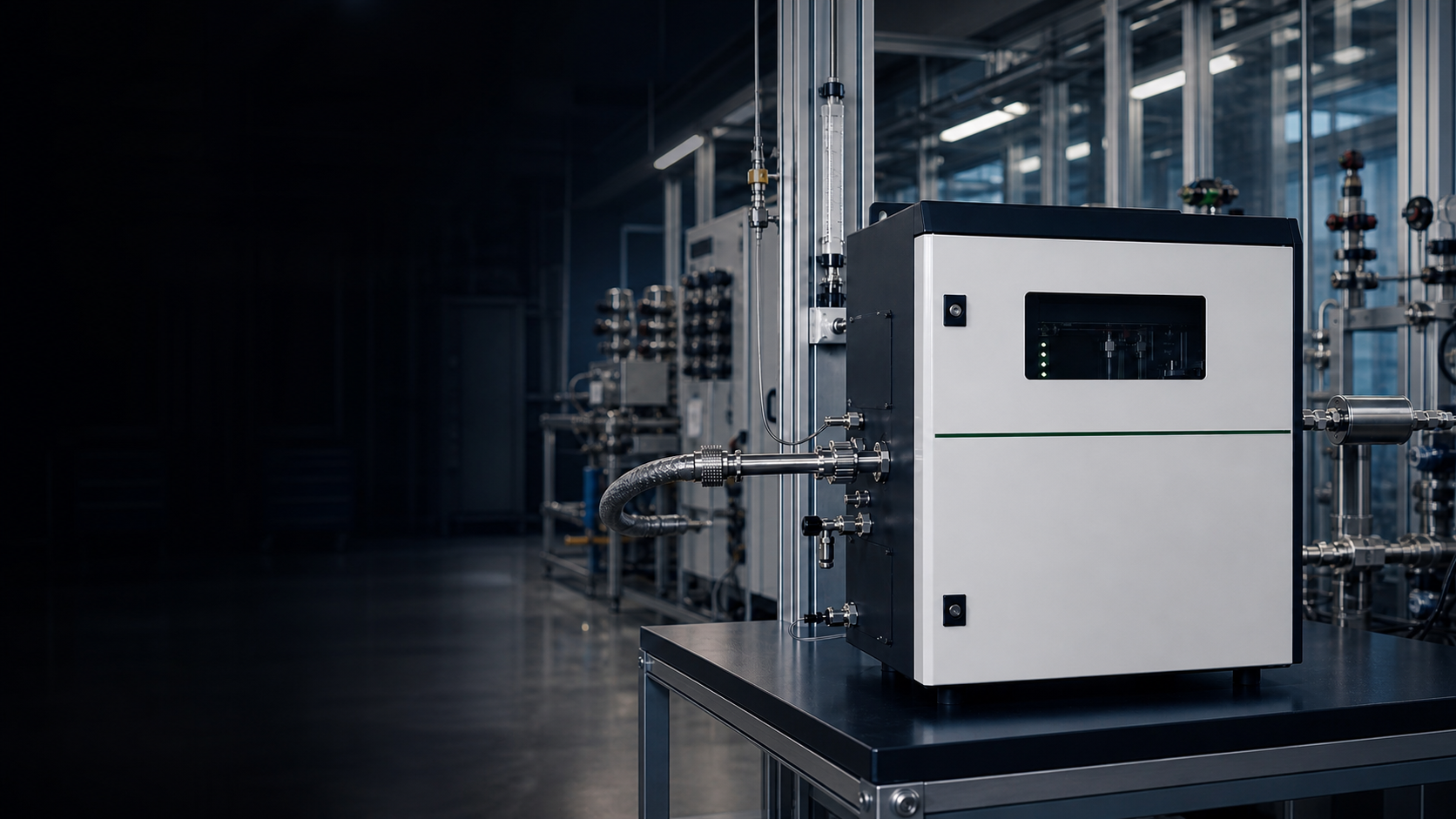
ZS8100-HCl — TDLAS extractive HCl process analyzer for incineration CEMS, chlor-alkali, PVC/VCM, and semiconductor CVD exhaust duty.
 In-line Process
ZS8100-HCl · TDLAS
ZS8100-HCl Process Hydrogen Chloride Analyzer
TDLAS diode-laser hydrogen chloride analyzer for waste-incineration CEMS (EU IED ≤10 mg/Nm³), chlor-alkali, PVC / VCM / EDC, and semiconductor CVD chlorosilane exhaust
- Range
- 0–50 ppm / 0–200 ppm / 0–5000 ppm (multi-range)
- Accuracy
- ±2 % FS or ±1 ppm (whichever greater)
- Response (T90)
- <10 s
- Detection Limit
- <0.5 ppm (CEMS-useful)
- Wetted Parts
- Hastelloy C-276 on heated sample path
- Output
- 4–20 mA / RS-485 Modbus / HART
Where HCl Measurement Lives in the Plant
From incineration CEMS compliance to chlor-alkali process tracking and semiconductor CVD exhaust abatement — hydrogen chloride in three demanding industrial environments.
Environmental & Incineration CEMS
Waste-incineration and hazardous-waste CEMS reporting HCl ≤50 mg/m³ at the stack under EU IED BAT and EN 14181 QAL1/QAL2 quality assurance. TDLAS on a Hastelloy heated CEMS train delivers continuous HCl alongside HF, SO₂, and NOₓ in a shared-rack architecture — the measurement principle best suited to permanently wet, acid-bearing stack gas.
See environment applicationsChemical Process — Chlor-Alkali & PVC/VCM
Cell-room and compression-section HCl tracking in chlor-alkali plants, and PVC / VCM / EDC monomer process and vent-gas monitoring. Wet-scrubber upstream/downstream abatement verification for acid-gas treatment systems. The heated Hastelloy sample path handles the corrosive, reactive nature of HCl in these process environments without material degradation or measurement dropout.
See chemical applicationsSemiconductor & CVD Exhaust
Continuous HCl monitoring in semiconductor CVD chlorosilane (TCS / DCS) decomposition exhaust streams and acid-etch scrubber outlet verification. Semiconductor fabs operate zero-tolerance HCl release policies at scrubber outlets — continuous TDLAS measurement provides the real-time HCl data needed to confirm scrubber performance and trigger maintenance before permit limits are approached.
See semiconductor applicationsWhy GESHINE for HCl Analyzers
TDLAS measurement principle, Hastelloy C-276 corrosive-service wetted path, incineration CEMS application depth, and direct engineering access from the team that built the instrument.
TDLAS — Reagent-Free HCl Measurement
The ZS8100-HCl uses single-line laser absorption at the HCl overtone band. No electrochemical cell to replace, no reagent to deplete, no humidity sensor to cross-correct. The optical cell is a service item measured in years, not months — suited to continuous incineration CEMS and corrosive process duty where EC cell replacement costs accumulate.
Hastelloy C-276 Corrosive Service Path
All HCl-wetted components in the ZS8100-HCl and ZS-SCS-800 sampling system use Hastelloy C-276 — a nickel-molybdenum-chromium alloy with demonstrated resistance to HCl-bearing acid-gas service at elevated temperature. PTFE sealing surfaces minimize HCl adsorption at low ppm. Standard SS316L wetted parts are not specified for incineration flue-gas HCl duty.
Incineration CEMS Application Depth
GESHINE engineers have worked on HCl CEMS applications at waste-incineration and hazardous-waste facilities under EU IED BAT compliance requirements. Application support covers matrix review for H₂O / SO₂ / HF background, sample conditioning specification, EN 14181 QAL2 measurement uncertainty discussion, and DAS integration — from feasibility through commissioning and ongoing QAL3 support.
Manufacturer Direct
Direct access to the engineering team that designed and built the ZS8100-HCl. Shorter lead times, competitive pricing on spare parts, and factory-level technical support — including application-specific matrix review when HCl co-exists with SO₂, HF, and CO₂ in mixed acid-gas matrices that need laser-line selection verification.
HCl Analyzer Questions, Answered
From TDLAS measurement rationale and Hastelloy sampling requirements to incineration CEMS compliance and EN 14181 QAL2 audit preparation.
Why is TDLAS recommended for HCl measurement in wet incineration stack gas?
Three properties of incineration flue gas make TDLAS the defensible choice for HCl CEMS: (1) high water-vapor content (typically 10–25 %vol) that overlaps the HCl absorption band in broadband NDIR — TDLAS places the laser line at a specific HCl feature that sits above the H₂O continuum, resolving HCl optically rather than by humidity compensation; (2) the co-presence of SO₂, HF, and CO₂ that introduce spectral background in wider-band techniques, addressed by laser-line selection and application matrix review; (3) the highly corrosive, reactive nature of HCl in wet acid gas at stack temperatures, requiring materials and measurement approaches that preserve sample integrity from probe tip to analyzer cell.
Why does HCl measurement require heated Hastelloy C-276 sample lines rather than standard SS316?
HCl is highly soluble in water. If the sample path temperature drops below the acid dew point (roughly 60–80 °C for typical HCl concentrations in incineration flue gas), HCl dissolves into condensate film on the sample line walls — causing measurement dropout (the HCl reaches the analyzer at a lower concentration than is present at the measurement point) and simultaneous aggressive corrosion of the sample path materials. Standard SS316L is adequate for non-corrosive gases but is attacked by concentrated HCl at elevated temperatures. Hastelloy C-276 — a nickel-molybdenum-chromium alloy — provides markedly better resistance to HCl-bearing acid service at the temperatures and concentrations found at incineration and chlor-alkali installations. The heated line must maintain temperature above the dew point throughout its full length, including bends and connections.
What is EN 14181 QAL2 and why does it matter for HCl CEMS?
EN 14181 defines the quality assurance framework for automated measuring systems (AMS) installed at stationary source CEMS positions in the EU. QAL1 is the initial type-approval test confirming the instrument meets minimum performance criteria under laboratory and field conditions. QAL2 is the site-specific calibration and uncertainty assessment carried out once the system is installed, using a reference method (typically extractive isokinetic sampling) to establish the functional relationship between the AMS reading and the reference value and to document measurement uncertainty. Annual Surveillance Testing (AST) maintains the QAL2 calibration over time. For HCl CEMS, QAL2 is mandatory for permit compliance under the EU IED — the measurement uncertainty obtained at QAL2 must be within the allowed tolerance for the permit limit, which means instrument selection, installation quality, and sampling system integrity all affect compliance status.
What is the OSHA PEL and ACGIH TLV for hydrogen chloride, and what measurement range covers workplace safety?
OSHA sets a Ceiling PEL of 5 ppm for hydrogen chloride — workers must not be exposed to concentrations at or above this level at any time. ACGIH sets a TLV-Ceiling (TLV-C) of 2 ppm for the workplace. NIOSH recommends a 5 ppm Ceiling (15-minute) and an IDLH of 50 ppm. For fixed-point continuous workplace safety monitoring, a measurement range of 0–10 ppm HCl with a detection limit below 0.5 ppm is typically specified. These safety-range applications are served by electrochemical HCl detectors as a Conditional path — not the same equipment as incineration CEMS, which operates in a 0–50 / 200 ppm range at stack conditions.
Does SO₂ co-present in incineration flue gas interfere with TDLAS HCl measurement?
HCl and SO₂ both absorb in the mid- and near-infrared regions, and their spectral features can overlap at some wavelengths in broadband measurement approaches. TDLAS addresses this at the optical level: the laser is tuned to a single, narrow HCl ro-vibrational absorption feature at approximately 1.74 μm in the near-IR overtone band. The SO₂ absorption cross-section at this specific wavelength is substantially lower than the HCl feature, and residual SO₂ background can be accounted for in the application matrix review. Similarly, HF and CO₂ are resolved through line selection and matrix analysis. The matrix review should be conducted for each specific installation, as the magnitudes of SO₂, HF, and CO₂ backgrounds vary between sites and affect the residual interference estimate.
What is the difference between the ZS8100-HCl and the sister TDLAS form factor?
Both the ZS8100-HCl and the sister TDLAS form factor use TDLAS as the measurement principle and share the same fundamental advantage for HCl in wet, corrosive matrices — laser-line-selected non-contact optical measurement with Hastelloy C-276 heated sample path. The difference is platform and form factor: the ZS8100-HCl is on the mainstream GESHINE TDLAS process analyzer platform, while the sister form factor is based on the H₂S-family platform. For most incineration CEMS, chlor-alkali, and PVC/VCM applications, the ZS8100-HCl is the default recommendation. The sister TDLAS form factor is specified when the H₂S-family skid geometry or mounting arrangement fits the project installation constraints better, and is available by project review. Both configurations are confirmed with range and accuracy per project.
How should I verify HCl scrubber performance using continuous TDLAS measurement?
Wet-scrubber abatement verification for HCl requires continuous measurement at both the scrubber inlet and outlet. Inlet measurements face the highest HCl concentrations and most corrosive conditions — typically 100–2000 ppm HCl range in incineration flue gas, at high temperature and high moisture. Outlet measurements must detect low-ppm HCl (≤10 ppm for typical abatement targets) against a gas matrix that still carries residual moisture, SO₂, and acid aerosol from incomplete scrubbing. TDLAS at both points, each with its own Hastelloy heated sample line and analyzer, gives the data needed to calculate abatement efficiency in real time and trigger scrubber maintenance when outlet HCl begins to trend upward before the permit limit is reached. The inlet and outlet analyzers can share a DAS or SCADA integration point via Modbus.
Is MCERTS or US EPA PS-18 certification available for HCl CEMS?
MCERTS (UK Environment Agency scheme, administered by Sira) and US EPA Performance Specification 18 (PS-18, Hydrogen Chloride CEMS) are the relevant type-approval frameworks for HCl continuous measurement systems in the UK and US respectively. The ZS8100-HCl is at the MCERTS / PS-18 target scope stage — certification is the intended path for the GESHINE own-brand hardware, but type-approval testing and documentation sign-off have not yet been completed. Until certification is confirmed per project, the analyzer can be deployed for process and non-certified CEMS applications; for regulated permit-CEMS in the UK or US, confirm current certification status at the time of project specification with the GESHINE application team.
Request a Quote for HCl Analyzers
To configure the right HCl analyzer for your application, please have these details ready when you contact us:
- Target HCl concentration range at the measurement point (ppm or mg/m³)
- Sample gas temperature, pressure, and water vapor content (% vol H₂O)
- Background matrix: SO₂, HF, CO₂, NOₓ, and particulate levels co-present with HCl
- Application type: incineration CEMS / chlor-alkali process / PVC-VCM vent / semiconductor CVD / scrubber verification
- Compliance requirement: EU IED BAT, EN 14181 QAL2, MCERTS, US EPA PS-18, or process-only duty
- Sample point distance and preferred sample line routing (heated line length estimate)
- Output and integration requirements (4–20 mA, Modbus, HART, OPC-UA, DAS protocol)
- Area classification and local hazardous-area approval framework, if applicable
Get HCl Application Expert Consultation
Our application engineers specialize in TDLAS HCl measurement, Hastelloy corrosive-service sample conditioning, and incineration CEMS compliance under EN 14181 QAL2.