
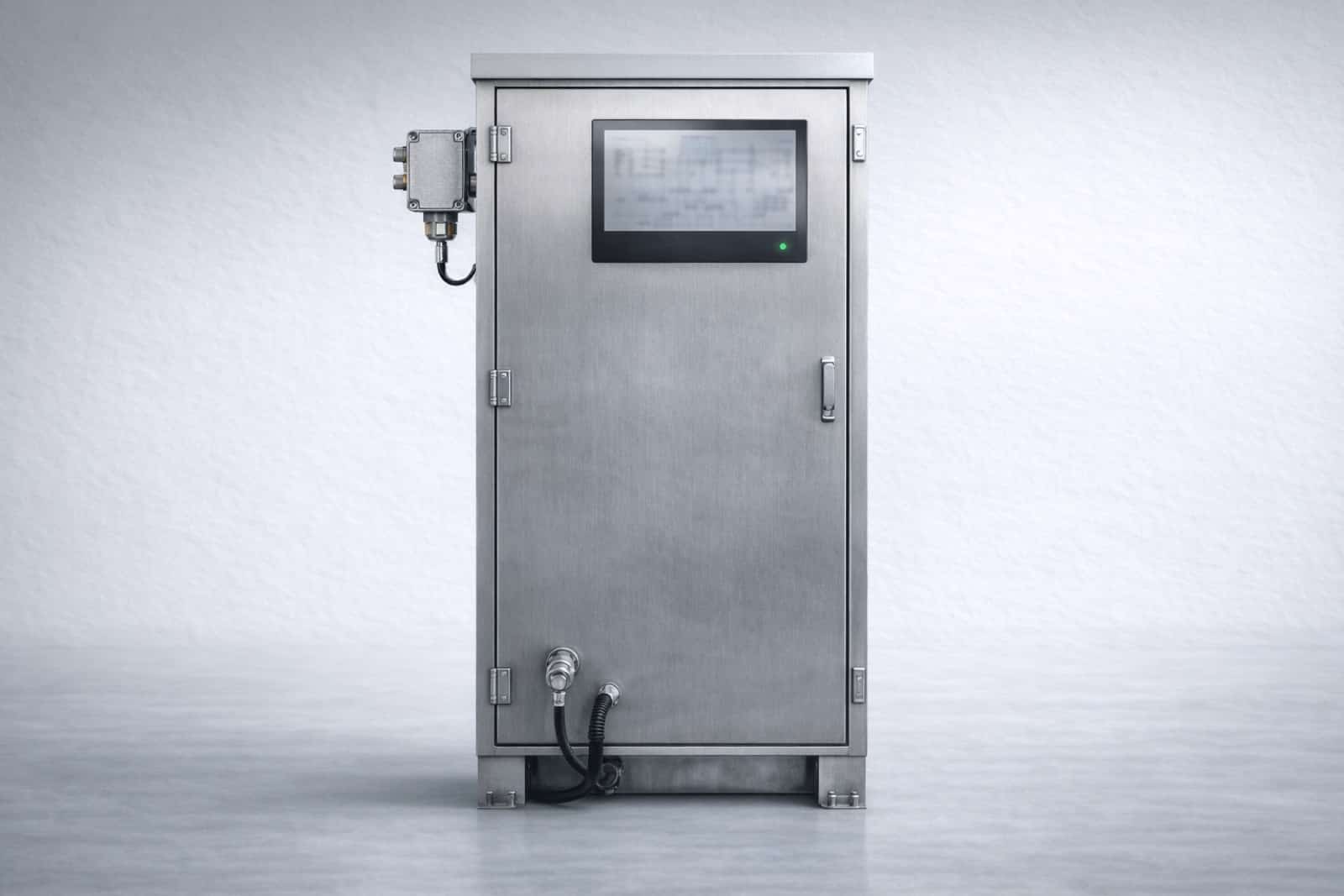
OEM Gas Analyzers for System Integrators
Gas sensing modules for integrators who build the final product — not off-the-shelf consumer sensors, not complete analyzer boxes.
GESHINE supplies three gas sensing module platforms — TDLAS for selective laser absorption, NDIR for cost-efficient infrared, and GFC for interference-rejection multi-gas work — packaged as engineering building blocks for CEMS cabinet builders, HVAC and IAQ panel OEMs, specialty analyzer integrators, and research teams. Engagement is a co-design conversation, not a catalogue transaction.
What GESHINE Brings to an OEM Engagement
An OEM platform supplier is judged on four things: whether they own the core technology, whether they can manufacture at the integrator’s rhythm, whether they respect the integrator’s IP, and whether engineering is actually available to talk to. We are explicit about all four.
In-House Core Technology
Laser sources, optical design, reference-cell assemblies, and signal-processing firmware are developed and maintained in Wuhan. Platform iteration is controlled end-to-end — no black-box dependency on a foreign module supplier that could disappear mid-program.
Manufacturing Scale for OEM Volumes
A 1,500 m² facility with ISO 9001 quality management, full spectral calibration on every unit, and a production line configured for multi-SKU OEM deliveries. Volume ramps are planned with the integrator, not scrambled.
IP and Confidentiality Discipline
Every engagement starts with a mutual NDA. Co-developed design files, custom firmware forks, and application-specific calibration data stay with the integrator under an agreed license scope. GESHINE does not redistribute co-designed assets to competing integrators.
Co-Development Engagement Model
Integrators talk directly to application and hardware engineering — not just a sales account manager. Requirements capture, interface mapping, and platform selection happen as a joint exercise, with technical ownership on both sides of the engagement.
TDLAS · NDIR · GFC Platform Cores
Three sensing platforms, each tuned to a different integration economics and a different selectivity requirement. Pick the platform that matches the integrated product you are building — or talk to engineering if the application sits across two.
TDLAS OEM Core
Narrow-linewidth diode laser, scanning electronics, and reference cell packaged for selective single-line absorption measurement.
The TDLAS core is designed for integrators who need selective, interference-free measurement of a single species against a complex matrix — where an NDIR front end would give up too much selectivity and where ppb-level sensitivity drives the analyzer architecture. GESHINE supplies the laser diode module, reference optics, and control electronics as an engineering platform; the integrator completes the sample path, housing, and application-specific certification.
Integration Fit
- Acid-gas CEMS platforms — HCl, HF, NH₃, H₂O at regulated emission limits
- Clean-energy process purity — hydrogen, ammonia cracking, green methanol
- Semiconductor tool monitoring — etch chamber, CVD, abatement outlet
- Trace-gas research and calibration standards
Signal & Interface
- Analog 4-20 mA process output
- Modbus RTU / RS-485 for host integration
- Digital UART / TTL for custom controller boards
- Alarm relays and diagnostics register set
Packaging Expectation
- Sensor head + controller split architecture
- DIN-rail or sub-rack mounting options
- Typical power 20 W at 24 VDC
- Operating envelope -10 to +55 °C at the controller
Target Buyer
- CEMS cabinet builders and compliance-system OEMs
- Specialty analyzer builders for chemical and semiconductor
- Research and calibration-standard developers
- Clean-energy process integrators
NDIR OEM Core
Broadband IR source, narrow-band optical filter, and pyroelectric detector packaged for cost-efficient CO / CO₂ / CH₄ measurement.
The NDIR core is built for integrators whose bill of materials cannot absorb a laser platform but whose product still requires industrial-grade repeatability over consumer sensor modules. GESHINE supplies the optical bench, filter wheel or fixed-filter detector, and conditioning electronics; the integrator completes the sample path and housing. This is the platform for HVAC, indoor air quality, greenhouse, biogas, and fermentation monitoring — applications where compact power budgets and steady long-term drift behavior define the product.
Integration Fit
- HVAC / BEMS CO₂ monitoring panels
- Indoor air quality (IAQ) wall-mount and duct-mount instruments
- Greenhouse climate controllers
- Biogas composition grading and digester monitoring
- Fermentation and bioprocess CO₂ off-gas headers
Signal & Interface
- Analog 4-20 mA or 0-10 V process output
- Modbus RTU / RS-485
- UART / TTL and I²C for board-level integration
- Optional digital twin readings over Modbus TCP
Packaging Expectation
- PCB-level optical bench or housed cell
- Low power — under 5 W typical at 12 VDC
- Compact envelope for wall-mount and panel integration
- Operating envelope -20 to +60 °C
Target Buyer
- HVAC / BEMS / IAQ panel OEMs
- Greenhouse and horticulture controller builders
- Biogas and anaerobic digester monitoring integrators
- Bioprocess / fermentation equipment OEMs
GFC OEM Core
Reference gas cell rotated through the optical path for cross-interference rejection — the selectivity layer NDIR alone cannot deliver.
GFC is the platform for integrators who need NDIR-style cost envelope but cannot tolerate cross-interference from overlapping IR absorbers. A reference cell filled with the target gas is rotated into the beam, and the correlation signal isolates the species of interest from water vapor, CO₂ background, and adjacent hydrocarbons. GESHINE supplies the optical module, reference-cell assembly, and correlation electronics; the integrator builds the system around it for selective CO / CO₂ / N₂O / CH₄ measurement in mixed combustion matrices.
Integration Fit
- Greenhouse-gas CEMS for 40 CFR Part 98 / EU ETS MRV duty
- Nitric-acid tail-gas N₂O monitoring and abatement feedback
- Landfill and biogas multi-component speciation
- Medical oxygen trace-CO / CO₂ QA
- Mixed flue-gas CO measurement with high water vapor background
Signal & Interface
- Analog 4-20 mA process output
- Modbus RTU / RS-485 standard
- Optional Modbus TCP / Ethernet for cabinet integration
- Diagnostic and calibration register set exposed to host
Packaging Expectation
- Optical module + controller / driver board
- Typical power 15 W at 24 VDC
- Rotating reference-cell assembly qualified for long-duty operation
- Operating envelope -10 to +55 °C at the controller
Target Buyer
- CEMS cabinet builders for greenhouse-gas compliance
- Environmental compliance OEMs and tail-gas monitoring SI
- Landfill / biogas speciation integrators
- Medical oxygen and specialty-gas QA equipment builders
Where Integrators Embed Our Platform Cores
Six representative integrator applications. The platform core is the sensing front end — the integrator owns housing, sample path, certification, and the customer relationship. Each engagement is scoped per program.
HVAC, BEMS, and IAQ Panel OEMs
Embedded NDIR cores for HVAC, building-energy, and indoor-air-quality panels — demand-controlled ventilation logic, low power budget, and ASHRAE-aware compliance posture.
Discuss this applicationBiogas, Landfill Gas & Anaerobic Digester
NDIR and GFC cores for CH₄ and CO₂ composition monitoring in landfill gas, digester headers, and biogas-grading systems supplied by waste-to-energy integrators.
Discuss this applicationCEMS Acid-Gas Compliance Cabinets
TDLAS sensing cores for CEMS cabinet builders measuring HCl, HF, NH₃, or H₂O at regulated emission limits — selective single-line absorption against complex flue matrices.
Discuss this applicationGreenhouse & Horticulture Climate Controllers
Low-power NDIR cores for greenhouse climate controllers, plant-growth chambers, and horticulture environment integrators — compact envelope and steady long-term drift behavior.
Discuss this applicationCarbon Capture & Greenhouse-Gas Monitoring
GFC sensing cores for greenhouse-gas CEMS, carbon-capture pilot monitoring, and 40 CFR Part 98 / EU ETS MRV duty — cross-interference rejection in mixed combustion matrices.
Discuss this applicationBioprocess & Fermentation Equipment OEMs
NDIR cores for bioprocess CO₂ off-gas monitoring and fermentation-tank composition tracking — board-level integration and host controller bring-up for biotech equipment OEMs.
Discuss this applicationThese are representative integrator profiles, not an exhaustive list. If your application sits outside this set — exotic gases, regulated life-science duty, or experimental sensing geometry — start the conversation anyway and we will tell you honestly whether the platform fits.
Discovery to Production — 5 Staged Deliverables
Every OEM engagement runs through five staged deliverables, each with its own acceptance gate. No hand-wave promises, no invisible scope creep — each stage has a written exit condition before the next begins.
Discovery
Integrator brief: target gases, range, matrix, host interface, certification targets, and production volume. GESHINE engineering confirms platform fit, flags gaps, and proposes a candidate core — or declines the engagement honestly if the application does not fit our portfolio.
Co-Design
Platform selection locked in. Signal mapping, mechanical envelope, thermal budget, and interface spec drafted jointly. Prototype scope, acceptance test plan, and IP terms captured in a co-design agreement.
Prototype
One to three pre-production units delivered with full spectral calibration, characterization data, and a reproducible bring-up procedure. Integrator validates against their host controller and application test fixtures.
Pilot
Small-batch pilot for field or partner-site trial. Results feed back into platform tuning, firmware revisions, and any calibration-model adjustments needed for the integrator’s specific duty.
Production
Volume ramp under an agreed PCN (Product Change Notification) window, obsolescence-notice commitment, and dual-source options for critical sub-components. Quarterly reviews align the forecast with GESHINE production planning.
Per-Gas Spec Comparison Across TDLAS / NDIR / GFC
Per-gas range, detection limit, precision, T90, sample flow, matrix, and cross-sensitivity — every figure shipped with a status badge so engineers can tell verified bench data from industry-typical reference data at a glance.
TDLAS — Tunable diode laser absorption — single-line selective absorption against complex matrix
5 typical gases shown- Power
- 24 VDC, ~20 W nominal at controller
- Signal Interfaces
- 4–20 mA · Modbus RTU · RS-485 · UART / TTL · Alarm relays
- Ambient Temperature
- -10 to +55 °C at the controller
- Ingress Protection
- Sub-enclosure module; integrator housing defines final IP rating
- Mechanical Envelope
- Sensor head + controller split architecture; DIN-rail or sub-rack mounting
| Gas | Range | LDL | Precision | T90 | Sample Flow | Matrix | Cross-Sens | Status |
|---|---|---|---|---|---|---|---|---|
| CO | 0–500 ppm | ~1 ppm | ±2% FS under matched matrix | < 2 s | 0.5–2 L/min | Dry N₂ / air; flue gas with integrator pretreatment | CH₄ vs CO < 1% under documented matrix; per-program disclosure | Reference range, pending GESHINE verification |
| CO₂ | 0–10% vol | ~10 ppm | ±2% FS under matched matrix | < 2 s | 0.5–2 L/min | Background N₂ / air / flue gas; matrix-aware calibration up to 30% vol H₂O | H₂O documented per program; CH₄ separation by line selection | Reference range, pending GESHINE verification |
| CH₄ | 0–5% vol (or 0–100 ppm trace line) | ~1 ppm | ±2% FS under matched matrix | < 2 s | 0.5–2 L/min | Natural gas / flue gas / inert background | CO₂ vs CH₄ separated by line selection; H₂O matrix-aware | Reference range, pending GESHINE verification |
| H₂O | 0–5,000 ppm | ~0.5 ppm | ±2% FS under matched matrix | < 2 s | 0.5–2 L/min | Inert / process-gas background; particulate removed upstream | CO₂ / CH₄ separated by line selection; per-program disclosure | Reference range, pending GESHINE verification |
| NH₃ | 0–100 ppm | ~0.5 ppm | ±2% FS under matched matrix | < 2 s | 0.5–2 L/min | Post-SCR flue gas with integrator hot-wet sample path | H₂O / SO₂ documented per program; line selection isolates NH₃ | Reference range, pending GESHINE verification |
NDIR — Non-dispersive infrared — broadband IR source through narrow-band optical filter
4 typical gases shown- Power
- 12 VDC, < 5 W typical
- Signal Interfaces
- 4–20 mA · 0–10 V · Modbus RTU / RS-485 · UART / TTL · I²C · Modbus TCP option
- Ambient Temperature
- -20 to +60 °C
- Ingress Protection
- PCB-level optical bench or housed cell; final IP set by integrator panel
- Mechanical Envelope
- Compact envelope for wall-mount and panel integration
| Gas | Range | LDL | Precision | T90 | Sample Flow | Matrix | Cross-Sens | Status |
|---|---|---|---|---|---|---|---|---|
| CO₂ | 0–2,000 / 0–5,000 ppm (HVAC duty) | ~10 ppm | ±2% reading or ±50 ppm CO₂ (whichever greater) | < 30 s diffusion / < 10 s pumped | Diffusion or 0.1–1 L/min pumped | Indoor air / HVAC return / digester header / greenhouse air | H₂O / overlapping IR absorbers documented per program; ASC routine in fresh-air-accessible deployments | Reference range, pending GESHINE verification |
| CO | 0–500 ppm | ~5 ppm | ±2% FS or ±5 ppm (whichever greater) | < 30 s | Diffusion or 0.1–1 L/min pumped | Indoor air / combustion exhaust with conditioning | H₂O / hydrocarbons documented per program; filter bandwidth isolates CO line | Reference range, pending GESHINE verification |
| CH₄ | 0–100% vol (biogas grading) | ~50 ppm | ±2% FS under matched matrix | < 10 s pumped | 0.1–1 L/min pumped | Digester header / landfill gas / fermentation off-gas (post-conditioning) | CO₂ / H₂O / overlapping hydrocarbons documented per program | Reference range, pending GESHINE verification |
| SO₂ | 0–2,000 ppm | ~10 ppm | ±2% FS under matched matrix | < 30 s | 0.1–1 L/min | Flue gas with integrator hot-wet or dilution path | H₂O / NO / NO₂ documented per program; filter bandwidth isolates SO₂ | Reference range, pending GESHINE verification |
GFC — Gas filter correlation — reference cell rotated through the optical path for cross-interference rejection
4 typical gases shown- Power
- 24 VDC, ~15 W nominal at controller
- Signal Interfaces
- 4–20 mA · Modbus RTU · RS-485 · Modbus TCP / Ethernet option · Diagnostic register set
- Ambient Temperature
- -10 to +55 °C at the controller
- Ingress Protection
- Sub-enclosure module; integrator housing defines final IP rating
- Mechanical Envelope
- Optical module + controller / driver board with rotating reference-cell assembly
| Gas | Range | LDL | Precision | T90 | Sample Flow | Matrix | Cross-Sens | Status |
|---|---|---|---|---|---|---|---|---|
| CO | 0–500 ppm under high-H₂O matrix | ~0.5 ppm | ±2% FS under matched matrix | < 10 s | 0.3–1.5 L/min | Mixed flue gas with high H₂O background; integrator pretreatment assumed | H₂O / CO₂ / hydrocarbons isolated by reference-cell correlation | Reference range, pending GESHINE verification |
| CO₂ | 0–10% vol | ~10 ppm | ±2% FS under matched matrix | < 10 s | 0.3–1.5 L/min | Mixed flue gas / nitric-acid tail-gas / landfill gas | H₂O / hydrocarbons isolated by reference-cell correlation | Reference range, pending GESHINE verification |
| N₂O | 0–100 ppm (nitric-acid tail-gas) | ~0.5 ppm | ±2% FS under matched matrix | < 10 s | 0.3–1.5 L/min | Nitric-acid tail-gas; greenhouse-gas CEMS feed; integrator pretreatment assumed | H₂O / CO₂ / NO isolated by reference-cell correlation | Reference range, pending GESHINE verification |
| CH₄ | 0–100% vol (landfill / biogas) | ~50 ppm | ±2% FS under matched matrix | < 10 s | 0.3–1.5 L/min | Landfill / biogas / digester header with integrator conditioning | CO₂ / hydrocarbons isolated by reference-cell correlation | Reference range, pending GESHINE verification |
Reference-range figures are industry-typical envelopes drawn from peer datasheets pending GESHINE bench verification. Once own-brand per-gas verification lands, the badge flips to Verified and the row enters public spec citations.
Platform-Level Integration Envelope
Shared power, mechanical, communication, and environmental envelope across the three platform cores. Platform-specific numbers sit inside each platform card above; this table is the integrator’s at-a-glance check.
12 VDC (NDIR) · 24 VDC (TDLAS, GFC)
Platform-dependent — NDIR <5 W, GFC ~15 W, TDLAS ~20 W nominal.
Module + controller split · PCB-level variant for NDIR
DIN-rail and sub-rack mounting available for TDLAS / GFC controllers.
4-20 mA · Modbus RTU · RS-485 · UART / TTL · I²C (NDIR) · Ethernet (GFC option)
Custom protocol bridges supported as co-design scope.
-20 to +60 °C (NDIR) · -10 to +55 °C (TDLAS, GFC)
IP rating follows the integrator housing; platform cores are sub-enclosure.
Commercial: CE · RoHS · REACH · FCC documentation on request
Program-scoped: ATEX, IECEx, SIL, MCERTS, and regional CEMS approvals scoped per co-design program and finalized in the integrator’s certification filing.
Platform cores are supplied as sub-enclosure modules; IP rating, housing certifications, and hazardous-area compliance are a function of the integrator’s final assembly and are scoped as part of the co-design agreement.
What’s in the Documentation Pack
A typical prototype and production documentation pack includes the artifacts an integrator needs to design, build, and verify against the platform core — not a sales brochure, not a gated whitepaper.
Interface Control Pack
Pinout, connector spec, electrical levels, power envelope, and boot-timing diagram so the integrator can mechanical- and electrical-design in parallel with platform fit confirmation.
Protocol Pack
Modbus register map, serial command examples, and diagnostics register set documented in spreadsheet + PDF — readable before the PO, not gated behind a sales cycle.
Mechanical Pack
STEP 3D model or dimensioned drawing, mounting and keep-out constraints, and thermal interface notes — the data the integrator needs for housing, panel, or sub-rack design.
Bring-Up Procedure
Step-by-step first-power-up, communications check, and baseline verification procedure — written so an instrumentation engineer can stand up a unit without back-and-forth email.
Acceptance Test Plan
Prototype acceptance criteria and factory-acceptance-test outline scoped jointly — every prototype and pilot ships against criteria the integrator agreed before bring-up.
Calibration & Traceability Record
Per-unit calibration record covering spectral cal, range linearity, and serial traceability — issued with each prototype and production unit, archived against the batch.
Characterization Summary
Response, environmental, and known-interferent behavior captured against the agreed application matrix — scope and depth defined per program, not pre-published as a generic dataset.
Fault & Alarm Code Table
Diagnostic flags, fault codes, and alarm semantics published as a table — host integrator can map module health into the cabinet HMI and SCADA without reverse engineering.
Reference Host Code (Optional)
Sample host integration code or command examples for common controller platforms — provided where the program scope justifies it, not as a generic SDK download.
Pack contents and depth are scoped against the program — a prototype-only engagement is lighter than a multi-year production engagement. The intent is the same in both cases: an integrator’s instrumentation engineer can stand up the module, verify it against the host controller, and ship the cabinet without a vendor support cycle gating the work. Optional evaluation hardware and interface aids may be scoped per program.
Procurement Commitments — PCN, LTB, EOL, Dual-Source
Sustaining-engineering and supplier-quality teams ask the same four questions every time. The answers go into the co-design agreement, not the brochure.
Product Change Notification
Agreed window before any impacting change to the platform core. Integrators are consulted, not surprised — and the change rationale is documented against your program.
Last-Time-Buy Support
Bridge orders sized to the integrator’s installed-base service horizon. We size the LTB against your sustaining commitments, not a fixed catalogue cliff.
Documented EOL Migration Path
When a platform sunsets, a documented migration to a form/fit/function-equivalent core or transition plan is part of the EOL notice — never an unsolicited discontinuation.
Critical Sub-Component Review
Critical sub-components reviewed during co-design for second-source viability. Supply-risk register kept with the integrator and refreshed at quarterly forecast review.
Partner Profile
GESHINE OEM engagements are scoped for integrators who own the final product and customer relationship. This is not a distribution channel for low-cost consumer sensors, and it is not a retail catalogue.
Tier-2 / Tier-3 Instrumentation Integrators
Builders who package gas analyzers, dust monitors, flow meters, and data acquisition into complete CEMS or process-analysis cabinets — and need a sensing core that behaves like industrial equipment, not a consumer module.
HVAC / BEMS / IAQ Panel OEMs
Controller and panel builders embedding CO₂, CO, and VOC sensing into building automation products — where drift, longevity, and calibration traceability matter more than absolute unit cost.
Specialty Analyzer Builders
Integrators producing application-specific analyzers for chemical, semiconductor, clean-energy, or pharmaceutical duty. The GESHINE platform supplies the sensing front end; the integrator owns the application stack, certification, and customer relationship.
Research, Pilot Plants, and University Labs
Research groups prototyping gas-sensing systems for environmental monitoring, combustion science, or biogas research. Small-volume OEM engagements with a documented bring-up path — not retail SKU purchases.
OEM Gas Analyzer & Sensing Module FAQ
Answers to the questions that typically surface during OEM evaluation — MOQ, lead time, IP, obsolescence, certifications, and co-branding.
How does an OEM engagement with GESHINE work?
An OEM engagement starts with a mutual NDA and a requirements brief — target gases, range, matrix, host interface, certification targets, and anticipated volume. Our engineering team evaluates platform fit, flags gaps honestly, and proposes a candidate core. From there, co-design, prototype, pilot, and production are staged deliverables under a co-design agreement rather than a catalogue purchase. Integrators talk directly to application and hardware engineering, not just sales.
How do I choose between TDLAS, NDIR, and GFC for my product?
The decision turns on three factors. (1) Target gas and range — TDLAS for selective single-line laser absorption against a complex matrix or low-ppm / ppb sensitivity; NDIR for cost-efficient CO / CO₂ / CH₄ at industrial-grade repeatability; GFC for NDIR-class cost envelope with reference-cell rejection of overlapping IR absorbers. (2) Power and packaging — NDIR fits sub-5 W panel and battery duty; TDLAS and GFC are higher-power split-architecture modules. (3) Cross-interference and matrix — flue gas with combustibles, water vapor, or overlapping species pushes the decision toward GFC or TDLAS. Discovery starts with your gas list and matrix; we propose the candidate platform and decline honestly if none fit your application.
Where is the line between a sensing module and a finished analyzer?
A platform core is the sensing front end — laser source or IR optics, reference cell, signal-processing electronics, and core firmware. The integrator owns the housing, sample path, user interface, certification filing, and end-customer relationship. A finished analyzer is a turnkey instrument from the GESHINE catalogue (CEMS systems, in-situ probes, sampling-conditioning skids) that ships ready for plant deployment without integration engineering. If you want a unit to specify and install, look at the catalogue. If you want a sensing core to embed inside your own product line, the OEM program is the entry point.
What MOQ and lead times should I plan for on an OEM module program?
MOQ depends on the platform and the scope of the co-design. A TDLAS OEM core with custom calibration or firmware typically starts at a small pilot batch (single-digit units) for the prototype phase, with production MOQ aligned to the integrator’s forecast rather than a rigid catalogue number. Lead time from NDA to first prototype is typically 6-12 weeks for a platform match with minor customization; full co-designed variants can run longer. We agree these numbers explicitly during discovery — no blanket promises.
How are calibration, verification, and Auto-Self-Calibration (ASC) handled on OEM programs?
Each unit ships with a per-serial calibration record covering spectral cal and range linearity. NDIR cores typically expose an Auto-Self-Calibration (ASC) routine that learns a fresh-air baseline; for sealed-room or process-line deployments where the module never sees ambient air, we document how to disable or override ASC via Modbus register or firmware option, and we confirm the platform-variant default during discovery so it is never a silent surprise. Verification cadence — bump tests, full re-calibrations, and field-verification intervals — is written into the acceptance test plan against the integrator’s duty rather than published as a generic “X months” headline.
What service life and wear parts should I plan for?
Industrial laser diodes, IR sources, and reference-cell assemblies are designed for continuous-duty operation; the practical service life depends on duty cycle, sample matrix, and ambient temperature at the controller. Rather than a generic year number, we publish the wear-part list (laser diode for TDLAS; broadband IR source for NDIR; reference-cell seals and rotation mechanism for GFC; optical windows where applicable) and an expected maintenance cadence in the program-specific characterization summary. Replacement-part availability and refurbishment routes are a planned part of the LTS commitment, not an afterthought.
How do you disclose cross-sensitivity and application-specific interferents?
Cross-sensitivity is platform- and matrix-specific — a generic interferent table published on a website is more marketing than engineering. During discovery and co-design, we capture your matrix (gas composition, water vapor, particulates, temperature, pressure) and provide a matrix-aware cross-sensitivity disclosure inside the characterization summary. For TDLAS the selectivity story is single-line absorption against a known background; for NDIR it is filter bandwidth plus sample conditioning; for GFC it is reference-cell correlation that isolates the target species from overlapping IR absorbers. We do not make the integrator guess at the bench.
Can you adapt to an existing housing or interface, or support second-source qualification?
Yes — adapting to an integrator’s existing mechanical envelope, electrical interface, or host protocol is a routine co-design scope. If you already have a sensing module in production and want to qualify a second source for supply-chain risk reduction, we target form / fit / function compatibility under a documented qualification plan. We do not trade on the trademarks or part numbers of other vendors, and we will not publish “drop-in for [Brand X]” claims — but the engineering work to make the integration genuinely second-source viable is a normal program scope.
Who owns the IP, branding, and custom firmware or calibration assets?
Default position: GESHINE retains ownership of the platform core (laser source, optical design, reference-cell assembly, core firmware) and licenses it to the integrator for the agreed product scope. Integrator-specific customizations — mechanical housings, application firmware forks, application calibration models, host protocol bridges — are the integrator’s IP. Module identification, firmware banner, host protocol identifier, and packaging can be customized to the integrator’s branding under a private-label arrangement; we do not enforce GESHINE trademark visibility on integrated products. The exact licensing scope and any exclusivity terms are negotiated per engagement and written into the co-design agreement before prototype work begins.
What certifications do you support for OEM modules?
The platform cores are supplied with CE, RoHS, REACH, and FCC documentation on request — these are part of the standard commercial scope. ATEX hazardous-area certification, SIL functional safety, MCERTS / EN 15267 CEMS certification, and regional environmental approvals (US EPA performance specs, China HJ methods) are handled as a co-engineering scope because certification requires testing of the full integrated product, not the platform core alone. We support the integrator’s certification filing with platform-level test data, design documentation, and factory audit access.
Do you commit to PCN, LTB, EOL notice, and dual-source sub-component review?
Yes, with discipline proportional to the engagement. For active OEM programs, GESHINE issues Product Change Notifications (PCN) with an agreed window before any impacting change to the platform core. Last-Time-Buy (LTB) bridge orders are sized to the integrator’s installed-base service horizon, not a fixed catalogue cliff. End-of-Life (EOL) notice carries a documented migration path to a form / fit / function-equivalent core where one exists. Critical sub-components are reviewed for second-source viability during co-design and tracked in a supply-risk register refreshed at quarterly forecast review. For integrators whose end-customer contracts require longer obsolescence windows (military, regulated environmental, clinical), a multi-year lifecycle commitment is negotiated as part of the co-design agreement, not assumed by default.
What does after-shipment support and RMA handling look like?
After-shipment support is structured around the program rather than a generic SLA poster. Each engagement has a named application engineer for technical questions — first-response window agreed in the co-design contract against the integrator’s downtime tolerance. RMA evaluation, repair-or-replace decision, and return shipment windows are written into the production agreement against your service obligations to the end customer; spare-parts kits are scoped for programs with field-service requirements. We do not publish a one-size-fits-all RMA SLA because the meaningful number depends on whether your unit sits inside a CEMS cabinet at a regulated stack or inside a greenhouse climate panel.
Discuss an OEM Integration with GESHINE
To scope a co-development engagement, please have these details ready in your first message:
- Target gases and concentration ranges
- Matrix / sample conditions (wet, dry, reactive, clean)
- Target platform (TDLAS, NDIR, GFC) or open to recommendation
- Host controller / protocol requirements
- Power and mechanical envelope constraints
- Certification targets (CE, RoHS, ATEX, SIL, regional CEMS)
- Anticipated annual volume and production geography
- Timeline from NDA to first prototype

Talk to GESHINE Engineering
First conversation is with an application engineer, not an account rep. We either confirm platform fit, propose the candidate core, or tell you honestly that this is not our envelope.