
Petroleum Refining Gas Analysis Solutions
Claus SRU tail-gas SO₂ / H₂S ratio control, hydrogen reforming / PSA purity, alkylation H₂S monitoring, fluid catalytic cracking (FCC) flue gas, and flare / fugitive THC.
Primary buyer: SRU / hydrogen plant engineer + process optimization lead + flare / environmental compliance officer
How Petroleum Refining Buyers Think About Gas Analysis
Refinery buyers run a gauntlet of sulfur management, hydrogen production, combustion efficiency, and fugitive / flare emission compliance. Claus Sulfur Recovery Units (SRUs) depend on tight 2:1 H₂S:SO₂ tail-gas ratio control; hydrogen reforming and PSA purity drive hydrocracker and hydrotreater performance; alkylation units need continuous H₂S monitoring; FCC and fired-heater stacks need NOₓ / SO₂ CEMS; flare compliance needs heated-FID total-hydrocarbon reporting. GESHINE delivers process H₂S, bulk-% hydrogen, NDIR CO / CO₂, and FID THC analyzers for this set.
Industry Challenges
- Claus SRU tail-gas H₂S / SO₂ ratio control — UV fluorescence with hydrocarbon scrubber for SO₂, in-situ cross-stack TDLAS for H₂S; 2:1 ratio maintained to maximize sulfur conversion
- Hydrogen plant (SMR + PSA) product-gas purity monitoring for hydrotreater / hydrocracker feeds — bulk %vol via TCD
- Alkylation unit (HF or sulfuric) process and safety monitoring — HF alkylation requires TDLAS HF process analyzer plus perimeter leak detection
- FCC regenerator flue-gas CEMS (SO₂ / NOₓ / CO / CO₂ / O₂) with fast catalyst-fines-tolerant sampling
- Flare-header total-hydrocarbon monitoring under 40 CFR Part 60 Subpart Ja — heated FID with wide dynamic range
- Fired-heater / furnace combustion efficiency (O₂ + CO trim) and NOₓ reduction optimization
- Sour-water stripper, amine regenerator, and tail-gas-treatment-unit (TGTU) amine loop H₂S and NH₃ monitoring
Key Gases for Petroleum Refining
Tap any gas to see the analyzer family, technology options, and selection guide for that measurement target.
H₂S
Hydrogen Sulfide
Claus SRU feed and tail-gas, amine regenerator, sour-water stripper — in-situ cross-stack TDLAS is the process technology GESHINE leads with.
View H₂S analyzersSO₂
Sulfur Dioxide
Claus SRU tail-gas, FCC regenerator stack, boiler combustion — UVF with HC scrubber is the reference method.
View SO₂ / NOₓ analyzersH₂
Hydrogen
SMR + PSA product purity, hydrotreater / hydrocracker feed, alkylation / isomerization makeup gas — TCD bulk %vol.
View Hydrogen analyzersTHC
Total Hydrocarbons
Flare-header mass emission under 40 CFR Part 60 Subpart Ja — heated FID is the compliance reference method.
View Total Hydrocarbon analyzersNOₓ
Nitrogen Oxides
FCC regenerator CEMS and fired-heater stack — CLD reference method.
View SO₂ / NOₓ analyzersCO / CO₂
Carbon Monoxide / Dioxide
FCC regenerator CO boiler efficiency, fired-heater O₂ / CO trim, and GHG MRV — NDIR process / CEMS.
View CO / CO₂ analyzersSKUs for Petroleum Refining Duty
Analyzers frequently selected for Petroleum Refining duty — chosen for the gases, process conditions, and compliance targets typical of this vertical.
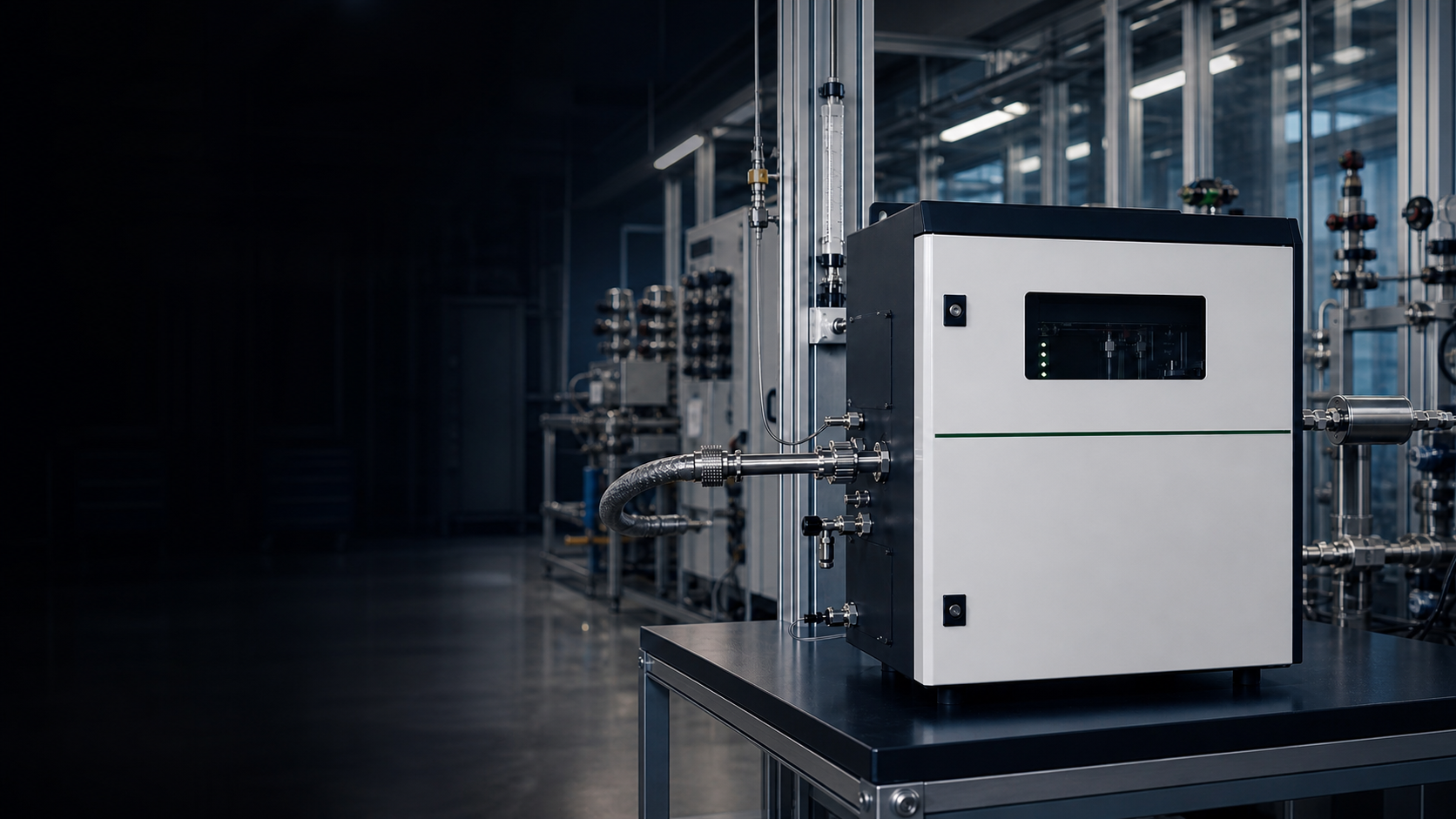 ZS8300-H2S
ZS8300-H2S Process H₂S Analyzer
In-situ cross-stack TDLAS analyzer for H₂S in process gas; measurement range configured per application.
In-situ cross-stack TDLAS H₂S process analyzer for Claus SRU feed / tail-gas, amine regenerator, and sour-water stripper duty.
ZS8100-O2ZS8100-O2 Process Oxygen Analyzer
High-accuracy paramagnetic O₂ measurement for process optimization.
Paramagnetic / zirconia process O₂ for fired-heater combustion control and regenerator air-balance.
ZS6200-CO/CO2ZS6200-CO/CO₂ Process NDIR Analyzer
Dual-channel NDIR for simultaneous CO and CO₂ measurement.
NDIR process CO / CO₂ analyzer for FCC regenerator, fired-heater stack, and combustion efficiency.
ZS8600-MGZS8600-MG Multi-Component Analyzer
Multi-pass TDLAS multi-component analyzer for simultaneous refinery process-gas composition tracking.
Multi-gas extractive process analyzer for combined hydrocarbon process stream composition tracking.
Regulatory Framework for Petroleum Refining
Standards that typically govern Petroleum Refining monitoring specifications. Per-SKU certification details are listed on each product page.
- US EPA 40 CFR Part 60 Subpart J / Ja — Standards of Performance for Petroleum Refineries (flare / fuel gas)
- US EPA 40 CFR Part 63 Subpart CC — NESHAP for Petroleum Refineries
- US EPA Method 25A / 25B — Total Gaseous Organic Concentration
- EU IED BAT — BREF for refining of mineral oil and gas (2015)
- API Standard 560 — Fired Heaters for General Refinery Service
- API Standard 521 — Pressure-relieving and Depressuring Systems (flare systems)
- API RP 932-B — Design, Materials, Fabrication, Operation, and Inspection Guidelines for Avoiding Environmental Cracking in Amine Units
Petroleum Refining Field Experience
Deployments and typical profiles from petroleum refining operations.
Typical Deployment — SRU Tail-Gas H₂S / SO₂ Ratio Control
Representative deployment profile on a Claus Sulfur Recovery Unit at a hydrotreater-heavy refinery. An in-situ cross-stack TDLAS H₂S analyzer paired with a UV-fluorescence SO₂ analyzer on the tail-gas enables closed-loop 2:1 H₂S:SO₂ ratio control, improving sulfur recovery and damping SO₂ stack excursions during feed swings.
Challenge
Sulfur Recovery Units run most efficiently when the Claus reaction 2 H₂S + SO₂ → 3 S + 2 H₂O receives feed at the stoichiometric 2:1 molar ratio. In practice, acid-gas feed composition swings with upstream hydrotreater duty, and without fast tail-gas analysis the ratio drifts — driving sulfur recovery efficiency down and producing SO₂ stack excursions that risk permit exceedance.
Solution
- In-situ cross-stack TDLAS for the H₂S measurement and a UV-fluorescence analyzer for SO₂ on the Claus tail-gas stream, matched for closed-loop ratio control
- Heated sample line above the acid-gas dew point to prevent condensation on the way from take-off to analyzer
- Ratio output tied back to the air/O₂-enrichment controller and the acid-gas splitter, enabling real-time closed-loop adjustment
- O₂ process analyzer on the Claus reactor air supply for combustion-control stoichiometry; ZS-SCS heated sample skid standard on this duty
Outcome
- Sulfur recovery efficiency improves toward design (typical plants recover 95–99.5 % with proper ratio control)
- Tail-gas SO₂ excursions during feed swings are shortened and shallower
- Sulfur product quality stabilises; bright-yellow colour spec is easier to hold
- Regulatory exceedance risk on the SRU stack drops as ratio control replaces open-loop operation
Cross-Links Into the Main Catalogue
Explore the broader GESHINE catalogue by gas type or measurement technology.
Gas Categories
Need Engineering Support Around This Project?
Beyond analyzer selection, GESHINE supports system design, site delivery, and lifecycle service for installations like this.
Petroleum Refining Gas Analysis FAQ
Questions commonly raised during procurement and specification for this industry.
Why is 2:1 H₂S:SO₂ the target on Claus tail-gas?
The Claus reaction 2 H₂S + SO₂ → 3 S + 2 H₂O runs at stoichiometric optimum when H₂S and SO₂ enter the catalytic converters at a 2:1 mole ratio. Drift in either direction drops sulfur recovery efficiency — too much H₂S leaves unconverted H₂S in tail-gas (odor, health, compliance); too much SO₂ leaves unreacted SO₂ and wastes oxidation capacity. Continuous in-situ cross-stack TDLAS H₂S measurement paired with a UV-fluorescence SO₂ analyzer on the tail-gas closes this loop in real time.
How is hydrogen purity measured on SMR + PSA product gas?
Thermal-conductivity (TCD) analyzers (ZS6300-H2 class) measure bulk H₂ %vol at product-gas outlet with ppm-level detection limit and multi-decade dynamic range. TCD handles the ≈99 % purity target directly; trace-grade sub-ppm impurity measurement — relevant for fuel-cell-grade hydrogen — needs laser-based (TDLAS) or chromatography paths and sits outside the bulk TCD scope.
Does flare-header THC monitoring require heated FID?
Under 40 CFR Part 60 Subpart Ja, yes — the flare vent-gas total-hydrocarbon measurement is a heated-line, heated-FID reference method. Cold sample paths strip heavier hydrocarbons and bias the reading low. A heated-FID total-hydrocarbon analyzer with heated extractive sampling above 180 °C, configured for the flare-header dynamic range, is the technology of record for this duty.
Is HF alkylation monitoring different from sulfuric alkylation?
Yes. HF alkylation uses anhydrous HF as the catalyst and requires both process HF measurement (for catalyst loading and conversion control) and perimeter HF safety monitoring (for personnel exposure). TDLAS HF (ZS8100-HF class) with heated Monel / PFA sampling is the process technology of record; fixed HF safety sensors plus UV-DOAS are additional perimeter layers. Sulfuric alkylation does not need HF analyzers but imposes its own mist / aerosol / sulfate-tracking chemistry outside this scope.
What is a tail gas analyzer, and what does it measure on a Claus sulfur recovery unit?
A tail gas analyzer is the continuous analyzer on the gas leaving a Claus sulfur recovery unit (SRU) — and, where fitted, the tail-gas treating unit (TGTU) — used to trim sulfur recovery and confirm emissions compliance. It measures the residual sulfur species (H₂S, SO₂) and supporting components so SRU air demand can be controlled; the classic Claus control target is a roughly 2:1 H₂S-to-SO₂ ratio. Technology is selected by where the analyzer sits and the stream condition: in-situ cross-stack TDLAS for H₂S and pulsed UV fluorescence or UV absorption for SO₂, with in-situ optics or heated-extractive sampling chosen for stream temperature and sulfur dew point. GESHINE covers SRU feed and tail-gas H₂S / SO₂ duty within the wider refining gas analysis scope, alongside fired-heater O₂ and flare-header monitoring.
How is refinery gas (fuel gas and process off-gas) analyzed?
Refinery gas — the mixed fuel-gas and process off-gas from FCC units, reformers, hydrotreaters, and the gas plant — is analyzed for both combustion control and safety. Full component speciation (H₂, C1–C4 hydrocarbons, H₂S, CO) for fuel-gas heating value and balance is a process-GC duty; GESHINE’s role is the dedicated component measurements that run continuously alongside it: H₂S for treating and corrosion, O₂ for fired-heater combustion, and CO / CO₂ for efficiency. Where one delivered system must combine continuous component analysis with GC composition, that is scoped as a partner-GC integration. The refining industry solutions map these measurements unit by unit.
Don’t see your scenario? Send the plant, duty, and regulatory framework and application engineering will respond within 48 hours.
Scope a Refining Gas Analysis Project
Share the unit (SRU, SMR / PSA, alkylation, FCC regenerator, hydrotreater / hydrocracker, flare, fired heater, amine regenerator), the target gas, the concentration envelope, and the regulatory framework (EPA Part 60 Subpart J / Ja, Part 63 CC, EU IED BAT). GESHINE application engineers will scope the analyzer stack and sampling skid and return an RFQ within 48 hours.
- Plant type and process unit (Petroleum Refining)
- Target species and concentration envelope
- Regulatory framework (see standards list above)
- CEMS vs process duty / safety path
- Sample conditioning envelope (temperature, dust, dew point, corrosives)
- Quantity, project timeline, and integration partner

Petroleum Refining Application Consultation
Application engineering will scope the analyzer stack, sampling skid, and certification pathway for your petroleum refining duty.