
Semiconductor Gas Analysis Solutions
CVD / etch chamber exhaust (HCl / HF / Cl₂ / SiH₄), high-purity process gas QA, N₂O diffusion furnace, high-purity H₂ carrier, and cleanroom moisture monitoring.
Primary buyer: Facilities / gas delivery engineer + CVD / etch process engineer + EHS / abatement lead
How Semiconductor & Electronics Buyers Think About Gas Analysis
Semiconductor fabs deploy gas analysis across three distinct problem sets: process-tool exhaust scrubber inlet / outlet verification for toxic CVD / etch species (HCl / HF / Cl₂ / SiH₄ by-products), high-purity process-gas quality at the bulk-specialty-gas yard and tool-of-record hookup, and cleanroom / sub-fab moisture / trace-impurity monitoring. The technology mix leans hard on TDLAS for corrosive process gases, TCD for bulk hydrogen, and tunable-diode moisture analyzers; most buyers specify heated sample paths and high-purity materials (electropolished 316L VAR, nickel, or PFA).
Industry Challenges
- CVD and etch chamber exhaust HCl / HF / Cl₂ / SiCl₄ / SiH₄ by-product monitoring at scrubber inlet and outlet for abatement efficiency verification
- N₂O diffusion / LPCVD furnace process gas qualification and off-gas monitoring
- High-purity hydrogen carrier gas (epitaxy, annealing) purity verification at ppb impurity level
- Bulk / specialty gas yard (N₂, He, Ar, Cl₂, NH₃) incoming and distribution quality QA
- Cleanroom and sub-fab moisture (H₂O), O₂, CO₂ monitoring for ISO 14644 Class 1–10 specification
- Perimeter toxic-gas detection (HCl / HF / Cl₂) at gas-cabinet, valve-manifold-box, and fab-perimeter locations
Key Gases for Semiconductor & Electronics
Tap any gas to see the analyzer family, technology options, and selection guide for that measurement target.
HCl
Hydrogen Chloride
CVD chamber by-product and scrubber-inlet / outlet abatement verification — TDLAS with heated Hastelloy sampling.
View HCl analyzersHF
Hydrogen Fluoride
Wet-etch and CVD exhaust, gas-cabinet perimeter leak detection — TDLAS with Monel / PFA sampling.
View HF analyzersCl₂
Chlorine
Etch chamber exhaust scrubber verification and bulk Cl₂ distribution QA — UV-DOAS primary technology.
View Chlorine analyzersN₂O
Nitrous Oxide
Diffusion / LPCVD furnace process gas and off-gas abatement — GFC infrared primary technology.
View Nitrous Oxide analyzersH₂
Hydrogen
Epitaxy / anneal carrier gas purity and gas-cabinet LEL safety — bulk %vol via TCD for process, catalytic bead for safety.
View Hydrogen analyzersH₂O
Moisture
Ultra-high-purity process gas and cleanroom moisture QA at ppb level — TDLAS / CRDS technologies.
View Moisture analyzersSKUs for Semiconductor & Electronics Duty
Analyzers frequently selected for semiconductor & electronics duty — chosen for the gases, process conditions, and purity targets typical of this vertical.
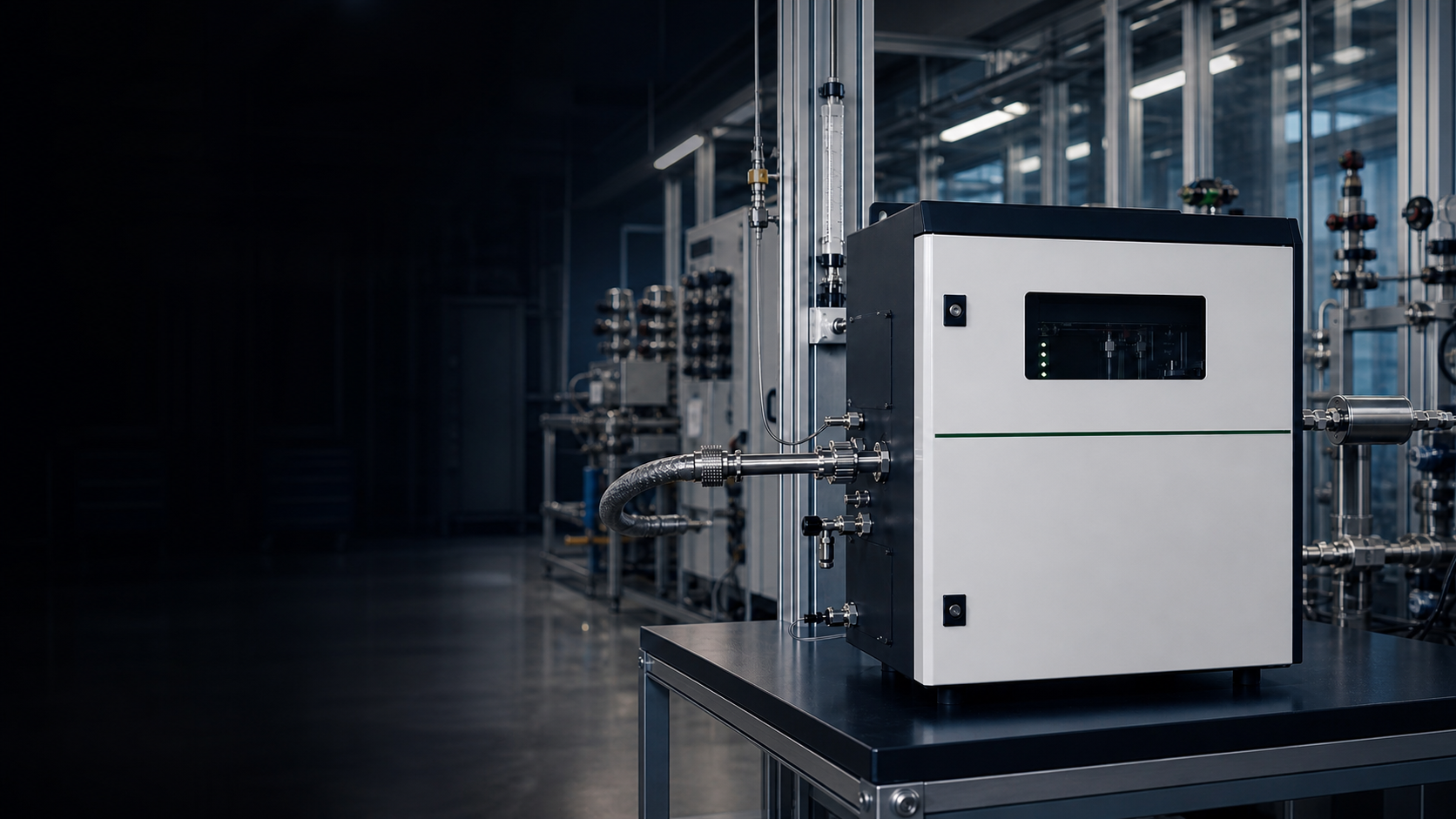 ZS8100-HCl
ZS8100-HCl Process Hydrogen Chloride Analyzer
TDLAS analyzer for ppm-level HCl in CVD / etch chamber exhaust and scrubber abatement verification.
TDLAS HCl process and abatement-scrubber analyzer with heated Hastelloy sampling for CVD exhaust and gas-cabinet perimeter.
ZS8100-HFZS8100-HF Process Hydrogen Fluoride Analyzer
TDLAS analyzer for low-ppm HF in wet-etch / CVD exhaust with Monel / PFA sampling.
TDLAS HF process analyzer with heated Monel / PFA sampling for wet-etch / CVD exhaust abatement.
ZS-UVDOAS-CL2Process Chlorine Analyzer
UV-DOAS analyzer for gas-phase Cl₂ in etch chamber exhaust and bulk Cl₂ distribution QA.
UV-DOAS chlorine analyzer for etch chamber exhaust scrubber verification and bulk Cl₂ distribution QA.
ZS8100-H2OProcess Moisture Analyzer
TDLAS analyzer for low-ppm to ppb H₂O in high-purity process gas and cleanroom QA.
Moisture analyzer for high-purity process gas and cleanroom H₂O QA at low-ppm to ppb range.
ZS6300-H2ZS6300-H2 Process Hydrogen Analyzer
TCD analyzer for bulk %vol H₂ purity in epitaxy / anneal carrier gas.
TCD hydrogen analyzer for bulk epitaxy / anneal carrier gas %vol purity (process path; safety %LEL via separate catalytic-bead SKUs).
Regulatory Framework for Semiconductor & Electronics
Standards that typically govern semiconductor & electronics monitoring specifications. Per-SKU certification details are listed on each product page.
- SEMI S2 — Environmental, Health, and Safety Guideline for Semiconductor Manufacturing Equipment
- SEMI F57 — Provisions for Ultra-Pure Water and Ultra-Pure Chemical Distribution Systems
- ISO 14644 — Cleanrooms and Associated Controlled Environments (Class 1–10 specification)
- ISO 14698 — Cleanrooms Biocontamination Control
- SEMI C3.29 / C3.44 — Standards for Specialty Gases (HCl, HF, NH₃ purity)
- Compressed Gas Association (CGA) G-series commodity specifications for bulk industrial gases
- US OSHA 29 CFR 1910.1200 / SEMICONDUCTOR NESHAP where applicable
Semiconductor & Electronics Field Experience
Deployments and typical profiles from semiconductor fab operations.
Typical Deployment — 300 mm Fab CVD Scrubber-Outlet HCl / HF Monitoring
Representative deployment profile on a 300 mm logic fab. A TDLAS-based HCl + HF exhaust monitor on the CVD wet-scrubber outlet provides continuous abatement-efficiency verification, replacing a quarterly draeger-tube audit workflow and establishing a continuous performance baseline under SEMI S2.
Challenge
CVD process exhaust routes HCl and HF through a wet scrubber before release. Regulatory and EHS governance requires quantitative proof that the scrubber is achieving its design efficiency continuously, not just during quarterly audits. Draeger-tube spot checks miss transient excursions during chamber cleans or scrubber chemistry swings, and fluoride species are quickly lost in standard stainless sampling hardware.
Solution
- TDLAS HCl analyzer (ZS8100-HCl class) and TDLAS HF analyzer (ZS8100-HF class) on the wet-scrubber outlet, each with its own heated sample loop to preserve acid-gas integrity
- Monel 400 wetted parts with PFA internal tubing on the HF line to prevent fluoride attack on chromium in stainless steel
- Heated sample line held 130–180 °C above the HF dew point from probe tip to analyzer inlet
- Continuous data stream fed into the fab EHS system for SEMI S2 performance baseline and deviation alarms
Outcome
- Abatement-efficiency verification moves from quarterly spot check to continuous confirmation
- Transient excursions during chamber-clean cycles become visible and actionable
- SEMI S2 documentation package gains continuous-measurement evidence rather than draeger-tube records
- Fluoride-specific sampling-material discipline is documented and auditable across equipment qualification
Cross-Links Into the Main Catalogue
Explore the broader GESHINE catalogue by gas type or measurement technology.
Gas Categories
Need Engineering Support Around This Project?
Beyond analyzer selection, GESHINE supports system design, site delivery, and lifecycle service for installations like this.
Semiconductor & Electronics Gas Analysis FAQ
Questions commonly raised during procurement and specification for this industry.
What materials are mandatory for HF sampling in fab exhaust?
HF wet-etch and CVD exhaust requires Monel 400 (or nickel alloys) on all wetted parts with PFA internal tubing. Stainless steel is unacceptable — fluoride ion attacks chromium and produces volatile CrF₂ that both fails the material and contaminates the sample. The heated sample line must run above the HF dew point (typically 130–180 °C depending on water content) from probe tip to analyzer inlet. ZS8100-HF is specified with these defaults.
How do TDLAS analyzers handle the high-purity process gas requirements?
TDLAS analyzers read through a closed optical path without the sample ever contacting consumable reagents or membranes, which preserves purity. For ppb-range H₂O, O₂, or trace impurity monitoring in high-purity specialty gases, the analyzer body typically uses electropolished 316L VAR or nickel wetted parts and all-metal valve seats. The spectroscopy itself does not consume or contaminate the sample — a key advantage over electrochemical or paramagnetic alternatives.
Is GFC the right technology for semiconductor N₂O?
Yes for diffusion / LPCVD furnace process gas monitoring and for post-abatement off-gas. GFC (ZS6500-N2O class) self-references against H₂O and CO₂ matrix drift at the 4.5 μm N₂O fingerprint, which handles wet scrubber outlets cleanly. For sub-ppb audit-grade N₂O (rare in fabs but possible in R&D contexts) the route is TDLAS or CRDS, not GFC.
Can the same analyzer cover process and safety duty in a fab?
Usually not. Process analyzers (TDLAS, GFC, UV-DOAS) target ppm to %vol accuracy on a specific stream; safety detectors (electrochemical cells, catalytic-bead, IR point) target %LEL or TLV-level alarm response with multi-point coverage. Fabs normally run both with separate network, calibration, and SIL discipline. GESHINE publishes these as separate product families — process analyzers under the gas-specific categories and safety / LEL detectors under combustible-gas-detectors.
Don’t see your scenario? Send the plant, duty, and regulatory framework and application engineering will respond within 48 hours.
Scope a Semiconductor Gas Analysis Project
Share the duty (CVD / etch exhaust abatement verification, diffusion furnace, bulk / specialty gas QA, cleanroom moisture, high-purity carrier gas, or perimeter safety), the target species, the concentration envelope (ppb to %vol), and the materials / purity requirements (electropolished 316L VAR, nickel, PFA). GESHINE application engineers will scope the analyzer stack and sampling architecture and return an RFQ within 48 hours.
- Fab area and process unit (Semiconductor & Electronics)
- Target species and concentration envelope
- Regulatory framework (see standards list above)
- Abatement-verification / process vs safety duty path
- Sampling / materials envelope (heated path, dew point, high-purity wetted parts)
- Quantity, project timeline, and integration partner
Semiconductor & Electronics Application Consultation
Application engineering will scope the analyzer stack, sampling architecture, and materials pathway for your semiconductor & electronics duty.