
SO₂ & NOₓ Analyzers — UV-DOAS, UV-Fluorescence and Chemiluminescence CEMS & Process Solutions
SO₂ and NOₓ measurement configurations scoped for CEMS compliance and process control.
Two GESHINE paths cover sulfur dioxide and nitrogen oxide measurement. ZS-CEMS-200 packages a UV-DOAS SO₂ channel and a CLD NOₓ channel into a CEMS cabinet — engineered to EN 15267-3 QAL1 scope — for regulated stack reporting. A dual-platform process package — UV-Fluorescence SO₂ on ZS6200-SO2 and CLD NO/NOₓ on ZS6100-NOx — covers fast-response FGD and SCR loop control. Portable electrochemical spot-checking is an industry screening method, not a GESHINE product path. EPA 40 CFR Part 60/75, EN 14181 QA workflow, and HJ 75/HJ 76 project alignment are reviewed per project and confirmed against the selected analyzer package.
Why Traditional SO₂/NOₓ Monitoring Fails — and Why UV-DOAS + CLD Took Over
A stack that cannot hold its SO₂ or NOₓ channel through an EN 14181 AST cycle is not a hardware problem — it is a reporting-availability problem. Wet-chemistry legacy analyzers (DPD colorimetry, iodometric titration, pararosaniline) drift between reagent batches, require documented consumable chemicals traceability that most plants lost the appetite for ten years ago, and cannot meet the <1.5 percent of certified range uncertainty that QAL1 type-testing penalises. When the AST surveillance test fails, the QAL2 window re-opens, the reference-method engagement gets scheduled, and on Acid Rain Program stacks the EPA 40 CFR Part 75 allowance-tracking clock keeps ticking on provisional values that may or may not hold up. The hardware was rarely the expensive line item; the audit re-open is.
On the process-control side the failure mode is different and often invisible. A flue-gas desulfurization reagent dose that is tuned against an SO₂ reading with a 30-second transport lag chases its own tail — limestone slurry can be over-dosed, operators compensate by tightening the deadband, and the avoidable reagent cost should be quantified from site baseline load, reagent price, slurry quality, and control-loop records rather than quoted as a fixed percentage — and nobody sees the analyzer as the root cause. On SCR/DeNOₓ loops the same lag lets NOₓ slip rise and NH₃ slip spike as the catalyst ages, because the control system is steering off a stale signal. Sulfur recovery unit Claus tail gas is the most punishing case — a 30-60 second response time means the incinerator runs rich or lean for a full reaction cycle before the DCS corrects. Real-time means sub-5-second response in practice, not a marketing phrase.
Portable spot-checking is the third failure case. An environmental consultant carrying a hand-held electrochemical analyzer through a client site for pre-compliance screening produces useful directional data — where a site is clearly in limits or clearly over — but the same instrument in the hands of a client who reads “SO₂ 180 ppm” as a Part 75 reportable number is a regulatory exposure. Portable electrochemical analyzers, as a method class, are screening and diagnostic instruments and not a QAL2 or EPA Method 7E reference-method substitute. Buyers who treat a portable reading as a compliance datum discover the gap during an audit, not before. The remedy in all three cases is the same: separate the screening method from the process tool from the compliance tool, and scope each to what it is actually qualified for.
What a Wrong SO₂/NOₓ Reading Actually Costs
AST Drift Risk
A SO₂ or NOₓ CEMS channel that misses its weekly automated span check trends toward QAL2 failure. A failed AST or invalid CEMS period can create material retesting, reporting-correction, substituted-data, and temporary-compliance workload. The cost exposure is jurisdiction-, permit-, and allowance-market-dependent and should be quantified from the site’s own QA history.
CLD Converter Unmonitored
Chemiluminescence NOₓ measurement depends on a NO₂-to-NO thermal or molybdenum converter whose efficiency decays with use. An analyzer that does not document converter efficiency at AST produces a regulation-compliant NO reading and a silently drifting NOₓ reading — the hardest-to-detect CEMS failure mode.
Wet-Chemistry Reagent OPEX
Wet-chemistry programs can create recurring reagent, labor, waste-handling, and maintenance cost that should be compared against analyzer, sampling-system, and QA lifecycle cost for the specific number of stacks. UV-DOAS and CLD use no wet-chemistry reagents — the consumables are UV lamps (5000 hr) and CLD ozone generator service, not reagent chemicals.
UV-DOAS vs Pulsed UV Fluorescence vs Chemiluminescence vs Electrochemical
Four technologies share the industrial SO₂ and NOₓ market, and two of them both invoke the word “UV” — which is the single most common source of specification confusion on this page. UV-DOAS and UV Fluorescence measure SO₂ through entirely different optical paths: UV-DOAS fits a differential absorption spectrum, UV Fluorescence counts emitted fluorescence photons. Chemiluminescence (CLD) is the default NOₓ technology across both certified and process duty. Electrochemical (EC) is screening-only and explicitly not a compliance reference method. The table below reports real-world envelopes so engineers can match the correct technology to drift tolerance, response-time budget, regulatory scope and sample-matrix cleanliness, rather than treating “UV” or “electrochemical” as undifferentiated category labels.
| Technology | Primary Analyte | Principle | Range | T90 | Best For / Limitations |
|---|---|---|---|---|---|
| UV-DOAS (Differential Optical Absorption Spectroscopy) | SO₂ + NOₓ (single spectrometer) | Broadband 200–300 nm UV through sample cell; DOAS algorithm fits differential absorption to high-resolution reference cross-section — extracts concentration from spectral shape, removes broadband interferents mathematically. | 0–3000 mg/m³ SO₂ · 0–1500 mg/m³ NOₓ | Confirmed in the delivered datasheet | Certified CEMS duty — EN 14181 QAL1, EPA 40 CFR Part 60/75 Acid Rain, HJ 76-2017 reporting. GESHINE’s QAL1-scoped SO₂ path on ZS-CEMS-200. Requires heated sampling (ZS-SCS-800) on wet stacks to prevent window fouling. |
| Pulsed UV Fluorescence | SO₂ (NOₓ companion via CLD) | In a typical pulsed-UVF implementation, pulsed UV (≈214 nm) excites SO₂; emitted fluorescence at longer wavelengths (≈240–410 nm) is counted behind an instrument-specific bandpass filter — fast single-wavelength measurement with water-vapour and aromatic-HC quench correction. Excitation and detection bands vary by lamp, filter and optical design. | Configured per application | Confirmed in the delivered datasheet | Process control — FGD reagent dosing, SCR/SNCR optimisation, SRU Claus tail-gas closed-loop. GESHINE’s process SO₂ channel on the ZS6200-SO2 platform, paired with the CLD ZS6100-NOx for NOₓ. Fast response is the reason to pick this over UV-DOAS. Not a CEMS reference method; fluorescence quench correction under changing matrix is harder to certify than UV-DOAS under QAL1. |
| Chemiluminescence (CLD) | NOₓ (NO + NO₂ via converter) | Internal ozone generator; NO + O₃ → NO₂* → hν photon counted by photomultiplier. A thermal converter reduces NO₂ → NO so the instrument measures NO + NO₂ as NOₓ — molybdenum catalytic converters often operate around 300–350 °C, while stainless-steel and other converter designs use their own specified conditions. | Configured per application | Confirmed in the delivered datasheet | The default NOₓ technology across both certified and process duty — used on the ZS-CEMS-200 cabinet and as the CLD NOₓ channel (ZS6100-NOx) in the dual-platform process package. Converter efficiency must be documented at AST; ozone generator is a service item (typical service life confirmed in the delivered datasheet). Low cross-interference with heated sampling (ZS-SCS-800). |
| Electrochemical (EC) — generic industry method example, not a GESHINE product | SO₂ + NOₓ (dual sensor) | Diffusion-limited redox reaction at catalyst electrode; output current proportional to analyte partial pressure. Dual-sensor head carries one SO₂ cell and one NO + NO₂ cell; temperature compensation via internal thermistor. | Generic method example — instrument-dependent | Generic method example — instrument-dependent | Portable screening and diagnostic duty only — compliance pre-screening, boiler commissioning, environmental consulting spot checks. Sensor cartridges are consumables with instrument-dependent service life. Explicitly not a QAL2 or EPA Method 7E reference-method substitute, and not a GESHINE product path on this page. |
When to Select Which
When to select which: UV-DOAS is GESHINE’s QAL1-scoped SO₂ path on ZS-CEMS-200 and a strong fit where spectral deconvolution, wet-stack matrix review, and long-term drift control matter. Do not present it as the universally preferred SO₂ technology for every regulated CEMS; UV fluorescence, NDIR/NDIR-GFC, FTIR, and other certified AMS architectures can also appear in regulated programmes. UV fluorescence is the right GESHINE process-control pick where response time matters more than certification — FGD reagent dosing, SCR inlet optimisation, and SRU Claus tail-gas closed-loop control — because fast T90 with ppm-level detection lets the DCS steer before the excursion reaches the stack, which is why the SO₂ process channel sits on the ZS6200-SO2 platform. Chemiluminescence handles NOₓ on both the ZS-CEMS-200 cabinet and the ZS6100-NOx process platform, with converter efficiency verified under the applicable commissioning, AST, or EPA Method 7E workflow. Electrochemical remains a portable diagnostic and pre-screening method only; it is not a Part 75 reportable datum or a QAL2 / Method 7E substitute, and it is not a GESHINE product path on this page.
Having distinguished the four technologies, the next block walks through how each of them physically extracts a SO₂ or NOₓ concentration from a real stack or process sample.
How UV-DOAS, UV Fluorescence and CLD Measure SO₂ & NOₓ (Working Principle)
Every SO₂/NOₓ reading on this page — a certified CEMS record, a process-control trim signal or a portable spot check — comes out of one of the measurement paths below. The five blocks trace how each technology physically extracts a SO₂ or NOₓ concentration from a real, hot, wet stack or process sample, and where the compensation that keeps the reading honest is applied.
UV Differential Optical Absorption (UV-DOAS) — SO₂ CEMS Channel
A broadband UV source between 200–300 nm passes through the sample cell and onto a spectrometer. SO₂ presents a structured absorption band in this region; the DOAS algorithm fits the measured differential absorption against a high-resolution SO₂ reference cross-section and extracts concentration from the spectral shape rather than a single-wavelength intensity. This removes broadband interferents (turbidity, source aging, window fouling) mathematically and is the reason UV-DOAS is GESHINE’s QAL1-scoped SO₂ path on the ZS-CEMS-200. On the ZS-CEMS-200, UV-DOAS handles the SO₂ channel and is packaged with the CLD NOₓ channel in one CEMS cabinet, with the applicable certified documentation confirmed per project.
Pulsed UV Fluorescence — SO₂ Process Channel
In a typical pulsed-UVF implementation, a pulsed UV lamp excites SO₂ molecules in the sample cell around 214 nm; the excited SO₂ relaxes by emitting fluorescence photons at longer wavelengths (typically 240–410 nm), which a photodiode behind an instrument-specific bandpass filter counts — excitation and detection bands vary by lamp, filter and optical design. Fluorescence intensity is proportional to SO₂ partial pressure after water-vapour and aromatic-hydrocarbon quench correction. The measurement is fast because it does not require a spectral fit, and is the correct pick for closed-loop FGD and SRU process control on the ZS6200-SO2 platform (paired with the CLD ZS6100-NOx for the NOₓ channel). It is not a CEMS reference method — fluorescence quenching correction under changing matrix is harder to certify than UV-DOAS under QAL1.
Chemiluminescence (CLD) — NOₓ on Both CEMS and Process, Electrochemical for Portable Screening
CLD generates ozone (O₃) internally from a silent-discharge ozone generator and mixes it with the NO in the sample; the NO + O₃ reaction produces electronically excited NO₂* which relaxes by emitting a photon (hν) that a photomultiplier counts. For NOₓ, a molybdenum or stainless-steel thermal converter reduces NO₂ to NO upstream of the reaction cell — molybdenum catalytic converters often operate around 300–350 °C, while other converter designs use their own specified conditions — so the instrument measures NO + NO₂ as NOₓ via thermal converter, and converter efficiency must be documented at AST. CLD is the NOₓ channel on both the ZS-CEMS-200 cabinet and the ZS6100-NOx process platform. Electrochemical (EC) cells used in portable hand-helds rely on a diffusion-limited redox reaction at a catalyst electrode; output current is proportional to analyte partial pressure. EC is a diagnostic and screening method, not a reference method — sensor cartridges are consumables and the method is explicitly scoped out of QAL2 / EPA Method 7E reference-method duty.
SO₂ Detection — UV-DOAS vs Pulsed UV Fluorescence
Choosing between the two SO₂ methods comes down to whether the channel is a compliance datum or a control loop. UV-DOAS is the QAL1-scoped pick on this page: its spectral fit holds QAL1 uncertainty across the EN 14181 AST interval and rejects window fouling and source drift mathematically, so it is the SO₂ channel on the ZS-CEMS-200 for QAL2 and EPA Method 6C duty in a hot, wet, CO₂-rich flue matrix — for SO₂ QA, reference EPA Method 6C where the applicable US rule invokes it; EPA Method 7E is the NOₓ method. Pulsed UV fluorescence is the process pick: faster response (T90 project-specific) for closed-loop FGD and sulfur-recovery control on the ZS6200-SO2 platform, accepting that fluorescence quench correction in a changing water-rich matrix is harder to certify. A common stack runs both — UV-DOAS in the CEMS cabinet and pulsed UV fluorescence in the control-room loop — each doing what it is qualified for.
NOₓ Detection — CLD, Converter Efficiency and the NO + NO₂ Math
NOₓ detection rests on three facts. First, the regulated number is NO + NO₂ reported as NO₂, so the channel must capture both species, not NO alone. Second, chemiluminescence (CLD) sees only NO, so a thermal converter at project-specific temperature reduces NO₂ to NO upstream of the cell — making converter efficiency a documented, AST-verified parameter under EN 14792 and EPA Method 7E rather than a hidden assumption. Third, placement matters: NOₓ measured at the SCR outlet pairs with an upstream NOₓ reference and an NH₃-slip channel to close the DeNOₓ control loop, because the catalyst face is where reduction efficiency and ammonia slip both appear. CLD on the ZS-CEMS-200 cabinet and the ZS6100-NOx process platform supports converter-efficiency verification during commissioning and AST support; confirm whether a factory or site acceptance report is included in the delivered project document pack. Portable electrochemical hand-helds use a dual NO/NO₂ EC cell and need no converter, but remain a screening method rather than a GESHINE product path.
CEMS Rack vs Process Analyzer vs Portable Checker
UV-DOAS + CLD Reporting Rack
Complete ZS-CEMS-200 rack with UV-DOAS for SO₂ and chemiluminescence for NOₓ + auxiliary O₂, dust, flow modules. EN 14181 QAL1 and EPA PS-2 documentation (with Appendix F / Part 75 QA where applicable) is scoped against the selected project package.
Heated probe + heated transfer line above acid dew point, particulate filter, optional dilution probe for high-load coal-fired plants. Daily automatic zero check with instrument-grade N₂ and weekly span verification with certified SO₂/NOₓ reference gas via the internal solenoid manifold.
- Coal/gas-fired power plant CEMS for IED/LCPD compliance
- Cement / steel / waste-to-energy emission reporting
- FGD outlet reporting & SCR slip closure
UV-Fluorescence + CLD (Process)
Fast-response process analyzer for FGD reagent control and SCR ammonia-injection optimization. UV-Fluorescence on SO₂ gives sub-5-second T90, CLD on NOₓ.
Heated probe + heated line, coalescing filter, ammonia scrubber if NH₃ slip in matrix. Sample conditioning shared with parent CEMS rack when adjacent.
- Closed-loop FGD limestone slurry dosing control
- SCR / SNCR ammonia-injection optimization
- Refinery sulfur recovery unit (SRU) gas analysis
Electrochemical Handheld
Battery-powered handheld for rapid emission spot checks, compliance verification audits, and maintenance diagnostics. Built-in thermocouple input, EC sensor cartridges, SD card data logging.
Built-in pump draws sample via stainless probe (with optional water trap) from stack port. Manual cool-down via integrated peltier or air-cooler.
- QAL2 audit field cross-check vs fixed CEMS
- Combustion tune-up & small boiler / engine surveys
- Source-test preparation / compliance spot checks
Portable EC checker: lowest entry cost. Replacement sensor cartridges drive 1-year OPEX.
Process UV-F + CLD: higher upfront for fast-response process control; can pay back through reduced FGD reagent overfeed — quantify from site baseline records.
CEMS UV-DOAS rack: highest upfront cost but documentation and commissioning cost amortized across compliance lifecycle — favorable 5-year cost per reporting-duty hour.
SO₂/NOₓ Analyzer Selection by Compliance, Speed and Cross-Interferent
Three questions narrow most SO₂/NOₓ specs: is it regulated CEMS reporting, process control, or audit spot-check; what is the matrix moisture / NH₃ slip context; and which jurisdiction’s reference method applies.
CEMS Reporting vs Process Control — Different Duties
Regulated CEMS reporting (EN 14181 QA workflow, EPA PS-2 / Appendix F / Part 75 where applicable, and HJ 75/HJ 76 in China) should be scoped through the ZS-CEMS-200 UV-DOAS + CLD rack with the applicable documentation package confirmed per project. Process control around FGD or SCR closed loops needs faster T90 than CEMS allows, so the dual-platform process package — UV-Fluorescence SO₂ on ZS6200-SO2 plus CLD NOₓ on ZS6100-NOx — is the fit there. Don’t conflate the two: a CEMS analyzer optimizes for reporting documentation, not control speed.
NH₃ Slip and the CLD Converter Problem
CLD measures NOₓ by reducing NO₂ to NO in a heated converter, then measuring NO chemiluminescence. With heavy SCR ammonia slip, NH₃ in the matrix can oxidize on the converter surface and convert partially to NO, inflating the apparent NOₓ reading. Mitigations: pre-converter ammonia scrubber, hot-vs-cold converter comparison method, or — where converter integrity becomes a recurring maintenance issue — a separate project-specific engineering review.
Reference Method by Jurisdiction
EU IED / LCPD compliance: EN 14181 QAL1/QAL2/AST surveillance using analyzers with confirmed QAL documentation (UV-DOAS for SO₂, CLD for NOₓ). US 40 CFR Part 60: PS-2 for SO₂ and NOₓ CEMS, with reference Method 6C / Method 7E and Appendix F QA where invoked. China: HJ 75-2017 for installation, operation, QA, and data handling; HJ 76-2017 for CEMS technical requirements and test procedures; GB/T 16157 and local requirements may also apply to stationary-source sampling. Specify the analyzer to match the reference framework before procurement — an EN 14181-scoped unit is not automatically EPA PS-2 compliant.
Need a guided pick? The interactive gas selector walks persona, regulatory target, analyte priority and form factor in a few questions — open the SO₂/NOₓ selector in the Tools hub. The side-by-side specification matrix below compares all three models on every dimension that usually settles the selection conversation.
ZS-CEMS-200 vs ZS6200-SO2 / ZS6100-NOx — Side-by-Side
Two GESHINE SO₂/NOₓ paths serve different regulatory envelopes, and the right choice is a function of what the data has to prove. The ZS-CEMS-200 is the CEMS cabinet — engineered to EN 15267-3 QAL1 scope — that goes into the stack CEMS shelter and generates the auditable EN 14181 record for EU IED, EPA 40 CFR Part 60/75 Acid Rain and HJ 76-2017 reporting. The dual-platform process package — UV-Fluorescence SO₂ on ZS6200-SO2 and CLD NO/NOₓ on ZS6100-NOx — sits in the FGD or SCR control room, takes the DCS input, and closes the reagent-dosing or catalyst-control loop with fast response. Portable electrochemical hand-helds remain a separate industry screening method for pre-compliance spot-checks and commissioning diagnostics, not a GESHINE product path. Specific ranges, response times, I/O and certification status are configured per application and confirmed in the delivered datasheet; the matrix below compares the dimensions that usually settle the selection conversation.
| Parameter | ZS-CEMS-200 | ZS6200-SO2 / ZS6100-NOx | Portable EC screening (industry method) |
|---|---|---|---|
| Path Type | CEMS cabinet (EN 15267-3 QAL1 scope), climate-controlled enclosure | Dual-platform process package (two analyzers, one duty) | Portable hand-held, screening method — not a GESHINE product |
| SO₂ Technology | UV-DOAS (differential absorption spectroscopy) | Pulsed UV Fluorescence (ZS6200-SO2) | Electrochemical (dual diffusion cell) |
| NOₓ Technology | Chemiluminescence (CLD) with thermal converter | Chemiluminescence (CLD) on ZS6100-NOx | Electrochemical (NO + NO₂ cell) |
| SO₂ / NOₓ Range | Configured per application; QAL1 certified range confirmed in the delivered datasheet | Configured per application; process ranges confirmed in the delivered datasheet | Screening-grade range, instrument-dependent |
| Response T90 | CEMS-grade spectral-fit response, configured per application | Fast process response for closed-loop control, configured per application | Diffusion-limited, slower than optical methods |
| Sample Handling | Heated extractive via ZS-SCS-800 sampling skid | Heated wetted parts; integrated sample conditioning per platform | Internal pump; probe + thermocouple |
| Outputs / Integration | 4–20 mA · Modbus · OPC-UA · integrated DAHS; configured per project | 4–20 mA · Modbus · HART; relay outputs configured per platform | On-device data logging / export |
| Certification Scope | QAL1 / EN 15267-3 / EPA Part 60/75 / HJ 76 review — confirmed per project | CE / EMC and safety scope per platform; not a regulated CEMS reference instrument | Not a QAL2 or EPA Method 7E reference method |
| Typical Use | Regulated CEMS reporting — coal-fired power plant, WTE incinerator, cement kiln stack, Acid Rain Program reporting | FGD control loop, SCR/SNCR optimisation, SRU Claus tail gas, refinery process heaters | Compliance pre-screening, boiler commissioning, environmental audits — NOT a reference method |
| Sampling-Skid Dependency | Requires ZS-SCS-800 heated sampling skid — a substantial separate line item whose cost depends on stack distance, heat-trace length, moisture, dust load and cabinet scope | Heated wetted parts built-in; optional ZS-SCS-800 for high-moisture Claus tail gas | Standalone probe and thermocouple |
The matrix narrows the choice in principle. The product cards below pull in the full datasheet record — certifications, I/O options, dimensions, downloads — so procurement can move from selection to specification without another round of datasheet hunting.
GESHINE SO₂ & NOₓ Analyzer Series
Two paths — CEMS reporting cabinet (engineered to EN 15267-3 QAL1 scope) + dual-platform fast-response process package.
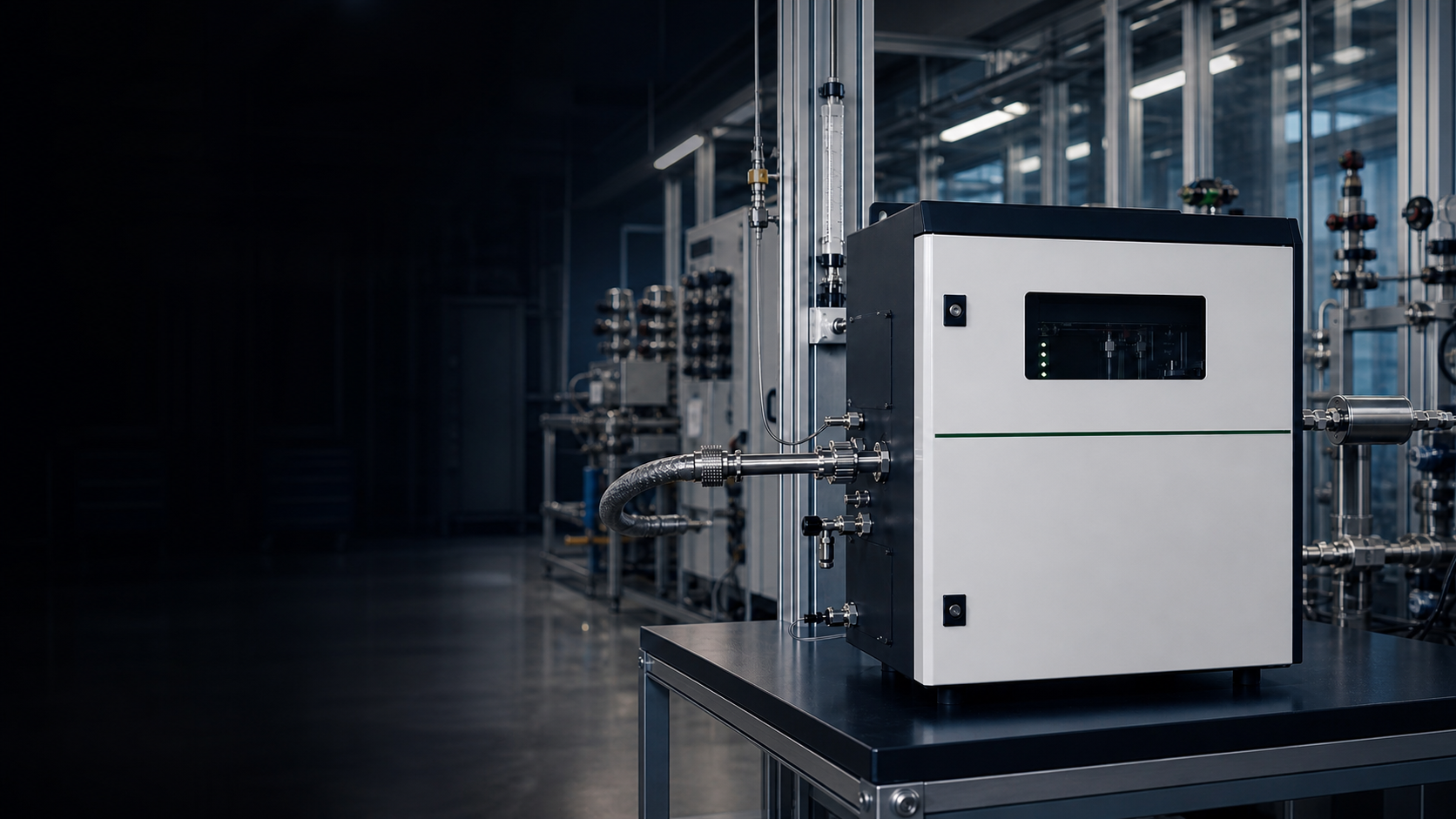 CEMS System
ZS-CEMS-200 · UV-DOAS / CLD
ZS-CEMS-200 CEMS SO₂/NOₓ Analyzer
CEMS cabinet (EN 15267-3 QAL1 scope) — UV-DOAS SO₂ channel and CLD NOₓ channel for continuous compliance reporting.
- SO₂ Channel
- UV-DOAS
- NOₓ Channel
- CLD
- Ranges
- Per application
- Docs
- QAL path review
Process PackageZS6200-SO2 / ZS6100-NOx · UVF + CLD
ZS6200-SO2 / ZS6100-NOx Process Package
Dual-platform process duty — UV-Fluorescence SO₂ on ZS6200-SO2 plus CLD NO/NOₓ on ZS6100-NOx for FGD and SCR loop control.
- SO₂ Platform
- ZS6200-SO2 (UVF)
- NOₓ Platform
- ZS6100-NOx (CLD)
- Duty
- Process control
- Ranges
- Per application
Where UV-DOAS, Pulsed UV Fluorescence and CLD SO₂/NOₓ Matter
SO₂ and NOₓ surface across heavy industry either as a regulated emission, a process-control feedback signal, or a pre-compliance screening result — and the engineering brief rarely matches cleanly across two sites. The six cards below are segmented by application, not by industry, because the regulatory driver (Part 60 vs Part 75 vs IED vs MOEFCC), the dominant analyte (SO₂-first on FGD outlet, NOₓ-first on SCR outlet), the sample matrix (wet, dusty, high-moisture Claus tail gas) and the response-time budget all change with what the analyzer is physically watching. Where an application sits on the boundary between two cards, engineering review with a site-specific sample is the honest answer.
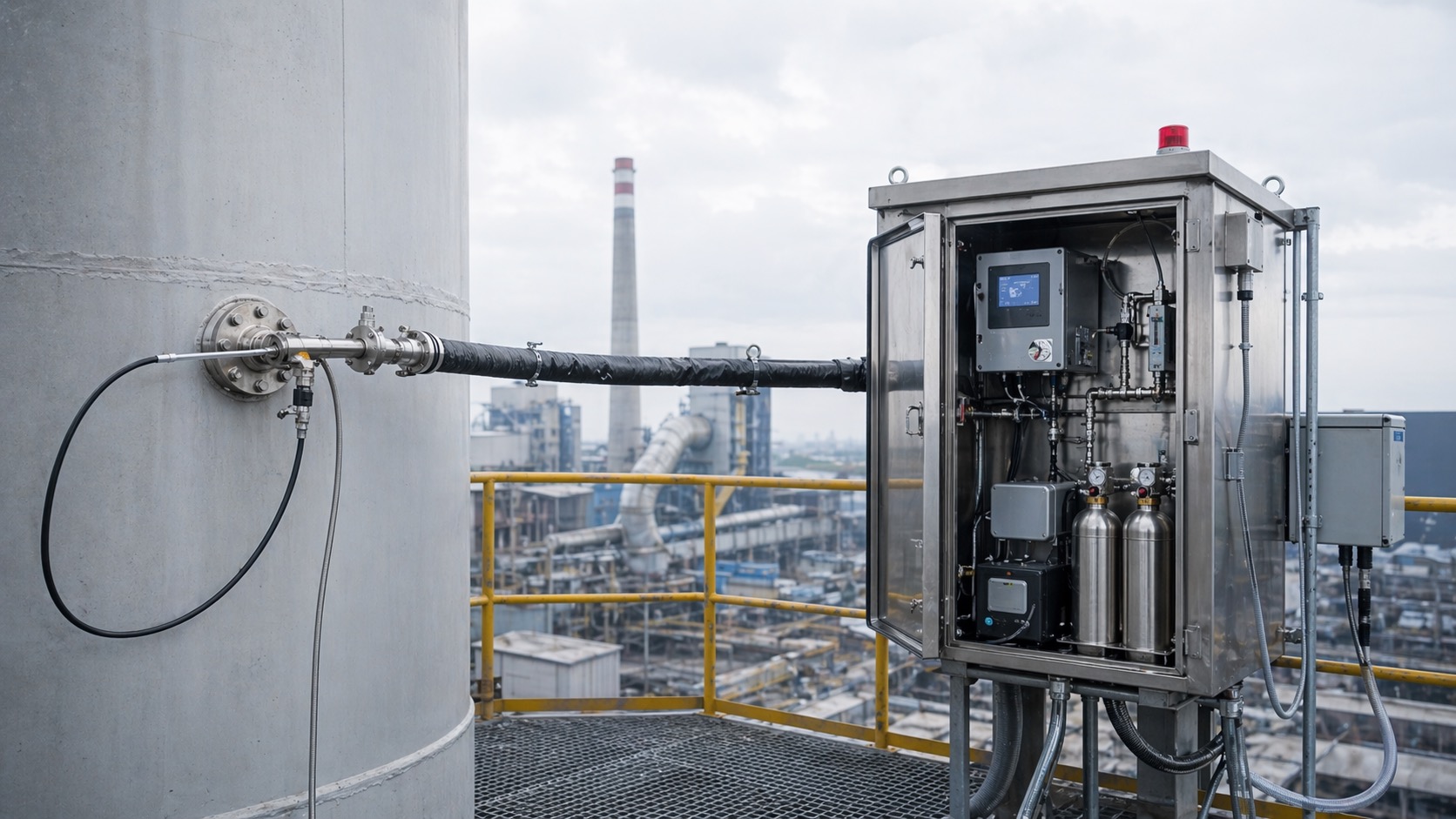
Coal-Fired FGD Outlet — SO₂ Compliance + Reagent Control
ChallengeFGD outlet reporting is the single most audited SO₂ datum on a coal plant — IED in Europe, Part 60 + Part 75 Acid Rain in the US, MOEFCC in India, HJ 76-2017 in China. Legacy wet-chemistry analyzers can struggle at tightened detection limits, and reagent dosing tuned against a slow SO₂ reading can create avoidable limestone-slurry overfeed that should be quantified from site baseline records before any savings percentage is quoted.
SolutionZS-CEMS-200 is scoped against EN 14181 QAL1 + Part 60/75 + HJ 76-2017 with UV-DOAS as primary SO₂ technology; pair with the dual-platform ZS6200-SO2 / ZS6100-NOx process package in the control room for fast feedback to the reagent-dosing loop. The integrated DAHS archives configured averages for the applicable reporting formats; storage depth is confirmed per project.

Gas Turbine SCR Outlet — NOₓ + NH₃ Slip
ChallengeSCR outlet monitoring needs both NOₓ reduction efficiency and NH₃ slip measurement at the same catalyst face. A DeNOₓ CEMS without the paired NH₃ channel leaves a control-loop hole that shows up as catalyst aging and downstream air-heater fouling rather than as a regulatory failure.
SolutionThe ZS6100-NOx CLD platform measures NOₓ via thermal converter at the SCR outlet, paired with an ammonia analyzer on the same stack for NH₃ slip. The CLD thermal-converter efficiency is documented at commissioning per EN 14792 and re-verified at each AST, closing the NO-vs-NOₓ gap that competing datasheets often gloss over.

Waste-to-Energy Incinerator Stack — CEMS Reporting
ChallengeMunicipal and industrial WTE plants under the EU Industrial Emissions Directive report SO₂ and NOₓ continuously at half-hourly averages with QAL1-certified equipment. WTE flue gas is among the dirtiest — chloride load, high moisture, variable combustion matrix — which is the condition that sinks an under-specified CEMS inside the first QAL2 window.
SolutionZS-CEMS-200 with UV-DOAS for SO₂ and CLD for NOₓ, mandatory heated sampling via ZS-SCS-800 to hold the sample above the acid condensation point through the heat-traced line. Channels are configured for QAL2 readiness on typical retrofits because the EN 15267-3 QAL1 type-test documentation travels with the cabinet — certificate extract confirmed per project — and the sampling skid is scoped for WTE chloride load.
Sulfur Recovery Unit / Claus Tail Gas — SO₂ Process Control
ChallengeClaus tail gas is the most punishing SO₂ application: high water vapour, aggressive sulfur compounds, variable combustion matrix and a 30–60 s transport lag on conventional analyzers that loses the DCS a full reaction cycle of closed-loop control. The incinerator runs rich or lean, tail-gas SO₂ spikes, and the plant discovers the lag during an environmental audit.
SolutionThe ZS6200-SO2 UV-Fluorescence platform handles fast SO₂ on the Claus tail-gas incinerator outlet, with heated wetted parts and wetted-material options confirmed per application. The platform is configured around SRU tail-gas chemistry and the sampling interface is built for the matrix rather than adapted from a generic stack configuration; response time is configured per application.

Cement Kiln Pre-Heater — SO₂ + NOₓ Process Monitoring
ChallengeCement rotary-kiln exhaust is hot, dusty and chemically aggressive; raw-material sulfur cycles drive SO₂ spikes at the pre-heater outlet, and NOₓ from high-temperature flame zones feeds SCR or SNCR reagent dosing downstream. Cold-sample analyzers dust-plug on a monthly cycle and the control room stops trusting the reading.
SolutionThe ZS6200-SO2 / ZS6100-NOx process package with heated wetted parts, integrated sample conditioning and combined SO₂ + NOₓ detection feeds continuous data to the kiln control system without the plugging cycles typical of unheated instruments. Where the plant also faces CEMS reporting, a parallel ZS-CEMS-200 on the same stack provides the auditable EN 15267-3 QAL1-scope record — certificate extract confirmed per project.

Diesel Engine / Stationary Genset — Compliance Pre-Screening
ChallengeStationary reciprocating engines, diesel gensets and emergency power units are subject to intermittent compliance checks under Part 60 Subpart JJJJ / IIII and equivalent regional regulations. Sending a fixed CEMS team to every site is cost-prohibitive, but a portable reading misread as a reportable datum is a regulatory exposure.
SolutionPortable electrochemical hand-helds with dual SO₂ + NOₓ EC cells, thermocouple input for stack temperature and on-device data export for audit traceability are the industry screening method for this duty — not a GESHINE product path. The method is explicitly a screening and diagnostic tool: sites passing pre-screening save the cost of an unnecessary reference-method engagement; sites failing pre-screening trigger a properly scoped QAL2 / Method 7E engagement on a certified instrument such as the ZS-CEMS-200.
The six applications above cover the majority of the SO₂/NOₓ installed base. The next block documents the regulatory frameworks that govern the two highest-stakes applications — FGD stack compliance and SCR/DeNOₓ control — followed by the certifications that determine where and how these analyzers can legally be deployed, scoped per SKU.
Regulatory Compliance: FGD Stack Monitoring & SCR/DeNOₓ Control
FGD & Stack Compliance
Flue-gas desulfurization stack monitoring sits at the intersection of four independent regulatory regimes — EN 14181 QAL1/QAL2/AST for EU IED reporting, EPA 40 CFR Part 60 Performance Specifications for US New-Source emissions, EPA 40 CFR Part 75 Acid Rain Program for US utility SO₂ allowance trading, and HJ 76-2017 for Chinese coal-fired power plant CEMS duty. Most plants ultimately report into more than one regime depending on ownership structure, export market and capital provenance, and the CEMS cabinet has to satisfy each regulator with its own document trail. Part 75 Acid Rain is the unique differentiator on this page: it is the only regime in this block that carries an allowance-shortfall cost separately from the analyzer compliance cost — for Part 75 projects, CEMS availability is financially material because missing or invalid data can affect substituted-data handling, emissions accounting, and allowance reporting under the applicable rule. The ZS-CEMS-200 is the only GESHINE SKU scoped against all four regimes simultaneously, with the EN 15267-3 QAL1 certificate extract, the EPA 40 CFR Part 60 Performance Specification reference (field-demonstrated after installation), the Part 75 Acid Rain compliance documentation and the HJ 76-2017 reporting-format support travelling with the unit — the applicable certificate set confirmed per project.
Standards in Scope
- EN 14181:2014 — Stationary source emissions — Quality assurance of automated measuring systems (QAL1 / QAL2 / QAL3 / AST) — applicable to ZS-CEMS-200 only
- EN 15267-3:2023 — Air quality — Assessment of air quality monitoring equipment — Part 3: Performance criteria and test procedures for stationary automated measuring systems for continuous monitoring of emissions from stationary sources — ZS-CEMS-200 only
- EPA 40 CFR Part 60 Appendix B — Performance Specification 2 for SO₂ and NOₓ continuous emission monitoring systems; Appendix F quality assurance procedures where invoked by the applicable rule — ZS-CEMS-200 only
- EPA 40 CFR Part 75 — Acid Rain Program continuous emission monitoring with allowance reporting — unique to SO₂/NOₓ, ZS-CEMS-200 only
- HJ 76-2017 — Chinese national CEMS standard for flue gas from stationary sources — ZS-CEMS-200 only
- MCERTS — UK Environment Agency approval for regulated emissions monitoring — ZS-CEMS-200 only
Application Example (illustrative)
Illustrative scenario, not a specific named installation. A 1,200 MW coal-fired plant scopes a 4-stack CEMS upgrade to meet revised SO₂ limits (200 mg/m³) under new MOEFCC norms after existing wet-chemistry analyzers cannot hold the detection limit at the tightened threshold. Four ZS-CEMS-200 cabinets are configured to the EN 15267-3 QAL1 scope at the new limit — certificate extract confirmed per project — and because UV-DOAS uses no wet-chemistry reagents the plant removes the recurring reagent line item across the four stacks; model the saved cost from reagent price and stack count — no saved-cost outcome is guaranteed. A plant reporting into both MOEFCC and a voluntary international ESG framework would carry the EN 15267-3 QAL1 type-test documentation with each cabinet.
SCR / DeNOₓ Regulatory Framework
Selective catalytic reduction and selective non-catalytic reduction are the dominant NOₓ abatement technologies across power, cement, waste-to-energy and refinery heaters, and the regulatory scope is NOₓ reduction efficiency AND ammonia slip at the same catalyst face. EN 14792 is the European reference method for NOₓ determination from stationary sources and specifies the chemiluminescence detection principle along with converter-efficiency test procedures. EPA Method 7E is the US equivalent for instrumental determination of NOₓ from stationary sources. Both require the NO-to-NO₂ converter efficiency to be documented at commissioning and re-verified at every AST — a point that is quietly omitted on many competing datasheets. The ZS-CEMS-200 CLD channel and the ZS6100-NOx process CLD platform should have converter-efficiency verification documented during commissioning or AST support; confirm the exact factory or site acceptance report in the delivered project document pack. SCR outlet monitoring is physically coupled with ammonia slip measurement, because the same catalyst that reduces NOₓ releases excess NH₃ when the reagent injection is over-dosed; scoping a DeNOₓ CEMS without the paired NH₃ channel leaves a known hole in the control loop that operators pay for in catalyst aging and air-heater fouling.
Standards in Scope
- EN 14792:2017 — Stationary source emissions — Determination of mass concentration of nitrogen oxides (NOₓ) — Chemiluminescence reference method
- EPA Method 7E — Determination of nitrogen oxides emissions from stationary sources (instrumental analyzer procedure)
- EPA 40 CFR Part 60 Appendix F — Quality Assurance Procedures for NOₓ CEMS data
- ISO 10396:2007 — Stationary source emissions — Sampling for the automated determination of gas emission concentrations
- EN 15259:2007 — Air quality — Measurement of stationary source emissions — Requirements for measurement sections and sites
Application Example
A refinery sulfur recovery unit ran the ZS6200-SO2 / ZS6100-NOx process package on the Claus tail-gas incinerator outlet with paired SCR outlet NOₓ monitoring. The SRU needed fast SO₂ response to enable closed-loop air-injection control at the incinerator, while the downstream SCR needed continuous NOₓ and paired NH₃ monitoring to keep catalyst aging predictable. The ZS6200-SO2 platform delivered fast process response with heated wetted parts; in this application pattern closed-loop air-injection control trimmed tail-gas SO₂ excursions — illustrative, not a guaranteed outcome — and the paired NH₃ channel kept ammonia-slip visible through the control room rather than trending silently through the air heater. The SCR/NH₃ physical coupling is the reason DeNOₓ scoping conversations pull in the ammonia-analyzer category.
Certifications & Compliance
SO₂/NOₓ measurement operates under four independent regulatory regimes — EU IED via EN 14181 QAL1/QAL2/AST, US EPA 40 CFR Part 60 New-Source Performance Specifications, the US EPA 40 CFR Part 75 Acid Rain Program with separate allowance tracking, and the Chinese HJ 76-2017 CEMS standard — and Part 75 is the unique differentiator on this page because no other gas category in the GESHINE catalogue cites it. GESHINE scopes every certification per SKU rather than the category as a whole, so a buyer can match the specific instrument against the specific site permit and notified-body expectation before procurement commits, rather than inheriting a blanket “CEMS-certified” claim that does not always hold up when an auditor asks for the type-test report.
European conformity for health, safety, environmental protection.
Applies to both paths (ZS-CEMS-200 / ZS6200-SO2 · ZS6100-NOx)United Kingdom Conformity Assessment, post-Brexit equivalent of CE.
Both pathsIngress protection rating (dust and splash water protected).
ZS-CEMS-200 cabinetIndependent performance type-test.
ZS-CEMS-200 — certificate scope confirmed per projectUK Environment Agency approval for regulated emissions monitoring.
ZS-CEMS-200 — certificate scope confirmed per projectEU type-test for continuous emissions monitoring equipment (QAL1 performance criteria and test procedures).
ZS-CEMS-200 (both SO₂ and NOₓ channels) — certificate scope confirmed per projectQAL2/QAL3/AST documentation and installed-system QA path for ZS-CEMS-200 projects, applied after EN 15267-series acceptance.
ZS-CEMS-200 — field-demonstrated per projectPerformance Specification 2 for SO₂ and NOₓ continuous emission monitoring systems; Appendix F quality assurance procedures where invoked by the applicable rule. Performance Specifications are site-level tests demonstrated after installation.
ZS-CEMS-200 — field-demonstrated per projectUS Acid Rain Program continuous emission monitoring with allowance reporting (unique to the SO₂/NOₓ category).
ZS-CEMS-200 — reporting-format support; China type-approval per projectChinese stationary-source flue-gas CEMS technical requirements and test procedures for SO₂, NOₓ and particulate matter; HJ 75-2017 covers installation, operation, QA and data management on the same projects.
ZS-CEMS-200 onlySafety and EMC standards.
ZS6200-SO2 / ZS6100-NOx process platformsQuality management system certification covering production of all three SKUs.
QMS referenceThe ZS-CEMS-200 is the only path in this category scoped to QAL1 / MCERTS / EPA Part 60 / EPA Part 75 / HJ 76-2017 reporting. The ZS6200-SO2 / ZS6100-NOx dual-platform process package is fast-response and not regulator-authorised as a reference instrument for CEMS duty, and should not be specified as one. Portable electrochemical screening is explicitly not a QAL2 or EPA Method 7E reference-method substitute and is an industry method for pre-compliance screening and diagnostic duty only, not a GESHINE product path — the FAQ below and the Transparency paragraph at the bottom of this page restate this boundary so no buyer discovers it during an audit. Where a site needs a process analyzer and a separate CEMS channel on the same stack, the standard configuration is the ZS6200-SO2 / ZS6100-NOx package in the control-room loop and a ZS-CEMS-200 in the CEMS cabinet, each doing what it is qualified for. Factory calibration certificates and certified reference-gas documentation are supplied per project; national metrology traceability and any NIST-traceable cylinder chain are confirmed in the delivered certificate pack. When the type-test is included in the order scope, the ZS-CEMS-200 additionally provides the category’s regulated-CEMS documentation scope — QAL1 certificate extract, Part 75 documentation package and a commissioning template suitable for a QAL2 engagement, confirmed per project; the ZS6200-SO2 / ZS6100-NOx process platforms do not inherit QAL1, EPA Part 60/75, HJ 76, TÜV, or MCERTS scope from ZS-CEMS-200.
With technology, products and certifications scoped, the remaining decisions are commercial — price tiers, the sampling-skid adjacency that swings the total invoice, lead time and long-term support — which the procurement block below walks through.
Why GESHINE for SO₂/NOₓ Monitoring
EN 14181 + EPA PS project documentation review, FGD & SCR fast-loop control siblings, and project-specific feasibility review when unusual in-situ or hot/wet duty falls outside the standard SO₂/NOₓ catalogue.
EN 14181 + EPA PS Review
ZS-CEMS-200 projects are scoped against EN 15267-3 QAL1 / EN 14181 QA workflow, EPA PS-2 plus Appendix F / Part 75 requirements where applicable, and China HJ 75/HJ 76 project requirements. Confirm the current dossier and jurisdictional fit during project specification.
Fast Process Sibling
The ZS6200-SO2 / ZS6100-NOx dual-platform process package feeds fast SO₂ and NOₓ signals to FGD limestone-slurry dosing and SCR ammonia-injection closed loops — supporting reagent optimization while the reporting package remains scoped separately.
Laser Absorption Feasibility Review
GESHINE can review project-specific laser absorption requests for SO₂ or NO where line selection, in-situ geometry, range, and certificate scope are confirmed separately. The standard paths on this page remain the ZS-CEMS-200 CEMS cabinet and the ZS6200-SO2 / ZS6100-NOx process package — TDLAS is not an option code or upgrade path on these products.
Manufacturer Direct
Direct access to the engineering team that designed and built your CEMS rack. Shorter lead times, competitive pricing, and factory-level technical support including spare parts and QAL2/AST commissioning service.
Pricing, Lead Time & After-Sales Support
SO₂/NOₓ analyzers fall into three commercial tiers by form factor and certification scope. Tiers are qualitative for first-pass budgeting; contact GESHINE for a budgetary quote scoped to your site conditions.
Portable dual-electrochemical SO₂/NOₓ hand-helds are the industry screening method for pre-compliance screening, boiler commissioning, environmental audits, and stationary-genset diagnostics — explicitly not a QAL2 / Method 7E reference instrument, and not a GESHINE product path. Where screening flags a failure, escalate to the certified ZS-CEMS-200 cabinet.
ZS6200-SO2 pulsed UV fluorescence SO₂ + ZS6100-NOx CLD NOₓ package for FGD, SCR/SNCR, SRU Claus tail gas, and refinery process duty. Heated wetted parts, wetted-material options, HART/Modbus integration, and sampling accessories are scoped at RFQ.
ZS-CEMS-200 UV-DOAS + CLD CEMS package for certified emissions monitoring where QAL1 documentation, DAHS, sampling design, commissioning support, and site QA define the budget. ZS-SCS-800 heated sampling hardware is quoted as a separate site-specific line item.
Buyer Advisory
Published price tiers are useful for first-pass budgeting only. The two most common sources of surprise quotes on this page are budgeting the CEMS analyzer alone without the ZS-SCS-800 heated sampling skid that the install physically requires, and specifying the process-grade ZS6200-SO2 / ZS6100-NOx package for a duty that will subsequently need Part 60 / Part 75 / EN 14181 compliance documentation. A bare ZS-CEMS-200 is an analyzer; a stack-mounted CEMS is an analyzer plus a heated sampling probe plus a heat-traced sample line plus a cooler or thermal-dilution stage plus a filter rack plus the cabinet that houses them. The sampling skid is a substantial separate line item whose cost depends on stack distance, heat-trace length, moisture, dust load and cabinet scope — and plants that budget only the analyzer are the single largest source of mid-project cost escalation. Send the sample matrix, water-vapour load, dust-loading after any precipitator, sample pressure and temperature at the tap point, required reporting units (ppm vs mg/m³, corrected or uncorrected for O₂ and moisture), DAHS / historian target, regulatory scope (Part 60 vs Part 75 vs IED vs HJ 76) and whether the project includes QAL1 documentation review, QAL2 on-site engagement or training — and the quote converges in one or two iterations.
What Moves the Price
The single biggest price mover on this page is the sampling skid that sits upstream of the analyzer. A QAL1 CEMS install is typically well above the raw analyzer price once the ZS-SCS-800 heated sampling skid, heated sample line, cooler or thermal-dilution stage, probe and filter rack are included — and that is before the climate-controlled cabinet if the site does not already have a CEMS shelter. Budgeting only the analyzer line item is the number-one source of surprise invoices and mid-project scope escalation on SO₂/NOₓ installs. The second price mover is DAHS integration — the ZS-CEMS-200 ships with an integrated DAHS so a simple reporting loop is included, but plants with existing central historians (OSIsoft PI, AVEVA, SAP, proprietary utility MIS) usually need a gateway engineering package. The third is certification scope: when the EN 15267-3 QAL1 type-test is included in the order scope it is priced into the unit — certificate extract confirmed per project — while adding TÜV or MCERTS document-pack scope, or Part 75 Acid Rain allowance reporting templates, adds notified-body time rather than hardware cost, and where the local environment agency accepts one but not the other the certification pick itself moves the invoice. Part 75 Acid Rain allowance-shortfall exposure is a separate commercial risk outside the analyzer scope and is market-variable — for Part 75 projects, CEMS availability is financially material because missing or invalid data can affect substituted-data handling, emissions accounting, and allowance reporting under the applicable rule.
The Dominant Cost Risk
A failed AST or invalid CEMS period can create material retesting, reporting-correction, substituted-data, and temporary-compliance workload — usually the dominant cost risk in a CEMS purchase, and commonly larger than the analyzer price itself. The exposure is jurisdiction-, permit-, and allowance-market-dependent and should be quantified from the site’s own QA history. On Part 75 stacks, allowance accounting adds a separate commercial dimension under the applicable rule.
Lead Time
- Standard configuration
- Lead time for the ZS6200-SO2 / ZS6100-NOx process package is confirmed at order, including factory calibration, production test report and accessory kit.
- QAL1 CEMS cabinet
- The ZS-CEMS-200 lead time covers base build plus QAL1 document package assembly, EN 15267-3 type-test report compilation and TÜV / MCERTS / Part 75 documentation kitting; confirmed per project.
- CEMS + sampling skid integration
- Additional time applies when the order bundles a ZS-SCS-800 heated sampling skid, enclosed cabinet, heat-traced sample line and stack-side probe into a single turnkey CEMS delivery package; the end-to-end window is confirmed per project.
- MOQ
- Unit and volume pricing are confirmed in the delivered quotation; framework-agreement pricing available for multi-year capex programmes across utility, WTE or cement fleets.
Warranty & Calibration Traceability
- Standard factory warranty
- Standard factory warranty terms are confirmed at order and cover electronics, UV optical bench, CLD reaction chamber, sample-conditioning hardware and sample-interface windows.
- Extended warranty options
- Extended warranty options are available at order; extended warranty and service scope are defined in the service agreement.
- Calibration traceability
- Each analyzer ships with factory calibration documentation. National-metrology traceability, NIST-traceable cylinder documentation, and any project-specific reference-gas chain are confirmed in the delivered certificate pack. When the type-test is included in the order scope, the ZS-CEMS-200 additionally provides its EN 15267-3 QAL1 certificate extract, Part 75 documentation package and a QAL2 commissioning template, confirmed per project.
- Portable EC screening (industry method)
- Portable electrochemical hand-helds are an industry screening method, not a GESHINE product path; EC sensor cartridges are user-replaceable consumables with instrument-dependent service life. Route screening duty to engineering review rather than the certified product line.
- Out-of-warranty service
- UV optical-bench refurbishment, CLD ozone-generator replacement and firmware upgrade programmes are offered; lifecycle service programmes are scoped per installation — important for CEMS installations where regulator-approved equipment cannot be swapped out casually.
After-Sales Support — Calibration, Spares, Training & DAHS
A SO₂/NOₓ analyzer earns its keep over a decade-plus of service, so the support model matters as much as the datasheet. Below are the support channels that back every GESHINE SO₂/NOₓ analyzer, from first-response engineering to regulator reporting cycles.
Technical Support
Application engineers are reachable by phone and email on a guaranteed next-business-day first response. For analyzers connected to the plant network, remote diagnostics over Modbus TCP or OPC-UA allow the GESHINE service team to review UV optical-bench alignment, CLD ozone-generator status, daily zero and weekly span records, alarm history and DAHS export logs without needing a site visit — typically halving the mean-time-to-diagnosis for field issues on CEMS installations and supporting the CEMS data availability that Part 75 substituted-data handling makes financially material.
Calibration & Validation
ZS-CEMS-200 performs an automated daily zero against instrument-grade N₂ and a weekly span verification against a certified SO₂ / NOₓ reference cylinder; all results are logged and trended for EN 14181 AST compliance. On-site QAL2 support uses certified SO₂ / NOₓ reference cylinders and documents the traceability chain in the delivered certificate pack — where a formal reference-method report is required, the report is issued by the responsible accredited stack-testing contractor or party named in the project scope. GESHINE engineers document CLD converter efficiency during commissioning support. The ZS6200-SO2 / ZS6100-NOx process platforms calibrate against the same certified reference gas on an interval confirmed per application.
Spare Parts & Critical Components
UV lamps (5000 hr service life), CLD ozone generators (5000 hr typical), spectrometer CCDs, sample filter cartridges, EC sensor cartridges, heated sample-line sections and reference cells are stocked for 48-hour dispatch from the factory to minimise unplanned CEMS downtime — which for a regulated installation is directly linked to regulatory reporting availability and, on Part 75 stacks, to substituted-data and allowance accounting under the applicable rule. A 5-year spares package covering UV lamp, CLD ozone generator and sensor cartridges is available at order so the site does not depend on emergency procurement when a wear part reaches end of life.
Operator Training
A 2–3 day on-site commissioning visit walks operators, maintenance technicians and EHS / quality staff through HMI workflows, alarm response, daily and weekly validation procedures, CLD converter-efficiency verification and the QAL2 / AST documentation path that the site will execute on its own after handover. Remote operator-training packages for shift handover and additional headcount are delivered through a customer portal with recorded modules, live screen-share sessions with an application engineer, and per-user assessment worksheets tied to the plant’s specific regulatory regime (Part 60 / Part 75 / IED / HJ 76).
DAHS & Reporting Support
The ZS-CEMS-200 integrated DAHS ships pre-configured with reporting templates for EN 14181 AST, EPA 40 CFR Part 60 Performance Specifications, EPA 40 CFR Part 75 Acid Rain quarterly reports, and the HJ 76-2017 format used by Chinese power plants. First-year reporting-cycle support is included with the analyzer to walk the plant through its first monthly / quarterly / annual regulator submission. Export formats include XML, CSV and direct Modbus / OPC-UA tags for a central historian bolt-on when the plant elects to consolidate onto PI or AVEVA.
Further commercial, integration and technical questions are covered in the FAQ below. If your specific question is not answered there, the RFQ form brings an application engineer into the thread within one business day.
Frequently Asked Questions
From CEMS documentation frameworks to FGD reagent control, converter efficiency and portable screening boundaries.
When is TDLAS worth a feasibility review for SO₂ or NO?
TDLAS can be a valid project-specific physics path for narrow-line, in-situ, hot/wet, or very fast-response applications, but this SO₂/NOₓ category does not list a standard TDLAS SO₂/NO product. The standard paths here are the ZS-CEMS-200 (UV-DOAS + CLD CEMS cabinet) and the ZS6200-SO2 / ZS6100-NOx dual-platform process package (UVF SO₂ + CLD NOₓ); portable electrochemical screening is an industry method, not a GESHINE product path. Treat laser absorption as a separate engineering review through the TDLAS technology overview; do not describe it as an upgrade from UV-DOAS/CLD unless a project-specific configuration, range, sample geometry, and certification package are confirmed.
Why does CLD struggle with ammonia in the matrix?
CLD measures total NOₓ by routing the sample through a heated converter (typically molybdenum, stainless-steel or carbon, each at its own specified operating conditions) to reduce NO₂ to NO before chemiluminescent reaction with ozone. With heavy SCR ammonia slip in the matrix, NH₃ can oxidize on the converter surface to NO, inflating the apparent NOₓ reading. Mitigations: pre-converter NH₃ scrubber, periodic hot-vs-cold converter cross-check, or — where converter integrity becomes a recurring maintenance issue — a separate project-specific engineering review.
What is EN 14181 QAL2/AST surveillance and why does it matter?
EN 14181 defines three quality assurance levels for CEMS: QAL1 (manufacturer type approval), QAL2 (installed performance test by accredited body, done at commissioning + every 5 years), QAL3 (operator daily/weekly drift checks), AST (Annual Surveillance Test by accredited body). All four levels run together; a CEMS not under QAL2/AST surveillance is not EN 14181 compliant regardless of product documentation. Confirm ZS-CEMS-200 documentation status and commissioning scope for the selected project before permit submission.
How do EPA PS-2 / Appendix F QA requirements differ from EN 14181?
EPA Performance Specification 2 covers SO₂ and NOₓ continuous emission monitoring systems. Appendix F and Part 75 add quality-assurance, certification, missing-data, and reporting requirements when the applicable rule invokes them. EN 14181 uses the QAL1/QAL2/QAL3/AST framework. A unit documented for one regime does not automatically satisfy the other; confirm the selected dossier against the permit before procurement.
How does fast SO₂ measurement optimize FGD reagent dosing?
FGD limestone slurry dosing is typically over-fed to maintain compliance margin, because feedback from a 15–20 second CEMS lag means the controller can’t react to transient load swings without overshoot. A sub-5-second SO₂ measurement at the FGD outlet (UV-Fluorescence process analyzer) closes the loop tighter, allowing dosing to track actual SO₂ load. Closed-loop SO₂ measurement can reduce avoidable reagent overfeed when the baseline control strategy is conservative or delayed — quantify the savings from inlet-load variability, reagent cost, slurry quality, control-loop tuning and maintenance records before quoting a percentage.
What sample conditioning does a UV-DOAS SO₂/NOₓ CEMS need?
A typical UV-DOAS CEMS sample train uses a heated probe with backflush option for high-dust service, a heated transfer line maintained above the acid dew point (~180°C for coal), particulate filtration, and optional dilution for high-load coal-fired plants. The UV cell is normally kept on a hot/wet path, so cool-dry conditioning is avoided where it would create acid-condensation loss. For ZS-CEMS-200, QAL3 trend records come from a daily automatic zero check with instrument-grade N₂ and weekly span verification with certified SO₂/NOₓ reference gas through the internal solenoid manifold. Annual AST or RATA comparison is performed against the standard reference method required by the applicable regime: EN reference methods under EN 14181 projects, or EPA Method 6C for SO₂ and Method 7E for NOₓ where a US rule invokes them.
How are CEMS data reported under IED / EPA / HJ regimes?
China CEMS projects should be scoped against HJ 75-2017 for installation, operation, QA, data review, and management, and HJ 76-2017 for system technical requirements and test procedures. EU IED and US EPA Part 60/75 reporting rules use different averaging, validity, QA, and electronic-reporting workflows. Confirm the local platform, DAHS/DAS interface, averaging rules, and required data availability against the permit before shipment.
What is the difference between SO₂ in mg/m³ and ppm?
ppm (parts per million) is a molar concentration; mg/m³ is mass concentration. The conversion for SO₂ at standard conditions: 1 ppm SO₂ ≈ 2.86 mg/m³ at 0°C / 101.325 kPa, ≈ 2.62 mg/m³ at 25°C. EU and China emission limits are typically stated in mg/m³ at reference conditions (0°C, 101.325 kPa, 6% O₂ for coal, 11% O₂ for biomass, 15% O₂ for gas turbine). US limits are typically ppm or lb/MMBtu. CEMS analyzers report in the unit configured at QAL2, but the underlying physics is the same.
What industries use SO₂/NOₓ analyzers?
SO₂/NOₓ monitoring spans power generation (coal/gas-fired CEMS), cement & lime (kiln emission), waste-to-energy (incinerator stack), refining (FCC regenerator, SRU tail, fired heater), petrochemical (ethylene cracker furnace, propylene reformer), steel (sinter plant + coke oven), pulp & paper (recovery boiler), and glass manufacturing. Each industry’s emission limits and reference methods differ by jurisdiction; specify the analyzer to the regulatory regime upfront.
What is the difference between EPA 40 CFR Part 60 and Part 75, and why is Part 75 called out separately?
Part 60 is the US Federal Performance Specification regime for New Stationary Sources — it defines how a SO₂ or NOₓ CEMS has to perform to be acceptable as a monitoring instrument. Part 75 is the Acid Rain Program, which sits on top of Part 60 for utility SO₂ and NOₓ emissions and adds a separate allowance-tracking obligation — tonnes of SO₂ emitted are debited against a tradable allowance account, and a data-availability shortfall triggers substituted-value reporting that may or may not clear the commercial bar. Part 75 is the unique differentiator for the SO₂/NOₓ category, and it is why CEMS availability is financially material on Part 75 facilities: missing or invalid data can affect substituted-data handling, emissions accounting, and allowance reporting under the applicable rule. The ZS-CEMS-200 is scoped for both regimes.
How do EN 14181 QAL1, QAL2 and AST relate, and what does each cover in practice?
QAL1 is the instrument-level type-test performed by a notified body (TÜV, MCERTS) against EN 15267-3 — it certifies that the analyzer design can meet uncertainty and drift requirements at reference conditions, and it travels with the unit. QAL2 is the site-level calibration performed by an accredited stack-testing contractor after install, comparing the CEMS against a reference-method test over 2–3 days; it produces the calibration function and the variability validation. AST (Annual Surveillance Test) is the yearly re-verification of QAL2 validity at the site — a reduced reference-method comparison checking that the CEMS has not drifted outside the QAL2 envelope. A missed AST or a failed QAL2 re-opens the compliance loop. The ZS-CEMS-200 ships engineered to EN 15267-3 QAL1 type-test scope, with the certificate extract confirmed per project; QAL2 and AST are commissioning services.
Can a portable electrochemical analyzer be used as a reference-method substitute for QAL2 or EPA Method 7E?
No, and the page is explicit about this in three separate places so no buyer discovers it during an audit — this FAQ, the Transparency paragraph at the bottom of the page, and the certifications block above. Portable dual-cell electrochemical hand-helds are an industry screening method for compliance pre-screening, boiler commissioning, environmental spot-checks and stationary-genset diagnostic duty, not a GESHINE product path. They are not QAL1-certified and they are not an EN 14181 or EPA Method 7E reference instrument. Portable EC is a productivity method for environmental consultants and commissioning engineers; it is not a compliance-reporting datum. Sites needing QAL2 or Method 7E must use a certified reference-method engagement or a QAL1-certified ZS-CEMS-200.
What does “NOₓ = NO + NO₂” mean, and how does the converter efficiency affect the reading?
The regulatory definition of NOₓ is the sum of NO and NO₂, both reported as NO₂. Chemiluminescence detection only sees NO directly, so a thermal or molybdenum converter reduces NO₂ to NO upstream of the reaction cell — molybdenum catalytic converters often operate around 300–350 °C, while other converter designs use their own specified conditions — and the instrument therefore measures NO + NO₂ as NOₓ via thermal converter. Converter efficiency decays with use, and an undocumented converter produces a compliant-looking NO reading while the NOₓ reading silently drifts. EN 14792 and EPA Method 7E both require converter efficiency documented at commissioning and re-verified at every AST. ZS-CEMS-200 and the ZS6100-NOx process CLD platform support converter-efficiency verification during commissioning and AST support; confirm whether a factory or site acceptance report is included in the delivered project document pack. Portable electrochemical hand-helds use a dual EC cell (NO + NO₂) and do not rely on a converter, but remain a screening method rather than a GESHINE product path.
Why can a single ZS-CEMS-200 cabinet cover QAL1 scope for both SO₂ and NOₓ when many competitors only QAL1 one analyte?
The ZS-CEMS-200 packages UV-DOAS SO₂ measurement and CLD NOₓ measurement in one CEMS cabinet — both channels are engineered to be type-tested together under EN 15267-3, with the QAL1 certificate extract listing both analytes explicitly and confirmed per project. Competing CEMS designs often split SO₂ and NOₓ across two separate analyzer modules with two separate type-test reports, which doubles the cabinet footprint, doubles the DAHS configuration burden and doubles the QAL2 engagement scope. Integrating both in one cabinet is the reason a single ZS-CEMS-200 can be scoped to EN 14181 QAL1 (EU), EPA 40 CFR Part 60/75 (US, field-demonstrated after installation) and HJ 76-2017 (China) reporting on one unit — the applicable certificate set confirmed per project.
Can the ZS-CEMS-200 report in both mg/m³ and ppm, and how are reference conditions handled?
Yes. The integrated DAHS reports concentration in mg/m³ (EN / HJ format), ppm (EPA format) or both, and applies the reference-condition corrections (dry basis, reference O₂, reference temperature and pressure) that each regulator requires. Part 75 Acid Rain reporting expects corrected concentrations at the stack-specific reference O₂, EN reporting expects EN reference conditions, and HJ 76-2017 uses its own basis. The DAHS configuration is preset at commissioning to match the site’s applicable regulator and can run parallel outputs where a site reports into more than one regime — common for export-dependent plants with both MOEFCC and voluntary ESG framework obligations. Unit conversion on the fly avoids the spreadsheet-based post-processing that is a common AST audit finding.
What is the difference between UV-DOAS and pulsed UV fluorescence, and why does one go in the CEMS and the other in the process line?
UV-DOAS (Differential Optical Absorption Spectroscopy) passes broadband UV 200–300 nm through the sample cell and fits the measured differential absorption against a reference SO₂ cross-section — concentration is extracted from spectral shape, which removes broadband interferents mathematically and is the reason UV-DOAS holds QAL1 uncertainty across the months-long AST interval. Pulsed UV fluorescence excites SO₂ with a pulsed UV lamp and counts the emitted fluorescence photons (in a typical pulsed-UVF implementation, ≈214 nm excitation with fluorescence detected ≈240–410 nm through instrument-specific filters) — a single-wavelength measurement with water-vapour and aromatic-hydrocarbon quench correction. Fluorescence is faster but fluorescence quench correction under changing matrix is harder to certify than the DOAS spectral fit, which is why UV-DOAS goes in the ZS-CEMS-200 CEMS cabinet and pulsed UV fluorescence goes on the ZS6200-SO2 process platform.
How long does the CLD ozone generator last, and what is the maintenance schedule?
The CLD (Chemiluminescence Detector) generates ozone internally from a silent-discharge generator running on a small flow of instrument air or pure oxygen. The ozone generator and UV lamp are consumable optical components with a service life confirmed in the delivered datasheet; under continuous CEMS duty they are typically scheduled together at the annual preventive-maintenance visit before detection-cell intensity falls below the trend threshold. Between service intervals the ozone generator is monitored via its own discharge-current and photomultiplier-response diagnostics, both logged through Modbus TCP and visible in the GESHINE service portal. Quarterly optical window cleaning and sample filter replacement are the only field tasks between annual services; the ZS-CEMS-200 flags both through the HMI.
Does the ZS-CEMS-200 need a heated sampling line, and why is the ZS-SCS-800 a separate line item?
Yes — every QAL1 CEMS install on a wet stack requires heated sampling to hold the sample above the acid condensation point through the transport line, otherwise condensate forms on the probe and the window and the UV-DOAS reading degrades before the AST window closes. The ZS-SCS-800 is the matching heated sampling skid — probe, heat-traced line rated to 180 °C, cooler or thermal-dilution stage, particulate filter rack and the cabinet that houses them. It is priced separately because it is site-specific (stack distance, heat-trace length, dust loading, moisture matrix) and because separating the analyzer from the sampling skid on the invoice prevents the “cheap-CEMS” bid-spec scenario where a plant under-budgets the install materially and discovers the gap during commissioning.
How does the SCR outlet couple NOₓ measurement with ammonia-slip measurement?
Selective catalytic reduction injects ammonia (NH₃) upstream of a catalyst that reduces NO + NO₂ to N₂ using NH₃ as the reductant. The catalyst face is the single location where both NOₓ reduction efficiency and NH₃ slip manifest as output signals — NOₓ is what the catalyst removed, NH₃ slip is what escaped unreacted. Scoping a DeNOₓ CEMS with only the NOₓ channel leaves a known control-loop hole; the NH₃ slip that should have triggered a reagent-dose correction instead feeds downstream into the air heater, where it forms ammonium bisulfate and fouls heat-transfer surfaces. The honest scope is a paired NOₓ channel (the ZS6100-NOx process platform or ZS-CEMS-200) plus a NH₃ analyzer on the same stack — see the ammonia-analyzers category for the matching NH₃ SKU.
How is NOₓ reported — NO only, NO₂ only, or NO + NO₂ as NO₂?
NOₓ is reported as the sum of NO and NO₂, expressed as NO₂ — not NO alone and not NO₂ alone. At a combustion stack most NOₓ leaves as NO, with NO₂ a smaller and variable fraction depending on the matrix and excess air, so reading NO only would understate the regulated number. Chemiluminescence (CLD) detects NO directly, so a thermal converter at project-specific temperature reduces NO₂ to NO ahead of the cell, letting the instrument report NO + NO₂ as NOₓ. Because converter efficiency drifts with use, EN 14181 / EN 14792 and EPA Method 7E require it documented at commissioning and re-checked at every AST — an undocumented converter shows a clean NO trace while the NOₓ total quietly drifts. Always confirm the reporting basis (as NO₂, dry, at reference O₂) on the analyzer spec sheet before comparing two quotes.
What is the working principle of a SO₂ gas analyzer in 2026?
A modern SO₂ gas analyzer works by ultraviolet (UV) measurement of the SO₂ molecule, in one of two forms. For certified emission monitoring, UV differential optical absorption spectroscopy (UV-DOAS) passes broadband UV through the sample and fits the SO₂ absorption band against a reference cross-section, extracting concentration from spectral shape — this rejects broadband interference such as window fouling and is why UV-DOAS holds QAL1 uncertainty across the EN 14181 AST interval. For fast process and FGD control, pulsed UV fluorescence excites SO₂ at a project-specific wavelength and counts the emitted photons, giving a quicker response (T90 project-specific) at the cost of harder-to-certify quench correction. Older NDIR and wet-chemistry SO₂ methods still exist but are rarely specified for new stacks. Pick UV-DOAS for the CEMS datum and pulsed UV fluorescence for the closed-loop process line in a wet, CO₂-rich flue matrix.
Can I use a SO₂/NOₓ CEMS for natural-gas sulfur measurement?
No — a SO₂/NOₓ CEMS measures SO₂ in combustion flue gas after the fuel is burned, not the sulfur content of raw natural gas before combustion. The two sit at opposite ends of the process: a CEMS such as the ZS-CEMS-200 mounts on the stack and reports SO₂ that formed when fuel sulfur oxidised, in a hot wet CO₂-rich matrix, for EN 14181 / EPA Part 75 compliance. Natural-gas sulfur is mostly H₂S and total sulfur in a clean pressurised pipeline matrix, which needs a dedicated H₂S or total-sulfur analyzer upstream, not a flue-gas CEMS. If you need to verify pipeline NG quality and safety — H₂S, moisture, trace O₂ — see the natural gas analyzers category for the matching sub-application SKUs. Use the SO₂/NOₓ CEMS only for the post-combustion emission datum.
The Engineering Team Behind This Guide
GESHINE’s SO₂/NOₓ analyzer recommendations rest on our engineering team’s hands-on experience with UV optical-bench, UV-DOAS and chemiluminescence (CLD) measurement across process and CEMS duty. We scope the ZS-CEMS-200 against EN 14181 / Part 60 / Part 75 / HJ 76-2017 CEMS duty and the ZS6200-SO2 / ZS6100-NOx dual-platform process package against FGD, SCR and SRU process control — because those are the two envelopes our installed base actually occupies, and we design the sampling integration with the ZS-SCS-800 around the specific matrix each occupies. Portable electrochemical spot-checking is an industry screening method for pre-compliance and diagnostic duty, not a GESHINE product path; it is explicitly not a QAL2 or EPA Method 7E reference-method substitute, and we do not recommend it as one regardless of how much it saves on hardware, because a buyer who misreads a portable EC reading as a Part 75 reportable datum inherits a regulatory exposure that the hardware savings cannot cover. Every specification on this page is sourced from GESHINE product datasheets, production-test data, delivered certificate packs where applicable, and the industry standards cited in the References block.
Standards & References
- EN 14181:2014 — Stationary source emissions — Quality assurance of automated measuring systems (QAL1 / QAL2 / QAL3 / AST).
- EN 15267-3:2023 — Air quality — Assessment of air quality monitoring equipment — Part 3: Performance criteria and test procedures for stationary automated measuring systems for continuous monitoring of emissions from stationary sources.
- EN 14792:2017 — Stationary source emissions — Determination of mass concentration of nitrogen oxides — Standard reference method: chemiluminescence.
- EPA 40 CFR Part 60 — Standards of Performance for New Stationary Sources, including Appendix B Performance Specification 2 for SO₂ and NOₓ CEMS, with Appendix F Quality Assurance Procedures where applicable.
- EPA 40 CFR Part 75 — Continuous Emission Monitoring for the Acid Rain Program (SO₂ and NOₓ allowance tracking with separate reporting obligations).
- EPA Method 7E — Determination of nitrogen oxides emissions from stationary sources (instrumental analyzer procedure); EPA Method 6C is the corresponding SO₂ instrumental method.
- HJ 76-2017 — Specifications and test procedures for continuous emission monitoring systems for flue gas emitted from stationary sources (China); HJ 75-2017 covers installation, operation, QA and data management.
Ready to Specify a SO₂/NOₓ CEMS or Process Analyzer?
Tell us whether the measurement is for CEMS compliance (EN 14181 / Part 60 / Part 75 / HJ 76-2017), FGD or SCR process control, or pre-compliance screening, and share the stack matrix, concentration range and certification scope required. Our application engineers will return a configured quotation, with timing confirmed per RFQ scope, including the ZS-SCS-800 sampling-skid line items as part of the turnkey CEMS chain. To configure the optimal SO₂/NOₓ chain for your duty point, please have these details ready:
- Duty type: regulated CEMS reporting / process control / audit spot-check
- Regulatory framework: IED / EPA 40 CFR Part 60 or Part 75 / HJ 75 + HJ 76 / local permit
- SO₂ and NOₓ ranges (ppm or mg/m³) and reference O₂ basis
- Plant type (coal / gas / biomass / waste-to-energy / cement / refinery SRU)
- Flue gas matrix: temperature, moisture, particulate load, NH₃ slip
- Auxiliary modules needed (O₂, dust, flow, CO, HCl, mercury)
- DAS / plant DCS integration (Modbus, OPC-UA, HJ 212 China DAS)
- QAL2 commissioning support: turnkey vs vendor-supplied vs in-house
Get SO₂/NOₓ CEMS Consultation
Our application engineers support EN 14181 QAL1/QAL2 + EPA PS documentation review and FGD/SCR closed-loop control across power, cement, and refinery duty.