
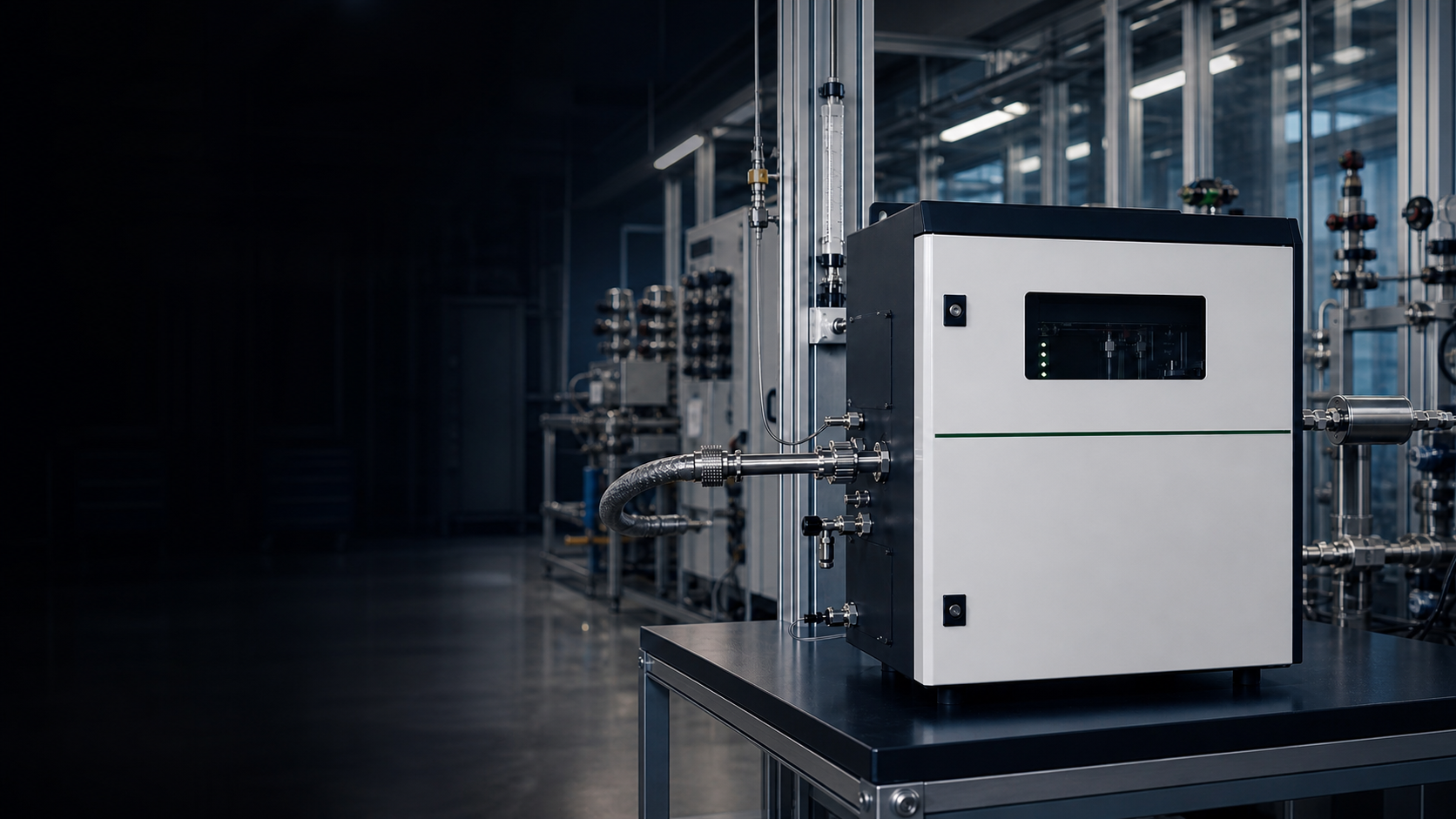
NDIR Gas Analyzers — Non-Dispersive Infrared Technology
Non-dispersive infrared (NDIR) optical absorption for CO, CO₂, CH₄, N₂O, hydrocarbons, and refrigerants — mature, cost-effective, and the default path for CEMS stack gas and process monitoring where molecular infrared absorption is strong and the matrix is well-characterized.
What Is NDIR Gas Analysis?
NDIR is the industrial workhorse of infrared gas measurement. Instead of scanning a continuous spectrum, it uses a broadband IR source, one or more bandpass filters that isolate the molecular absorption feature of the target gas, and a detector that integrates the transmitted energy — the drop in transmitted light translates to concentration via Beer-Lambert. NDIR is cheaper, simpler, and mechanically more stable than scanning spectroscopies, which is why it remains the default choice for CO / CO₂ CEMS, process combustion control, indoor air-quality CO₂ monitoring, and many greenhouse-gas and refrigerant applications. What NDIR trades for that robustness is single-line selectivity and ppb-trace reach — those are TDLAS territory. For matrices where cross-interference is manageable (or correctable via dual-beam / Gas Filter Correlation optics and proper sample conditioning), NDIR is the correct choice and pretending otherwise would mis-spend the project budget.
NDIR Measurement Principle
Engineering & Sample-Conditioning Notes
- Water vapor is the dominant matrix interferent for most NDIR channels; either dry the sample upstream (Peltier cooler / Nafion) or route the cross-interference through a dual-beam reference or GFC optical head.
- Optical window contamination (soot, oil film, condensate) is the most common field failure mode — specify particulate filtration and heated sample lines above the hydrocarbon dew point.
- Temperature and pressure compensation must be built-in for stack work; uncorrected 10 °C drift or 50 mbar pressure swing will silently shift %-level readings.
- Span drift control: a traceable zero gas (N₂ or scrubbed zero air) plus a certified span cylinder every 24–90 days is non-negotiable for regulatory CEMS duty.
- Path length is a design choice, not an accessory — doubling the cell improves low-end detection but doubles saturation risk on upset concentration; the correct answer is application-specific.
Single-Beam, Dual-Beam, and GFC
GFC (Gas Filter Correlation) is a variant of the NDIR optical family — not a separate technology. Choose among the three based on matrix complexity, drift tolerance, and compliance scope.
Single-Beam NDIR
One optical path through the sample cell; reference is either a time-multiplexed beam or an adjacent wavelength on the same detector.
- Lowest cost and simplest optics
- Compact enough for OEM, portable, and IAQ modules
- Minimal moving parts
- More exposed to source / detector drift
- Less robust against H₂O and CO₂ cross-interference
- Span discipline required to hold compliance
Indoor air-quality (CO₂), budget process indicators, OEM flue-gas modules
Dual-Beam NDIR
Two parallel optical paths — sample cell and sealed reference cell (or two detectors with different filters) — ratioed to cancel source-intensity drift.
- Source-drift and window-contamination rejected in the ratio
- Stable long-interval calibration behavior
- The default architecture for compliance-grade CO / CO₂ CEMS
- Higher cost and larger optical head
- Still matrix-sensitive without dryer or correction filters
Industrial process CEMS, combustion stack CO / CO₂, refinery flue-gas monitoring
GFC (Gas Filter Correlation) NDIR
A rotating filter wheel carries a sealed cell filled with the target gas itself; the wheel alternates the optical path between a “target-blocked” and “target-open” state. GFC is a variant of the NDIR family with self-referenced rejection of H₂O / CO₂ continuum interference.
- Self-references against matrix interference at the target molecule’s own fingerprint
- Strong choice for N₂O, CO, and NH₃ in wet / CO₂-rich stacks
- CEMS-grade stability without switching to laser optics
- Rotating filter wheel adds mechanical complexity
- Still broadband: below-sub-ppm duty is better served by TDLAS
Nitric-acid tail-gas N₂O (e.g. ZS6500-N2O), wet-stack CO, compliance-grade greenhouse-gas CEMS
Where NDIR Works Best
NDIR is the default for CO and CO₂, a Good fit for CH₄ / N₂O / SO₂, and a Conditional path for THC and refrigerants. Each row links to the GESHINE gas category that currently covers that duty.
| Gas | Formula | Absorption Band | Typical Range | NDIR Fit | Notes & Recommended Path |
|---|---|---|---|---|---|
| Carbon Monoxide | CO | 4.65 μm (fundamental) | 0–50 ppm / 0–500 ppm / 0–100 %vol (multi-range NDIR) | Excellent | The textbook NDIR target. Sole caveat is N₂O overlap around 4.5 μm — dual-beam or GFC optics resolve it in mixed stacks. CO / CO₂ Category |
| Carbon Dioxide | CO₂ | 4.26 μm (strong) / 2.7 / 15 μm | 0–500 ppm (IAQ) / 0–20 %vol (combustion) / 0–100 %vol (CEMS / process) | Excellent | Strong, well-isolated absorption and high-volume commoditization make NDIR the default CO₂ technology across IAQ, process, and CEMS scales. CO / CO₂ Category |
| Methane | CH₄ | 3.3 μm / 7.7 μm | 0–100 ppm (leak / IAQ) / 0–100 %vol (process) | Good | NDIR works for bulk / %vol CH₄ and LEL-adjacent duty, but heavier hydrocarbons cross-absorb near 3.3 μm; for speciated or ppb-trace methane, route to TDLAS. Combustible Gas Category |
| Nitrous Oxide | N₂O | 4.50 μm (fundamental) | 0–50 ppm (CEMS) / 0–5 %vol (process) | Good | N₂O shares the 4.5 μm window with CO, so GFC-variant NDIR is typical for wet-stack nitric-acid tail-gas and greenhouse-gas CEMS. ZS6500-N2O is the in-house GFC infrared path. N₂O Category |
| Total Hydrocarbons (THC) | CnHm | 3.3–3.4 μm (C–H stretch) | 0–100 ppmC to 0–10,000 ppmC | Conditional | NDIR THC is a valid budget path on simple matrices (EPA Method 25B reference), but carbon response is compound-dependent; FID remains the compliance-grade continuous reference method. Route buyers who need defensible THC to the FID primary. THC / NMHC Category |
| Sulfur Dioxide | SO₂ | 7.3 μm / 8.6 μm | 0–500 ppm (CEMS) / 0–5 %vol (process / acid plant) | Good | NDIR SO₂ is deployed on boiler / acid-plant stacks where UV-DOAS is not chosen; water-vapor rejection via dual-beam or heated sampling is the usual engineering fix. SO₂ / NOx Category |
| Refrigerants & Halocarbons | R-134a / R-410A / SF₆ | 8–10 μm (C–F / S–F stretch) | 0–100 ppm (leak) / 0–1000 ppm (recovery) | Conditional | Refrigerant NDIR is a real market (leak-check, service, recovery) but highly compound-specific and typically handled by partner / OEM modules rather than GESHINE’s current self-owned line. |
NDIR vs TDLAS / GFC / UV-DOAS
Pick the technology that matches the matrix and the regulatory framework — not the marketing buzzword. NDIR is the right answer when absorption is strong and the matrix is manageable; TDLAS wins on selectivity and ppb-trace reach.
| Parameter | NDIR | TDLAS | GFC NDIR | UV-DOAS |
|---|---|---|---|---|
| Spectral Region | Mid-IR 2–15 μm, broadband filtered | Near-IR 0.76–2.5 μm single laser line | Same as NDIR (mid-IR) with gas-filled reference cell | UV 190–400 nm differential absorption |
| Typical Accuracy | ±1–2 % FS | ±0.5–1 % FS or ±0.1 ppm | ±1–2 % FS, better rejection in wet / CO₂-rich matrix | ±1–2 % FS |
| Detection Limit | ppm (low-range 0.5–5 ppm on clean matrix) | Sub-ppm to ppb on favorable lines | Low-ppm (better than plain NDIR on interferent-rich stacks) | ppm on UV-absorbing molecules (SO₂, NO₂, NH₃, Cl₂) |
| Response (T90) | 15–60 s typical | <2–10 s | 30–60 s (filter wheel modulation) | 10–30 s |
| Cross-Interference | H₂O continuum and overlapping IR bands are the main risks | Laser-line selection effectively resolves neighboring species | Self-referenced against H₂O / CO₂ continuum at target feature | Low in UV; but matrix must have a UV-absorbing target |
| Multi-Gas on One Head | Yes, via swappable filters (up to 3–5 channels) | One gas per laser; multi-gas needs multi-laser optics | Typically single-target; multi-gas via multi-wheel | Yes, via full UV spectrum deconvolution |
| Sample Conditioning | Dry sample preferred; heated line if heavy hydrocarbons present | Flexible — hot, wet gas tolerated when laser line avoids H₂O | Same as NDIR; dryer often optional thanks to self-referencing | Heated sampling for acid / reactive matrices |
| Relative Capex | Low to medium | Medium to high | Medium (NDIR + filter wheel) | Medium to high |
| Best For | CO / CO₂ CEMS + combustion, IAQ CO₂, budget process indicators | Low-ppm / corrosive / complex matrix where selectivity is mandatory | N₂O CEMS, wet-stack CO, GHG MRV reporting | SO₂ / NO₂ / NH₃ / Cl₂ CEMS, especially long-path stack optics |
Choose NDIR (or GFC NDIR) When…
- Target is CO, CO₂, bulk CH₄, or compliance-grade N₂O on a wet / CO₂-rich stack
- Project is a CEMS stack duty that already references NDIR / Method 10 / Method 3A
- Capex and long-interval calibration stability outrank ppb-trace reach
- Multi-range or multi-channel filter wheel simplifies fleet standardisation
- Matrix interference is known and can be resolved with dryer or dual-beam / GFC optics
Route to TDLAS / FTIR / UV-DOAS / FID When…
- ppb-trace or single-line selectivity is mandatory (TDLAS for NH₃ / HF / HCl)
- Stack is SO₂ / NO₂ / NH₃ / Cl₂-dominated with strong UV absorption (UV-DOAS)
- Lab or R&D needs full-spectrum deconvolution across unknown species (FTIR)
- Regulated THC / NMHC reporting under EPA Method 25A / EN 12619 (heated FID)
- Matrix is dominated by overlapping IR bands that NDIR cannot separate
NDIR in Industrial Duty
From CO / CO₂ stack CEMS and combustion control to nitric-acid N₂O, building HVAC CO₂, and process-vent hydrocarbon screening — where NDIR earns its place in the plant.
CO / CO₂ Stack CEMS
- Challenge
- Combustion sources — coal, gas, biomass, waste — need continuous, defensible CO and CO₂ reporting under 40 CFR Part 60 / Part 75 and equivalent EU IED BAT ceilings. Budget, reliability, and long-interval calibration behavior usually beat ppb-trace reach as the ranking criteria.
- Solution
- Dual-beam NDIR on heated extractive or cold-dry conditioned sample, paired with a traceable zero / span discipline. The ZS6200-CO/CO₂ NDIR analyzer and the ZS-CEMS-100 package cover the standard industrial stack envelope.
Combustion Control & Boiler Optimization
- Challenge
- Process boilers, fired heaters, and kilns run air-fuel ratio off CO + CO₂ feedback. Analyzers here fail when sample lines cool below hydrocarbon dew point or when span drift goes unnoticed between outages.
- Solution
- NDIR with heated probe + heated sample line and routine span discipline. Multi-channel filter wheel lets a single head track CO, CO₂, and optionally CH₄ for flue-gas combustion efficiency and residual-hydrocarbon slip.
Nitric-Acid Tail-Gas N₂O (GFC NDIR)
- Challenge
- Nitric-acid plants emit potent N₂O after the abatement reactor; greenhouse-gas MRV under 40 CFR Part 98 and EU ETS asks for continuous, auditable reporting in a wet, CO₂-rich matrix where broadband NDIR alone is exposed to interference.
- Solution
- GFC variant NDIR with sealed N₂O reference cell on a rotating wheel self-references against H₂O / CO₂ continuum. ZS6500-N2O is the in-house GFC infrared SKU for this duty.
Indoor Air Quality CO₂ & Building HVAC
- Challenge
- IAQ CO₂ sensing in commercial HVAC and demand-controlled ventilation must run 24/7 with minimal recalibration and at module price points where TDLAS cannot compete.
- Solution
- Compact single-beam NDIR modules at the 4.26 μm CO₂ band are the market default. Single-component CO₂ reading drives DCV dampers and ASHRAE 62.1 compliance tracking.
Process Vent CH₄ / Hydrocarbon Screening
- Challenge
- Landfill gas, biogas, anaerobic digestion, and process vents often need bulk CH₄ / CO₂ composition tracking at %vol scale where FID is overkill and TDLAS is oversold.
- Solution
- Multi-channel NDIR (CH₄ at 3.3 μm + CO₂ at 4.26 μm + O₂ via paramagnetic co-cell) gives a compact biogas / landfill composition analyzer. Speciated NMHC or compliance-grade THC should still route to the heated-FID path.
GESHINE NDIR / IR Family
Cross-links to real GESHINE products and companion categories. NDIR-adjacent SKUs that are not independently registered (e.g. NDIR-only THC or refrigerant modules) appear as category links instead of orphaned product cards.
ZS6200-CO/CO₂ NDIR Analyzer
NDIR CO / CO₂ analyzer for process and combustion service, with extended span stability and multi-range configuration.
View ProductZS-CEMS-100 CO / CO₂ CEMS Package
NDIR-based continuous emission monitoring package targeting 40 CFR Part 60 / EU IED stack reporting.
View ProductCO / CO₂ Analyzer Category
Full CO / CO₂ analyzer family — NDIR, paramagnetic, and cross-technology selection guidance.
Browse CategoryN₂O (Nitrous Oxide) Analyzer Category
GFC-variant NDIR process monitoring for nitric-acid tail-gas, GHG CEMS, ESG carbon accounting, and medical oxygen QA (ZS6500-N2O).
Browse CategoryTotal Hydrocarbon (THC / NMHC) Analyzer Category
NDIR is a Conditional budget path for THC (EPA Method 25B context); the compliance-grade default is a heated-FID THC analyzer.
Browse CategoryNDIR Gas Analyzer FAQ
Common questions on when to pick NDIR, how GFC differs, and how to manage water-vapor interference on real stacks.
What is NDIR and how is it different from plain IR or FTIR?
NDIR stands for non-dispersive infrared. Unlike scanning FTIR, which resolves the full spectrum, NDIR uses a broadband IR source and one or more bandpass filters that isolate a pre-selected absorption feature. This is why NDIR is cheaper, simpler, and mechanically more stable — and also why its selectivity is lower than TDLAS (single laser line) or FTIR (full spectral deconvolution). It is the right tool for mature, high-volume gas targets like CO and CO₂ where the absorption feature is strong and the matrix is well understood.
Why is NDIR the default for CO₂ instead of TDLAS?
Three reasons. First, CO₂ has an unusually strong, well-isolated mid-IR absorption at 4.26 μm that NDIR exploits efficiently. Second, the target concentration range for most applications — from 400 ppm ambient up to 20 %vol flue gas — is comfortably within NDIR dynamic range. Third, commoditization: NDIR CO₂ modules have been volume-manufactured for decades, so capex and OEM integration are far cheaper than a TDLAS laser head. TDLAS only wins on CO₂ when ppb-trace or single-laser multi-gas requirements dominate the project.
How does water vapor interfere with NDIR, and how do I manage it?
Water has broad continuum absorption across the mid-IR that overlaps many target bands — especially CO near 4.6 μm and N₂O near 4.5 μm. The three engineering options are: (1) dry the sample upstream via a Peltier cooler or Nafion tube (simplest, but can strip water-soluble target species); (2) use dual-beam optics with a reference filter at an adjacent wavelength to ratio out the continuum; or (3) use GFC architecture with a sealed target-gas reference cell that self-references against the wet matrix at the target feature. GFC is how most compliance-grade wet-stack N₂O and CO analyzers handle this.
Is NDIR suitable for ppb-level trace measurement?
Usually no. NDIR detection limits are set by broadband filter bandwidth, source-intensity fluctuation, and Beer-Lambert shot noise, and realistic low-range duty is around 0.5–5 ppm on clean matrices. Anything ppb-level — fenceline toxics, fuel-cell-grade hydrogen impurity audits, semiconductor ppb HCl / HF work — belongs to TDLAS, CRDS, or lab-grade chromatography, not NDIR. Buyers who were quoted a “ppb NDIR” should re-read the datasheet for the matrix and path-length assumptions.
How is GFC different from standard NDIR?
GFC — Gas Filter Correlation — is a variant of the NDIR optical family, not a separate technology. The difference is that the reference path runs through a sealed cell filled with the target gas itself. When the rotating filter wheel passes the target-filled cell in front of the beam, all of the target absorption is pre-absorbed, so the detector sees “everything except target.” When the non-filled cell is in place, the detector sees “everything including target.” The ratio of the two states cancels matrix interferences at the target molecule’s own spectral fingerprint. GFC costs more than plain NDIR and adds a rotating mechanism, but it is what turns NDIR into a CEMS-grade instrument on difficult matrices.
What certifications does an NDIR CEMS need for regulatory duty?
In the US, Performance Specifications 3 (O₂ / CO₂) and 4 / 4A (CO) under 40 CFR Part 60 Appendix B set the ongoing accuracy / calibration drift targets, with Reference Methods 3A and 10 for instrumental measurement. In the EU, MCERTS (UK Environment Agency) and EN 15267 / EN 14181 QAL1 / QAL2 / AST cover type-approval and plant-level calibration. Greenhouse-gas MRV adds 40 CFR Part 98 (US) and Regulation 2018/2066 (EU ETS). Procurement should pin the target certifications in the specification, not rely on vendor marketing badges.
How does an NDIR gas analyzer actually work, step by step?
An NDIR gas analyzer works by passing infrared light through the sample and measuring how much the target gas absorbs at its characteristic wavelength, in four steps. First, a broadband IR source emits across the mid-IR; the beam is chopped or modulated so the electronics can separate it from background heat. Second, the beam crosses the sample cell, where the target gas (CO, CO₂, CH₄, N₂O) absorbs at its band — for example CO₂ at 4.26 μm. Third, a bandpass filter in front of the detector isolates that band and the detector measures the surviving intensity; the fractional absorption follows the Beer-Lambert law, so it scales with gas concentration and path length. Fourth, a single-beam design auto-zeros on clean gas, while a dual-beam design ratios the sample against a sealed reference path to cancel source drift. The firmware then converts absorption to ppm or %vol on a 4-20 mA / Modbus output.
NDIR vs FTIR — when is single-gas NDIR enough and when do I need FTIR?
Single-gas NDIR is enough when you measure one or two well-defined IR-active gases; you need FTIR when the job demands many species at once or a multi-component reference method. Pick NDIR when the target list is short and stable — CO, CO₂, CH₄, N₂O on a known matrix — because one bandpass filter per gas is cheap, rugged and mature, and a single-gas NDIR easily covers ppm-to-%vol process and CEMS duty. Move to FTIR when you need roughly four or more species simultaneously, when speciation across HCl / HF / NH₃ / N₂O matters (waste-incineration EU BAT, semiconductor), or when a permit names a multi-component method such as EPA Method 320 — duties where stacking four NDIR channels is costlier and clumsier than one spectrometer. The crossover is component count and method, not raw accuracy. For how FTIR works as a method and how it compares to TDLAS and NDIR, see the FTIR vs NDIR method guide; for GESHINE multi-gas hardware the production route is configured multi-pass TDLAS. This NDIR page remains the single-gas IR home.
What is a closed-path (extractive) NDIR analyzer, and how does it differ from open-path?
A closed-path (extractive) NDIR analyzer draws a gas sample into a sealed internal cell of fixed path length, while an open-path NDIR measures across an open distance in the process or ambient air with no sample extraction. In a closed-path design a probe and heated line pull stack or process gas through conditioning (filter, cooler) into the analyzer’s own cell, where temperature, pressure and path length are controlled — which is why extractive NDIR dominates CEMS and process duty where a stable, repeatable reading matters. Open-path NDIR sends the IR beam across a duct, a stack diameter or a fenceline span to a retroreflector or separate receiver, giving a path-averaged concentration with no sample handling — useful for area and fenceline monitoring but exposed to alignment, dust and weather. The trade-off is control versus coverage: closed-path for a precise point measurement, open-path for a spatially averaged one.
How is an NDIR gas cell calibrated, and how often does it need zero/span?
An NDIR gas cell is calibrated with a two-point zero and span: flow a zero gas (clean N₂ or scrubbed air) to set the no-absorption baseline, then a certified span gas near the top of the range to set the slope, with the firmware fitting the Beer-Lambert response between. Frequency depends on duty: process indicators may hold for weeks, but regulated CEMS typically run an automatic daily zero and span check against reference cylinders, logged for audit, with a manual multi-point verification on a longer interval as part of the QA routine. The drift sources are source aging, detector response and window fouling — which is exactly what the zero/span cycle catches before it biases the reading. Dual-beam and GFC designs self-reference between calibrations to stretch the interval, but they do not remove the need for traceable span gas. Match the cadence to the matrix and the regulator, not to a fixed calendar.
Is a portable NDIR gas analyzer suitable for continuous fixed CEMS duty?
No — a portable NDIR analyzer is built for spot checks and short surveys, not for continuous fixed CEMS duty. A portable NDIR is optimised for battery life, fast warm-up and one-hand operation for boiler tune-ups, leak surveys and commissioning, and it auto-zeros between measurements rather than holding a traceable baseline for months. A fixed CEMS runs unattended around the clock with conditioned sampling, automatic daily zero/span, a logged data record and the type-approval (US Performance Specifications, EN 15267 / EN 14181) that regulated reporting requires — none of which a portable carries. Using a portable as a stand-in for a CEMS fails on uptime, traceability and certification, and an auditor will reject the data. The right pattern is a fixed CEMS at the regulated point and a portable for surveys and cross-checks around it.
Ready to Specify an NDIR Analyzer?
Share your gas target, matrix composition, required range, and regulatory framework — GESHINE application engineers will scope the right NDIR, GFC, or adjacent technology path (including whether NDIR is genuinely the correct choice or whether the project should route to TDLAS, UV-DOAS, or FID) within 48 hours.
- Target gas (CO / CO₂ / CH₄ / N₂O / THC / refrigerant)
- Matrix composition (moisture, CO₂, hydrocarbons, dust)
- Required range and detection limit
- Variant preference (single-beam / dual-beam / GFC)
- Regulatory framework (40 CFR Part 60 / 75 / 98, EU IED, MCERTS)
- Hazardous-area and ambient-temperature envelope
- Output protocols (4-20 mA / RS-485 Modbus / HART)
- Sample conditioning constraints (heated line, dryer, probe design)

Get NDIR Expert Consultation
Our application engineers will tell you honestly whether NDIR is the right answer for your stack or whether the project should route to TDLAS, UV-DOAS, or heated FID — and then scope the right configuration.