
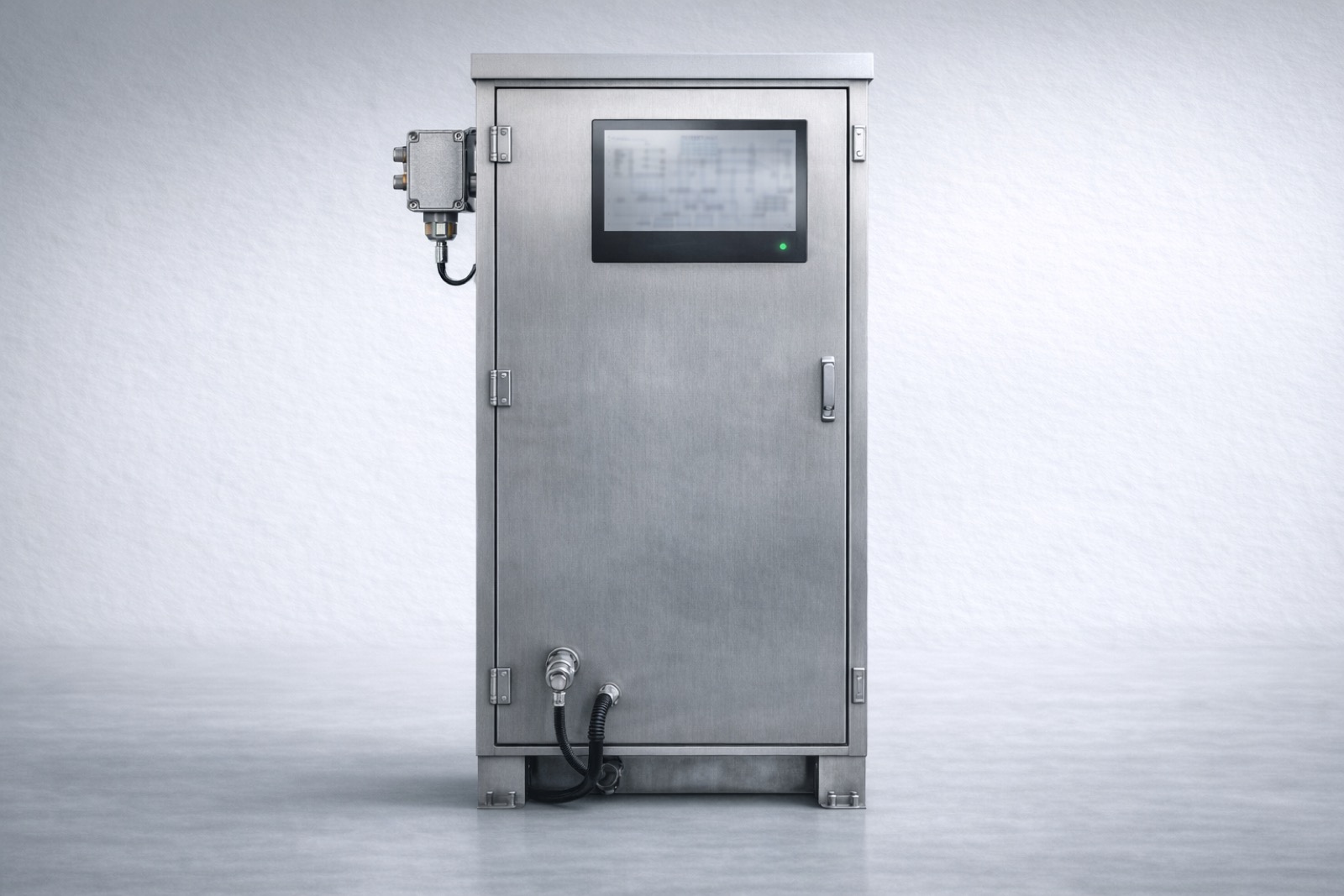
Process Chlorine Analyzer
UV-DOAS chlorine analyzer for continuous process monitoring in chlor-alkali and chemical plants
- Range
- 0–200 ppm Cl₂ (configurable to 2000 ppm)
- Accuracy
- ±1% of reading or ±0.1 ppm
- Response
- <5s T90
- Output
- 4-20mA, Modbus, HART
Overview
The GS8600-CL2 uses UV differential optical absorption spectroscopy for continuous gas-phase Cl₂ measurement in chlor-alkali production, water treatment, and chemical safety applications.
- UV-DOAS optical cell architecture
- Humidity and temperature compensation in the optical model
- Automatic reference spectrum compensation
- Corrosion-resistant wetted parts (PTFE/Hastelloy)
- SIL 2 rated for safety-critical applications
- Simultaneous Cl₂ + ClO₂ measurement option
- Cl₂ in CEMS: the wall-mounted ZS9100 UV-DOAS CEMS covers stack Cl₂ alongside SO₂/NO/NO₂/NH₃/O₂ in one enclosure
Full Technical Specifications
Key Performance
| Metric | Value | Status |
|---|---|---|
| Range | 0-200 ppm Cl2; configurable to 2000 ppm | confirmed |
| Accuracy | ±1% of reading or ±0.1 ppm | confirmed |
| Response | <5s T90 | confirmed |
| Output | 4-20mA, Modbus, HART | confirmed |
Specifications
| Specification | Value |
|---|---|
| Range | 0–200 ppm Cl₂ (configurable to 2000 ppm) |
| Accuracy | ±1% of reading or ±0.1 ppm |
| Response | <5s T90 |
| Output | 4-20mA, Modbus, HART |
Deployment Environments
Common process environments where this model is evaluated.
Certification Scope
Standards are listed with scope and status so engineering review can verify the applicable enclosure, area, and safety case.
| Standard | Scope | Variant | Status | Document |
|---|---|---|---|---|
| CE | Approval listed in v1 certification badges | Project variant | approved | On request |
| ATEX | Approval listed in v1 certification badges; zone and gas-group scope not specified in v1 source data | Project variant | approved | On request |
| SIL 2 | Functional-safety badge listed in v1 certification badges; proof-test details not stated in v1 source data | Project variant | approved | On request |
Request Documentation
Request technical datasheets, user manuals, certificates, and application notes for this model.
Evidence Notes
Gas-phase UV-DOAS chlorine architecture
The v1 application set covers chlor-alkali, chemical storage, pulp and paper, and gas-phase water-treatment dosing contexts. This gas analyzer path uses UV-DOAS, PTFE/Hastelloy wetted parts, reference-spectrum compensation, and extractive sample conditioning where wet or acid-gas matrices are present.
Technical & Engineering Details
Secondary engineering detail — expand each topic for the full measurement, envelope, sample-system, and maintenance information.
01 Measurement Principle and Limits
How the measurement is bounded
UV-DOAS measures gas-phase Cl2 absorption with differential spectral processing for continuous process monitoring.
Requires
- Corrosion-resistant PTFE/Hastelloy wetted parts for chlorine and acid-gas contact
- Reference-spectrum compensation for changing UV background
- Extractive sample conditioning selected for wet-stack or acid-gas duty
Interferents and Limits
- SO2, HCl, and HF spectral overlap can require matrix-specific compensation
- ClO2 is a declared simultaneous measurement option and should be specified separately from Cl2
- Aerosols or condensation in a wet-stack sample path can change the optical basis
- Aqueous free or total chlorine residual measurement; GS-WCL series is the separate water-domain path
- Wet-stack gas without heated or corrosion-resistant sample conditioning
- High SO2, HCl, or HF background without UV-DOAS matrix review
02 Operating Envelope
Use these limits as selection inputs, then confirm sample condition, ambient exposure, and materials before quotation.
- Cl2
- ClO2 option
- SO2/HCl/HF spectral-overlap matrix review
- Aqueous chlorine residual analysis
- Wet-stack or condensing duty without suitable heated sample conditioning
- Matrix with strong UV-absorbing acid gases without application review
03 Sample System Boundary
Sampling mode, conditioning components, and exclusions define where the analyzer responsibility ends and the sample system begins.
- UV-DOAS optical cell
- reference spectrum compensation
- PTFE/Hastelloy wetted path
- extractive sample conditioning
- Aqueous sample panels are outside this gas-phase analyzer boundary
04 Maintenance & Spares site-specific
Tasks, consumables, and access items are shown only when structured maintenance data is available.
- Inspect UV optical path and corrosion-resistant wetted components for acid-gas service
- Review reference-spectrum compensation when Cl2, ClO2, SO2, HCl, or HF matrix changes
- Confirm heated or cool-dry sample conditioning selection before wet-stack duty
- Sample-line filters or conditioning parts when configured extractively
Frequently Asked Questions
What does the GS8600-CL2 measure, and how?
The GS8600-CL2 uses UV-DOAS — UV differential optical absorption spectroscopy — to measure gas-phase Cl₂ absorption with differential spectral processing for continuous process monitoring. The published range is 0–200 ppm Cl₂ (configurable to 2000 ppm) with ±1% of reading or ±0.1 ppm accuracy and a <5s T90 response; a simultaneous Cl₂ + ClO₂ measurement option is available.
How does the GS8600-CL2 handle corrosive chlorine and acid-gas service?
It uses corrosion-resistant PTFE/Hastelloy wetted parts for chlorine and acid-gas contact. The operating envelope covers Cl₂, the ClO₂ option, and an SO₂/HCl/HF spectral-overlap matrix review; matrices with strong UV-absorbing acid gases should be reviewed before application.
Which gases can interfere with the Cl₂ measurement?
SO2, HCl, and HF spectral overlap can require matrix-specific compensation. ClO2 is a declared simultaneous measurement option and should be specified separately from Cl2. Aerosols or condensation in a wet-stack sample path can change the optical basis, and a high SO2, HCl, or HF background should get a UV-DOAS matrix review.
What sample conditioning does the GS8600-CL2 require?
It runs in an extractive configuration with reference-spectrum compensation and a PTFE/Hastelloy wetted path; extractive sample conditioning is selected for wet-stack or acid-gas duty. The compatible conditioning systems are the GS-SCS-600 Cool-Dry Sampling System and the GS-SCS-800 High-Temperature Heated Sampling System. Aqueous sample panels are outside this gas-phase analyzer boundary.
Can the GS8600-CL2 measure chlorine residual in water?
No. The GS8600-CL2 is a gas-phase Cl₂ analyzer. Aqueous free or total chlorine residual measurement is the separate water-domain path covered by the GS-WCL series, not this gas analyzer.
What approvals does the GS8600-CL2 carry?
CE, ATEX, and SIL 2 approvals are listed for this model. The ATEX zone and gas-group scope is not specified, and the SIL 2 proof-test details are not stated in the v1 source data, so both should be confirmed against the installation and safety case during engineering review.
Related & Alternatives
Alternative Solutions

Related Measurement Technologies
Measuring more than just chlorine? Explore complementary analytical categories.
 SO₂ / NOₓ
SO₂/NOₓ Analyzers
UV-DOAS and chemiluminescence analyzers for sulfur dioxide and nitrogen oxide measurement, essential for CEMS compliance and flue gas desulfurization control.
View Products Multi
Multi
Multi-Gas Analyzers
Simultaneous multi-component gas analysis using FTIR, NDIR, and combined-sensor platforms for complex process streams, comprehensive CEMS, and research applications.
View ProductsReview GS8600-CL2 against site conditions
Send gas range, sample temperature, pressure, moisture, and certification needs before final model selection.