
Industrial Moisture Analyzers — Trace H₂O & Dew-Point Monitoring Solutions
ppm-level moisture measurement with TDLAS — optical baseline stability with planned verification.
TDLAS-based moisture analyzers for trace and percent-level water vapor measurement in natural gas pipelines, process gas streams, and combustion flue gas — delivering ppb to %vol dynamic range with sub-2-second response.
Why Traditional Moisture Measurement Fails — And How TDLAS Solves It
Moisture in process gas is deceptively difficult to measure at the concentrations engineers actually care about. A chilled mirror hygrometer is the laboratory gold standard for dew point, yet in field service the mirror fouls with hydrocarbons, sulfur compounds and particulates, and the thermoelectric stack requires 30 to 300 seconds per reading. Every unplanned outage for mirror cleaning or re-alignment is time the pipeline, dryer or compressor is blind to its own specification — and the reference that looks authoritative at an audit has failed to notice two days of off-spec product leaving the plant.
Aluminum oxide (Al₂O₃) capacitive sensors are cheap and fast out of the box, but they drift — typical specifications require annual factory recalibration, and even then the sensor responds differently after a moisture upset than before. For custody transfer, semiconductor UHP gas and process validation, a drifting measurement is indistinguishable from a failed measurement: you cannot defend the number to an auditor, cannot reliably reconcile a sales-gas invoice, and cannot confidently release a wafer lot built on instrument-gas whose dew point your operators merely hope was below the specification threshold.
The cost of a wrong moisture reading compounds quickly. A natural gas pipeline that exceeds the water specification sheds hydrate inhibitor, risks hydrate plugs at pressure-reducing stations and can incur custody-tariff penalties from the receiving operator. A semiconductor UHP line that drifts above its moisture limit scraps a batch of wafers whose individual value dwarfs the analyzer capex several times over. A compressed instrument air header that develops unseen moisture pits the pilot-valve seats of an entire loop and turns a routine compressor-maintenance day into a plant-wide control-valve overhaul. TDLAS was adopted in these applications precisely because it removes the failure modes of mechanical mirrors and drifting sensors — replacing “hope the sensor is still accurate” with a measurement traceable to the physical absorption of a water line.
What a Wrong Moisture Reading Actually Costs
Pipeline Hydrate Formation
Natural gas exceeding the pipeline water specification (typically 4–7 lb/MMscf or ~100 ppm) allows hydrate nuclei to form at pressure-reducing stations and Joule–Thomson valves, plugging flow and shutting in production until chemical injection or heating clears the line.
Custody Transfer Off-Spec Penalty
Moisture out of specification at a custody transfer point means the receiving party can refuse the gas, levy a penalty, or require remedial dehydration — all at the seller’s cost. The dispute is only ever resolved with a defensible, traceable measurement.
Semiconductor UHP Batch Loss
A single unplanned excursion above the semiconductor gas specification (commonly < 1 ppb H₂O on the bulk gas header) can scrap an entire wafer lot worth six-to-seven figures. Drifting Al₂O₃ sensors give no warning until the fab has already lost the batch.
Dew point vs ppmv — reporting the same moisture two ways
Moisture can be reported as a dew-point temperature or as a ppmv concentration, and they describe the same water two ways — the difference is whether pressure is baked into the number. ppmv (or ppbv) is a mole-fraction concentration that does not change with pressure, so it is the natural unit for process and trace work and for comparing two streams directly. Dew point is the temperature at which that water would condense, which depends on pressure — the same gas has a higher dew point at higher pressure — so a dew-point spec is only meaningful with its reference pressure stated. TDLAS measures the mole fraction directly and the firmware converts to dew point at the line pressure, plus lb/MMscf for custody. When a contract is written in dew point, always pin the reference pressure; when it is written in ppmv, pressure is not needed.
How TDLAS Measures Moisture
Having framed the technology trade-offs, this section drills into how TDLAS actually derives a moisture concentration — the step-by-step physics that makes drift-free, consumable-free moisture measurement possible.
Laser Tuning Across the H₂O Absorption Line
A near-infrared diode laser is driven by a precision current ramp so its output wavelength scans across a single, isolated water-vapor absorption feature. The line is chosen for minimal overlap with methane, CO₂, and other background species, which is what gives TDLAS its low cross-interference.
Beer–Lambert Absorption Measurement
The laser beam crosses the measurement cell (in-situ or extractive) and is detected on the far side. The wavelength-resolved absorbance is governed by the Beer–Lambert law and is fitted to the water-vapor mole fraction in the cell — with the firmware compensating pressure, temperature and line-shape effects — independent of sensor chemistry or consumable material.
Digital Concentration Output
Modern TDLAS firmware runs the scan hundreds of times per second, fits the absorption line shape in real time, and returns ppm / ppb / dew-point / lb-MMscf on a 4–20 mA loop, Modbus register, HART variable or OPC-UA tag — ready to drop into a DCS or historian with no signal conditioning.
TDLAS vs Chilled Mirror vs Capacitive — Moisture Technology Comparison
Three measurement principles share the industrial moisture-analyzer market, each with distinct physics, response characteristics and maintenance envelopes. The table below reports real-world operating specifications so engineers can benchmark technologies against their own application — sample cleanliness, concentration range, response-time requirement, hazardous-area classification, and the site maintenance appetite that is actually available day to day — rather than relying on marketing datasheet extremes. Where the numbers here disagree with a vendor datasheet, trust the operating envelope of your installed base and ask for the test conditions behind the extreme claim.
| Technology | Principle | Range | Accuracy | Response | Best For / Limitations |
|---|---|---|---|---|---|
| TDLASGESHINE | A tunable diode laser scans across a specific H₂O absorption line in the near-infrared; absorption is proportional to moisture concentration via Beer-Lambert law. | 0.1 ppm to 30 %vol | ±1 ppm or ±1% of reading | T90 < 2 s | Trace moisture in natural gas, process gas drying verification, semiconductor UHP gas, fast-response in-situ applications. Higher upfront cost than capacitive sensors; optical windows require periodic cleaning in dirty gas streams. |
| Chilled Mirror | A mirror surface is cooled until condensation forms, detected by an optical sensor. The dew/frost point temperature is a direct measure of moisture content. | −100 °C to +20 °C dew point | ±0.1 °C dew point | T90 30–300 s (depending on step size) | Primary reference standard, laboratory calibration, custody transfer verification requiring traceable measurements. Very slow response; mechanical moving parts; contamination-sensitive mirror surface requires frequent cleaning; high maintenance. |
| Capacitive (Al₂O₃) | A thin-film aluminum oxide capacitor changes capacitance as water molecules adsorb into the porous dielectric layer, proportional to moisture partial pressure. | −110 °C to +20 °C dew point | ±2 °C dew point | T90 30–120 s | Cost-effective spot checks, compressed air monitoring, non-critical drying applications with moderate accuracy requirements. Sensor drift over time (requires annual recalibration); slow recovery from moisture upset; hysteresis effects. |
When to Select Which Technology
TDLAS is the modern default for continuous online moisture measurement where drift, consumables and response time all matter — trace-ppm natural-gas dehydration monitoring, process-gas drying verification, ATEX hazardous-area installations, semiconductor UHP bulk-gas headers, and any application where a traceable, drift-free record is part of the quality or compliance case. Chilled mirror remains the laboratory and custody-transfer reference standard where a primary, traceable dew-point measurement is needed and a 30- to 300-second response is acceptable; it is not the right technology to close a control loop on a fast-moving dehydrator. Capacitive aluminum-oxide sensors are the most cost-effective choice for non-critical compressed-air or instrument-air spot monitoring where a factory recalibration each year is operationally feasible and moisture upsets are infrequent, but the annual drift budget makes them a poor fit for custody transfer, UHP gas or anywhere the measurement feeds a regulated report.
Moisture Analyzer Installation — Extractive, In-Line, or Compact Panel
ZS8100-H2O Process TDLAS
Heated extractive sample chain for natural gas dehydration verification, process gas drying, and SCS-routed combustion flue gas moisture. Hazardous-area field enclosure; ATEX Zone 1 scope confirmed per certificate.
Heated sample probe + heated transfer line above the matrix dew point, particulate filter, optional Nafion permeation dryer for cleanup before optical cell.
- NG TEG / molecular sieve dehydration outlet verification
- Ethylene / propylene / chlorine drying system monitoring
- Combustion flue gas moisture for SCR / heat rate optimization
Process Line Direct Tap
Direct flange-mount or pipe-tap installation on clean dry process gas streams. No extractive sample chain; optical cell connects to the line via short stub. Used where matrix is already low dew-point.
Clean dry gas, no particulate carryover, dew point already below optical cell window temperature. Bypass loop for isolation maintenance.
- Air separation product line moisture purity verification
- Semiconductor UHP gas delivery (N₂, Ar, He) trace H₂O
- Clean process gas where matrix already meets dew-point spec
Compact / Portable TDLAS — Online Indoor Duty
A half-rack panel-mount / portable TDLAS configuration with built-in sample conditioning, suited to compressed air dryer outlet monitoring, instrument gas trim, and process drying verification on tight panel real estate. Referenced here as a project-review companion to the ZS8100-H2O, available by project review rather than as a standalone catalogue SKU on this page.
Internal flow path handles a low-ppm indoor range; built-in flow controller and particulate filter. No heated line needed for dry-air duty.
- Compressed air dryer outlet continuous monitoring (ISO 8573-1 class 4 / 5)
- Instrument gas / nitrogen blanket header trim
- Process drying skid panel where space is tight
Capacitive Al₂O₃: lowest entry. Annual recalibration drift, hysteresis on moisture spikes, sensor replacement at 3 years.
Compact / portable TDLAS configuration: panel-mount upfront, no consumable cell. Favorable 3-year cost for low-ppm indoor online duty.
ZS8100-H2O process TDLAS: highest CAPEX with heated SCS. No tape / cell consumable; favorable 5-year cost for ppb-grade NG duty.
ZS8100-H2O vs Compact / Portable TDLAS Configuration — Technical Specifications & Selection Guide
Both moisture paths shown here are TDLAS — the underlying measurement physics is the same. The decision between the in-line ZS8100-H2O and a compact / portable TDLAS configuration is an installation and certification question, not a technology question. The matrix below lines up every dimension that typically determines which path fits site: form factor, dynamic range, accuracy class, sample-flow budget, hazardous-area rating, DCS protocol support and the operator workflow on the HMI. Use it to narrow down within a minute, then ask engineering to confirm against your sample-conditioning drawings.
| Parameter | ZS8100-H2O | Compact / Portable TDLAS |
|---|---|---|
| Form Factor | In-line Process (field enclosure) | Compact half-rack panel / portable configuration |
| Range | 0.1 ppm – 30 %vol H₂O | Indoor low-ppm envelope, confirmed per project |
| Accuracy | ±1 ppm or ±1% of reading | Compact-class accuracy, confirmed per project |
| Response T90 | < 2 s | Comparable TDLAS response, configuration-dependent |
| Sample Flow Requirement | 0.5 – 2 L/min (integrated conditioning) | Low-flow with built-in filter + flow control |
| Certifications | CE, ATEX Zone 1 (scope confirmed per certificate) | Indoor safe-area scope, confirmed per project |
| Outputs | 4–20 mA, Modbus, HART | Standard analog & serial I/O, confirmed per project |
| Display / UI | Industrial HMI with remote-diagnostic access via Modbus TCP / OPC-UA | Compact local display; configuration confirmed per project |
| Typical Use | Natural gas dehydration, process drying, semiconductor UHP, flue gas | Compressed air, instrument gas, plastics drying, pharmaceutical purity |
| Maintenance | Auto-validation with internal reference cell; 5-year calibration window | Auto-validation; maintenance & service interval confirmed per project |
The matrix settles which path is the right fit in principle. The product section immediately below expands the in-line ZS8100-H2O into full datasheet context, with the compact / portable TDLAS configuration available by project review — engineering confirms certifications, I/O and dimensions against your drawings.
GESHINE Moisture Analyzer Series
ZS8100-H2O — process Zone-1 ATEX TDLAS. A compact / portable TDLAS configuration is referenced as a project-review companion.
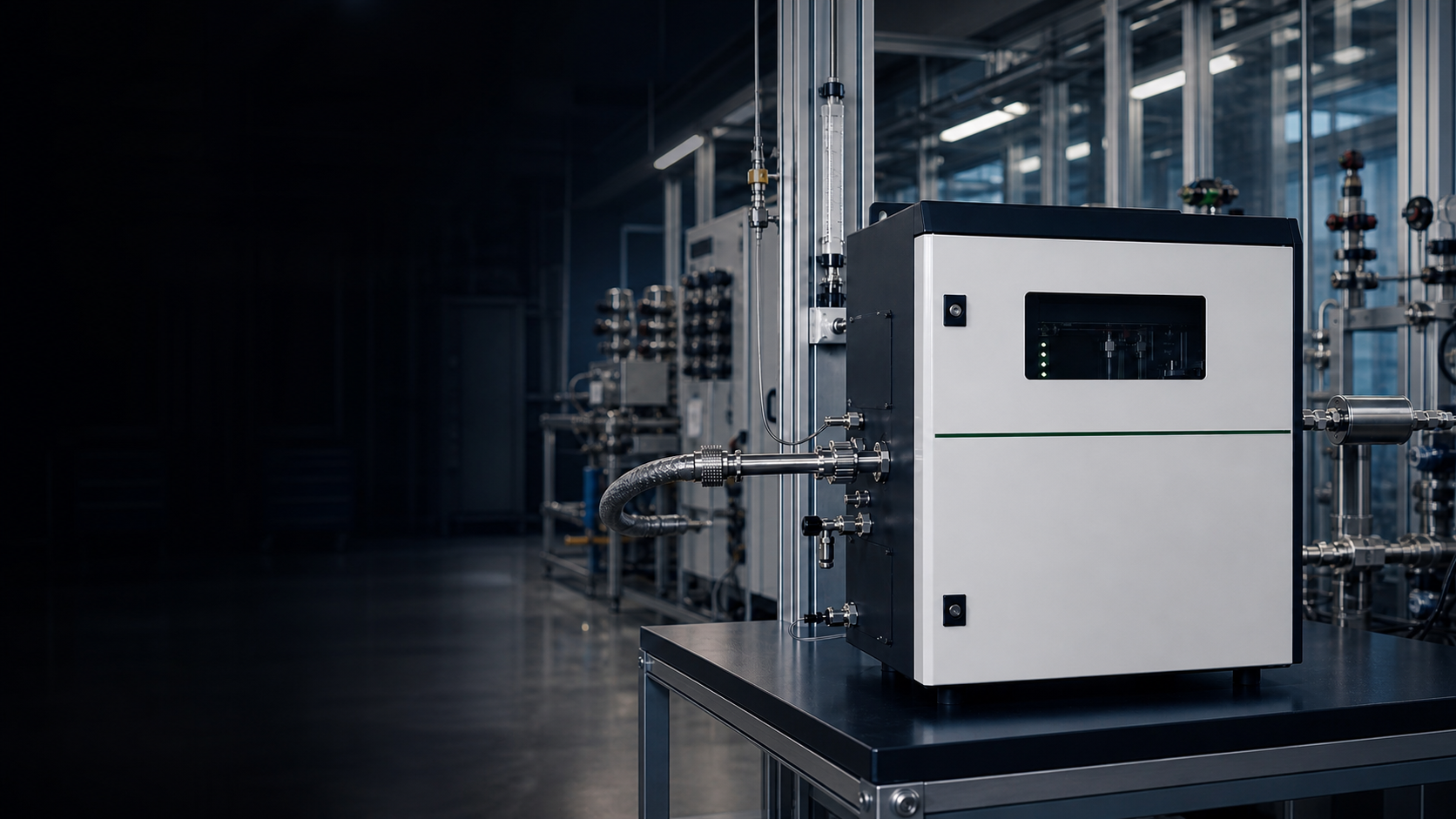 In-line Process
ZS8100-H2O · TDLAS
ZS8100-H2O Process Moisture Analyzer
TDLAS-based trace moisture measurement for natural gas dehydration verification and process gas drying.
- Range
- 0.1 ppm – 30 %vol
- Accuracy
- ±1 ppm or ±1%
- Response
- <2s T90
- Output
- 4-20mA · Modbus · HART
Compliance and Certifications for Moisture Analysis
Moisture analyzers reach into environments that range from indoor compressed-air panels to ATEX-classified natural-gas metering skids to semiconductor cleanroom gas cabinets. Each of those environments imposes its own compliance obligation on the instrument — enclosure protection, ignition-source management, quality-system traceability — and GESHINE scopes its certifications per SKU so that a buyer can verify the specific instrument against the specific site drawing before procurement.
European conformity for health, safety, and environmental protection.
Applies to ZS8100-H2O; confirmed per project for a compact / portable TDLAS configurationExplosion-protected field enclosure for hazardous-area installation.
Applies to ZS8100-H2O onlyQuality management system reference; certificate scope confirmed per project.
QMS referenceATEX coverage on the ZS8100-H2O field enclosure is Zone 1 — suitable for natural-gas dehydration outlets, Joule–Thomson skid areas, loading/unloading metering stations and similar classified areas; the specific protection concept and marking are confirmed per project against the site hazardous-area drawings. A compact / portable TDLAS configuration is scoped for indoor, safe-area installation only — with its certification confirmed per project — and should not be specified for hazardous-area service. Every analyzer ships with a factory calibration certificate, with traceability documentation confirmed per project, and — on request — a supplementary commissioning documentation package suitable for regulated industries (pharmaceutical GxP, custody-adjacent moisture monitoring, environmental compliance).
Moisture Monitoring Across Industries and Processes
Moisture shows up in gas streams as a quality, safety and efficiency variable across many industries. Each of the eight scenarios below has its own measurement envelope — concentration range, sample pressure and temperature, hazardous-area classification, reporting unit, integration target — and each maps to either the in-line ZS8100-H2O or a compact / portable TDLAS configuration depending on that envelope. The cards call out the specific challenge, the TDLAS solution, and the single metric that decides whether the installation is working.

Natural Gas Dehydration (TEG & Molecular Sieve)
ChallengeGlycol and molecular-sieve dehydration units must deliver < 7 lb/MMscf (≈ 150 ppmv, basis-dependent) pipeline water specification while absorbers foul, regenerator temperatures drift and TEG concentration changes.
TDLAS SolutionA TDLAS analyzer on the dryer outlet reports real-time ppm H₂O with T90 < 2 s, catching breakthrough before the pipeline sales spec is violated and proving regeneration has fully dried the bed.

Pipeline Custody Transfer
ChallengeCustody transfer demands defensible, traceable moisture measurement. Chilled-mirror reference units are slow and contamination-prone, while capacitive sensors drift between annual recalibrations.
TDLAS SolutionTDLAS provides a continuous digital measurement with no drift and no consumable sensing element, creating an auditable record that both seller and buyer can reference against the ISO 18453 water-content/dew-point correlation, with ASTM D5454 as the electronic moisture-analyzer measurement practice.
Semiconductor UHP Gas Delivery
ChallengeUltra-high-purity gas headers for deposition, etch and anneal tools require sub-ppb H₂O stability. A drifting moisture sensor can scrap a full wafer lot before the drift is even noticed.
TDLAS SolutionContinuous TDLAS monitoring detects excursions in real time, and the absence of consumable cells removes the batch-to-batch sensor variability that plagues electrolytic and capacitive instruments in UHP service.
Hydrogen Production & Electrolyzer Dryness
ChallengeGreen-hydrogen electrolyzers and pink/blue hydrogen purification trains must deliver dry hydrogen to pipeline or storage specifications. Traditional sensors are slow to recover from the saturated-then-dry transition at startup.
TDLAS SolutionTDLAS tracks moisture from wet startup to specification dryness without suffering the hysteresis of capacitive sensors, enabling faster operator release of the product-hydrogen stream and tighter dryer cycling.

Compressed Air & Instrument Quality
ChallengePlant compressed-air and instrument-air headers must meet ISO 8573-1 class specifications; a failed desiccant bed or a flooded air dryer will silently pit pneumatic actuators across the entire facility.
TDLAS SolutionA compact / portable TDLAS panel configuration tracks dew point continuously at the dryer outlet, triggering bed-switch alarms before downstream instruments are damaged.
Plastics Drying Process Control
ChallengeEngineering plastics (PA, PET, PC) are hygroscopic; molding with residual resin moisture above specification produces splay, bubbles and degraded mechanical properties — and the fault is only seen at the press.
TDLAS SolutionA moisture analyzer on the dryer process-air discharge confirms the hopper is delivering dry air at the required dew point and flags desiccant saturation before defective parts are produced.
Pharmaceutical Gas Purity
ChallengeCompressed gases feeding pharmaceutical cleanrooms and filling lines must meet compendial moisture limits; validation expects documented continuous measurement, not spot samples.
TDLAS SolutionTDLAS produces a drift-free, traceable moisture record suitable for GxP data-integrity requirements, with digital outputs that integrate directly into validated historian and audit-trail systems.
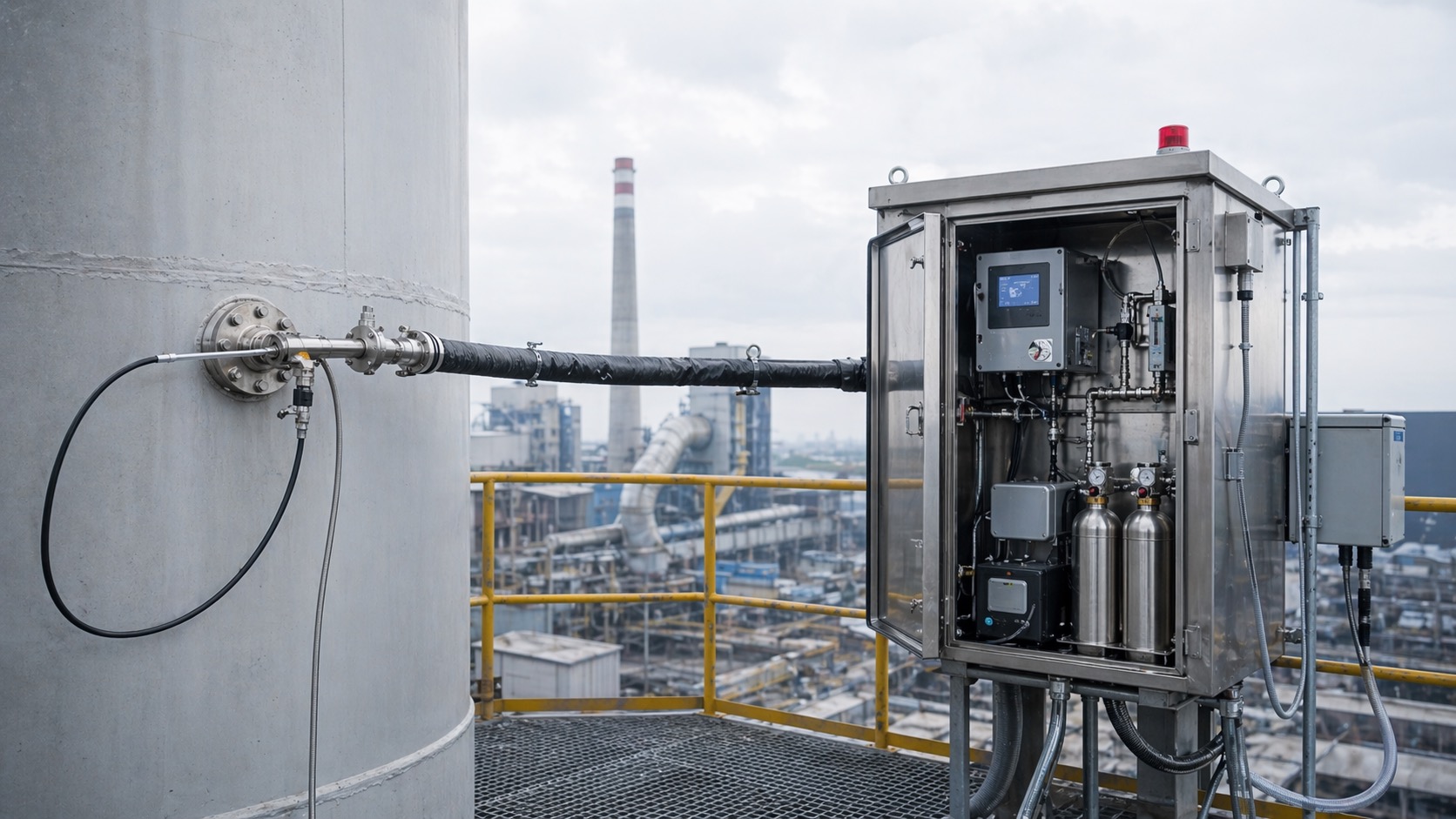
Flue Gas Moisture for Heat Rate Optimization
ChallengeUtility and industrial boiler operators need continuous flue-gas moisture to close the loop on heat rate, economizer efficiency and combustion air–fuel ratio — all of which degrade silently without a flue water measurement.
TDLAS SolutionAn in-situ TDLAS across the duct delivers a stable H₂O reading that the DCS can feed into heat-rate and excess-air optimization routines without tapping or conditioning the sample.
Across these eight application families, one kept ZS8100-H2O product plus a project-reviewed compact / portable path cover the market because TDLAS has the dynamic range. The next block documents the certifications that govern where and how these analyzers can be installed.
Why GESHINE for Moisture Monitoring
TDLAS is the GESHINE competitive moat — H₂O is our sweet spot for laser absorption spectroscopy.
TDLAS Is Our Core Competence
GESHINE TDLAS is built around H₂O as the canonical absorption target — the technology was designed for this gas before any others. Single-line laser absorption gives ppb-grade sensitivity with no consumable cell.
Sub-2-Second Response
Closed-loop dehydration control needs <2 s T90 to track upset transients without overshoot. TDLAS is the only moisture technology that delivers that response time at trace concentrations.
ATEX Zone 1 Enclosure Option
ZS8100-H2O offers an ATEX Zone 1 hazardous-area field enclosure for hazardous-area installation — suited to NG processing, refinery, and petrochemical duty; the specific protection concept, marking and certificate scope are confirmed per project against the site drawings.
Manufacturer Direct
Direct access to the engineering team that designed and built your moisture analyzer. Shorter lead times, competitive pricing, and factory-level technical support including optical window service and span gas traceability.
Procurement Guide — Pricing, Lead Time, and Integration Support
Moisture analyzers fall into three commercial tiers by form factor and hazardous-area scope. Ranges are qualitative for first-pass budgeting; ask for a budgetary quote scoped to your site conditions.
Half-rack or panel-mount / portable TDLAS configuration for indoor compressed-air, instrument-gas and process-drying duty in the low-ppm range. Includes built-in sample conditioning with standard analog and serial output; exact range, I/O and pricing confirmed by project review with communication options and cabinet integration.
Field-housed in-line TDLAS with wide dynamic range (sub-ppm to %vol) for safe-area natural-gas, process-gas drying and UHP bulk-header duty. ZS8100-H2O base configuration. Price moves with flow-panel integration, HART licensing, heated-line requirements and sample-cell metallurgy (SS316 standard; Hastelloy / PTFE on request).
ZS8100-H2O with ATEX Zone 1 hazardous-area enclosure option (scope confirmed per certificate), hazardous-area I/O interfaces or barriers as required by the site hazardous-area drawings, and the associated commissioning package for classified natural-gas metering, Joule–Thomson skids and chemical-plant hazardous areas. Upper end covers heated extractive-loop integration, SIL-2 loop compatibility review, and multi-point skid packages.
Buyer Advisory
Qualitative tiers are useful for first-pass budgeting only. The final quotation for a moisture analyzer depends on sample pressure and temperature, contaminant loading, hazardous-area classification, reporting unit required (ppm vs dew point vs lb/MMscf), DCS protocol, and whether the project includes sample conditioning, commissioning or operator training. Bring those boundary conditions to the RFQ and the quote will converge within one or two iterations; send only a datasheet request and the instrument tends to get specified for a harder environment than the site actually needs.
What Moves the Price
The single biggest price mover is the ATEX / hazardous-area certification of the field enclosure — the Zone 1 hazardous-area variant of the ZS8100-H2O is typically the largest single line-item on the quote, depending on third-party notified-body lead time. The next tier of moves comes from sample-conditioning integration: a fast-loop regulator, coalescing filter, heat-traced sample line and flow panel can each add cost individually and together often match the analyzer price on dirty or high-pressure sources. Optional items — HART over 4–20 mA, OPC-UA licensing, extended-warranty service contracts, redundant-optical-path options, custom HMI localization — are additive but typically modest. TDLAS carries no recurring sensor-replacement line item: there is no consumable cell, no electrolyte, no mirror service kit, so the total cost of ownership is dominated by capex and commissioning rather than the consumable curve that drives chilled-mirror and Al₂O₃ alternatives.
Warranty, Calibration, and Long-Term Support
TDLAS instruments earn their keep over a decade-plus of service, so the support model matters as much as the datasheet. Below: the support channels, the lead-time schedule, and the warranty and calibration commitments that back every moisture analyzer.
After-Sales Support
Technical Support
Application engineers are reachable by phone and email on a guaranteed next-business-day first response. For the ZS8100-H2O connected to the plant network, remote diagnostics over Modbus TCP or OPC-UA allow the GESHINE service team to review optical-path alignment, reference-cell validation history and alarm logs without needing a site visit — which typically halves the mean-time-to-diagnosis for field issues.
Calibration & Validation
The ZS8100-H2O runs an automatic internal reference-cell validation cycle on schedule, and TDLAS does not require field recalibration the way capacitive or electrolytic instruments do; the validation approach for a compact / portable configuration is confirmed per project. Where the quality system or custody contract requires on-site verification, GESHINE dispatches factory-trained engineers with traceable moisture-generator reference kits to verify the installed analyzer against a reference standard and issue a calibration certificate.
Spare Parts & Critical Components
Laser modules, optical-cell windows, sample filters and reference-validation assemblies are stocked for 48-hour dispatch from the factory to minimize installation downtime. A recommended 5-year spares package is available at order so that the field site does not depend on emergency procurement when a component reaches end of life, and individual line items can be added to the quote on request. Customs and documentation for cross-border shipments are pre-prepared by the GESHINE logistics desk to keep customs-hold risk out of the critical path when an instrument is down.
Operator Training
A 2–3 day on-site commissioning visit walks the operators through HMI workflows, alarm response, internal validation procedures and the escalation path when a reading drifts out of envelope. Remote operator-training packages for shift handover and additional headcount are delivered through a customer portal with recorded modules, screen-sharing sessions with an application engineer, and per-user assessment worksheets. Training tracks can be scoped separately for maintenance technicians, process engineers and quality / compliance personnel because each of those roles consumes the analyzer differently.
Lead Time
- Standard configuration
- 4–6 weeks from order confirmation for safe-area ZS8100-H2O builds, including factory calibration and production test report; lead time for a compact / portable TDLAS configuration is confirmed per project.
- ATEX Zone 1 / custom enclosure
- 8–10 weeks — 4–6 weeks base build plus 2–4 weeks for ATEX certification package verification, notified-body document compilation and certified-enclosure kitting.
- Sample-conditioning skid integration
- Add 2–4 weeks when the order includes fast-loop regulator, coalescing filters, flow panel, or heat-traced sample lines as part of the delivered package.
- MOQ
- Single units are shipped as evaluation / sample orders; volume pricing applies from 5 units and up. Framework-agreement pricing available for multi-year capex programs.
Warranty & Calibration Traceability
- Standard factory warranty
- 24 months from commissioning (or 30 months from shipment, whichever expires first) covering electronics, laser module, sample-conditioning hardware and optical windows.
- Extended warranty options
- 36- and 60-month extended warranties available at order; includes a defined annual preventive-maintenance visit and prioritized spares availability.
- Calibration traceability
- Every analyzer ships with a factory calibration certificate, with traceability documentation confirmed per project. On-site verification against traceable moisture-generator reference standards supported on request.
- Out-of-warranty service
- Fixed-rate laser-module refurbishment, optical-cell cleaning and firmware upgrade programs are offered to keep TDLAS units in service for 10+ years — critical for installations where capex approval cycles are slow.
Frequently Asked Questions About Moisture Analyzers
From TDLAS vs chilled mirror trade-offs to ATEX installation, custody-transfer standards, sample conditioning and trace UHP work.
TDLAS vs chilled mirror — which should I specify for natural gas dehydration monitoring?
Chilled-mirror hygrometers remain the traceable reference for dew-point calibration, but in field natural-gas service they are not the right control instrument: the mirror is susceptible to hydrocarbon fouling, the mechanical chiller needs 30 to 300 seconds per reading, and every cleaning cycle blinds the dehydration unit. TDLAS is the modern field choice — no moving optics, sub-2-second response, no consumable sensing element, and a native 4–20 mA / Modbus / HART output the DCS can close the loop on. Keep the chilled mirror in the lab for annual verification; run TDLAS online.
In-line process vs compact / portable TDLAS — which moisture path do I need?
Pick the ZS8100-H2O when you need a wide dynamic range (0.1 ppm to 30 %vol H₂O), field installation with an ATEX Zone 1 hazardous-area enclosure option (scope confirmed per certificate), fast response for trace-ppm natural-gas or process-gas service, and full industrial connectivity including HART. A compact / portable TDLAS configuration fits when the measurement falls within a low-ppm indoor range, the install is indoors or inside a cabinet, and a compact ½-rack panel with built-in sample conditioning is a better mechanical fit — typical uses are compressed air, instrument gas, plastics drying and pharmaceutical purity; that path is available by project review rather than as a standalone catalogue SKU. When in doubt, request engineering review and we will size against your sample flow, pressure and hazardous-area drawings.
How often does a TDLAS moisture analyzer need to be calibrated?
TDLAS is a spectroscopic measurement referenced to the physical Beer–Lambert absorption of the water line, not to a drifting sensor surface, so recalibration is infrequent compared with capacitive or electrochemical instruments. GESHINE specifies a 5-year calibration interval for the ZS8100-H2O under typical process conditions, and the ZS8100-H2O runs an automatic validation cycle against an internal reference cell between service visits; the validation approach and schedule for a compact / portable configuration are confirmed per project. Traceable verification against a chilled-mirror or other traceable reference standard can be carried out in the field on a documented schedule to satisfy quality-system or custody-transfer requirements.
How do I install a ZS8100-H2O in an ATEX hazardous area?
The ZS8100-H2O field enclosure offers an ATEX Zone 1 hazardous-area option — Ex marking, gas group and zone confirmed per certificate — with an explosion-protected housing and hazardous-area signal interfaces on the process-side penetrations as required by the site drawings. Typical installation is on a dedicated fast-loop sample line tapped from the dehydration outlet header, with a pressure regulator, coalescing filter and flow controller sized to deliver the rated 0.5–2 L/min into the analyzer. Route the 4–20 mA / Modbus / HART signal through an appropriate barrier or isolator back to the control room. Always follow IEC 60079 wiring practices and the site-specific hazardous-area drawings signed off by the responsible engineer.
Can a moisture analyzer report both ppm and °C dew point?
Yes. Water vapor concentration and dew point are thermodynamically equivalent at a given pressure, so the analyzer can report in whichever unit the downstream system expects. The ZS8100-H2O exposes ppm as the native reading and provides on-device conversion to °C dew point, lb/MMscf for custody transfer, or partial pressure — the selection is made in the HMI or over the digital interface; the reporting units available on a compact / portable configuration are confirmed per project. Because dew point varies with pressure while ppm does not, make sure the target reporting unit matches the pressure at which the reference specification is defined.
Why do aluminum oxide (Al₂O₃) moisture sensors drift?
An Al₂O₃ sensor is a thin porous dielectric whose capacitance changes as water adsorbs into the pore structure. The pore geometry itself changes slowly over time with thermal cycling, contamination, aggressive species and repeated moisture upsets, so the same concentration reads as a different capacitance six or twelve months later. Manufacturers compensate with annual factory recalibration, but between recalibration cycles the user has no field way to verify the drift magnitude. TDLAS sidesteps the problem because the measurement is the absorbance of a specific water absorption line, which is a physical constant and does not age.
Is TDLAS suitable for semiconductor ultra-high-purity gas moisture monitoring?
TDLAS is a strong fit for UHP bulk-gas headers where sub-ppb stability is the requirement, because the measurement has no consumable sensor to age, no electrolyte to deplete and no mechanical mirror to foul. The most critical point-of-use requirements in lithography and ALD tools sometimes still use secondary techniques for confirmation at the wafer, but at the bulk-gas distribution level TDLAS removes the drift problem that plagues capacitive and electrolytic instruments. For site-specific method selection and verification protocols in ultra-high-purity environments, consult the industry practice guides listed in the References section below.
What sample conditioning does a moisture analyzer need?
A moisture measurement is only as representative as its sample loop. For the ZS8100-H2O, provide a fast-loop tap off the main line, a pressure regulator stepping down to ~1 barg, a coalescing filter to protect the measurement cell from liquid carry-over, and a flowmeter holding 0.5–2 L/min. For a compact / portable TDLAS configuration, the on-board filter and flow control handle a low-flow sample directly, with the exact flow window confirmed per project. Avoid long dead-leg sample lines made of hygroscopic tubing (nylon, Teflon® can be acceptable but stainless steel is preferred for trace service) because residual wet tubing will absorb and then re-emit moisture for days.
Can I integrate the analyzer into my existing DCS over Modbus, HART, or OPC-UA?
Yes. ZS8100-H2O exposes 4–20 mA with HART, Modbus RTU and Modbus TCP for DCS and historian integration, plus an OPC-UA endpoint for plant digital-twin and predictive-maintenance platforms. A compact / portable TDLAS configuration provides standard analog and serial outputs for compact integrations, confirmed per project. On the ZS8100-H2O, every reading — moisture concentration, internal reference validation status, sample flow, enclosure temperature — is available as a discrete register address, which makes it straightforward to map the analyzer into any mainstream industrial control system or historian without bespoke gateway engineering, protocol translation layers, or custom driver development on the plant side.
How does TDLAS moisture measurement map to pipeline custody-transfer standards?
Custody-transfer moisture is framed by ISO 18453 (natural gas — correlation between water content and water dew point), with ASTM D5454 the electronic moisture-analyzer measurement practice; GPA 2261 covers natural-gas composition by gas chromatography rather than the moisture acceptance envelope itself. TDLAS reports a direct mole-fraction measurement that can be converted to dew point at the contract pressure, with full digital traceability and no moving sensing element to introduce uncertainty between custody events. For disputes, a traceable chilled-mirror verification can be performed on the same sample loop, with the TDLAS providing the continuous data record between verifications.
Why does my TDLAS moisture reading drift when gas composition changes (C1/C2/CO₂ co-absorber bias)?
A TDLAS moisture reading can shift when the background gas changes because neighbouring absorption lines from other species distort the water line — a co-absorber bias. TDLAS picks an isolated H₂O line, but the wings of strong absorbers such as methane (C1), ethane (C2) and CO₂ can overlap or pressure-broaden the water feature, and the broadening itself depends on the background gas mix. So a unit calibrated on one composition can read slightly high or low when the C1/C2/CO₂ ratio moves, even though the actual moisture is unchanged. Good TDLAS analyzers compensate by selecting a line with minimal cross-overlap, applying composition-dependent broadening corrections and, where needed, taking a background-gas input. If your stream composition swings widely (matrix range project-specific), give the application engineer the expected matrix envelope so the line selection and broadening model are sized for it rather than for a single nominal composition.
Measuring trace moisture in high-purity / UHP lines — what changes?
Measuring trace moisture in high-purity (UHP) lines changes the sampling system more than the analyzer — at a project-specified trace limit the line and fittings become the dominant error source. Water clings to and slowly outgasses from internal surfaces, so trace work requires electropolished stainless steel or fully inert wetted parts, all-welded or face-seal fittings, no hygroscopic tubing and minimal dead legs, because a single wet dead leg will feed moisture back into the stream for hours. The system must also be leak-tight to prevent ambient water ingress, and it needs a long, documented dry-down before readings are trusted (purge time project-specific). Validation differs too: at trace levels you verify against a moisture generator or a reference standard rather than a span gas, and you confirm the whole loop, not just the cell. TDLAS suits the duty because it has no consumable element to age, but the sampling discipline is what actually delivers the trace number.
How does flue gas moisture affect CEMS reporting?
Regulatory emission limits are typically reported on a dry-gas basis at a standard O₂ reference (6% for coal, 11% for biomass, 15% for gas turbine, 0% for waste). So flue gas moisture must be measured to correct the wet-basis analyzer reading to a dry-basis reported value. TDLAS moisture measurement in flue gas is paired with O₂, SO₂, NOₓ for the complete dry-basis CEMS correction. Heat rate optimization on power plants also uses flue gas moisture as a process variable.
What industries use moisture analyzers?
Moisture monitoring spans natural gas processing (TEG / molsieve dehydration, pipeline custody transfer), petrochemical (ethylene / propylene / chlorine drying for catalyst protection), semiconductor (UHP gas delivery for plasma etch, CVD, ALD), air separation (oxygen / nitrogen / argon product purity), power generation (flue gas moisture for CEMS correction and heat-rate optimization), compressed air systems (instrument air dryer verification), and food & pharma processing (atmosphere control in lyophilization and inerting).
References & Transparency
GESHINE’s moisture-analyzer recommendations rest on our engineering team’s hands-on experience with TDLAS moisture measurement across natural-gas, process-gas and UHP duty. We scope the ZS8100-H2O against the classic natural-gas / process-gas / UHP moisture-measurement envelope, and a compact / portable TDLAS configuration against the indoor instrument-air, compressed-air and drying-process envelope, because those are the two envelopes that our installed base actually covers — we do not recommend a TDLAS solution where a far cheaper Al₂O₃ spot sensor would satisfy the operating requirement, and we do not recommend our own SKUs into edge cases (cryogenic liquid moisture, aerosol-laden sample streams, unbounded laser-aggressive gas matrices) where engineering review is the honest answer. Every specification on this page is sourced from our production-test data, the corresponding product datasheet, or the industry standards cited in the References block.
Standards & References
- ISO 18453:2004 — Natural gas — Correlation between water content and water dew point
- ASTM D5454-11(2020) — Standard Test Method for Water Vapor Content of Gaseous Fuels Using Electronic Moisture Analyzers
- GPA 2261-25 — Analysis for Natural Gas and Similar Gaseous Mixtures by Gas Chromatography (natural-gas composition / matrix context, not a moisture acceptance method)
- SEMI F112-0820 — Test Method for Moisture Dry-Down Characteristics of Gas Delivery Systems by Cavity Ring-Down Spectroscopy (CRDS), for UHP gas-delivery moisture work (reference only)
- ISO 8573-1:2010 — Compressed air — Part 1: Contaminants and purity classes
- IEC 60079-0 / -1 / -11 — Explosive atmospheres (general requirements, flameproof “d”, intrinsic safety “i”) for hazardous-area equipment
- ISO 9001:2015 — Quality management systems — Requirements
Standards are cited for engineering context. Certificate scope and applicability are confirmed per project; listing a standard here is not a claim of product certification to it.
Ready to Solve Your Moisture Measurement Challenge?
To configure the optimal TDLAS moisture analyzer for your duty point, please have these details ready:
- Moisture range (ppm or dew-point °C) and target accuracy
- Matrix: NG / inert UHP / compressed air / flue gas / process drying
- Sample point pressure, temperature, hydrocarbon load
- Form factor preference: process Zone-1 rack vs compact panel-mount
- Compliance regime: pipeline tariff / CEMS / semi UHP / ISO 8573 class
- Hazardous area classification (ATEX zone, if applicable)
- Response time requirement (T90) for closed-loop control
- Output protocols (4-20mA, Modbus RTU/TCP, HART, OPC-UA)
Get TDLAS Moisture Consultation
Our application engineers specialize in TDLAS trace moisture across natural gas, semiconductor UHP, and process drying duty — H₂O is our core competence.