
NDIR Multi-Gas Analysis
Syngas Analyzer — NDIR Multi-Gas Analysis for Gasification & Industrial Process Control
Real time CO, CO₂, CH₄, H₂ & O₂ measurement for gasification process control. Online / rack-mount ZS6300 configuration for biomass, coal, and waste-to-energy applications.
Why Accurate Syngas Analysis Matters for Your Gasification Process
Inaccurate syngas composition readings feed the wrong air-fuel ratios into your gasifier control loop. Consequences stack fast: incomplete carbon conversion, reduced thermal efficiency, and wasted feedstock that erodes margins on every operating hour. When CO readings drift by even 2-3% from actual values, the downstream combustion or synthesis process either runs fuel-rich (wasting energy) or fuel-lean (risking flame instability and unplanned shutdowns).
Syngas — the gas mixture produced by gasification of carbonaceous feedstock — typically contains carbon monoxide (CO) at 30-60%, hydrogen (H₂) at 25-30%, carbon dioxide (CO₂) at 5-15%, and methane (CH₄) at 0-5%, with the rest as N₂ (US DOE NETL). Pyrolysis and partial oxidation reactions within the gasifier create this sample gas composition, which shifts constantly with feedstock moisture, particle size, gasification temperature, and oxygen (O₂) supply. Without real-time multi-gas data feeding back to your control system, operators are flying blind between periodic grab-sample analyses.
Continuous multi-gas monitoring closes the loop between measurement and process control. A continuous online gas analyzer installed at the gasifier outlet delivers updated composition data in seconds — fast enough for PLC-driven adjustments to air/steam injection. Whether you run a permanently installed online system for 24/7 production monitoring or need field commissioning and periodic spot checks, GESHINE scopes the deployment by project review.
So which measurement technology delivers the speed, accuracy, and reliability your gasification process demands — at a total cost of ownership that makes engineering sense.
GESHINE Syngas Analyzer Series — Models, Specifications & Selection Guide
Multi-component syngas / coal-gas analysis on GESHINE’s ZS6300 platform — NDIR for CO, CO₂, CH₄ and hydrocarbons, TCD for H₂, and electrochemical for O₂. Configured to your gasification process.
ZS6300 Syngas / Coal-Gas Analyzer
Rack-mount / cabinet unit for 24/7 gasifier and producer-gas monitoring. NDIR measures CO, CO₂, CH₄ and hydrocarbons; TCD measures H₂; electrochemical measures O₂. RS485/Modbus RTU + 4–20mA outputs connect to DCS/SCADA. Multi-point sampling and calibration scope are configured per project — confirmed on the delivered datasheet.
Field verification — by project review
For field commissioning, periodic spot checks, and cross-verification of an installed online analyzer, GESHINE scopes a portable or transportable sampling arrangement per project. Talk to our engineers for the arrangement that fits your site.
Full Specifications
| Parameter | ZS6300 Syngas / Coal-Gas Analyzer |
|---|---|
| CO Range | 0–100% (configurable, confirmed at RFQ) |
| CO₂ Range | 0–100% (configurable, confirmed at RFQ) |
| CH₄ Range | 0–100% (configurable, confirmed at RFQ) |
| H₂ Range | 0–100% (configurable, confirmed at RFQ) |
| O₂ Range | 0–25% (typical EC range, confirmed at RFQ) |
| CnHm / CₙHₘ (optional) | Gas capability available; range confirmed at RFQ |
| CO / CO₂ / CH₄ / CnHm Detection | NDIR |
| H₂ Detection | TCD (thermal conductivity) |
| O₂ Detection | Electrochemical |
| Outputs | RS485 / Modbus RTU · 4–20mA (per configuration) |
| Accuracy / Response (T90) / Resolution | Confirmed at quotation for the selected gas matrix, measuring range, and sample-conditioning package; stated on the delivered datasheet. |
| Heating-value calculation | Available when configured; certified calorific value and full hydrocarbon speciation remain a GC / lab / engineering-review duty |
Decision Matrix: ZS6300 Deployment by Scenario
| Application Scenario | Recommended Model | Reason |
|---|---|---|
| 24/7 process control & DCS integration | ZS6300 (online / rack) | 4–20mA + Modbus outputs, unattended operation; calibration scope confirmed per project |
| Field commissioning & spot checks | Portable arrangement — by project review | Transportable sampling scoped per site; talk to engineering |
| Research & laboratory | Engineering review | Flexible deployment between test rigs; scoped to the application |
| Multi-point monitoring | ZS6300 (online / rack) | Multi-point sampling available when configured; single analyzer covers multiple lines |
| Backup / verification of online system | Portable arrangement — by project review | Cross-check an installed analyzer during maintenance windows |
Need help selecting the right configuration? Our application engineers match analyzer technology and deployment mode to your specific gasification process.
NDIR + TCD + Electrochemical — How Our Triple-Sensor Approach Matches Each Gas Species
Three detection principles, each suited to the gas species it measures best. No single sensor technology measures all syngas components effectively — so we combine the right detector with the right gas.
NDIR (Non-Dispersive Infrared) — CO, CO₂, CH₄
A high-stability infrared light beam passes through a sample cell containing synthesis gas. CO, CO₂, and CH₄ molecules absorb infrared energy at specific wavelengths — a principle rooted in infrared spectroscopy that allows real-time monitoring of each component. A pyroelectric detector senses the absorption levels, which correlate directly to gas concentration. Our dual-beam optical design features a sealed reference channel to compensate for source drift, optical fouling, and temperature shifts — preserving calibration stability over the entire 5-10 year sensor lifespan. CₙHₘ (heavier hydrocarbons like C₂H₂, C₂H₄) can also be measured on the same NDIR bench using additional optical filter channels.
TCD (Thermal Conductivity Detector) — H₂
Hydrogen has the highest thermal conductivity of any gas — approximately 7 times that of air. A compensated thermal conductivity cell uses a heated platinum wire element that changes resistance as hydrogen concentration increases and draws heat from the filament. This resistance change translates directly to H₂ concentration in the sample gas stream. In syngas applications the difficulty is cross-interference from CO, CO₂, and CH₄, which also impact thermal conductivity. Our active compensation algorithm uses the NDIR outputs of these gases to correct the TCD reading on the fly, isolating the pure hydrogen contribution — reliable performance even when background gas composition shifts rapidly.
Electrochemical Cell — O₂
Oxygen is both a process variable and a safety parameter in syngas. Our electrochemical sensors provide rapid response to detect air entrainment or gasifier upset conditions, enabling operators to adjust process parameters immediately. It provides dependable measurement over the 0–25% range. Electrochemical cells are a consumable component with 1-3 year average life — a known maintenance item that we stock for quick delivery.
How NDIR Compares to Alternative Syngas Analysis Methods
| Feature | NDIR Syngas Analyzer | Gas Chromatography | FTIR Analyzer |
|---|---|---|---|
| Response Time | Seconds (continuous) | 3–15 minutes/cycle | 30–60 seconds |
| Measurement Mode | Continuous, real-time | Batch/periodic | Continuous |
| H₂ Detection | Yes (TCD) | Yes | No (IR inactive) |
| Accuracy (CO/CO₂) | ±1% FS | ±0.1% (higher) | ±1–2% FS |
| Maintenance | Low (annual calibration) | High (carrier gas, columns) | Medium (mirrors, alignment) |
| Operator Skill | Basic | Specialized technician | Moderate |
| Commercial Fit | Lower operating burden for continuous process control | Higher operating burden for lab analysis and certification | Higher fit for multi-component research |
| Best For | Process control, 24/7 | Lab analysis, certification | Multi-component research |
Most gasification plants site a GC in the lab for periodic verification while running an NDIR analyzer continuously at the process line. Both instruments serve complementary roles. FTIR performs well in multi-gas research scenarios but is limited in syngas applications by its inability to analyze H₂, a key syngas component.
Electrochemical O₂ sensors last 1-3 years and require periodic replacement. Our NDIR optical core — with no consumable elements — retains calibration stability across its full service life, directly reducing total cost of ownership: less sensor replacement, less calibration drift, and less down-time over a 10 year facility life compared to sensor-dependent solutions.
Source: Industry standard sensor lifecycle data; NDIR dual-beam drift compensation per manufacturer specification.
Syngas Analyzer Calculators
The interactive calculator shell loads the selection guide, composition calculator, and total cost of ownership comparison. If the tools do not load in your browser, use the fallback summary below and contact application engineering for a configured recommendation.
Gasification Process Monitoring — From Biomass to Blast Furnace Applications
Syngas composition varies from operation to operation and from feed to feed within the same facility. Your analyzer and sample conditioning system must be flexible to meet each unique application challenge.
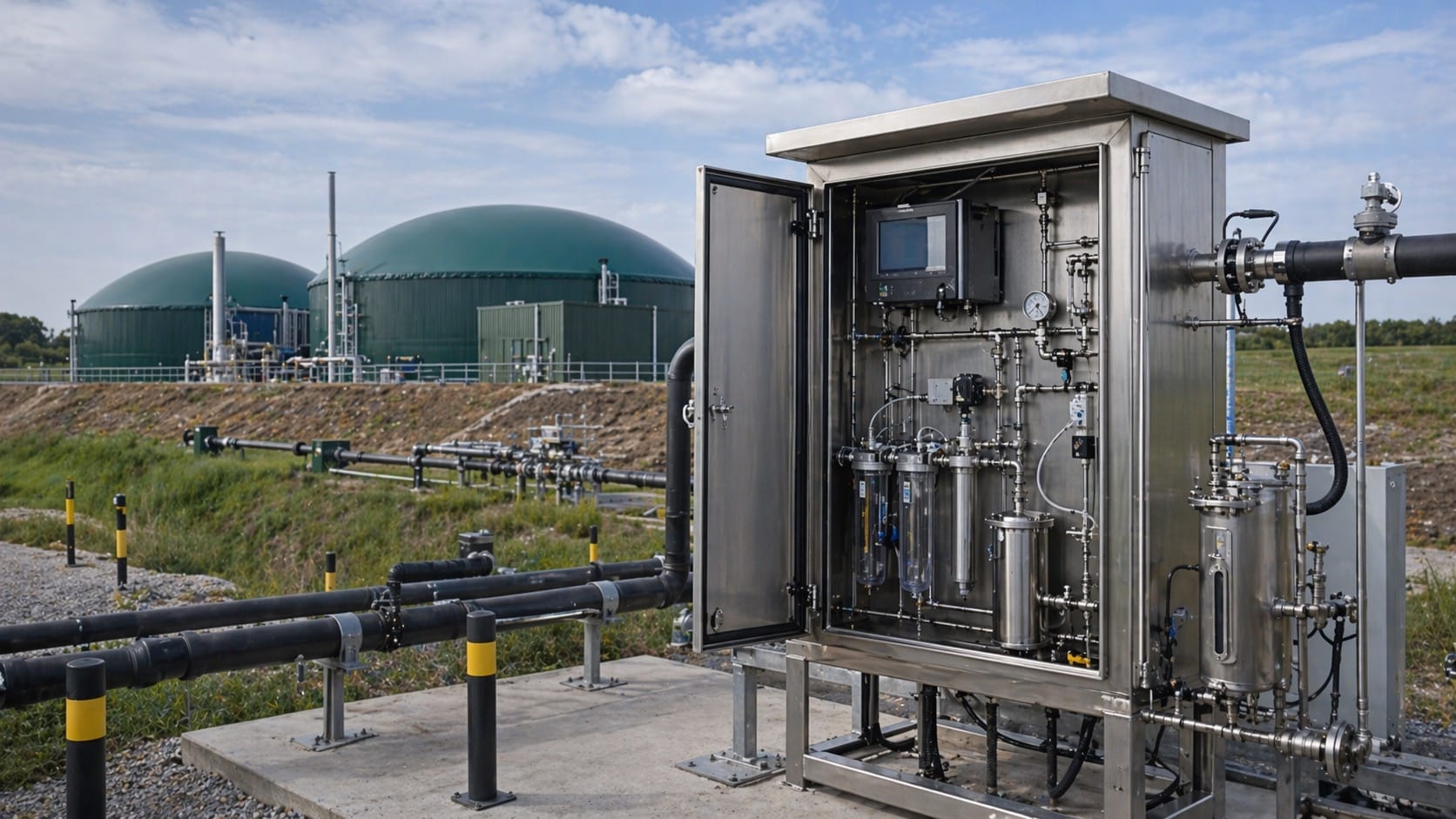
Biomass Gasification
Typical composition: CO 15-25%, H₂ 10-20%, CO₂ 10-15%, CH₄ 2-5%, N₂ balance. High tar and moisture content from the biomass feedstock.
Gas cooler + coalescing filter + desiccant required upstream of the analyzer inlet. Tar condensation in sample lines is the number one maintenance issue in biomass installations — a sector increasingly tied to clean energy production.
Carbon-based feedstock → real-time pyrolysis monitoring
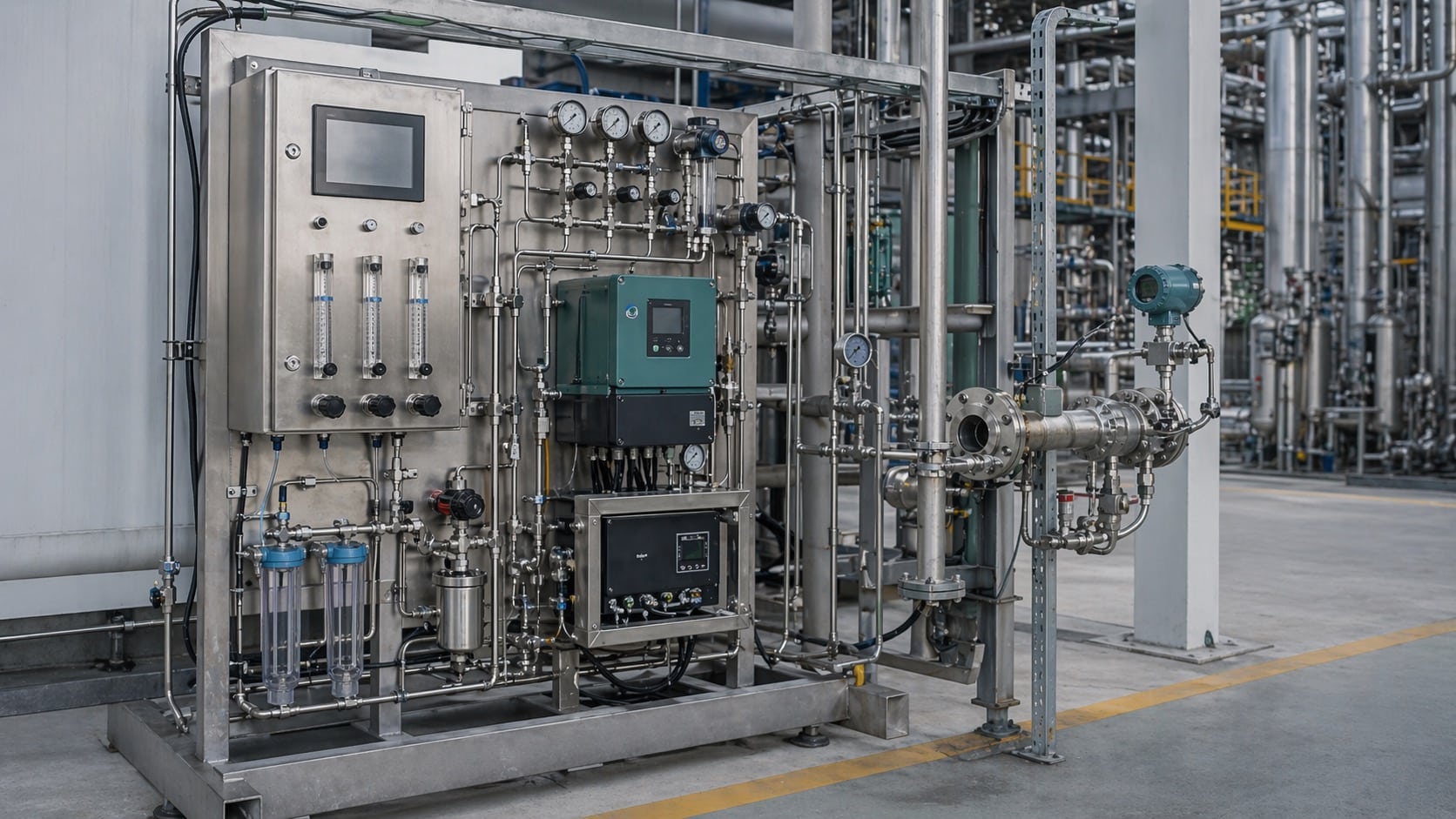
Coal Gasification
Typical composition: CO 30-60%, H₂ 25-30%, CO₂ 5-15%, CH₄ 0-5%. High CO concentrations and sulfur compounds (H₂S, COS).
Our 0-100% measurement range handles full-scale CO without dilution. Sulfur-tolerant sample conditioning protects sensor elements.
0–100% CO range, no dilution needed
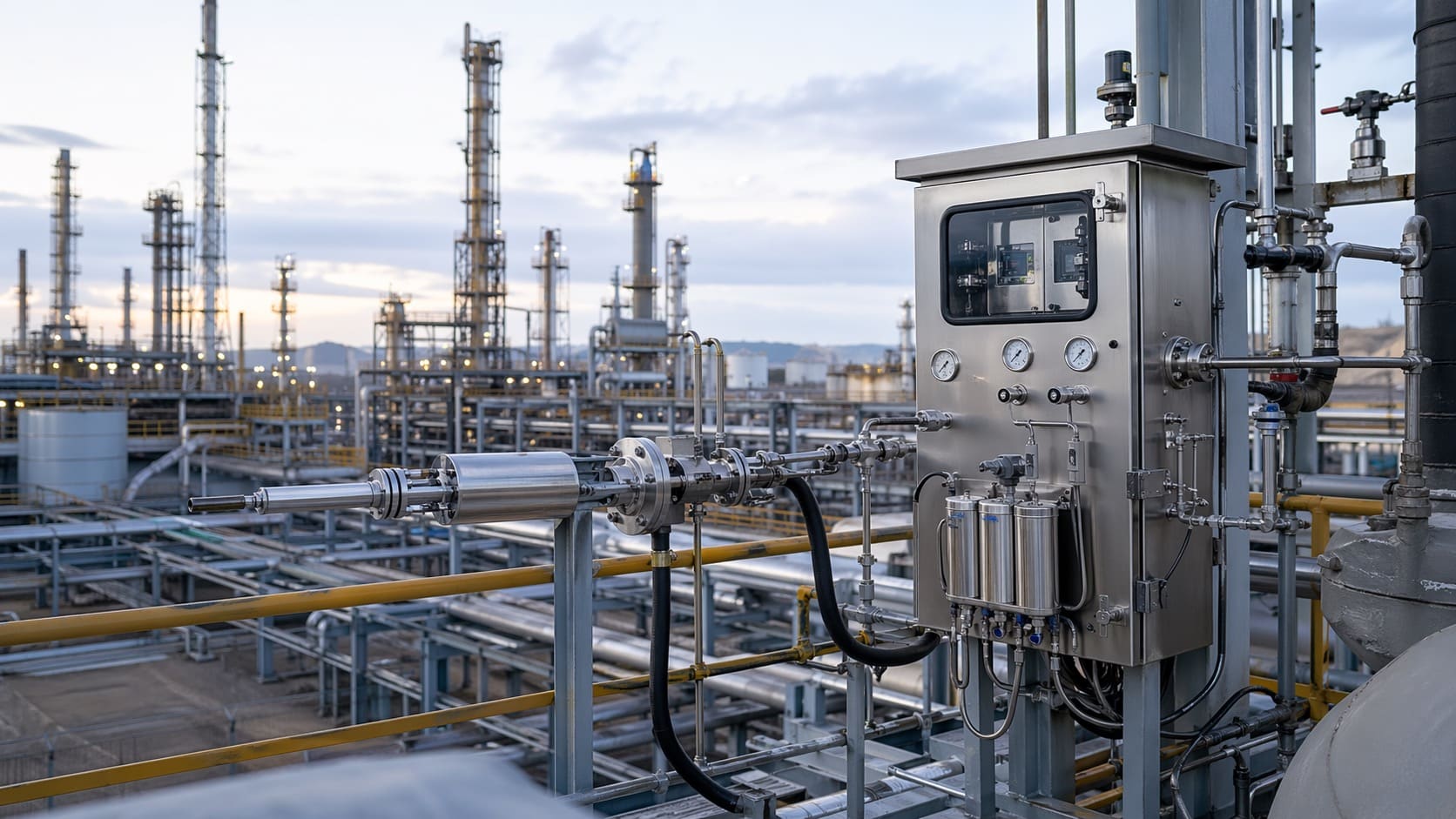
Blast Furnace Gas (BFG)
Typical composition: CO 20-25%, CO₂ 15-20%, H₂ 1-5%, N₂ 55-60%. Extremely high dust loading.
Multi-stage filtration mandatory. BFG’s relatively low calorific value makes accurate composition monitoring critical for efficient combustion in downstream boilers or gas engines.
Calorific value monitoring for combustion control

Waste-to-Energy
Variable composition depends heavily on waste feed mix. Unpredictable composition swings, high moisture, chlorinated compounds.
Fast, continuous response allows operators to react to composition changes before they cascade into combustion problems.
Real-time response for rapid composition swings
Chemical Synthesis (Methanol, Ammonia, Fischer-Tropsch)
Precise H₂/CO ratio control required for energy production and chemical conversion. Methanol synthesis targets approximately 2:1 H₂:CO.
Real-time continuous monitoring enables tighter process control than periodic GC sampling of the sample gas stream.
H₂/CO ratio precision for catalyst efficiency
Syngas monitoring requirements vary dramatically by feedstock and process. Our application engineers help match analyzer technology, sample conditioning, and deployment mode to your specific operating conditions.
Certifications, Compliance & Quality Assurance
All GESHINE analyzers are factory calibrated with certified reference gases traceable to national metrology standards and the calibration certification and test report are supplied.
- CE Marking — European Conformity for health, safety, and environmental protection
- ISO 9001 — Quality Management System certification for manufacturing processes
- National High-Tech Enterprise (China) — Government-recognized innovation status
- Multiple Invention Patents (TDLAS + NDIR) — Core spectroscopic sensing technology
- 1500 m² Production Facility, Wuhan — Full in-house manufacturing and calibration
Procurement Guide — Pricing, Lead Times & After-Sales Support
Procurement professionals investing in syngas analyzers are looking for more than specs. This is the commercial data that most suppliers hide or leave out altogether.
Prior to obtaining quotes; your application parameters should be specified: (1) gas measurement ranges, (2) desired accuracy for process control vs. report, (3) sampling conditioning needs, (4) calibration needs, (5) sensor life, (6) SCADA/DCS communication protocol support, and (7) supplier technical support response time and SLA terms. If these requirements are not gathered and communicated up front, analyzer specifications are mismatched and project schedules are affected.
| Item | Details |
|---|---|
| Lead Time | 2–4 weeks standard configuration. Expedited delivery available on request. |
| Minimum Order Quantity | 1 unit. No minimum order requirement. |
| Warranty | 12 months standard. Extended warranty options available. |
| Factory Calibration | Included with every unit. Certified reference gas traceable to national standards. |
| On-Site Commissioning | Available. Includes installation verification, calibration check, and operator training. |
| Spare Parts | Sensor modules, filters, pump assemblies stocked for fast shipping. O₂ sensor replacement kits available. |
| Technical Support | Email and phone response within 24 hours on business days. Remote diagnostics available. |
Frequently Asked Questions About Syngas Analyzers
Questions process engineers ask before selecting continuous or portable analysis for gasification and fuel-gas composition control.
How does a syngas analyzer work?
A syngas analyzer uses NDIR (non-dispersive infrared) sensors for CO, CO₂, and CH₄ detection based on infrared absorption at specific wavelengths. H₂ is measured via TCD (thermal conductivity detector) that exploits hydrogen’s uniquely high thermal conductivity. O₂ is detected by an electrochemical cell. Multi-sensor fusion with active cross-interference compensation delivers simultaneous measurement of all gas components.
What is the difference between a syngas analyzer and a gas chromatograph?
An NDIR syngas analyzer provides continuous, real-time measurement with response times in seconds — suitable for 24/7 process control. A gas chromatograph (GC) operates in batch mode with 3–15 minute cycle times and offers higher accuracy (±0.1%), making it better suited for laboratory analysis and certification. For gasification process monitoring, NDIR analyzers are the standard choice due to speed, lower maintenance, and minimal operator training requirements.
Can the analyzer handle syngas with moisture, tar, and dust?
Yes, with a proper sample conditioning system. The gas stream must pass through a cooler, particulate filter, and desiccant before entering the analyzer. The sample must be clean and dry at the inlet. GESHINE offers application-specific conditioning configurations for biomass, coal, and waste-to-energy syngas streams.
How much does a syngas analyzer cost?
Syngas analyzer cost depends on gas channels, measurement ranges, sample conditioning, number of measurement points, and integration requirements. Use the cost-of-ownership calculator for planning assumptions, then request a formal quote based on application details before procurement.
What maintenance does a syngas analyzer require?
NDIR sensors require an annual calibration check and have a 5–10 year operational life. Electrochemical O₂ sensors need replacement every 1–3 years. Sample conditioning filters should be inspected monthly. Overall maintenance requirements are significantly lower than gas chromatograph alternatives, which need carrier gas replenishment and column replacement.
How is the analyzer connected to PLC/DCS systems?
RS485/Modbus RTU digital and 4–20mA analog outputs, both running simultaneously. Modbus register chart included. Compatible with all major DCS and SCADA platforms.
What gases can be measured simultaneously?
Six gases simultaneously: CO, CO₂, CH₄, H₂, O₂, and CₙHₘ (optional heavy hydrocarbons). N₂ concentration is reported by difference. Calorific-value computation is available when configured, giving operators heating-value data for combustion control; a certified heating value or full hydrocarbon speciation remains a process-GC / lab duty. Readings update continuously so all channels stay synchronized during the rapid composition changes common in gasification processes.
How do I choose between portable and online syngas analyzers?
The ZS6300 is deployed as an online / rack-mount analyzer for continuous 24/7 process monitoring, DCS integration, and multi-point sampling. For field commissioning, periodic spot checks, or cross-verification of an installed analyzer, GESHINE scopes a portable or transportable sampling arrangement by project review rather than a fixed catalogue model. Talk to our engineers for the arrangement that fits your site.
Can a syngas analyzer measure coal gas and coal gasification composition?
Yes — coal gas, town gas, producer gas, and coal-gasifier output are usually treated as syngas-family (fuel-gas) streams for analyzer selection, so the same continuous analyzer that handles biomass or waste gasification measures their CO, CO₂, H₂, CH₄, and O₂ composition. Coal gasification gas is typically hot, wet, and tar- and dust-laden, so the measurement depends as much on the heated sample-conditioning train as on the optics. For metallurgical coal-derived streams — blast-furnace top gas, BOF converter gas, and coke-oven gas — the duty overlaps with steel-plant gas analysis, covered in the metallurgy industry solutions. The analyzer reports component concentrations continuously; where a certified heating value or full hydrocarbon speciation is required, that remains a process-GC duty.
Need a syngas answer tied to your gasifier, feedstock, or sampling train?
Ask a syngas application engineerReferences & Transparency
Sources & Standards Referenced
- US DOE National Energy Technology Laboratory — Gasifipedia: Syngas Composition and Properties.
- IEA Bioenergy — Gas Analysis in Gasification of Biomass and Waste: Technical Review.
- ACS Omega (2023) — Syngas Production from Biomass Gasification: Current Status and Advances.
- Gasification sampling, thermal conductivity detection, and analyzer conditioning references used for engineering cross-checks.
Our Engineering Perspective on Syngas Monitoring
GESHINE’s syngas analyzer platform builds on TDLAS and NDIR dual-core spectroscopic sensing technology developed at our 1500 m² facility in Wuhan’s Optics Valley. Specifications in this guide reflect calibrated measurement performance, verified with traceable reference sources. Our applications team have used syngas measurement solutions in biomass gasification, waste to energy and coal to chemicals industries throughout our extensive experience of industry projects.
Start Your Syngas Monitoring Project
Our applications engineering team will determine the best analyzer package for your requirements, supply detailed specifications and issue a formal quotation within 48 hours.
- Application type (biomass, coal, waste-to-energy, blast furnace)
- Gas components and measurement ranges required
- Sample conditioning requirements (tar, moisture, dust levels)
- Installation type (online continuous; field spot-check by project review)
- System integration (DCS/SCADA protocol support)
- Required response time and accuracy class
- Output protocols (4-20mA, Modbus, RS485)
- Certifications needed (CE, ISO 9001)
Get Syngas Expert Consultation
Our application engineers specialize in syngas analyzer configuration for gasification, blast furnace, waste-to-energy, and chemical synthesis applications.


