
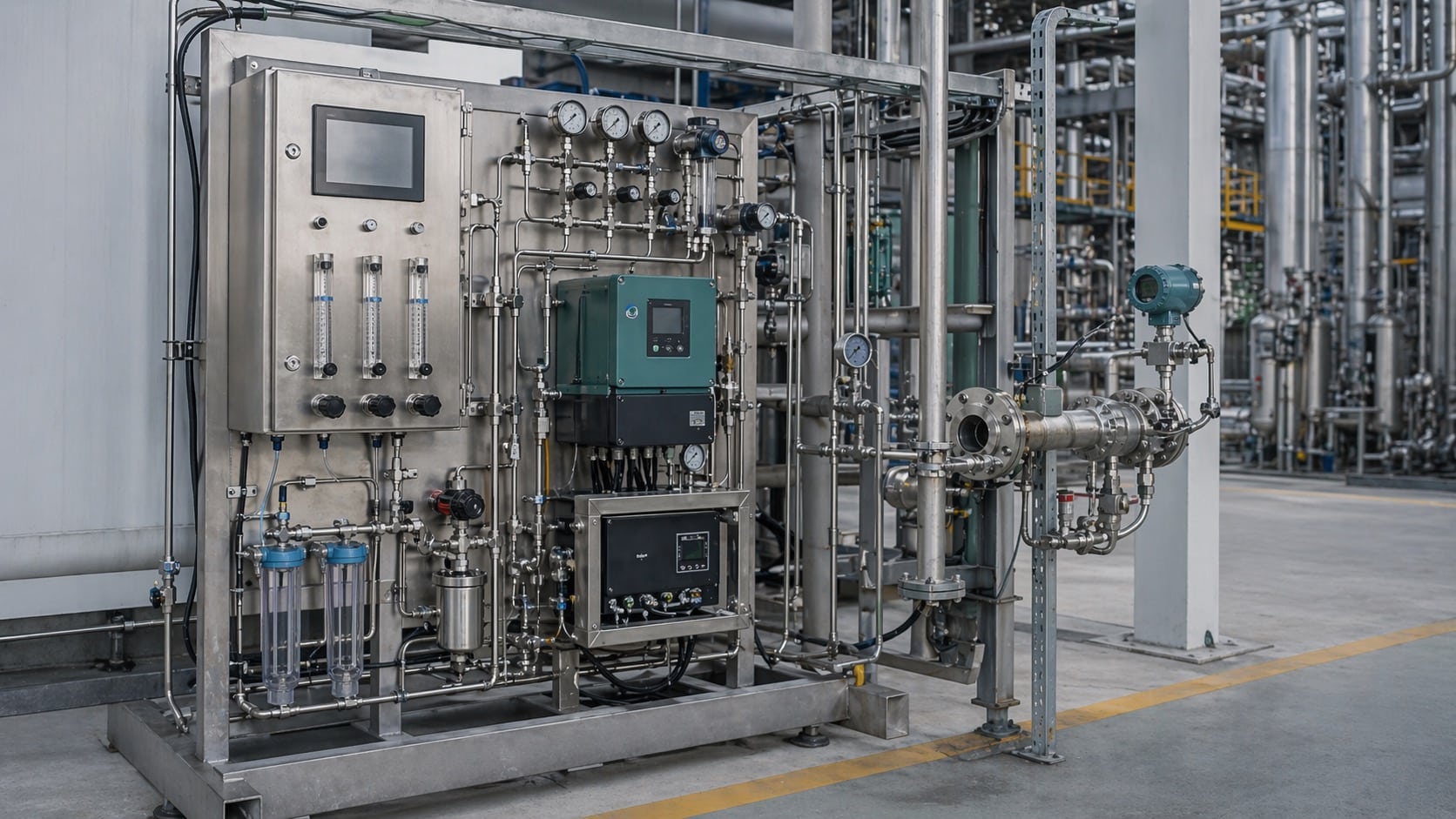
R&D-Driven Engineering Depth
TDLAS is our core — around it we run five complementary platforms. 60+ intellectual-property assets and 20+ drafted industry standards define the technical depth behind every GESHINE analyzer.
Six platforms, one integration discipline
Each platform targets a distinct measurement problem — ppb-level trace detection, multi-component UV, reference-method compliance. Having all six under one roof is why commissioning engineers can recommend the right tool for each duty, not push every problem to the same hammer.
Core — ppb detection, multi-component, cross-interference-free
Low drift, resistant to dust and background-gas interference
Cost-efficient infrared for CO / CO₂ / CH₄ / N₂O
Multi-channel UV for SO₂ / NO / NO₂ / NH₃ / Cl₂
NO / NOₓ reference-method analyzer
SO₂ reference-method analyzer
Auxiliary detection stacks — electrochemical (EC), thermal conductivity (TCD), and zirconia — complement the six core platforms in multi-gas and safety-duty applications.
How we decide what to invest in next
R&D resource is finite. Four signals keep investment focused on problems where a technology platform can actually close the gap for a customer — not on novelty for novelty’s sake.
Regulatory shift
New emissions limits (ultra-low-NOₓ, HCl tightening, PS-18 for N₂O) drive the platform and range we invest in next.
Plant duty gaps
When commissioning engineers report duties where no off-the-shelf analyzer fits (DGA acetylene, semiconductor CVD), we look at platform extension.
Platform maturity
Innovation in TDLAS (wavelength locking, DFB laser tuning) reaches customer value only when build discipline catches up — we invest where both meet.
Supply resilience
Second-source qualification and in-house optical cell build are R&D investments that keep lead times predictable under lot disruption.
Four stages from optical bench to line
Platform research
Concept validation on the optical bench — wavelength choice, cell geometry, algorithm strategy — against a reference duty.
Prototype build
First-article analyzer assembled in pilot cell with full FAT-equivalent data. Prototype serves as the gold reference for the production build.
Industry-standard contribution
Where relevant, our platform work contributes to drafting or revising Chinese industry standards — the standard then anchors the production spec.
Production handoff
R&D, manufacturing, and QC agree on the production spec, the FAT thresholds, and the calibration-gas chain before first unit leaves the line.
60+ IP assets across four categories
Invention & Utility-Model Patents
Optical cell design, laser-modulation methods, algorithm innovations, and analyzer architecture
Design Patents
Enclosure and HMI design registrations
Software Copyrights
Firmware, embedded algorithm stack, and analyzer software
Drafted Standards
20+ Chinese industry standards contributed to or drafted
Specific patent and standard references are available on request.
Evaluating analyzer platforms? Ask for the R&D briefing.
We can share platform roadmaps, patent summaries, and standards involvement relevant to your duty — under NDA where needed.