
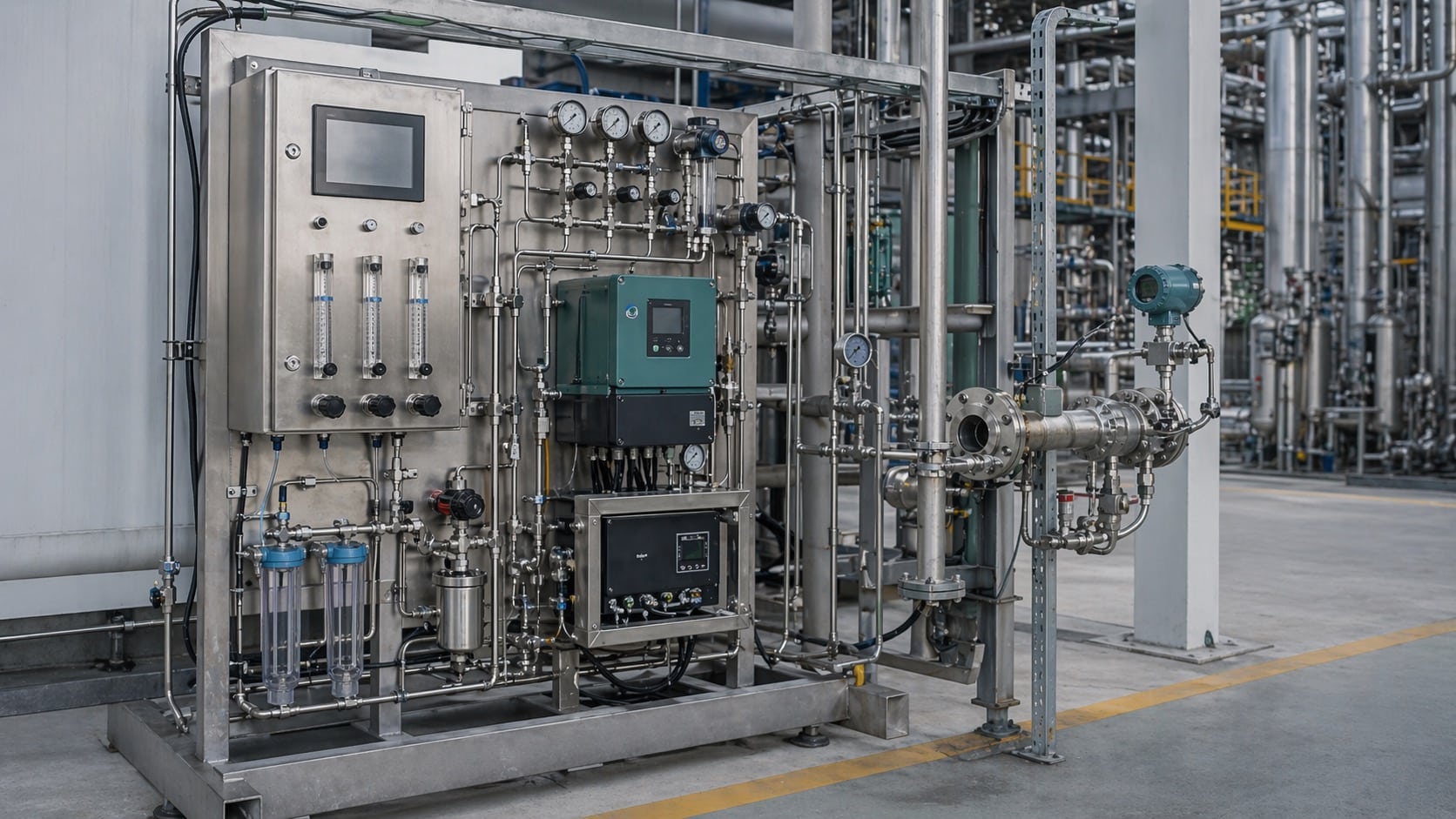
Natural Gas Quality & Safety Analyzers — Pipeline-Grade H₂S, Moisture, Trace O₂ & CH₄
Stable readings under glycol / methanol / amine carryover and compressor-station brownouts — sized for the matrix you actually have, not for pure N₂.
GESHINE natural gas analyzers focus on NG quality and safety sub-applications — H₂S sulfur removal monitoring, moisture / dew-point control, trace O₂ corrosion prevention, and CH₄ / hydrocarbon trace for pipeline, biogas upgrading, and LNG operations. We do NOT provide full GC composition analysis (C1–C9 hydrocarbon speciation, BTU / Wobbe primary calculation) — for those we partner with GC manufacturers.
What this page is not: GESHINE does not manufacture process gas chromatographs. We do not measure C1–C9 GC composition, BTU or Wobbe Index as a primary instrument. For those duties we route you to a third-party GC integration — see the partner section below.
Honest Scope: What We Do, What We Don’t, Where We Hand Off
Pipeline engineers waste days finding out a vendor over-claimed. We publish the scope up front so you can decide in 30 seconds whether GESHINE belongs on your shortlist.
In Scope
- H₂S sulfur removal monitoring
- Moisture & dew point control
- Trace O₂ corrosion prevention
- CH₄ / hydrocarbon trace
- Sample conditioning for hot / wet NG streams
Out of Scope
- NG full composition (C1–C9 GC speciation)
- BTU / Wobbe primary measurement
- Custody transfer accuracy class
- NG odorant detection
Partner Solution
For GC composition or custody-transfer billing accuracy, contact us — we coordinate third-party GC integration; the named platform is confirmed during RFQ.
Ask about a GC partner solutionFour Natural Gas Sub-Applications We Engineer For
Each sub-application has its own physics, its own failure modes, and its own anchor SKU. Pick the one that maps to your duty — the page is structured so you can jump.
H₂S Sulfur Removal Monitoring
ZS8300-H2S sits downstream of the amine / Sulfatreat / Iron-Sponge unit and watches the slip into the sales line. The point is not a number — it is whether your tape, EC or TDLAS train is still telling the truth after a glycol or methanol slug.
Engineering Notes- Lead-acetate tape is specific to H₂S only — mercaptans and COS pass through unseen. If your contract reads “total sulfur”, a tape-only train will miss it.
- EC cells need monthly regeneration and zero-span; the calendar operating cost is real and shows up in 5-year total cost of ownership.
- TDLAS-based H₂S is laser-line specific — glycol, methanol and amine carryover do not poison the sensor the way they kill EC, but a sample-line filter is still mandatory.
- Operator-reported pattern: lead-acetate tape consumables become a recurring monthly operating-cost line per analyzer at typical pipeline duty. Tape replacement intervals 15–30 days are normal.
Honest call: If your sales contract calls for total sulfur (H₂S + mercaptans + COS) rather than H₂S alone, ask us about a multi-stage train — tape and single-line TDLAS will under-report.
Moisture & Dew Point Control
The ZS8100-H₂O moisture analyzer holds the sales-gas dew point inside contract and keeps hydrate-formation risk off the operator’s daily report. Trace moisture lives or dies on sample integrity, not on the laser.
Engineering Notes- C1 / C2 / CO₂ co-absorber bias is real on TDLAS moisture — methane and ethane lines lie close to the H₂O line and bias the reading high; CO₂ peak-broadening biases it low. The calibration must be done against your gas composition envelope, not against pure N₂.
- Ambient air carries 100×+ the moisture of pipeline gas — every fitting upstream of the cell is a potential ingress. Lock-down compression fittings + heated transport line above the hydrocarbon dew point are non-negotiable.
- Spec moisture in the units the contract uses: lbs/MMSCF, ppmv at line pressure, °C dew point at MAOP — switching units silently after the order is signed is how disputes happen.
- Remote-site solar duty: a moisture analyzer’s sample pump and heated line are the power budget — ask us to size the power envelope before you commit to a solar panel.
Honest call: Signature peak drift on a laser moisture cell is a known long-horizon failure mode — annual zero-gas verification + span check on certified moisture is how you keep the reading honest. We size that into the commissioning plan.
Trace O₂ Corrosion Prevention
ZS8100-O2 monitors O₂ at pipeline ingress points and biogas-to-grid hand-offs, with the ppm-to-%vol range and sample conditioning sized to the corrosion-prevention duty at RFQ. Trace O₂ is a corrosion driver, a microbial-growth enabler, and in biogas upgrading a combustible-mixture risk.
Engineering Notes- Pipeline O₂ ingress accelerates internal corrosion and seeds microbiologically-influenced corrosion (MIC). The right low-range O₂ envelope and sample conditioning are duty-specific — sized against the corrosion-prevention target at RFQ.
- Biogas upgrading: O₂ above ~0.5–1 %vol in the upgraded stream is a safety signal — your fire-and-gas and the analyzer must agree on the trip point.
- Compressor-station electrical noise (brownouts, switching transients) shows up on analyzer 4–20 mA loops. Galvanic isolation + UPS-backed power are the routine remedy.
- Sample integrity again: tubing leaks pull ambient O₂ into the cell and bias the reading high. Soap-test or leak-test every joint at commissioning.
CH₄ & Hydrocarbon Trace
Heated-FID total-hydrocarbon measurement covers methane and total-hydrocarbon trace duties — leak detection, vent monitoring, RNG quality envelope. This is not a custody-transfer GC. For BTU / Wobbe primary measurement, see the partner solution section below.
Engineering Notes- CH₄ trace ≠ NG composition. This sub-application covers single-channel CH₄ / THC monitoring for safety and quality envelope — not C1–C9 hydrocarbon speciation.
- For BTU / Wobbe / hydrocarbon dew point, the right instrument is a process gas chromatograph (GC). GESHINE does not manufacture GCs — we can coordinate third-party GC integration on request.
- Vent / fugitive emissions duty: CH₄ has a 28× CO₂-equivalent GWP — operators on RNG and underground-storage sites use THC trace as the early-warning loop.
- Hydrocarbon dew point itself is a property calculation, not a single reading — talk to us about pairing trace CH₄ with a third-party GC and a HCDP model in DCS.
- Dedicated process CH₄ measurement (TDLAS / NDIR, ppm to %vol ranges) is a different duty from THC trace — for analyzer selection in that lane, see the Methane Analyzers category.
Honest call: If procurement is asking for a single box that reports BTU and full composition, that is a GC project — we will tell you that up front rather than sell you a CH₄ analyzer to look like one.
Where Natural Gas Analyzers Live
Six industries where the four sub-applications above show up under different names — pipeline metering, biogas-to-grid, LNG terminals, NGL processing, underground storage and fuel-cell hydrogen production.
Pipeline Operation
Biogas / RNG Upgrading
LNG Receiving Terminals
NGL Processing
Underground Storage
Hydrogen Production Feed-Gas Pretreatment
Sample Conditioning for Natural Gas Streams
Every analyzer above is only as good as the sample it receives. Glycol carryover, methanol slug, amine carryover, particulates and pressure swings are why these instruments fail — almost never the sensor itself.
Even “dry” pipeline gas carries methanol injection, TEG glycol carryover, fine particulates and trace condensate. The analyzer’s job ends at the cell window; the sample conditioning system (SCS) is what keeps the cell from being blinded by liquid and grit.
GESHINE sizes the SCS as a peer of the analyzer — not as a line-item afterthought. The typical stack for an NG monitoring point: knock-out pot → coalescing filter → pressure regulator → membrane separator → flow controller → heated transport line to the analyzer cell. Each element earns its place against a specific failure mode in the duty cycle.
- Lock-down compression fittings + leak-test at commissioning — ambient air carries 100×+ the moisture of pipeline gas.
- Heated transport line above the hydrocarbon dew point — condensation in the line is how moisture and H₂S readings die.
- Membrane separator plug-check cycles — required to keep liquid carryover out of the cell.
- Bypass loop sized for analyzer T₉₀ — long sample-line lag is invisible until you try to commission a control loop on the reading.
Common Mistakes Buyers Make on Natural Gas Analyzer Specs
Five spec-writing patterns we see at RFQ time that quietly cost money or fail audit — surfaced from public operator complaints and our own field commissioning notes.
Choosing tape-only H₂S when the contract reads “total sulfur”
Lead-acetate tape is specific to H₂S — mercaptans (RSH) and COS pass through invisibly. If your sales contract or fiscal handover specifies total sulfur, a tape-only train will under-report and you will discover it during the next audit.
Specifying moisture without naming the gas composition envelope
TDLAS moisture is biased by methane / ethane co-absorption (reading high) and by CO₂ peak broadening (reading low). A spec of “1 ppmv H₂O at 10 MPa” without the C1 / C2 / CO₂ envelope is a spec that can be calibrated against pure N₂ in the factory and miss truth by 20–40 % in the field.
Forgetting carrier-gas and cal-gas logistics in the 5-year cost
Tape consumables, EC-cell regen gas, GC carrier gas, multi-cal-gas cylinders, sample-line filters and pump rebuilds are real operating-cost lines. The analyzer with the lowest upfront cost often loses on 5-year total cost of ownership once the logistics are honest.
Skipping the sample probe because the analyzer “looks compact”
Liquid carryover (glycol / methanol / amine slug), particulates and pressure / flow fluctuations are why H₂S analyzers fail — not the sensor itself. Your analyzer is only as good as the sample it receives. Budget the sample conditioning system (SCS) as a peer of the analyzer, not as a line-item afterthought.
Treating field-serviceability as a footnote
At a remote pipeline metering station, a ship-back module is a multi-week outage. Ask vendors which modules are field-replaceable, which spares ship from in-country stock, and what the actual reseat / recommission sequence looks like.
Natural Gas Analyzer FAQ
Seven questions pipeline engineers ask us before the RFQ — plus three from public operator forums about TDLAS moisture drift, monthly H₂S operating cost, and remote / solar power budget.
Can GESHINE analyzers measure full NG composition (C1–C9) for BTU / Wobbe?
No. Full hydrocarbon speciation and primary BTU / Wobbe calculation require a process GC, which GESHINE does not manufacture. For custody-transfer billing, contact us and we will coordinate a third-party GC integration — the named platform is confirmed during RFQ.
Is there a calorific value or BTU analyzer for natural gas, and does GESHINE provide one?
Calorific value (heating value, BTU) and Wobbe index are energy figures derived from gas composition, so a calorific value or BTU analyzer is a process gas chromatograph or a calorimeter — instrument types GESHINE does not manufacture. GESHINE’s role on natural gas is the quality and safety side that runs alongside the energy measurement: H₂S, moisture / dew point, trace O₂, and CH₄ / hydrocarbon trace. Where a project needs the energy figure as well, GESHINE arranges the composition / BTU measurement as a third-party GC integration so the quality and energy channels are delivered together.
What H₂S range is realistic for pipeline NG quality monitoring?
ZS8300-H2S covers low-ppm H₂S typical for downstream of sweetening units and pipeline quality checks. Exact range depends on cell selection and gas-phase sulfur load — confirmed at RFQ.
Why is trace O₂ critical in NG pipelines?
O₂ ingress accelerates internal corrosion, encourages microbial growth, and in biogas upgrading risks combustible mixtures. ZS8100-O2 measures O₂ across a ppm-to-%vol envelope, sized at RFQ, for pipeline and biogas-to-grid corrosion-prevention duty; the required low end and sample conditioning are confirmed per project.
How do you handle the wet end of NG (dehydration outlet)?
The ZS8100-H2O moisture analyzer measures H₂O and dew point in pipeline gas — typical positions are TEG dehydrator outlet and gate-station sales meter, to keep the gas inside ISO 13686 / contractual dew-point spec.
Do I need a sample conditioning system for natural gas?
Yes — even “dry” pipeline NG carries methanol, glycol carryover, fine particulates, and trace condensate. Pair the trace analysers above with a ZS-SCS sampling system to protect the cells and stabilise readings.
Do you cover biogas / RNG upgrading?
Yes — H₂S, moisture and trace O₂ are exactly the duties biogas upgrading needs before pipeline injection. We do not measure CH₄ / CO₂ percentage with custody-grade accuracy (that is a third-party GC duty) but we cover the safety and quality envelope.
Why does my TDLAS moisture reading drift when the gas composition changes?
Co-absorbers shift the laser-line signal. Methane and ethane absorb close to the H₂O line and bias the reading artificially high if the calibration was built for a leaner gas. CO₂ peak broadening biases the reading the other way. The fix is composition-aware calibration done against your gas envelope, plus annual span verification against certified moisture — not a different laser.
What’s the realistic monthly operating cost for tape H₂S vs TDLAS H₂S?
Operator reports consistently describe lead-acetate tape consumables as a recurring monthly operating-cost line per analyzer at typical pipeline duty. TDLAS-based H₂S has no tape, but adds a heated sample line and periodic span verification — the trade is consumables vs. sample-train engineering. The right answer depends on your duty cycle and which technology survives your glycol / methanol carryover pattern.
Can the analyzer run on remote / solar power?
Sometimes — the answer depends on the sample pump, heated line and electronics duty cycle. Ask us to publish the power budget (W average / W peak) for the configuration we quote so your solar / battery panel can be sized honestly. We will not tell you “yes, runs on solar” and ship a 200 W heated-line that empties the battery overnight.
Different gas envelope or contract spec?
Send your matrix to an NG application engineerNeed GC composition, BTU or Wobbe? Ask About the Partner Solution.
GESHINE does not manufacture process gas chromatographs. For C1–C9 hydrocarbon speciation, BTU / Wobbe primary measurement and custody-transfer accuracy class, we coordinate third-party GC integration (Agilent / ABB / Endress+Hauser-class platforms, named platform confirmed during RFQ) — and we’ll tell you up front when that is the right answer rather than ours.
- C1–C9 hydrocarbon speciation (third-party micro GC platforms)
- BTU / Wobbe primary measurement for fiscal handover
- Hydrocarbon dew point modeling from GC composition
- Custody-transfer accuracy class systems with full audit trail
Send a Partner Inquiry
Describe your duty (stream composition, accuracy class, custody vs check measurement, site footprint). We’ll route to the right partner — or tell you why your duty doesn’t need a GC at all.


