
Sampling & Conditioning Systems
Heated probes, filtration, cooling, and flow control that keep the sample representative from the stack to the analyzer.
The ZS-SCS line — high-temperature heated extractive systems, Peltier cool-dry conditioning, and modular stack-mount probe / filter assemblies — delivers a clean, representative sample to CEMS and process analyzers in wet, corrosive, dusty, and high-temperature gas streams. The sample-conditioning chain is the foundation of accurate gas analysis.
How Sample Conditioning Works
Extractive Sample-Handling Chain — Probe to Analyzer Inlet
A gas analyzer is only as good as the sample it sees. Sample conditioning extracts process gas, removes what would damage or bias the instrument — particulates, moisture, condensable acids — and delivers a clean, representative sample at the temperature, pressure, and flow the analyzer needs.
- Heated path keeps reactive and acid gases above the dew point — no condensation or adsorption loss
- Staged filtration protects optical cells and wetted parts from particulate
- Cool-dry conditioning removes the H₂O that biases many analyzers
- Wetted-material selection (SS316L / PTFE / Hastelloy C-276) matched to the corrosive load
The Conditioning Chain, Step by Step
In-Situ vs Extractive Sampling — and the Enclosure Around It
The first decision is whether to measure across the duct or extract a sample. Extraction then splits into heated and cool-dry conditioning by what the analyzer needs.
Cross-Duct In-Situ
The analyzer measures directly across the duct or stack — no sample is extracted. The only sampling hardware is optical-window purge air and flange alignment, which removes the conditioning chain entirely.
Window purge air, flange / mounting alignment, and optical-path length matched to the duct. No heated line, no chiller, no extractive train.
- Clean optical access with sub-second response and no sample lag
- Reactive gases (NH₃, HCl) that adsorb in extractive sample lines
Heated Extractive (ZS-SCS-800)
A heated probe and 180°C heated line carry wet, corrosive, or acid-bearing flue gas to the analyzer without condensation. Hastelloy C-276 wetted parts and automatic blowback handle the harshest CEMS duty.
Heated probe + heated line (up to 30 m standard / 50 m optional), sintered in-stack filter with blowback, secondary fine filter, flow control — held above the acid dew point end to end.
- Wet-FGD outlet, incineration, and acid-gas CEMS sampling
- HCl / HF / SO₃ streams where 316SS lines corrode or adsorb
Cool-Dry Extractive (ZS-SCS-600)
A Peltier cooler drops the sample dew point below 5°C and a coalescing filter removes aerosols, delivering the clean, dry sample that many process analyzers require — with automatic peristaltic condensate drain.
Peltier cooler/dryer, 0.5 µm coalescing filter, automatic condensate drain, flow control. Compact wall-mount enclosure.
- Process gas, ambient, biogas, and natural-gas analyzers needing dry sample
- NDIR / paramagnetic analyzers where H₂O biases the reading
Power & Heat-Trace Budget
Heated line and cabinet draw continuous power (≈1200 W on a 30 m heated system); the line-length and ambient set the supply and the number of heated zones.
Instrument Air for Blowback
Automatic filter back-purge needs a clean ~6 bar instrument-air supply; cycle timing is tuned to the dust loading of the duty.
Access, Cal-Gas & HVAC
Plan for calibration-gas plumbing, filter / probe service access, condensate drain routing, and shelter HVAC where a full analyzer house is used.
Select the SCS Configuration by Stream Condition
There is no universal sampling chain. The stream’s temperature, moisture, dust, corrosivity, and pressure drive the wetted material, heating, filtration, and flow design. This is the summary view — the full 14 sample-handling modes are detailed on the Services page.
| Stream Condition | Key Risk | Conditioning Response | Recommended ZS-SCS Path |
|---|---|---|---|
| Corrosive acid gas (HCl / HF / Cl₂ / SO₃) | Acid attack and adsorption loss on standard 316SS | Hastelloy C-276 / PTFE wetted parts, fully heated above the acid dew point | ZS-SCS-800 (Hastelloy option) |
| High-temperature wet (saturated stacks) | Condensation; water, SO₃, and HCl dropout | Heated probe + 180°C heated line maintained end to end | ZS-SCS-800 |
| Dusty / tar-laden (kilns, incinerators, gasifiers) | Filter plugging and optical / cell fouling | Sintered in-stack filter with automatic blowback; heated knockouts for tar | ZS-SCS-400 probe + ZS-SCS-800 |
| Negative-pressure duct | Air in-leak that dilutes and biases the sample | Ejector / pump sizing and a leak-tight heated train that stabilises flow | ZS-SCS-800 + engineering review |
| High-pressure process line | Condensation on pressure let-down; unsafe expansion | Staged pressure reduction, heated regulators, and relief protection | Root pressure-reduction box + ZS-SCS path |
| Clean, dry analyzer feed | H₂O bias on the analyzer reading | Peltier cool-dry below 5°C dew point, coalescing filter, automatic condensate drain | ZS-SCS-600 |
| Sulfur-recovery (Claus / SRU) | Sulfur dropout and H₂S / SO₂ ratio bias | Sulfur-resistant materials, heated transfer, and condensate control | ZS-SCS-800 + engineering review |
Summary mapping only. Final wetted-material, heated-line length, and flow design are confirmed per project against the measured stream conditions.
Choosing a Sampling System by Stream Condition
Three questions narrow most SCS specs: how corrosive is the gas, how hot and wet is it, and how much dust or tar does it carry.
Corrosive Acid-Gas Streams (HCl / HF / Cl₂ / SO₃)
Standard 316SS sample lines corrode and adsorb acid gases, biasing the reading low. Corrosive duty needs Hastelloy C-276 (or PTFE / Monel) wetted parts and a fully heated path above the acid dew point. The ZS-SCS-800 with the Hastelloy option is the path of record — typically waste incineration, chlor-alkali, and glass-furnace service. See the stream-condition selection matrix for the full mapping.
Hot, Wet, High-Moisture Stacks
Saturated flue gas demands a choice: keep the sample hot with a 180°C heated extractive chain (so acids and moisture never condense), or drop the moisture deliberately with Peltier cool-dry conditioning where the analyzer needs a dry sample and the target species is not water-soluble. ZS-SCS-800 covers the heated path; ZS-SCS-600 covers cool-dry. Reactive species (NH₃, HCl) stay on the heated path to avoid loss in the condensate.
High-Dust & Tar-Laden Duty (kilns, incinerators, gasifiers)
Particulate plugs filters and fouls optics. A sintered in-stack filter with automatic blowback maintains flow under heavy dust loading, and heated knockouts stop tar plugging on gasifier and coke-oven streams. The ZS-SCS-400 modular probe (SS316L / Inconel, up to 800°C) feeds a ZS-SCS-800 heated chain. The full 14 duty profiles are detailed on the engineering services page.
ZS-SCS Sampling & Conditioning Systems
3 systems — heated extractive, Peltier cool-dry, and modular stack-mount probe.
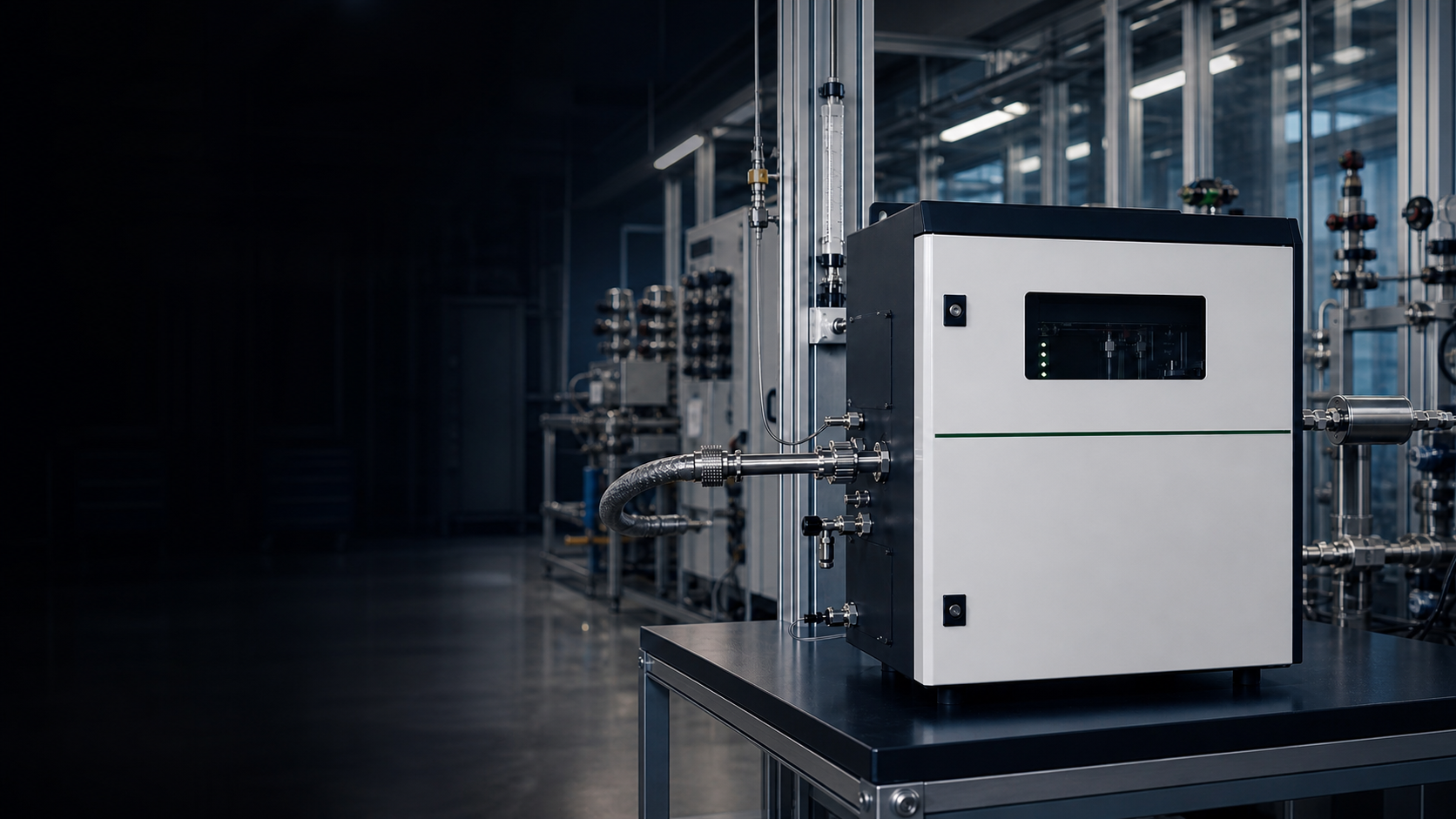 Heated Extractive
ZS-SCS-800 · Heated Extractive
ZS-SCS-800 High-Temperature Heated Sampling System
Complete heated extractive system for corrosive and wet gas streams — 180°C from probe tip to analyzer inlet.
- Temperature
- 180°C continuous
- Materials
- SS316L · PTFE · Hastelloy
- Flow Rate
- 1-5 L/min
- Filtration
- 2 µm sintered
Cool-DryZS-SCS-600 · Peltier Cool-Dry
ZS-SCS-600 Cool-Dry Sampling System
Compact cooler-dryer system for clean, dry sample delivery to process analyzers.
- Dew Point
- <5°C (adjustable)
- Flow Rate
- 0.5-3 L/min
- Filtration
- 0.5 µm coalescing
- Drain
- Auto peristaltic
Probe & FilterZS-SCS-400 · Extractive Probe
ZS-SCS-400 Probe & Filter Assembly
Modular stack-mount sampling probe with integrated sintered filtration; standard and heated versions.
- Length
- 0.5 – 3.0 m
- Material
- SS316L · Inconel
- Filter
- 2-20 µm sintered
- Temp Rating
- Up to 800°C
Where Sample Conditioning Earns Its Keep
From wet-FGD CEMS to corrosive chemical streams and sulfur recovery — the conditioning chain is what lets the analyzer survive the duty.
Power & Waste-to-Energy CEMS
Heated extractive sampling on wet, acid-bearing, high-particulate flue gas — Hastelloy C-276 wetted parts and automatic blowback keep CEMS available through incineration and coal / biomass stack duty.
See power applicationsChemical & Petrochemical Process
Corrosive HCl / HF / Cl₂ / SO₃ process and scrubber streams need Hastelloy C-276, Monel, or PTFE wetted parts and a fully heated path above the acid dew point to keep the sample representative.
See chemical applicationsSulfur Recovery & Refining
Claus / SRU tail-gas H₂S / SO₂ ratio sampling demands sulfur-resistant materials, heated transfer, and condensate control so the measured ratio reflects the process, not dropout in the line.
See refining applicationsWhy GESHINE for Sample Conditioning
In-house sampling engineering, corrosive-grade materials, and skids matched to the analyzer fleet — scoped per project, not sold from a fixed catalogue.
In-House Sampling Engineering
Heated lines, filtration, drying, and skid + P&ID layout designed by the same engineering team that builds the analyzers — no translation layer between the sample chain and the instrument it feeds.
Corrosive-Grade Materials
SS316L, PTFE, Hastelloy C-276, Monel, and Inconel wetted parts selected to the acid load and temperature — so HCl, HF, Cl₂, and SO₃ streams do not corrode the line or adsorb the analyte.
Matched to the Analyzer Fleet
ZS-SCS systems pair with GESHINE ZS-series rack analyzers — and with most third-party heads requiring a clean, heated or dry sample at atmospheric pressure.
Scoped Per Project
Custom skid, P&ID, heated-line sizing, wetted-material selection, and certification scope are confirmed against the measured stream — not pre-published as universal specifications.
Sampling & Conditioning Questions, Answered
Common questions on heated vs cool-dry conditioning, wetted materials, line length, and keeping the sample representative.
Why heat the sample line, and to what temperature?
Heating keeps the sample above its dew point so water, SO₃, and HCl do not condense on the way to the analyzer. Condensation causes sample loss, corrosion, and cross-contamination that invalidate the measurement. The ZS-SCS-800 maintains 180°C continuously from probe tip to analyzer inlet — above the typical acid dew point of around 160°C for wet flue gas.
When do I need Hastelloy C-276 instead of standard SS316L?
Hastelloy C-276 wetted parts are required for flue gas containing HCl above ~50 mg/m³, HF, or high SO₃ — typically waste incinerators, chlor-alkali plants, and glass furnaces. SS316L is adequate for standard coal / gas combustion. Standard stainless lines corrode and adsorb acid gases, biasing the reading low, so the wetted-material choice is confirmed against the measured corrosive load per project.
Heated extractive vs cool-dry conditioning — which do I choose?
Choose heated extractive (ZS-SCS-800) when the analyte is water-soluble or reactive (NH₃, HCl, HF, SO₃) and must never see condensation — the whole path stays hot. Choose cool-dry (ZS-SCS-600) when the analyzer needs a dry sample and the target species is not lost to the condensate, such as NDIR CO / CO₂ or paramagnetic O₂ where H₂O would bias the reading. Many sites run both paths for different analyzers off the same tap point.
How does automatic blowback keep the filter clear?
Compressed instrument air (around 6 bar) is periodically pulsed back through the in-stack sintered filter to dislodge accumulated particulate. Cycle timing is configurable — from a few minutes to many hours — and is tuned to the dust loading of the duty, so high-particulate kiln and incinerator streams keep flowing without manual filter changes between service visits.
What is the maximum heated sample line length?
Standard runs are up to 30 metres; extended runs to 50 metres are available with additional heating zones. Longer runs require increased power-supply capacity and additional temperature-monitoring points, so the line length feeds directly into the power budget and the number of independently controlled heated zones at design time.
In-situ vs extractive sampling — when is each right?
In-situ measurement avoids extraction entirely — the analyzer measures across the duct — which removes the conditioning chain, gives the fastest response, and suits reactive gases that would adsorb in a sample line, provided there is clean optical access and reliable window purge. Extractive sampling is preferred when the duct is too dusty or hot for direct optics, when the sample must be conditioned (dried, filtered, pressure-reduced) for the analyzer, or when several analyzers share one conditioned sample. Many CEMS racks combine both.
Which analyzers is the ZS-SCS compatible with?
The ZS-SCS systems are compatible with all GESHINE ZS-series rack-mount analyzers and with most third-party analyzers that require a clean, heated or dried sample delivered at atmospheric pressure. The conditioning path is selected to match what the downstream analyzer needs at its inlet, so the same skid can feed a multi-gas CEMS rack.
Do I need a full conditioning system for a clean, dry process gas?
Not always. For dry, clean, non-corrosive process gas, a modular probe and sintered filter (ZS-SCS-400) with a simple flow control can be sufficient — the full heated or cool-dry chain is reserved for wet, corrosive, dusty, or condensable streams. The right scope is set by the measured stream conditions, which is why GESHINE confirms the configuration against the temperature, dew point, dust, and corrosive load rather than over-specifying by default.
Request a Quote for a Sampling & Conditioning System
To scope the right sampling chain for your analyzer, please have these stream parameters ready:
- Target gas and the analyzer(s) the sample feeds
- Stack / process temperature and pressure
- Sample dew point and moisture content
- Particulate / dust loading
- Corrosive components (HCl / HF / Cl₂ / SO₃ / H₂S)
- Required sample flow rate and number of streams
- Distance from tap point to analyzer (heated-line length)
- Hazardous-area classification (ATEX zone, if applicable)

Get Sampling-System Consultation
Our application engineers specialize in heated extractive, cool-dry, and corrosive-stream sampling design — including custom skids, wetted-material selection, and P&ID.


