
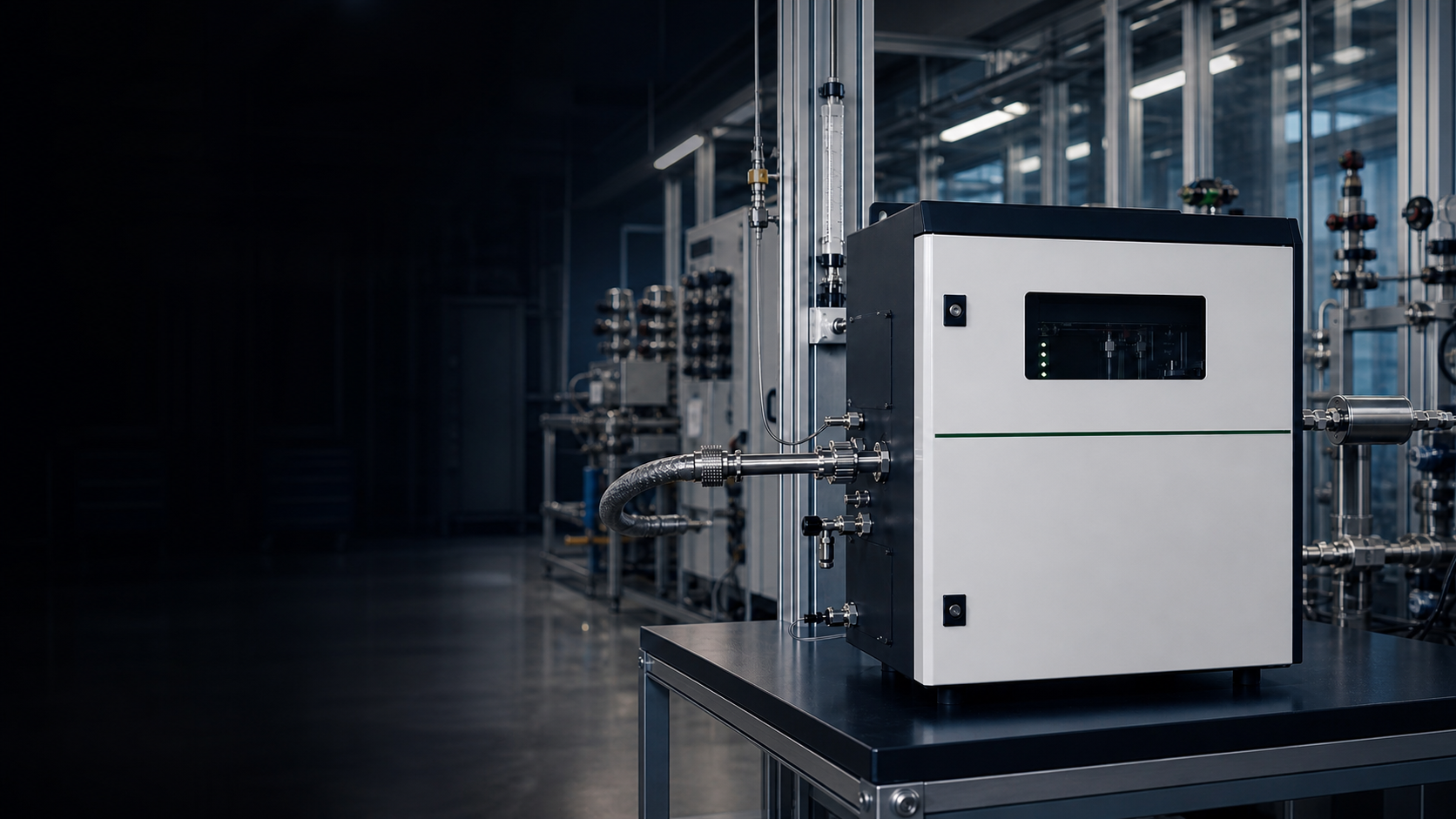
UV-DOAS Gas Analyzers — Ultra-Violet Differential Optical Absorption Technology
Ultra-violet differential optical absorption spectroscopy (UV-DOAS) for SO₂, NO / NO₂, Cl₂, NH₃, O₃, and selected aromatic compounds — multi-wavelength fitting in the 190–400 nm range delivers simultaneous multi-gas measurement with water-vapor immunity for FGD, SCR, incineration, chlor-alkali, and ambient stack and process monitoring.
What Is UV-DOAS Gas Analysis?
UV-DOAS exploits the fact that SO₂, NO₂, Cl₂, NH₃, O₃, and some aromatic hydrocarbons have distinctive, narrow-band vibronic absorption features in the 190–400 nm ultraviolet region that survive intact on the way through industrial stack and ambient air. By measuring the differential absorption — the high-frequency structure riding on top of a smooth broadband attenuation — and fitting it with a least-squares combination of reference cross-sections, UV-DOAS can quantify several UV-absorbing species simultaneously from a single optical path. The two defining strengths in industrial service are (a) water-vapor immunity, which removes the dryer / GFC optics burden that NDIR carries on wet stacks, and (b) genuine multi-gas simultaneous output on a single detector. Where UV-DOAS does not belong is on targets with no UV fingerprint (CO, CO₂, CH₄ — NDIR / TDLAS territory), on ppb-level NO₂ compliance duty where chemiluminescence remains the reference method, or in buyers’ shopping lists as a synonym for UV fluorescence (different physics, same spectral neighborhood).
UV-DOAS Measurement Principle
Engineering & Deployment Notes
- UV-DOAS is water-vapor immune at the target wavelengths, which removes the dryer / GFC optics burden that NDIR carries on wet stacks — a decisive advantage for FGD outlets and wet incineration scrubbers.
- Source lamp aging is the dominant long-term drift: D₂ lamps age in hundreds to a few thousand hours; planned lamp-replacement schedules must be part of the project, not an afterthought.
- UV window contamination (particulate deposition, condensate film) shows up as a slow broadband attenuation that the differential fit rejects, but only until the throughput drops below detector SNR — periodic purge and window-cleaning discipline still matter.
- Temperature and pressure compensation on extractive UV-DOAS must be built-in for regulatory CEMS duty; open-path installations additionally need path-averaged temperature / pressure handling.
- UV-DOAS is not a chemistry instrument — ppb NO₂ compliance duty in ambient air monitoring stations often still uses chemiluminescence (CLD) as the reference method for NO + NO₂ reporting.
Deep-UV, Broadband, and Open-Path DOAS
All three share the same differential-fit method, but the source, window material, and geometry drive which target gases and deployment scenarios they fit. Most industrial CEMS platforms combine deep-UV and broadband; open-path DOAS is a separate long-baseline deployment choice.
Deep-UV DOAS (190–250 nm)
Deuterium-lamp or deep-UV LED source + solar-blind detector, tuned to the fine-structure absorption bands of SO₂ (200–230 nm), NH₃ (195–220 nm), and NO (at 226 nm).
- Strongest differential cross-sections for SO₂ / NH₃ / NO
- Near-zero solar background (solar-blind region) for open-path deployments
- Established reference method for SCR ammonia slip and wet FGD SO₂ outlet
- Deuterium lamp life 1000–2000 hours (planned replacement schedule required)
- Sapphire / MgF₂ window materials mandatory; standard quartz is opaque at 190 nm
- Higher lamp / optics purchase cost than 250–400 nm variants
Wet-FGD SO₂ outlet, SCR NH₃ slip, nitric-acid plant stack, deep-UV ambient monitoring
Broadband UV DOAS (250–400 nm)
Xenon arc or UV LED array + array spectrometer covering 250–400 nm, tuned to NO₂ (350–450 nm), Cl₂ (260–360 nm), O₃ (250–290 nm), and aromatics (255–290 nm).
- Longer lamp life and lower operating cost than deep-UV
- Broader simultaneous multi-gas window (NO₂ + Cl₂ + O₃ + aromatics on one spectrometer)
- Standard UV-grade quartz and fused-silica components acceptable
- Solar background is significant in open-path mode and must be actively corrected
- SO₂ and NH₃ fits degrade above 260 nm; deep-UV is preferred for those targets
- Aromatic quantification is sensitive to mixture composition
Chlor-alkali Cl₂ process, post-SCR NO₂ monitoring, ozone generation QA, urban ambient
Open-Path / Long-Path DOAS
Transmitter and retroreflector (or active receiver) separated by 10–1000 m across a fenceline, plume corridor, or chemical-park perimeter; spectrum is integrated over the beam path.
- Long optical path drives detection down to sub-ppm, low-ppb on select targets in ambient air
- Beam-integrated measurement gives a representative corridor average, not a point sample
- Single beam tracks several target species simultaneously
- Weather dependence — fog, heavy rain, and snow drop throughput below detection
- Alignment maintenance on long paths is a real operational cost
- Not a stack-CEMS replacement — regulatory stack reporting still uses extractive or in-situ point analyzers
Fenceline ambient, urban air quality, emergency-response plume tracking, research-grade atmospheric studies
Where UV-DOAS Works Best
UV-DOAS is the default for SO₂ / NO₂ / Cl₂ on wet CEMS stacks and chlor-alkali process duty, a Good fit for NO / NH₃ / O₃, and a Conditional path for aromatics and elemental mercury. Where GESHINE has a matching gas category, the row links to it.
| Gas | Formula | UV Absorption Band | Typical Range | UV-DOAS Fit | Notes & Recommended Path |
|---|---|---|---|---|---|
| Sulfur Dioxide | SO₂ | 200–230 nm (fine-structure, deep-UV) | 0–1000 ppm (CEMS) / 0–100 ppm (wet-FGD outlet) / sub-ppm (ambient long-path) | Excellent | UV-DOAS is the default instrumental reference method for FGD outlet SO₂ and wet-stack CEMS; the deep-UV fine structure survives wet matrix without drying. SO₂ / NOx Category |
| Nitrogen Dioxide | NO₂ | 350–450 nm (broadband structured) | 0–500 ppm (CEMS / SCR outlet) / sub-ppm (ambient long-path) | Excellent | UV-DOAS resolves NO₂ directly without the NO₂→NO converter / ozone reactor CLD architecture demands; CLD still wins on ppb ambient NO₂ compliance work. SO₂ / NOx Category |
| Nitric Oxide | NO | ≈ 226 nm (gamma band, deep-UV) | 0–500 ppm (CEMS) / 0–50 ppm (SCR outlet) | Good | NO fits are weaker than NO₂ and require deep-UV source + solar-blind detector; CEMS rigs often combine UV-DOAS NO₂ + CLD NO for a complete NOₓ report. SO₂ / NOx Category |
| Chlorine | Cl₂ | 260–360 nm (broadband, peak ≈ 330 nm) | 0–50 ppm (process / safety) / 0–1000 ppm (chlor-alkali cell gas / %vol-scale variants) | Excellent | Replaces consumable electrochemical cells in continuous chlor-alkali, PVC / VCM, and water-treatment Cl₂ duty — minimal long-term drift, no humidity interference, and simultaneous interference compensation. Chlorine Category |
| Ammonia | NH₃ | 195–220 nm (deep-UV, structured) | 0–200 ppm (SCR slip / CEMS) / 0–2000 ppm (process extension) | Good | Deep-UV DOAS is the extractive-CEMS default for NH₃ slip at SCR / SNCR outlets, especially when SO₂ and NO₂ are measured on the same optical platform. Sub-ppm in-situ NH₃ usually still routes to TDLAS near-IR. Ammonia Category |
| Ozone | O₃ | 250–290 nm (Hartley band, strong) | 0–200 ppm (process / generator QA) / sub-ppm (ambient) | Good | UV-DOAS O₃ is deployed in ozone-generator QA, AOP water-treatment off-gas, and ambient monitoring. Many regulatory ambient O₃ stations still use dedicated UV absorption photometers rather than full DOAS. |
| Aromatic Hydrocarbons | BTEX (Benzene / Toluene / Xylene) | 255–290 nm (π→π* transitions) | 0–50 ppm (fenceline) / low-ppb (long-path ambient) | Conditional | Aromatic DOAS is real but mixture-composition sensitive; deployments are typically research / fenceline ambient rather than regulated stack CEMS. Speciated VOC compliance is covered by our VOC analyzer range (PID / FID / GC-MS). |
| Mercury | Hg⁰ | 253.65 nm (atomic resonance) | sub-ppb (CEMS / ambient) | Conditional | Elemental Hg uses a narrow atomic line at 253.65 nm and is typically handled by Cold Vapor Atomic Fluorescence (CVAF) or dedicated UV absorption Hg CEMS — not generic multi-wavelength DOAS. Listed here for clarity: GESHINE does not currently offer an in-house mercury analyzer — Hg CEMS requirements are served through partner instruments on request. |
UV-DOAS vs TDLAS / NDIR / CLD / FTIR
Pick the technology that matches the physics, the matrix, and the regulatory framework — not the marketing buzzword. UV-DOAS wins on water-vapor immunity and multi-gas simultaneous UV absorbers; CLD remains the reference method for ppb ambient NOₓ; TDLAS / NDIR cover the IR targets.
| Parameter | UV-DOAS | TDLAS | NDIR | CLD | FTIR |
|---|---|---|---|---|---|
| Physics / Spectral Region | Ultraviolet differential absorption 190–400 nm | Near-IR 0.76–2.5 μm, single laser line | Mid-IR 2–15 μm, broadband filter | Chemiluminescent NO + O₃ → NO₂* reaction (not spectroscopy) | Full mid-IR spectrum with Fourier deconvolution |
| Typical Accuracy | ±1–2 % FS with fit-residual QA | ±0.5–1 % FS or ±0.1 ppm | ±1–2 % FS | ±1 % FS at ppm; ±2–5 % FS at ppb-ambient | ±2–5 % FS per component (mixture-dependent) |
| Detection Limit | Low-ppm extractive; sub-ppm to low-ppb on long-path / open-path ambient | Sub-ppm to ppb on favorable lines | ppm (low-range 0.5–5 ppm clean matrix) | Sub-ppb for NO / NO₂ (reference method for ambient NOₓ) | ppm to sub-ppm per component |
| Response Time (T90) | 10–30 s typical | <1–10 s | 15–60 s typical | <20 s (with ozone generator warm-up) | 30–60 s per spectrum scan |
| Cross-Interference Handling | Differential fit rejects broadband attenuation and overlapping absorbers | Laser-line selection resolves neighboring species | H₂O and overlapping IR bands are primary risks | Ammonia / water / CO₂ quenching must be compensated | Mixture-complex matrices require reference libraries |
| Multi-Gas Simultaneous | Yes — SO₂ / NO₂ / NH₃ / Cl₂ / O₃ in one optical head | One gas per laser; multi-gas = multi-laser optics | Yes via swappable filters (3–5 channels) | Effectively single-channel (NO + NO₂ with converter) | Yes — up to 10–20 species per spectrum |
| Sample Conditioning | Water-vapor immune; dryer usually not required | Hot, wet sample tolerated when laser line avoids H₂O | Dry sample preferred; or GFC / dual-beam correction | Full sample conditioning (dryer + converter + ozone) | Heated cell + extensive sample conditioning |
| Relative Upfront Cost | Medium to high | Medium to high | Low to medium | Medium (plus ozone generator consumable) | High |
| Best For | Wet-FGD SO₂, SCR NH₃ slip, chlor-alkali Cl₂, urban ambient plume | Corrosive / complex matrix low-ppm, single-gas process duty | CO / CO₂ CEMS, IAQ, combustion control | Regulatory ambient NOₓ reference method (ppb) | Lab NMHC speciation, research multi-gas, troubleshooting |
Choose UV-DOAS When…
- Target is SO₂, NO₂, Cl₂, NH₃, or O₃ on a wet or mixed-acid stack
- Multi-gas simultaneous output is needed on a single optical head
- Sample is wet and you want to avoid the dryer / GFC optics burden NDIR demands
- Fenceline or urban long-path / open-path geometry is part of the deployment
- Chlor-alkali / PVC / VCM process Cl₂ where electrochemical consumables are unacceptable
Route to TDLAS / NDIR / CLD / FTIR When…
- Target has no UV fingerprint (CO, CO₂, CH₄, refrigerants — NDIR territory)
- ppb-trace NOₓ ambient compliance reporting (CLD reference method)
- Single-line low-ppm HF / HCl / H₂S corrosive duty (TDLAS)
- Lab speciation across 10+ unknown species (FTIR full-spectrum)
- Regulated THC / NMHC continuous stack monitoring under EPA Method 25A (heated FID)
UV-DOAS in Industrial Duty
From wet-FGD SO₂ outlets and SCR ammonia slip to chlor-alkali Cl₂, multi-gas incineration stacks, and urban fenceline long-path — where UV-DOAS earns its place.
Wet-FGD SO₂ Outlet CEMS
- Challenge
- Coal-fired and industrial boilers with wet limestone / sulfite scrubbers discharge a saturated, wet stack gas that defeats most dry-sample architectures. Regulators still expect continuous SO₂ reporting under 40 CFR Part 60 / Part 75 and EU IED BAT; dryer-based NDIR or extractive NDIR with GFC is workable but adds conditioning complexity.
- Solution
- Extractive or in-situ UV-DOAS in the 200–230 nm deep-UV window measures SO₂ directly in wet gas without drying, using the differential fit to reject broadband attenuation and overlapping absorbers simultaneously. ZS-CEMS-200 pairs UV-DOAS SO₂ / NO₂ with chemiluminescence NO for a full CEMS stack.
SCR / SNCR NH₃ Slip Monitoring
- Challenge
- Ammonia slip downstream of selective catalytic / non-catalytic reduction is a closed-loop control signal for NH₃ injection and a regulatory compliance point at many stacks. Sample-line adsorption and matrix interference (SO₂, H₂O) defeat most chemistry-based approaches.
- Solution
- Deep-UV DOAS at 195–220 nm resolves NH₃ on the same optical head as SO₂ / NO₂, which turns the slip measurement into a multi-gas simultaneous output. GESHINE supplies this duty as an extractive UV-DOAS CEMS configuration (by project review); see the ammonia analyzer category for the full NH₃ range.
Chlor-Alkali and PVC / VCM Cl₂ Process
- Challenge
- Cell-room header, drying section, and downstream compression rely on continuous Cl₂ measurement for yield, corrosion, and safety. Traditional electrochemical Cl₂ cells have 6–12 month consumable lifetime, humidity drift, and zero-recovery cycles that interrupt process data.
- Solution
- UV-DOAS in the 260–360 nm broadband window eliminates the consumable cell, delivers continuous drift-resistant readings, and handles humidity and cross-gas interference in one fit. The ZS-UVDOAS-Cl₂ analyzer covers in-line process Cl₂ duty across the chlorine analyzer family.
Waste-Incineration Multi-Gas Stack
- Challenge
- Municipal and hazardous-waste incineration stacks carry SO₂, NO₂, NH₃ (from SNCR), HCl, and Cl₂ simultaneously. Running a separate point analyzer per species multiplies the sample-conditioning rack and the calibration burden.
- Solution
- UV-DOAS delivers SO₂ / NO₂ / NH₃ / Cl₂ simultaneously on one optical head; HCl stays on a dedicated TDLAS or FTIR channel because its strong UV absorption is below the DOAS operating window. The combined stack reduces rack footprint and calibration-gas manifold complexity.
Urban Ambient / Fenceline Long-Path
- Challenge
- Industrial park fencelines, urban air-quality networks, and emergency-response plume tracking need path-integrated measurement of SO₂, NO₂, O₃, and sometimes aromatics at sub-ppm to low-ppb concentrations over corridors of 100 m to 1 km.
- Solution
- Open-path / long-path UV-DOAS with transmitter and retroreflector covers the full target list on one beam without per-station gas cylinders; the differential fit handles atmospheric attenuation and solar background. Regulatory stack CEMS still runs on extractive or in-situ point analyzers — long-path DOAS is a complement, not a replacement.
GESHINE UV-DOAS Family
GESHINE UV-DOAS products and companion categories. Looking for UV fluorescence (the ZS6200-SO2 UVF analyzer) or an electrochemical instrument? Those use different sensing physics — find them in the SO₂ / NOₓ category.
ZS-CEMS-200 CEMS SO₂ / NOₓ Analyzer
Rack-mount CEMS platform combining UV-DOAS SO₂ / NO₂ with chemiluminescence NO for full stack reporting under 40 CFR Part 60 / EU IED BAT.
View ProductZS-UVDOAS-Cl₂ Chlorine Analyzer
UV-DOAS chlorine analyzer for chlor-alkali cell-room, compression, and process Cl₂ duty — no consumable electrochemical cell to drift.
View ProductSO₂ / NOₓ Analyzer Category
Full SO₂ / NOₓ family — UV-DOAS, UV fluorescence, and chemiluminescence selection guidance for CEMS and process service.
Browse CategoryChlorine (Cl₂) Analyzer Category
Dual-domain chlorine family — UV-DOAS gas-phase Cl₂ plus amperometric / DPD / reagentless aqueous residual chlorine packages.
Browse CategoryAmmonia (NH₃) Analyzer Category
TDLAS-based ammonia analyzers for SCR / SNCR slip monitoring, CEMS compliance, and process control across power, cement, and incineration.
Browse CategoryUV-DOAS Gas Analyzer FAQ
Common questions on when to pick UV-DOAS, how deep-UV and broadband variants differ, and how UV-DOAS relates to NDIR, CLD, FTIR, and UV fluorescence.
When should I choose UV-DOAS over NDIR?
Short answer: choose UV-DOAS when the target gas absorbs in the ultraviolet (SO₂, NO₂, Cl₂, NH₃, O₃, aromatics) and the sample is wet or multi-component. NDIR stays the default for targets with strong mid-IR fingerprints but no UV fingerprint (CO, CO₂, CH₄, refrigerants). On wet stacks, UV-DOAS avoids the dryer / GFC optics burden NDIR has to carry. For CEMS stacks with mixed acid gases and NH₃ slip, UV-DOAS typically wins on multi-gas simultaneous output from a single optical head.
Does UV-DOAS need sample drying like NDIR?
Usually no. Water vapor has negligible absorption in the 190–400 nm region at the narrow-band structure UV-DOAS uses for fitting, which is precisely why it is the default technology on wet-FGD outlets and wet incineration scrubbers. What it does need is temperature and pressure compensation (built-in), protection of the UV window from particulate / condensate deposition (purge and periodic cleaning), and planned source-lamp replacement. The water-vapor advantage is real; the engineering discipline is still real.
What is the difference between deep-UV DOAS and broadband UV-DOAS?
They are two wavelength regimes of the same method. Deep-UV DOAS (190–250 nm) uses deuterium or deep-UV LED sources, solar-blind detectors, and sapphire / MgF₂ windows, and targets SO₂, NH₃, and NO whose strongest fine-structure absorption sits in that region. Broadband UV-DOAS (250–400 nm) uses xenon arc or UV LED sources, standard UV-grade quartz, and targets NO₂, Cl₂, O₃, and aromatics that absorb above 250 nm. Most industrial CEMS platforms combine both regimes for a full multi-gas stack; ambient long-path DOAS often picks one regime to match the target mix.
How is DOAS different from FTIR?
Different spectral region and different deconvolution philosophy. UV-DOAS operates in 190–400 nm and fits a small number of well-characterized UV absorbers against narrow-band differential structure. FTIR operates across the full mid-IR and uses Fourier transform of a scanning interferogram to deconvolve broad overlapping bands for up to 10–20 species. FTIR wins on chemistry coverage and lab / research flexibility; UV-DOAS wins on targeted multi-gas CEMS simplicity, lower upfront cost, and water-vapor immunity. They are complementary, not competitors.
Why is elemental mercury handled differently?
Elemental Hg absorbs on a single narrow atomic resonance at 253.65 nm — a line, not a molecular vibronic band. Regulatory Hg CEMS instruments use Cold Vapor Atomic Fluorescence (CVAF) or dedicated UV absorption Hg photometers optimized for that one line, not a general multi-wavelength DOAS spectrometer. GESHINE does not offer an in-house mercury analyzer: compliance Hg CEMS projects are served through purpose-built partner instruments, scoped per project, rather than a general UV-DOAS SKU.
Is UV-DOAS the same as UV fluorescence?
No. UV absorption (DOAS) measures how much of an incident UV beam is absorbed at the target wavelengths. UV fluorescence measures the secondary re-emission from excited molecules (SO₂ fluoresces after being pumped with 214 nm photons) on a different detector geometry. Both live in the ultraviolet, but the physics, the detector arrangement, and the sample-cell engineering are all different. GESHINE’s UV-fluorescence product (the ZS6200-SO2 UVF analyzer) lives in the SO₂ / NOₓ category — it is a UVF instrument, not a UV-DOAS one, so compare it against UVF criteria when shortlisting.
What certifications should I pin for a UV-DOAS CEMS?
In the EU, MCERTS (UK Environment Agency) and EN 15267 / EN 14181 QAL1 / QAL2 / AST are the standard type-approval framework, with EN 14791 (SO₂), EN 14792 (NOₓ), and EN ISO 21877 (NH₃) as the reference methods. In the US, 40 CFR Part 60 Appendix B Performance Specifications (PS-2, PS-3, PS-6) and 40 CFR Part 75 cover instrumental stack monitoring. Specification should pin the target certifications explicitly rather than relying on vendor badges.
Is a generic “UV gas analyzer” the same as UV-DOAS, UV fluorescence (UVF), or a UV photometric SO₂ analyzer?
Not necessarily — “UV gas analyzer” is an ambiguous label, so route by what the instrument actually does. Generic wording like ultraviolet, UV absorption, online UV, or UV photometric multi-gas almost always points to UV-DOAS (differential optical absorption spectroscopy), which fits narrow-band UV structure for SO₂, NO₂, Cl₂, NH₃, and O₃ on one optical path. A search for “UV fluorescence” or “UV SO₂” instead means an emission-based chemistry — that is covered on the UV fluorescence (UVF) analyzer page. A “UV NOx” query usually lands best on the SO₂/NOx analyzer page, where UV-DOAS NO₂ pairs with chemiluminescence NO. When the UV label does not obviously match your target species and matrix, talk to an engineer who can map the duty to the right method.
Ready to Specify a UV-DOAS Analyzer?
Share your target species (SO₂ / NOₓ / NH₃ / Cl₂ / O₃ / aromatics), matrix composition, deployment geometry (extractive, in-situ, open-path), and regulatory framework — GESHINE application engineers will scope the right deep-UV, broadband-UV, or open-path DOAS configuration (including whether UV-DOAS is genuinely the correct choice or whether the project should route to TDLAS, NDIR, or CLD) within 48 hours.
- Target species (SO₂ / NO / NO₂ / Cl₂ / NH₃ / O₃ / aromatics)
- Matrix composition (moisture, particulate, acid gases)
- Deployment geometry (extractive, in-situ, open-path)
- Variant preference (deep-UV 190–250 nm vs broadband 250–400 nm)
- Required range and detection limit (ppm stack vs sub-ppm ambient)
- Regulatory framework (40 CFR Part 60 / 75, EU IED BAT, MCERTS, EN 14181)
- Output protocols (4-20 mA / RS-485 Modbus / HART)
- Path length / optical window / purge constraints

Get UV-DOAS Expert Consultation
Our application engineers will tell you honestly whether UV-DOAS is the right answer for your stack or fenceline — and when the project should route to TDLAS, NDIR, CLD, or heated FID instead — and then scope the right configuration.


