
Chlorine Analyzers — UV-DOAS Gas-Phase Cl₂ Monitoring
Configured UV-DOAS gas-phase Cl₂ measurement for chlor-alkali process monitoring and chemical-safety leak detection — process and fixed-point safety duties on one platform.
GESHINE’s gas-phase chlorine analyzer uses UV Differential Optical Absorption Spectroscopy to measure Cl₂ in process gas and ambient air. Process and fixed-point safety configurations share the same optical platform; range, response, enclosure and hazardous-area scope are configured per application and confirmed in the delivered datasheet. Dissolved residual chlorine in water is a separate water-analysis domain — see the note below to route an aqueous enquiry.
Why Gas-Phase Cl₂ Monitoring Is Hard — And How UV-DOAS Solves It
Two different chlorine measurement domains
Buyers searching for “chlorine analyzers” arrive with two very different problems. Gas-phase Cl₂ (molecular chlorine in process gas or ambient air) drives chlor-alkali process monitoring, chemical-storage leak detection, and area safety compliance — measured in ppm of gaseous Cl₂ with exposure-based alarm setpoints. Dissolved residual chlorine (free, total, combined Cl in water) is a separate water-analysis domain that drives drinking-water compliance, wastewater discharge permits, and cooling-tower biocide control — measured in ppm of dissolved HOCl/OCl⁻. The physics, wetted-parts materials, and integration paths are entirely different. This page covers the gas-phase Cl₂ analyzer; aqueous residual-chlorine measurement is handled by our application team as a separate water-analysis enquiry.
Chlorine disinfection and chlorine production are common; measuring Cl₂ gas reliably is not. A gas-phase chlorine analyzer determines molecular Cl₂ concentration in a process gas stream or ambient air — continuously, in seconds, without grab samples. The easy part is the reading. The hard part is keeping the reading honest in wet, corrosive, interference-laden chlorine service over years.
Continuous gas-phase Cl₂ monitoring runs into recurring challenges. First, consumable electrochemical Cl₂ cells drift with humidity and cross-respond to other oxidizing species, and the cell itself is a wear part with a limited service life. Second, wet chlorine is one of the most aggressive corrosion environments in industrial gas handling, so wetted-parts material selection and sample conditioning determine whether an analyzer survives in-line service or only handles dry, conditioned gas. Third, missed maintenance windows leave readings outside the site’s calibration or verification basis.
These failures have consequences. In process duty, an inaccurate Cl₂ reading degrades yield control and masks process upsets. In safety duty, a drifting or failed detector can leave an area unprotected against a leak whose exposure thresholds are measured in fractions of a ppm. The cost of a missed reading is both production and personnel risk.
UV-DOAS addresses these failure modes directly. A broadband UV optical path with reference-spectrum processing isolates the Cl₂ absorption band from the measured gas matrix, so there is no consumable electrochemical cell to replace and humidity does not shift the baseline the way it does with a diffusion-membrane sensor. Corrosion-resistant wetted parts are selected for the chlorine service, and range, response, enclosure rating and hazardous-area scope are configured per application and confirmed in the delivered datasheet. Interference review (mixed acid gases, aerosols, fog, condensation) and sample-conditioning choices remain part of the application engineering.
Knowing why a consumable-cell instrument drifts out of its window points to the next question: which configuration of the GESHINE UV-DOAS gas-phase analyzer — process measurement or fixed-point safety — fits your duty and process conditions?
Gas-Phase Cl₂ Exposure & Safety References
U.S. chlorine exposure references: Federal OSHA general industry PEL is 1 ppm ceiling; OSHA construction and maritime tables list a 1 ppm 8-hour TWA. Current ACGIH TLV is 0.1 ppm TWA and 0.4 ppm STEL. NIOSH REL is 0.5 ppm as a 15-minute ceiling, and NIOSH IDLH is 10 ppm. Configure alarm setpoints to the site safety basis and local jurisdiction. Presented as exposure/safety context that drives alarm set-points and monitoring scope — not analyzer accuracy.
Federal general-industry ceiling (29 CFR 1910.1000). Construction/maritime tables list a 1 ppm 8-hour TWA.
0.1 ppm 8-hour TWA; 0.4 ppm 15-minute short-term exposure limit (current).
0.5 ppm as a 15-minute ceiling (NIOSH Pocket Guide).
Immediately Dangerous to Life or Health — evacuate.
Exposure references drive alarm set-points and define the monitoring scope, not analyzer accuracy or product performance. Site-specific permit limits and local jurisdiction override these general values.
UV-DOAS Gas-Phase Cl₂ Measurement
One optical platform · Process measurement and fixed-point safety configurations
UV-DOAS for In-Line Cl₂ Process Monitoring
A broadband UV light source passes through the sample gas. Differential absorption spectroscopy mathematically isolates the Cl₂ spectrum from interfering species. The process configuration handles continuous in-line measurement at chlor-alkali cell outlets, compression and liquefaction stages; sample conditioning and wetted-parts materials are selected for the chlorine service.
- No electrochemical electrolyte; optical source and cell cleaning remain service items
- Measurement range configured per application on the optical path
- Enclosure and hazardous-area scope confirmed per project
- Reference-spectrum processing resists humidity baseline shift
UV-DOAS for Fixed-Point Cl₂ Leak Detection
The same UV-DOAS platform configured as a fixed-point area detector for chlorine cylinder rooms, storage buildings, and loading/unloading perimeters. Alarm relays are wired to the site safety basis; range, enclosure and hazardous-area documentation are configured per application and confirmed in the delivered datasheet.
- Fixed-point area monitoring for cylinder rooms and storage perimeters
- Configurable alarm relays set to the site safety basis and local jurisdiction
- No consumable cell — optical reference resists drift seen in diffusion sensors
- Hazardous-area enclosure scope confirmed per installation
Aqueous Residual Chlorine Is a Separate Water-Analysis Domain
Dissolved chlorine in water (drinking water, wastewater, cooling towers) uses different measurement methods — amperometric, DPD colorimetric and reagentless solid-state — with their own regulatory frameworks and sample handling. That is a water-analysis enquiry, not a gas-phase analyzer. Contact our application team to route an aqueous residual-chlorine request.
How UV-DOAS Actually Reads Gas-Phase Cl₂
Who needs gas-phase Cl₂ monitoring, the exposure references that drive safety alarm setpoints, and how the optical measurement separates the Cl₂ band from the gas matrix.
The Chlor-Alkali, Water-Plant and Chemical-Safety Duties
Gas-phase Cl₂ monitoring is the domain of chlor-alkali operators measuring Cl₂ at membrane cell outlets, liquefaction units, and compression stages; of water-treatment facilities protecting operators against cylinder and pipeline leaks; and of chemical producers running area and perimeter monitoring around storage, loading, and unloading zones.
The U.S. chlorine exposure references are: Federal OSHA general industry PEL of 1 ppm ceiling (OSHA construction and maritime tables list a 1 ppm 8-hour TWA); the current ACGIH TLV of 0.1 ppm TWA and 0.4 ppm STEL; the NIOSH REL of 0.5 ppm as a 15-minute ceiling; and the NIOSH IDLH of 10 ppm — thresholds a fixed-point detector must resolve accurately at sub-ppm concentrations, with alarm relays wired to audible/visual beacons and emergency shutdown interlocks, configured to the site safety basis and local jurisdiction.
How the Optical Path Separates the Cl₂ Band
The GESHINE UV-DOAS gas-phase analyzer covers both the in-line process and fixed-point safety deployment patterns with UV Differential Optical Absorption Spectroscopy: a broadband UV optical path and reference-spectrum processing that separate the Cl₂ absorption band from the measured gas matrix. Unlike a consumable electrochemical cell, the optical path is not a membrane/electrolyte sensor and avoids the periodic cell-replacement cycle — though mixed acid gases, aerosols, fog, condensation, and sample-conditioning choices still require application review.
Corrosion-resistant wetted parts are selected for wet-chlorine service, and the enclosure, hazardous-area zone, gas group, and installation class are configured per project and confirmed in the delivered datasheet rather than asserted as a fixed product certification on this page.
Aqueous Residual-Chlorine Methods — Amperometric vs Colorimetric vs Reagentless
Dissolved chlorine in water is a separate water-analysis domain from the gas-phase Cl₂ analyzer on this page. The reference table below explains the three industry methods for aqueous residual chlorine — accuracy, response, maintenance burden, and compliance fit — as buyer education. If your duty is dissolved chlorine in water, contact our application team to route an aqueous enquiry.
| Parameter | Amperometric | Colorimetric (DPD) | Reagentless |
|---|---|---|---|
| Measurement basis | Electrochemical current proportional to chlorine concentration | Reagent colour reaction read by photometer | Reagentless electrode response |
| Response Time (T90) | Sub-minute continuous | Slower batch measurement cycle | Sub-minute continuous |
| pH Sensitivity | Requires pH compensation | pH-independent (buffered) | Requires pH compensation |
| Reagent / consumable burden | Low to moderate: membrane, electrolyte, pH-sensor service parts, and calibration standards. | Highest: DPD reagent cartridges, tubing, flow-cell service, and verification workflow. | Lowest reagent burden: no DPD cartridge; service depends on electrode condition, fouling, and calibration practice. |
| Calibration Interval | Short | Self-calibrating each cycle | Long |
| Maintenance burden | Moderate | High (tubing + reagent) | Low |
| Compliance reporting fit | Operational control and grab-sample verification; amperometric titration reference method is SM 4500-Cl D where the permit or state approval allows it. | EPA Method 334.0 online analyzer protocol for drinking-water residual monitoring, with SM 4500-Cl G / ISO 7393-2 DPD colorimetric method references where applicable. | Process trending and control; not a default permit-reporting method unless the governing permit or state approval accepts the configured method. |
| Best For | Distribution systems, process control | Plant compliance, permit reporting | Remote sites, cooling towers, low running cost |
| Typical system cost | Mid-tier, driven by pH compensation, panel configuration, outputs, and sample handling. | Premium tier, driven by reagent handling, photometric hardware, verification workflow, and reporting documentation. | Entry to mid-tier, driven by sensor format, enclosure, controller, and installation requirements. |
| 5-year ownership profile | Moderate lifecycle burden when pH compensation and calibration discipline are maintained. | Highest lifecycle burden because reagents, tubing, verification, and labor dominate routine operation. | Lowest routine consumable burden; lifecycle cost depends mainly on calibration practice, water quality, and electrode service. |
Engineering Note — Chlorine Measurement Fundamentals
Most U.S. drinking-water residual-disinfectant monitoring is governed through 40 CFR 141.74 and approved alternative methods in Appendix A to 40 CFR Part 141. Free chlorine means HOCl plus OCl⁻. Combined chlorine means chloramines. Total chlorine means free plus combined chlorine. SM 4500-Cl D is the amperometric titration method; SM 4500-Cl G is the DPD colorimetric method. EPA Method 334.0 is an online residual-chlorine analyzer protocol for drinking-water compliance when the analyzer is calibrated or verified against an approved grab-sample reference method. For Clean Water Act/NPDES residual-chlorine reporting, 40 CFR 136.3 Table IB lists methods such as SM 4500-Cl D, E, F, and G; verify the governing permit and state approval before treating online analyzer output as compliance data.
Cost rows are relative method tiers for budget planning, not quotations — request a configured budgetary quote that separates hardware, sample handling, consumables, and service parts so lifecycle cost can be compared method by method.
Choosing the Right Gas-Phase Cl₂ Setup — Process or Fixed Safety
UV-DOAS Cl₂ Process Configuration
Extractive UV-DOAS configuration for continuous gas-phase Cl₂ monitoring in chlor-alkali membrane cell outlets, compression stages, and liquefaction trains. Sample conditioning, enclosure, and hazardous-area scope are configured per application and confirmed in the delivered datasheet.
- Chlor-alkali process Cl₂ optimization
- Liquefaction Cl₂ purity monitoring
UV-DOAS Cl₂ Fixed-Point Safety Configuration
Fixed-point UV-DOAS Cl₂ leak-detection configuration for chlorine storage, loading docks, and chemical-safety perimeters. Area-alarm setpoints are configured to the site safety basis and local jurisdiction; enclosure and hazardous-area documentation confirmed per project.
- Chlorine cylinder room area monitoring
- Loading dock / unloading station alarms
- Water treatment plant safety chain
Aqueous Residual Chlorine
Dissolved residual chlorine in water (drinking water, wastewater, cooling towers) is a separate water-analysis domain with its own panel form factors, methods, and sample handling — it is not the gas-phase UV-DOAS analyzer on this page. Our application team routes aqueous enquiries as a water-analysis request.
- Drinking water distribution disinfection feedback
- WWTP effluent dechlorination verification
- Cooling tower disinfectant residual control
Configuration Parameters for the UV-DOAS Gas-Phase Cl₂ Analyzer
The GESHINE gas-phase chlorine analyzer is configured per application rather than sold as a fixed-spec catalogue model. The parameters below are confirmed against your duty and stated in the delivered datasheet — measurement range, response, enclosure rating, and hazardous-area scope are project-specific. Our applications team confirms each parameter for your installation.
Gas-Phase Cl₂ — Process vs Fixed-Point Safety Configuration
| Parameter | Process Configuration | Fixed-Point Safety Configuration |
|---|---|---|
| Measurement Principle | UV-DOAS optical absorption | UV-DOAS optical absorption |
| Form Factor | In-line / extractive process analyzer | Fixed-point area safety detector |
| Measurement Range | Configured per application | Configured per application |
| Accuracy | Confirmed in the delivered datasheet | Confirmed in the delivered datasheet |
| Response (T90) | Confirmed in the delivered datasheet | Confirmed in the delivered datasheet |
| Enclosure / Hazardous-Area Scope | Confirmed per project and installation | Confirmed per project and installation |
| Output Protocols | 4-20 mA / Modbus (per configuration) | 4-20 mA / Modbus / alarm relays (per configuration) |
| Typical Use | Chlor-alkali process monitoring, dosing control | Area / perimeter safety, leak detection |
Aqueous Residual Chlorine — Separate Water-Analysis Domain
Dissolved residual chlorine in water (free, total, combined Cl) is measured by amperometric, DPD colorimetric, and reagentless solid-state methods — a separate water-analysis domain from the gas-phase UV-DOAS analyzer specified above, with its own ranges, accuracies, sample handling, and regulatory references. We do not list aqueous residual-chlorine specifications as catalogue products in this gas-analyzer range. If your duty is dissolved chlorine in water, contact our application team to route an aqueous enquiry.
The gas-phase analyzer is configured per application; measurement range, accuracy, response, enclosure rating, and hazardous-area zone/gas-group are confirmed in the delivered datasheet against your installation. Mixed acid-gas, aerosol, fog, and condensation matrices are reviewed per application.
Gas Cl₂ or Aqueous Chlorine — Confirm the Phase First
The first decision in any chlorine instrumentation project is the phase: are you measuring Cl₂ in a gas stream (chlor-alkali, chemical safety) or dissolved residual chlorine in a water stream (drinking water, wastewater, cooling tower)? This page is the gas-phase UV-DOAS analyzer. Aqueous residual chlorine is a separate water-analysis domain we route through our application team.
| Dimension | Gas Phase (UV-DOAS) — this page | Aqueous Phase — separate domain |
|---|---|---|
| Phase | Gas Cl₂ in air / process gas | Dissolved Cl₂ / HOCl / OCl⁻ in water |
| Typical concentration | ppm gaseous Cl₂ (configured per duty) | ppm dissolved residual chlorine |
| Sensing technology | UV-DOAS optical absorption | Amperometric / DPD / solid-state EC |
| Form factor | Process / extractive + fixed-point detector | Wall-mount panel + flow chamber |
| Sample chain | Sample probe + conditioned gas line | In-line tap + bypass loop |
| Compliance regime | OSHA / ACGIH / NIOSH exposure references · hazardous-area scope per project | EPA 334.0 · ISO 7393 · SDWA |
| Primary industries | Chlor-alkali · chemical safety · water plant gas room | Drinking water · wastewater · cooling tower · food |
| GESHINE coverage | UV-DOAS gas-phase Cl₂ analyzer (this page) | Routed as a water-analysis enquiry |
Pick gas-phase Cl₂ if your duty is in air or process gas
Chlor-alkali membrane cell outlets, liquefaction trains, chlorine cylinder rooms, water-treatment plant gas storage, chemical loading docks. The UV-DOAS analyzer handles both process measurement and fixed-point safety duties; hazardous-area scope is confirmed per project.
See the gas-phase UV-DOAS Cl₂ analyzer →Route an aqueous enquiry if your duty is dissolved chlorine in water
Drinking water disinfection feedback, wastewater dechlorination verification, cooling tower disinfectant residual, swimming pool / food-grade process control. Dissolved residual chlorine is a separate water-analysis domain — tell us the matrix and we route it to the right team.
Contact us for aqueous residual chlorine →Which Gas-Phase Cl₂ Configuration Fits Your Application?
Three questions narrow most gas-phase chlorine specs: process measurement or fixed-point safety, the exposure thresholds your alarm setpoints must resolve, and the hazardous-area scope of your installation. (Dissolved chlorine in water is a separate water-analysis domain — contact our team for an aqueous enquiry.)
Process Measurement vs Fixed-Point Safety
Process measurement watches Cl₂ in a chlor-alkali stream at cell outlets, compression, and liquefaction for yield control and upset detection. Fixed-point safety detection protects people in cylinder rooms, storage buildings, and loading perimeters against leaks. Both use the same UV-DOAS optical platform; the configuration, range, and outputs differ by duty and are confirmed in the delivered datasheet.
OSHA / ACGIH / NIOSH Gas-Phase Cl₂ References
Federal OSHA general industry PEL is 1 ppm ceiling (construction/maritime tables list a 1 ppm 8-hour TWA). Current ACGIH TLV is 0.1 ppm TWA / 0.4 ppm STEL. NIOSH REL is 0.5 ppm as a 15-minute ceiling; NIOSH IDLH is 10 ppm. For chlorine cylinder rooms, loading docks, and chemical-storage perimeters, the fixed-point UV-DOAS configuration drives alarm relays configured to the site safety basis and local jurisdiction. See the phase decision table to confirm gas vs aqueous.
Aqueous Residual Chlorine — Separate Domain
If you need free vs total chlorine in water (drinking-water dosing control, wastewater discharge dechlorination, cooling-tower biocide control), that is dissolved residual-chlorine measurement using amperometric, DPD colorimetric, or reagentless solid-state methods — a separate water-analysis domain, not the gas-phase analyzer on this page. Contact our application team to route an aqueous enquiry.
Where Gas-Phase Cl₂ Monitoring Earns Its Keep
Application patterns for the UV-DOAS gas-phase Cl₂ analyzer across chlor-alkali process measurement and chemical-safety leak detection. (Dissolved chlorine in water is a separate water-analysis domain — contact our team for an aqueous enquiry.)
Gas-Phase Cl₂ — Application Patterns
Chlor-Alkali Cell Room Monitoring
ChallengeContinuous Cl₂ measurement at membrane cell outlets, compression stages, and liquefaction units where humidity, trace oxidants, and corrosive wet-Cl₂ streams degrade consumable electrochemical sensors within months.
ApproachThe in-line UV-DOAS process configuration uses an optical reference path with no consumable cell and corrosion-resistant wetted parts selected for the chlorine service — stable optical measurement for yield control and upset detection.
Water Treatment Facility Safety
ChallengeDetecting Cl₂ cylinder and pipeline leaks at municipal water-treatment plants and wastewater disinfection facilities before release concentrations reach operator injury thresholds, while surviving high-humidity chlorine room environments.
ApproachThe fixed-point UV-DOAS safety configuration is specified to the site safety basis (low/pre-alarm, high/evacuation, and IDLH-level thresholds); alarm outputs, relay and setpoint count, and enclosure scope are configured and confirmed in the delivered datasheet and project design.
Chemical Area Monitoring
ChallengeArea monitoring for Cl₂ leaks inside chemical storage buildings and production areas where hazardous-area classification requires reviewed enclosure scope and where humidity, temperature swings, and oxidizing-gas cross-sensitivity defeat electrochemical detectors.
ApproachThe fixed-point UV-DOAS configuration uses an optical reference path with no consumable cell; alarm outputs, diagnostics and any multi-point wiring are configured and confirmed in the delivered datasheet and project design for compliance-audit installations.
Loading / Unloading Perimeter
ChallengePerimeter and loading-arm monitoring during Cl₂ tank-car and ISO-container transfers — the operation with the highest incident risk and the tightest expectation for perimeter and loading-bay detection.
ApproachMulti-point coverage with zone mapping to emergency shutdown is configured per installation; head count, exposure-threshold alarm outputs, controller topology, and shift-logging integration are confirmed in the delivered datasheet and project design.
Aqueous Residual Chlorine — Separate Water-Analysis Domain
Dissolved residual chlorine in water — drinking-water dosing control, wastewater dechlorination verification, cooling-tower biocide control, food-grade process water — is a separate water-analysis domain measured by amperometric, DPD colorimetric, and reagentless solid-state methods. It is not the gas-phase UV-DOAS analyzer on this page. Tell us the water matrix, target (free or total chlorine), and compliance regime, and our application team routes the enquiry. Contact us for aqueous residual chlorine →
GESHINE Gas-Phase Chlorine Analyzer — UV-DOAS Cl₂
One UV-DOAS optical platform, configured for process measurement or fixed-point safety. Aqueous residual chlorine is a separate water-analysis domain — routed through our application team.
Gas Phase · UV-DOASConfigured per duty · Chlor-Alkali / Chemical Safety
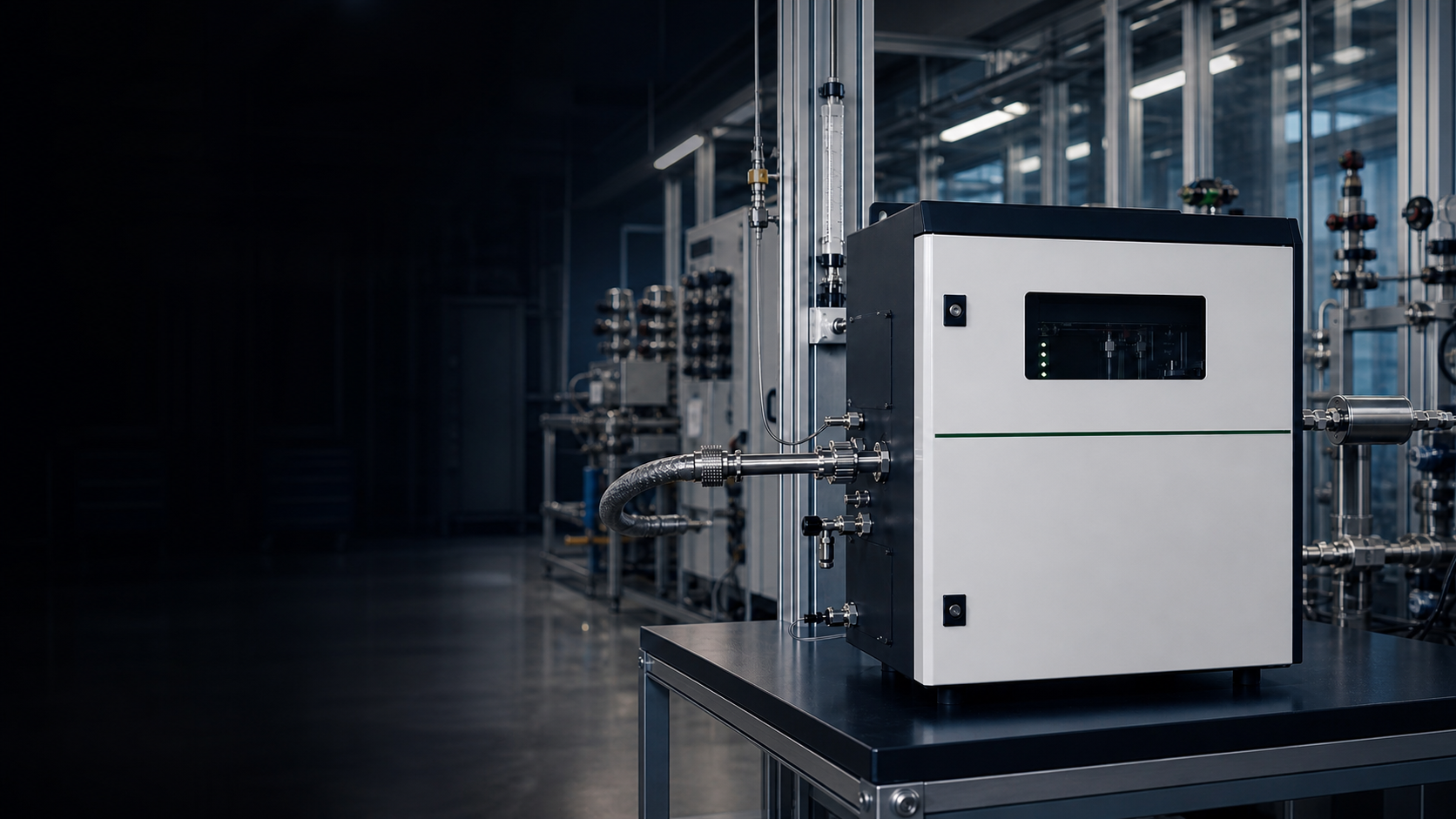 UV-DOAS
UV-DOAS Cl₂ Configuration
Gas-Phase Chlorine Analyzer
UV-DOAS optical Cl₂ measurement for chlor-alkali process monitoring and chemical-safety leak detection. Process and fixed-point safety duties on one platform; range, response, enclosure and hazardous-area scope configured per application.
- Principle
- UV-DOAS optical
- Range
- Configured per duty
- Output
- 4-20mA · Modbus
- Haz-area
- Confirmed per project
Aqueous PhaseSeparate Water-Analysis Domain
Dissolved Residual Chlorine in Water
Drinking-water, wastewater, and cooling-tower residual chlorine are measured by amperometric, DPD colorimetric, and reagentless solid-state methods — a separate water-analysis domain from the gas-phase UV-DOAS analyzer above, with its own panel form factors, regulatory references, and sample handling. We do not list aqueous residual-chlorine products in this gas-analyzer range. Tell us the water matrix and target (free or total chlorine) and our application team routes the enquiry.
Compliance and Certifications for Gas-Phase Chlorine Analysis
The GESHINE gas-phase chlorine analyzer is supplied with the certification and documentation your procurement and compliance teams need. The entries below describe the certification or standard type; wetted-material and hazardous-area documentation are reviewed or confirmed per project against your installation, and the delivered datasheet states the as-built certification scope. They are not a blanket affirmation that every configuration carries every certificate. (Aqueous residual-chlorine method standards are shown as separate-domain reference.)
Gas-Phase Cl₂ Documentation
Aqueous Method Standards — Separate-Domain Reference
Certification Scope, Stated Plainly
Gas-phase hazardous-area scope is configured per project: the explosion-protection scheme, zone, gas group, installation class, and any functional-safety or proof-test documentation are reviewed against your installation and stated in the delivered datasheet rather than asserted as a fixed product certification here. Each analyzer ships with calibration documentation referencing traceable standards to support your plant’s audit and installation review.
The aqueous method standards above (EPA 334.0, ISO 7393-2, SM 4500-Cl, NSF/ANSI 61) belong to the separate aqueous residual-chlorine water-analysis domain. They are listed here as buyer reference; if your duty is dissolved chlorine in water, our application team routes it as a water-analysis enquiry.
Gas-Phase Cl₂ Monitoring Across Industries and Processes
From chlor-alkali production gas Cl₂ to chemical-safety leak detection — the UV-DOAS gas-phase analyzer across the duties that drive process and safety monitoring.
Chlor-Alkali Production
Continuous Cl₂ monitoring at membrane cell outlets, liquefaction units, and compression stages to optimize production yield and detect process upsets. The UV-DOAS analyzer covers both in-line process measurement and fixed-point area safety on one optical platform.
See chemical applicationsWater Treatment Gas Safety
Fixed-point Cl₂ leak detection in chlorination rooms, cylinder-storage areas, and adjacent occupied spaces at municipal water and wastewater treatment plants — alarm relays wired to the site safety basis. (Dissolved residual chlorine in the treated water is a separate water-analysis enquiry.)
See environmental applicationsChemical Storage & Transfer Safety
Perimeter and area monitoring for Cl₂ leaks in chemical storage, loading/unloading operations, and production buildings — with alarm setpoints configured to OSHA / ACGIH / NIOSH exposure references and the site safety basis. The fixed-point UV-DOAS configuration drives the area alarm chain.
See industrial safetyWhy GESHINE for Gas-Phase Chlorine Monitoring
One UV-DOAS optical platform configured for process measurement and fixed-point safety, backed by direct factory engineering.
One Platform, Two Duties
Gas-phase Cl₂ process measurement and fixed-point safety detection on one UV-DOAS optical platform — the same engineering team scopes both duties, so your process and safety legs stay consistent instead of being split across two vendors.
Hazardous-Area Gas Safety, Scoped Per Project
Explosion-protected enclosure scope — zone, gas group, installation class, and any functional-safety documentation — is reviewed against your installation and confirmed in the delivered datasheet, then tied to ESD interlocks for chlor-alkali, water-plant gas rooms, and chemical-storage perimeters.
No Consumable Cell to Replace
UV-DOAS uses a broadband optical path with reference-spectrum processing instead of a consumable electrochemical cell, so there is no membrane/electrolyte wear part and humidity does not shift the baseline the way it does on a diffusion-membrane sensor.
Manufacturer Direct
Direct access to the engineering team that designed and built your analyzer. Shorter lead times, competitive pricing, and factory-level service on the gas-phase UV-DOAS platform and its optics.
Procurement Guide — Pricing, Lead Time, and Integration Support
Gas-phase UV-DOAS Cl₂ pricing depends on the configuration — measurement range, sample conditioning, enclosure and hazardous-area rating, output protocol, documentation package, and service expectations. Use the factors below for budget planning only; contact GESHINE for a configured budgetary quote.
Process Measurement
UV-DOAS · in-line / extractive
Cost scales with the measurement range, sample-conditioning chain, optical path, output protocol, and SCADA/PLC integration for continuous in-line Cl₂ monitoring. Best fit for chlor-alkali process measurement and dosing control.
Fixed-Point Safety
UV-DOAS · area detector
Cost scales with the number of detection points, alarm-relay and beacon configuration, controller/bus wiring, and the enclosure rating for the area. Best fit for cylinder rooms, storage buildings, and chemical-safety perimeters.
Hazardous-Area & Documentation
Explosion-protection · functional safety
Explosion-protected enclosure scope, functional-safety documentation, and proof-test packages add to the base configuration. Defined per project against the site safety basis and confirmed in the delivered datasheet.
What to Specify for an Accurate Quote
Make sure to specify when requesting a quote: (1) configuration — process measurement or fixed-point safety; (2) measurement range and target Cl₂ concentration; (3) the gas stream and sample conditions (process gas vs ambient area, humidity, mixed acid gases); and (4) the output protocol and any hazardous-area classification required to integrate with your DCS/PLC. This information allows us to preconfigure the analyzer to prevent delays during on-site commissioning. (Dissolved residual chlorine in water is a separate water-analysis enquiry — contact us to route it.) Ask for a budgetary quote that separates analyzer hardware, sample handling, and service parts so lifecycle cost can be compared.
- Standard configurationLead time confirmed in the delivered quotation
- Explosion-proof / custom rangeLead time confirmed in the delivered quotation (incl. hazardous-area documentation)
- Order termsMinimum order and volume terms confirmed in the quotation
Warranty, Calibration, and Long-Term Support
Post-installation services keep your gas-phase chlorine analyzer reading inside its verification basis for years — designed to minimize maintenance overhead and total cost of ownership.
Warranty term for electronics and the analyzer body is confirmed in the delivered contract; excludes routine service consumables. Extended warranty options available on request.
Remote technical support via video call for commissioning, troubleshooting, and configuration — resolving many issues without a site visit. On Modbus TCP / Ethernet units, engineers can review diagnostics and apply firmware updates remotely.
Parts and accessories — optical source, cell-cleaning kits, and sensor/electronic modules — spares dispatch is scoped in the service agreement to keep downtime short.
Guidance on the zero/span verification routine and the scheduled calibration cadence for the UV-DOAS optical path keeps readings inside the site’s calibration or verification basis before drift becomes a compliance issue.
Custom branding and firmware modification: OEM/ODM options are scoped per project for system integrators, with application-engineering support for the gas-phase UV-DOAS chlorine analyzer.
Frequently Asked Questions About Chlorine Analyzers
Gas vs aqueous domain selection, why UV-DOAS, exposure references, wet-Cl₂ materials, leak-detection design, and integration for the gas-phase Cl₂ analyzer.
Domain Selection
Gas Cl₂ or aqueous chlorine — which domain do I need?
The first question is the phase. If you’re measuring Cl₂ in air or process gas (chlor-alkali membrane cell outlet, chlorine cylinder room, chemical storage perimeter, plant safety chain), you need the gas-phase UV-DOAS analyzer on this page. If you’re measuring dissolved residual chlorine in water (drinking water disinfection, wastewater dechlorination, cooling tower disinfectant), that is a separate water-analysis domain handled by amperometric, DPD colorimetric, and reagentless solid-state methods. The two have completely different sensor technology, regulatory framework, and installation hardware — don’t conflate them. Tell us the phase and we route you to the right team.
Do I need a gas-phase Cl₂ analyzer or an aqueous residual-chlorine analyzer? (one keyword, two domains)
It depends on the phase you are measuring: a gas-phase Cl₂ analyzer detects molecular chlorine in air or process gas, while an aqueous residual-chlorine analyzer measures dissolved disinfectant in water — the same keyword “chlorine analyzer” covers two different instrument domains. Choose the gas-phase Cl₂ analyzer for safety leak detection around chlorination rooms, electrolysis cells and chlor-alkali process gas, where the hazard is airborne Cl₂ at ppm levels; GESHINE’s UV-DOAS gas-phase analyzer sits in this category. The aqueous residual-chlorine domain (drinking-water, wastewater and process-water disinfection control, measured by amperometric, reagentless or DPD colorimetric methods) is a separate water-analysis enquiry. The two share a name but not a measurement: if your sample is a gas you need the gas-phase Cl₂ instrument; if your sample is water you need the residual-chlorine instrument. Tell us the phase and we route you to the right domain.
What does a gas-phase chlorine analyzer do?
A gas-phase chlorine analyzer measures molecular Cl₂ concentration in a process gas stream or ambient air — continuously, in ppm, without grab samples. In process duty it feeds real-time Cl₂ data to your control system for yield and upset detection; in safety duty it drives alarm relays wired to the site safety basis when an airborne leak is detected.
Is aqueous residual chlorine (free vs total) covered on this page?
Dissolved residual chlorine in water is a separate water-analysis domain from the gas-phase analyzer on this page. As background: free chlorine (HOCl + OCl⁻) is the active disinfectant, combined chlorine is chloramines, and total chlorine is the sum of the two — drinking-water systems typically monitor free chlorine while wastewater plants monitor total residual chlorine for discharge limits. Those duties are measured by amperometric, DPD colorimetric, and reagentless solid-state instruments, not the gas-phase UV-DOAS analyzer. If your duty is dissolved chlorine in water, contact our application team to route an aqueous enquiry.
Gas-Phase Cl₂ Measurement & UV-DOAS
Why UV-DOAS instead of electrochemical for gas-phase chlorine monitoring?
Electrochemical Cl₂ sensors are low-cost and acceptable for spot-check or personal-monitor duty, but their diffusion membrane drifts with humidity, their output cross-responds to other oxidizing species, and the cell itself is a consumable with a limited lifetime. UV-DOAS (UV Differential Optical Absorption Spectroscopy) passes a broadband UV beam through the sample and resolves the Cl₂ absorption signature from interfering species using a reference spectrum. There is no consumable cell, humidity does not shift the baseline the way it does with a diffusion-membrane cell, and the optical reference resists the drift seen in consumable sensors. The trade-off is higher initial cost and the need to keep the optical cell clean in high-particulate service. For continuous process monitoring or hazardous-area safety monitoring where a sensor replacement outage is unacceptable, UV-DOAS is the durable choice.
What OSHA and NIOSH thresholds do gas-phase Cl₂ detectors need to resolve?
The U.S. chlorine exposure references are: Federal OSHA general industry PEL is 1 ppm ceiling (OSHA construction and maritime tables list a 1 ppm 8-hour TWA); the current ACGIH TLV is 0.1 ppm TWA and 0.4 ppm STEL; the NIOSH REL is 0.5 ppm as a 15-minute ceiling; and the NIOSH IDLH is 10 ppm. Configure alarm setpoints to the site safety basis and local jurisdiction. A compliant area-monitoring system must resolve sub-ppm concentrations accurately and map alarm thresholds to the site safety basis — typically a pre-alarm, an evacuation level, and an IDLH-level action. For the fixed-point UV-DOAS configuration, the measurement range, alarm outputs, relay and setpoint count, and controller topology are configured and confirmed in the delivered datasheet and project design.
How do wetted-parts materials hold up in wet-Cl₂ service at chlor-alkali plants?
Wet chlorine is one of the most aggressive corrosion environments in industrial gas handling. Standard stainless steels corrode rapidly at chlor-alkali membrane cell outlets and liquefaction units, so wetted-parts material selection determines whether an analyzer survives continuous in-line service or only handles dry, conditioned gas. The process configuration uses corrosion-resistant wetted-parts materials selected for wet-Cl₂ service; the specific material set and the suitable installation point are confirmed per application against your stream conditions, temperature, and pressure.
How should a chlorine leak detection system be designed for a water treatment plant?
A compliant Cl₂ leak detection system for a water-treatment facility typically combines fixed-point detectors inside the chlorination room, at cylinder-storage vents, and at the door to adjacent occupied areas, with alarm outputs wired to an audible/visual beacon and to the building HVAC / emergency shutdown logic. For the gas-phase UV-DOAS configuration, the alarm outputs, relay and setpoint count, controller topology, diagnostics, and multi-point wiring are configured and confirmed in the delivered datasheet and project design — alarm levels are set to the site safety basis and local jurisdiction (typically a low/pre-alarm, a high/evacuation alarm, and an IDLH-level interlock around 10 ppm). The number of heads, enclosure rating, and integration topology are scoped per installation.
Is UV-DOAS response fast enough for chlorine safety applications?
Yes. For safety-critical leak detection, the specification that matters is “time from release to operator alarm,” which is dominated by gas transport time from the leak point to the detector head plus detector response. In a typical chemical-storage or cell-room deployment, transport time is the larger term — detectors are located at strategic hot-spots, and gas diffusion and ventilation mixing take tens of seconds regardless of sensor speed. The optical UV-DOAS measurement responds quickly enough that the sensor itself is not the bottleneck; the as-configured response time is confirmed in the delivered datasheet. For process-control duty (dosing feedback, chlor-alkali cell optimization), the response supports closed-loop interlocks and setpoint tracking.
How do I integrate the gas-phase chlorine analyzer with my DCS or SCADA system?
The gas-phase analyzer supplies a 4-20 mA analog output directly accessible by any PLC analog input card, plus RS-485 Modbus RTU digital communications — send us your Modbus register map and we pre-wire and pre-configure to match. Alarm-relay outputs on the fixed-point safety configuration are wired to the site safety basis. The exact output and protocol set is defined per configuration and confirmed in the delivered datasheet.
Can one chlor-alkali plant use both gas and aqueous chlorine analyzers?
Yes — chlor-alkali plants often need both. The gas-phase UV-DOAS analyzer (this page) monitors product Cl₂ at the membrane cell outlet, compression, and liquefaction stages for process optimization, and protects personnel in the cell room and storage area as a fixed-point safety detector. Dissolved residual chlorine in the spent brine and product streams is a separate aqueous water-analysis duty. Tell us both legs and our engineering team scopes them together so commissioning and documentation stay consistent.
What industries use chlorine analyzers?
Gas-phase Cl₂ monitoring spans chlor-alkali production (membrane cell outlet + safety perimeter), water-treatment plant gas rooms (cylinder-storage leak detection), and chemical storage / loading docks (safety alarms). Dissolved residual-chlorine monitoring — drinking-water disinfection, wastewater dechlorination, cooling-tower biocide control, food processing, and pool/aquatics — is the separate aqueous water-analysis domain. Some facilities use instruments from both domains.
References & Transparency
The standards, methods and exposure references cited across this guide, with a plain statement of how GESHINE delivers each side of the dual-domain chlorine lineup.
Sources & Standards Referenced
- U.S. EPA — 40 CFR Part 141.74: Analytical and Monitoring Requirements for Residual Disinfectant.
- U.S. EPA — 40 CFR Part 136.3: Identification of Test Procedures (Approved Methods for CWA Compliance).
- U.S. EPA Method 334.0 — Determination of Residual Chlorine in Drinking Water Using an Online Chlorine Analyzer.
- ISO 7393-2:2017 — Water Quality: Determination of Free Chlorine and Total Chlorine, Part 2: Colorimetric Method Using DPD.
- APHA/AWWA/WEF — Standard Methods for the Examination of Water and Wastewater, 24th Edition, Method 4500-Cl G (DPD Colorimetric).
- NSF/ANSI 61-2020 — Drinking Water System Components: Health Effects.
- AWWA / Water Research Foundation resources — online residual-chlorine analyzer maintenance and verification practices.
- US EPA — Drinking Water Requirements: disinfection with chlorine, chlorination and chloramine.
How GESHINE Delivers Chlorine Monitoring
This page covers GESHINE’s gas-phase Cl₂ analyzer, which uses UV Differential Optical Absorption Spectroscopy and is configured for either in-line process measurement or fixed-point safety detection. Measurement range, response, enclosure rating, and hazardous-area scope are configured per application and confirmed in the delivered datasheet rather than asserted as fixed catalogue specifications here.
Aqueous residual chlorine (dissolved free, total, and combined chlorine in water) is a separate water-analysis domain measured by amperometric, DPD colorimetric, and reagentless solid-state methods. We route aqueous enquiries through our application engineering team as a water-analysis request rather than listing them as catalogue products in this gas-analyzer range. GESHINE remains responsible for application review, system integration, QA, documentation, quotation, and after-sales support across the configurations it delivers.
Ready to Specify Your Gas-Phase Chlorine Analyzer?
To configure the optimal gas-phase Cl₂ measurement chain for your duty, please have these details ready:
- Configuration: process measurement vs fixed-point safety detection
- Target Cl₂ measurement range and concentration
- Application (chlor-alkali / water-plant gas room / chemical-safety chain)
- Gas stream and sample conditions (process gas vs ambient area, humidity, mixed acid gases)
- Exposure / safety basis for alarm setpoints (OSHA / ACGIH / NIOSH / local jurisdiction)
- Hazardous-area classification and any functional-safety requirement for the installation
- DCS / SCADA integration protocol (4-20mA / Modbus RTU/TCP)
- Measuring dissolved chlorine in water instead? Note it — aqueous residual chlorine is a separate water-analysis enquiry
Get a Gas-Phase Chlorine Consultation
Our application engineers configure the UV-DOAS gas-phase Cl₂ analyzer for process measurement or fixed-point safety — and route aqueous residual-chlorine enquiries to the right water-analysis team.


