
Industrial CO & CO₂ Analyzers — NDIR Combustion Efficiency & CEMS Monitoring
Reliable NDIR technology for continuous CO and CO₂ monitoring in process and emissions.
Non-dispersive infrared analyzers for carbon monoxide and carbon dioxide measurement in combustion control, CEMS reporting, biogas upgrading, and indoor air quality applications.
Why CO/CO₂ Monitoring Fails — And How Stable NDIR Solves It
A boiler, kiln or gasifier that cannot trust its CO reading runs air-to-fuel ratio in the dark. Single-beam NDIR analyzers drift as their source ages, their detector warms, and particulate fouls the sample cell — typical drift is 3–5 percent of reading per month between manual recalibrations, and operators either stop tuning the burner altogether or over-correct for a phantom signal. The fuel cost of a 3 percent combustion-efficiency blind spot on a large utility boiler runs into the hundreds of thousands of dollars per year, and it shows up nowhere in the maintenance budget because the analyzer appears to be working.
The CEMS side of the page has a different failure mode. A CO or CO₂ channel that cannot hold EN 15267-3 QAL1 uncertainty between QAL2 audits forces a re-test, which forces a re-install, which in several jurisdictions forces back-filing of emission reports with provisional values — each of which carries its own regulatory exposure. CEMS hardware is rarely the most expensive line item in an emissions programme; the most expensive line item is the day the analyzer fails its QAL2 test, because the entire stack-monitoring loop re-opens. That is the risk the cheap-tier analyzers quietly transfer to the plant owner.
Portable spot-checking is the third failure case — auditors and facilities engineers carrying a hand-held through a building rely on readings taken minutes apart to compare zones; a portable whose auto-zero drifts between zones produces a report that says the HVAC system has a CO₂ problem it does not actually have, or fails to flag one it does. In all three cases the remedy is the same: move from single-beam NDIR with manual recalibration to dual-beam, gas-filter-correlation or high-stability single-beam NDIR with built-in auto-zero and, where the data has to hold up to an auditor, to a QAL1-type-tested instrument. That is the scope this page covers.
What a Wrong CO/CO₂ Reading Actually Costs
Combustion Efficiency Blind Spot
A drifting CO analyzer on a boiler economizer outlet can mask several percent of efficiency loss for months. On a large utility boiler the avoidable fuel spend is an illustrative six-figure annual figure that scales with load, fuel price and baseline tuning — not a guaranteed outcome, but real money that never appears in the maintenance budget.
CEMS QAL2 Audit Failure
A CO or CO₂ channel that cannot reproduce its reference-method result within the EN 14181 uncertainty envelope triggers a QAL2 re-test, analyzer replacement and back-filing of emission reports. The exposure is jurisdiction-dependent and commonly the dominant cost risk in the whole CEMS purchase — usually larger than the analyzer price itself.
Indoor-Air Reporting Error
A portable CO₂ analyzer whose auto-zero drifts between zones produces a false WELL / ASHRAE-62 non-compliance flag (or hides a genuine one). Remediation surveys re-run multi-day building audits that should have been done once.
CO vs CO₂ — separate NDIR bands, separate duty
Although CO and CO₂ are both measured by NDIR in the same optical bench, they sit on separate absorption bands and answer separate questions. CO absorbs near 4.6 µm and is a combustion-completeness signal — rising CO at the stack means unburned fuel and lost efficiency, watched at the low-ppm end (project-specific). CO₂ absorbs near 4.26 µm and is a combustion-quantity and greenhouse-gas signal, read at %vol. Because the selected bands are separated, channel filtering and calibration can keep cross-interference low, but the range and alarm logic for each are set independently — a CO trip guards against incomplete combustion, while the CO₂ reading feeds efficiency and emissions accounting.
How NDIR Measures CO and CO₂ — From Infrared Source to Compliance-Grade Output
Every CO/CO₂ reading on this page — process trim, a portable spot check or a certified CEMS record — comes out of the same non-dispersive infrared (NDIR) measurement path. The five stages below trace how the infrared measurement actually extracts a CO or CO₂ concentration from a real, dirty stack or process sample, and where the compensation that keeps the reading honest is applied.
Broadband Infrared Source
An incandescent or solid-state IR emitter produces a broad spectrum that covers the CO fundamental absorption band near 4.6 μm and the CO₂ band near 4.26 μm. The beam is chopped or correlation-modulated so the downstream electronics can separate the IR signal from ambient thermal background.
Beer–Lambert Absorption in the Sample Cell
The IR beam passes through a fixed-path sample cell containing the conditioned stack or process gas. CO and CO₂ absorb in their selected infrared bands; the analyzer derives concentration from absorbance behaviour under the Beer–Lambert relationship after calibration, pressure/temperature compensation, filter-band response, and line-shape or matrix corrections appropriate to the NDIR optical bench. Dual-channel detectors or sequential filter wheels separate the CO and CO₂ channels in the same bench.
Drift Compensation and Digital Output
Dual-beam optics reference every sample measurement against a sealed reference cell to cancel source-intensity drift, and gas-filter-correlation adds a second compensation layer that isolates the target-gas spectrum from broadband interferents such as water vapour. The firmware reports concentration as mg/m³, ppm or %vol on a 4–20 mA loop, HART 7 variable, Modbus TCP register or OPC-UA tag — ready for direct DCS or DAHS integration.
CO vs CO₂ — separate NDIR bands, separate duty
Although CO and CO₂ are both measured by NDIR in the same optical bench, they sit on separate absorption bands and answer separate questions. CO absorbs near 4.6 μm and is a combustion-completeness signal — rising CO at the stack means unburned fuel and lost efficiency, watched at the low-ppm end (project-specific). CO₂ absorbs near 4.26 μm and is a combustion-quantity and greenhouse-gas signal, read at %vol. Because the selected CO and CO₂ bands are separated, channel filtering and calibration can keep cross-interference low, but water vapour, pressure broadening, and CO/CO₂ channel overlap still need configured compensation and application review. The range and alarm logic for each channel are set independently — a CO trip guards against incomplete combustion, while the CO₂ reading feeds efficiency and emissions accounting.
Greenhouse-gas (CO₂) monitoring & Scope 1 reporting
For greenhouse-gas accounting the CO₂ channel does double duty: the same NDIR measurement that supports combustion control also underpins Scope 1 (direct) emissions reporting when it is paired with stack-flow and operating-hours data. A stack CO₂ concentration in %vol, combined with flue-gas flow, converts to a CO₂ mass-emission rate for the facility inventory under GHG Protocol or ISO 14064 frameworks. The analyzer provides the concentration datum; the DAHS or emissions-accounting layer applies the flow and emission-factor maths. Where a regulator requires a certified figure, the CO₂ channel runs under the same QAL / AST regime as the other CEMS channels rather than as an uncertified process reading.
Dual-beam vs Single-beam vs GFC — NDIR Variant Comparison for CO/CO₂
Three NDIR variants share the industrial CO/CO₂ market — all of them use infrared absorption at the 4.26 μm (CO₂) and 4.6 μm (CO) bands, and the differences are engineering choices about how to keep the measurement stable once the source, detector and sample gas start to age and foul. The table below reports real-world operating envelopes so engineers can match the correct NDIR variant to their drift tolerance, response-time budget, water-vapour interferent load and certification scope, rather than treating “NDIR” as one undifferentiated option.
| Technology | Principle | Range | Accuracy | Response | Best For / Limitations |
|---|---|---|---|---|---|
| Dual-beam NDIR | Two IR beams — one through the sample cell, one through a sealed reference cell — cancel source-intensity drift by ratioing sample signal against reference signal. | 2 ppm – 10 %vol CO · 0.01 – 100 %vol CO₂ | ±1 % of reading or ±1 % FS | T90 < 10 s | Continuous process duty — combustion efficiency, kiln exhaust, biogas-upgrade verification, greenhouse gas reporting. Holds zero for 6+ months; optical cell still needs quarterly cleaning on dirty flue gas. |
| Single-beam NDIR (auto-zero) | One IR beam through the sample; periodic auto-zero against clean ambient air establishes a running baseline. Lower parts count, lower cost, lower stability. | 0 – 2000 ppm CO · 0 – 5 %vol CO₂ | ±2 % of reading | T90 < 20 s | Portable and hand-held spot checks — HVAC / WELL audits, vehicle emission testing, boiler tune-up service. Not a continuous-compliance instrument; zero-point drift during active monitoring must be managed by the operator. |
| NDIR with Gas-Filter Correlation (GFC) | A rotating filter wheel alternates the IR beam between a target-gas-filled cell and a neutral-gas cell; the differential signal mathematically isolates the target-gas absorption from broadband interferents such as H₂O. | 0 – 1000 mg/m³ CO (to 5000) · 0 – 25 %vol CO₂ | <1.5 % of certified range per EN 15267 | T90 < 15 s | CEMS duty engineered to EN 15267-3 QAL1 scope / EPA 40 CFR 60 / HJ 76-2017 reporting — certificate set confirmed per project. Slightly slower response; filter wheel is a wear part with a defined service life; justified by audit-grade data quality. |
When to Select Which NDIR Variant
When to select which NDIR variant: single-beam NDIR with periodic auto-zero is the right pick for hand-held spot-check work and budget indoor-air audits — the instrument is cheap, the measurement only has to hold between zero cycles, and the buyer replaces the unit inside five years anyway. Dual-beam NDIR is the default for continuous in-line process duty — combustion efficiency loops, boiler trim, cement kiln exhaust, biogas-upgrade CO₂ verification — because the reference-cell compensation holds the zero for months at a time under the real drift loads an operating plant imposes. Gas-filter-correlation NDIR is the right pick whenever the data will face an auditor: the correlation wheel mathematically isolates the target-gas spectrum from water and hydrocarbons, which is the combination EN 15267-3 QAL1 testing penalises hardest, and is the reason GFC is the predominant CO/CO₂ technology in certified CEMS cabinets. Going up the tiers buys measurement stability, not a different physics.
Having framed which NDIR variant matches which application, the next section drills into how the infrared measurement itself actually extracts a CO or CO₂ concentration from a dirty stack sample.
Extractive vs Portable vs CEMS-Module Mounting for CO/CO₂
NDIR Process Analyzer
A heated sample line draws process gas, cool-dry conditioning removes moisture and particulates, and dual-beam NDIR measures CO and CO₂ in the optical cell — the workhorse for steady process and emissions duty.
Heated sample probe + heated transfer line (above dew point), coalescing filter, sample cooler/dryer, flow control. Optical cell needs clean, dry, particulate-free gas.
- Continuous process gas analysis at stable matrix points
- Biogas / landfill gas CO + CO₂ tracking on rack-mounted analyzers
Handheld NDIR
Battery-powered handheld with internal pump and a rugged field-grade housing. Simple one-button operation for combustion tune-up surveys, indoor air quality checks, and field verification of fixed CEMS. Survey configuration is scoped and confirmed per project review.
Built-in pump pulls ambient or duct sample via probe. Optional inline particulate filter for dust-heavy environments.
- Combustion tune-up surveys and duct spot checks
- Indoor air quality & refrigeration CO₂ field verification
- Cross-check of installed CEMS or DCS readings during commissioning
EN 15267 / EPA PS Review NDIR Rack Module
Drop-in 19-inch CEMS analyzer module with documentation scoped against EN 15267 and EPA Performance Specifications. Slot into an existing CEMS rack alongside SO₂/NOₓ/O₂ modules with shared sampling and DAS interfaces.
Shares the parent CEMS sampling train (heated probe, sample line, conditioning cabinet, calibration gas plumbing). Daily auto-zero and span checks via internal solenoid manifold.
- Coal / gas-fired power plant CEMS CO + CO₂ slot
- Cement kiln emission compliance reporting
- Waste-to-energy combustion control + carbon reporting
Portable handheld: favorable entry cost, with battery & sensor replacement budget — fits tune-up programs with a limited capital budget.
Extractive NDIR + SCS: higher upfront for sample conditioning, but a favorable cost-per-measurement over a 3-year process duty cycle.
CEMS rack module: documentation and commissioning cost amortized across compliance lifecycle; a favorable 5-year cost of ownership when paired with parent CEMS.
ZS6200-CO/CO2 vs Portable NDIR Path vs ZS-CEMS-100 — Specifications & Selection Matrix
All three CO/CO₂ duties in the GESHINE line are served by NDIR optics, and the right choice between them is a function of duty rather than physics. The ZS6200-CO/CO2 is the dual-beam process analyzer that sits in an analyzer house or rack and watches a combustion or kiln loop in real time. The portable NDIR path is the hand-held form factor that an auditor carries through a building or a service technician takes up to an economizer outlet for a spot check; it is scoped and confirmed per project review rather than ordered from a fixed datasheet, so the matrix gives its capability qualitatively rather than as catalogue numbers. The ZS-CEMS-100 is the EN 15267-3 QAL1-scope module that goes into a CEMS cabinet and generates the auditable record for environmental reporting. The matrix below compares every dimension that usually settles the selection conversation.
| Parameter | ZS6200-CO/CO2 | Portable NDIR Path | ZS-CEMS-100 |
|---|---|---|---|
| Form Factor | In-line Process (19″ rack, 4U) | Portable hand-held, carried for the survey | CEMS Module (19″ rack, 6U) |
| NDIR Variant | Dual-beam | Single-beam with auto-zero | Dual-beam + Gas-Filter Correlation |
| CO Range | 0–5000 ppm (configurable to 10 %vol) | Low-ppm survey range, confirmed per project review | 0–1000 mg/m³ (configurable to 5000) |
| CO₂ Range | 0–20 %vol (configurable to 100 %vol) | Low-percent survey range, confirmed per project review | 0–25 %vol |
| Accuracy | ±1 % of reading or ±1 % FS | Indicative survey-grade; not a compliance-grade figure | <1.5 % of certified range per EN 15267 |
| Response T90 | < 10 s | Fast enough for walk-through spot checks | < 15 s |
| Sample Handling | Integrated pump + filter; heated cell to 200 °C option | Self-contained pump and filter for ambient / near-stack sampling | 0.5–1.5 L/min; heated sample interface via ZS-SCS sampling skid |
| Outputs | 2 × 4–20 mA · HART 7 · Modbus RTU/TCP · 4 × relay SPDT | On-device readout and field logging for survey records | 4 × 4–20 mA · Modbus TCP · RS-485 · OPC-UA · integrated DAHS (2-yr storage) |
| Certifications | CE · UKCA | Survey instrument — not a compliance / QAL1 instrument | CE · UKCA · TÜV · MCERTS · EN 15267-3 QAL1 · EN 14181 · EPA 40 CFR 60 · HJ 76-2017 — certificate scope confirmed per project |
| Typical Use | Combustion efficiency, kiln exhaust, biogas upgrade, greenhouse gas reporting | Boiler tune-up, HVAC and WELL audits, vehicle exhaust, stack spot check | Regulated CEMS reporting — power plant, waste-to-energy, cement, regulated emission reporting |
| Calibration Interval | 6 months span verification (dual-beam zero stability) | On-demand auto-zero; zero/span check before each survey campaign | Daily auto-zero, weekly span check (automated); annual EN 14181 AST |
The matrix narrows the choice in principle. The kept catalogue analyzers (ZS6200-CO/CO2 and ZS-CEMS-100) carry their full certification and I/O detail below; the portable NDIR audit path stays a project-review envelope, with exact specifications and documentation confirmed by engineering at quotation.
Browse CO/CO₂ Analyzers
3 form factors — process and CEMS-rack module catalogue analyzers plus a portable field-audit path.
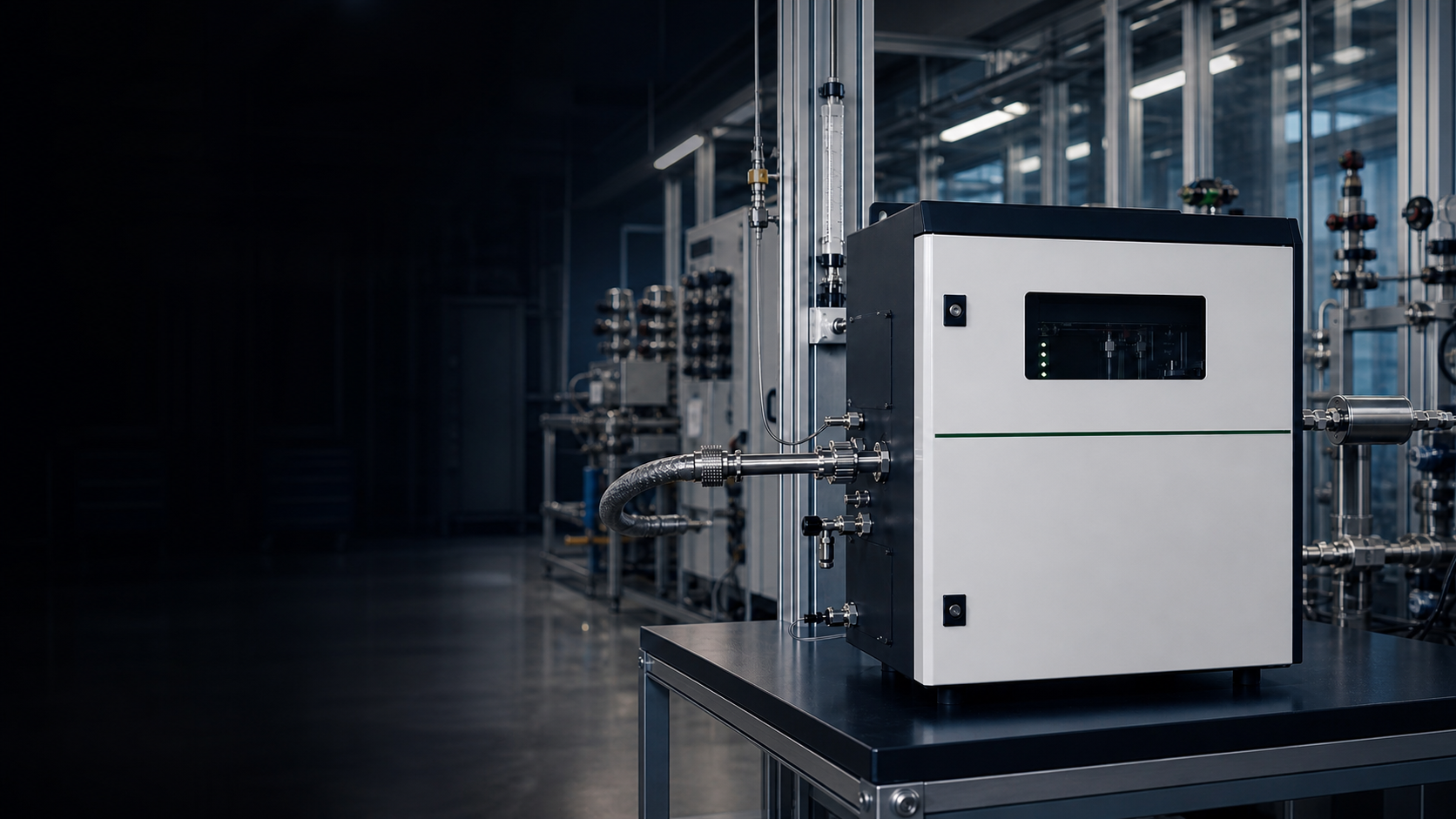 In-line Process
ZS6200-CO/CO2 · NDIR Dual-Beam
ZS6200-CO/CO2 Process CO/CO₂ Analyzer
Dual-channel NDIR for simultaneous CO and CO₂ measurement in stated process and flue gas matrices.
- CO Range
- 0-5000 ppm
- CO₂ Range
- 0-20 %vol
- Accuracy
- ±1% of range
- Output
- 4-20mA · Modbus · HART
PortablePortable NDIR · Project-Review Path
Portable NDIR CO/CO₂ Field-Audit Path
A hand-held NDIR form factor for on-site CO and CO₂ spot-checks and field verification — scoped and confirmed per project review rather than ordered from a fixed datasheet. Indicative envelope: low-ppm CO and low-percent CO₂ ranges for boiler tune-up, HVAC/IAQ surveys and stack spot checks; exact range, accuracy and outputs confirmed against the survey scope.
CEMS ModuleZS-CEMS-100 · GFC NDIR
ZS-CEMS-100 CEMS CO/CO₂ Module
CEMS analyzer module for continuous CO/CO₂ reporting, with EN 15267 / EPA PS documentation reviewed per project.
- CO Range
- 0-1000 mg/m³
- CO₂ Range
- 0-25 %vol
- Docs
- EN 15267 / EPA PS review
- Drift
- <1% FS / month
Compliance and Certifications for CO/CO₂ Analysis
CO/CO₂ measurement sits across two regulatory regimes — Western EU/US emissions compliance (EN 15267-3 QAL1, EN 14181 QAL2/QAL3/AST, EPA 40 CFR 60 Performance Specifications, MCERTS) and the Chinese HJ 76-2017 CEMS standard — and plants frequently report into both depending on site ownership structure. GESHINE scopes every certification per instrument rather than the category as a whole, so a buyer can verify the specific analyzer against the specific site permit and notified-body expectation before procurement commits, rather than inheriting a blanket “CEMS-certified” claim that does not always hold up when an auditor asks for the type-test report.
European conformity for health, safety, environmental protection.
ZS6200-CO/CO2 and ZS-CEMS-100 catalogue analyzersUnited Kingdom Conformity Assessment, post-Brexit equivalent of CE.
ZS6200-CO/CO2 and ZS-CEMS-100 catalogue analyzersIndependent performance type-test.
ZS-CEMS-100 — certificate scope confirmed per projectUK Environment Agency approval for regulated emissions monitoring.
ZS-CEMS-100 — certificate scope confirmed per projectEU type-test for continuous emissions monitoring equipment.
ZS-CEMS-100 (both CO and CO₂ channels) — certificate scope confirmed per projectQAL2/QAL3/AST documentation and installed-system QA path for ZS-CEMS-100 projects, applied after EN 15267-series acceptance.
ZS-CEMS-100 — field-demonstrated per projectPerformance Specification 3 for O₂/CO₂ CEMS; Performance Specification 4, 4A, or 4B for CO or CO/O₂ CEMS, as applicable to the source rule. Appendix F QA applies where the regulation invokes it. Performance Specifications are site-level tests demonstrated after installation.
ZS-CEMS-100 onlyChinese stationary-source flue-gas CEMS specifications and test procedures for SO₂, NOₓ, and particulate matter; retained as ZS-CEMS-100 Chinese CEMS system and reporting context, not as the CO/CO₂ channel type-test standard.
ZS-CEMS-100 contextQuality management system certification covering GESHINE analyzer production.
QMS referenceThe ZS-CEMS-100 is the only analyzer in this category engineered to EN 15267-3 QAL1 scope — the process ZS6200-CO/CO2 is a high-stability dual-beam analyzer but is not regulator-authorised as a reference instrument for CEMS, and the portable NDIR path is a field-survey tool that is explicitly not a compliance-grade instrument and should not be specified as one. Where a site needs a process analyzer and a separate CEMS channel on the same stack, the standard configuration is a ZS6200-CO/CO2 in the control-room loop and a ZS-CEMS-100 in the CEMS cabinet, each doing what it is qualified for. Both catalogue analyzers ship with factory calibration certificates and certified reference-gas documentation supplied per project, with national metrology traceability confirmed in the delivered certificate pack; when the type-test is included in the order scope, the ZS-CEMS-100 additionally ships with its QAL1 certificate extract and a commissioning template suitable for a QAL2 engagement, confirmed per project. The portable survey path is scoped per project rather than supplied against a compliance certificate pack.
With technology, products and certifications settled, the remaining decisions are commercial — price tiers, what drives those prices, lead time and long-term support — which the procurement block below walks through.
Where CO and CO₂ Measurement Lives — Eight Industry Applications
CO and CO₂ show up as either a combustion-efficiency signal or a regulated emission across most heavy industries, and the engineering brief is rarely the same across two sites. The eight cards below frame the measurement envelope for each industry we ship into — concentration range, dominant analyte, regulatory driver, sample matrix cleanliness, and which GESHINE analyzer is the usual fit — so a buyer can map an engineering brief to a purchase order without several rounds of back-and-forth on sample conditioning, certification scope and sampling-skid line items. Where the application sits on the boundary between two cards, engineering review is the honest answer.
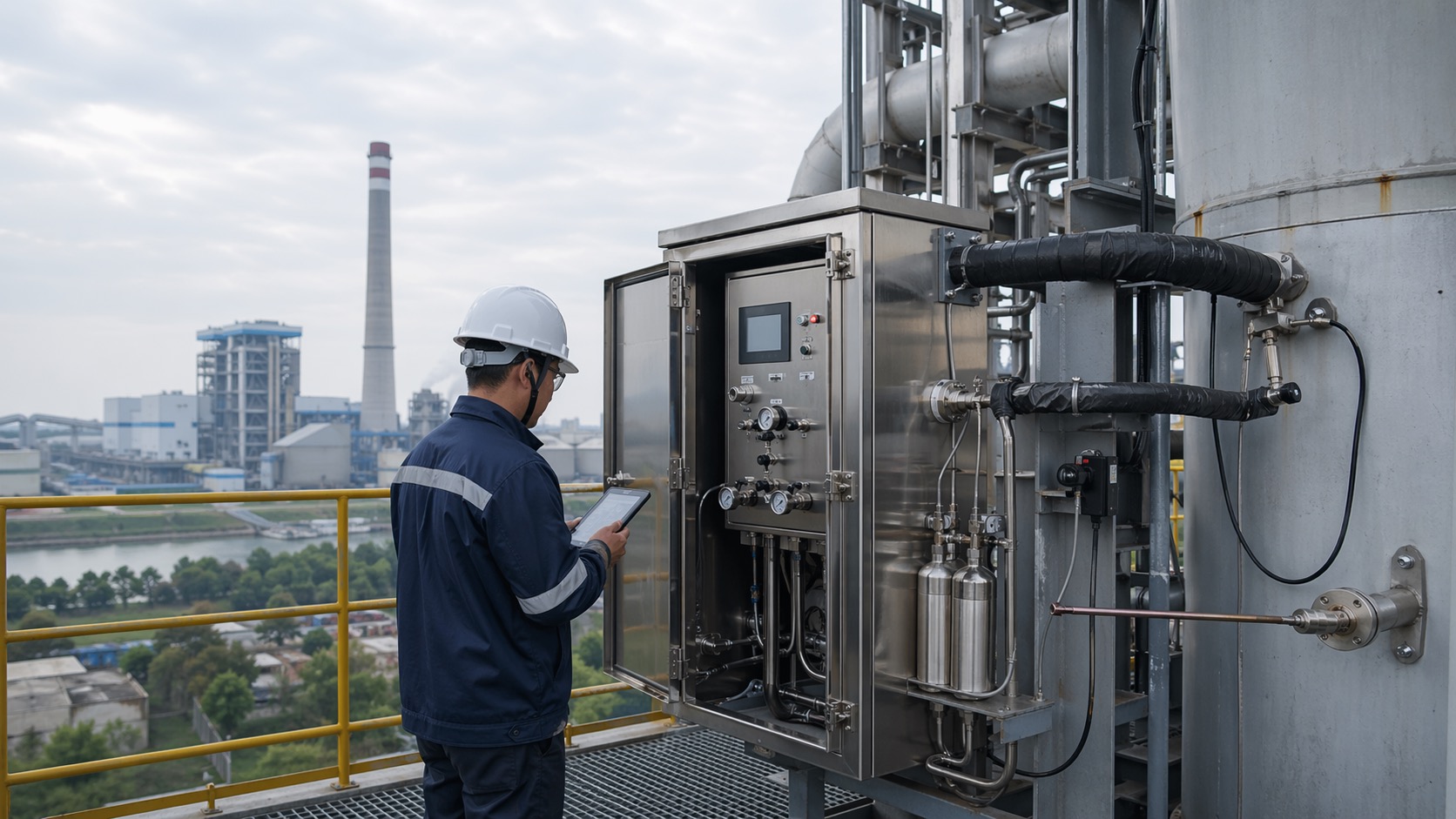
Power Generation — Boiler Combustion Efficiency
ChallengeCoal, gas and biomass utility boilers drift off optimal air-fuel ratio when the CO analyzer at the economizer outlet loses accuracy — and a few percent of efficiency loss on a large utility boiler is avoidable fuel spend that never shows up in the maintenance budget.
SolutionThe ZS6200-CO/CO2 dual-beam NDIR holds its zero for six months between span checks, closing the combustion loop on the DCS so trim-air control tracks the real CO reading rather than a drifting one.

Cement & Lime — Kiln Exhaust Monitoring
ChallengeRotary kiln exhaust is hot, dusty and chemically aggressive; CO spikes indicate process upset that risks catalyst damage and requires immediate burner adjustment, and CO₂ measurement feeds carbon-capture readiness calculations that are becoming non-optional for new EU plant permits.
SolutionZS6200-CO/CO2 with heated sample cell at 200 °C and integrated sample conditioning provides continuous CO/CO₂ data to the kiln control room without the dust-plugging cycles typical of cold-sample instruments.
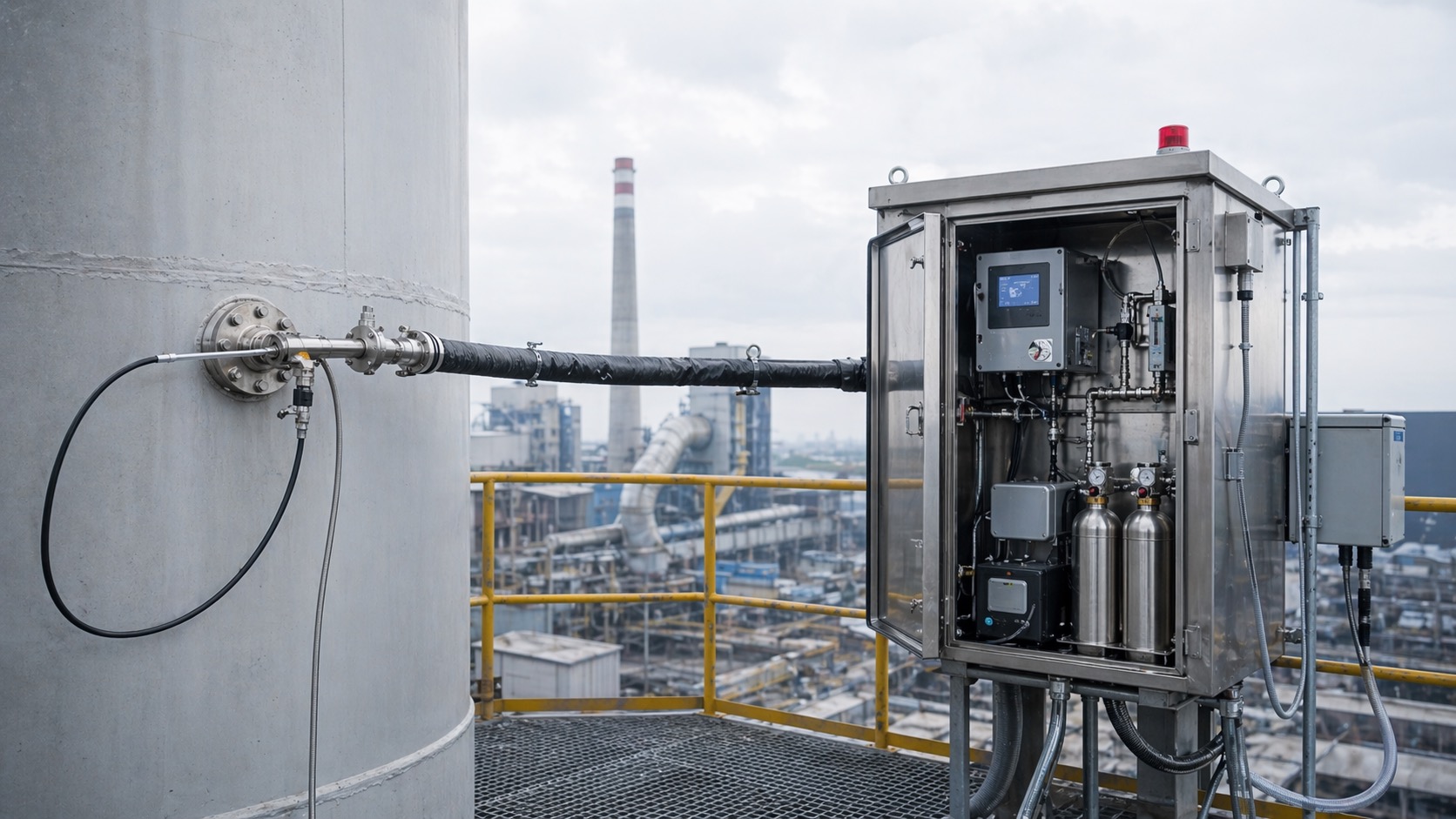
Waste-to-Energy — Regulated CEMS Reporting
ChallengeMunicipal and industrial WTE plants under the EU Industrial Emissions Directive must report CO continuously at half-hourly averages with QAL1-certified equipment; a QAL2 failure forces a re-test and back-filing of emission records.
SolutionZS-CEMS-100 is engineered to EN 15267-3 QAL1 scope for both CO and CO₂ channels — certificate extract confirmed per project — with integrated DAHS and automated daily zero/span, and the channels configured to reach QAL2 readiness efficiently on typical retrofits.

Refinery & Petrochemical — Fired Heater Optimisation
ChallengeFired heaters in refining and petrochemical service run close to their NOₓ and CO trade-off curves; a CO analyzer that under-reports drifts the heater rich and wastes fuel, over-reports drifts it lean and produces NOₓ exceedances.
SolutionZS6200-CO/CO2 with HART 7 output integrates into any mainstream industrial DCS as the CO input to the heater-trim advanced-control layer, tightening the combustion envelope without increasing NOₓ.
Biogas Upgrading — CO₂ Quality Assurance
ChallengeRaw biogas commonly carries a high CO₂ fraction that varies by feedstock and digester operation, while the upgraded biomethane outlet must meet the receiving network’s gas-quality specification under EN 16723-1 and local grid rules. Confirm the final residual-CO₂ limit with the grid operator rather than treating <2 %vol as a universal EN 16723 requirement.
SolutionZS6200-CO/CO2 configured with the wide CO₂ range (0–100 %vol) measures raw biogas, upgrade outlet and recovery loss in a single analyzer rather than three single-range instruments.

Combined Heat & Power — Engine Exhaust Trim
ChallengeReciprocating gas engines in CHP service lose 1–2 percent thermal efficiency between scheduled tune-ups as the CO reading from a drifting single-beam instrument misguides the lambda-control loop; the operator sees higher fuel cost but no clear diagnostic.
SolutionZS6200-CO/CO2 with dual-beam drift cancellation provides the CO input to the lambda controller; tune-up intervals extend because the measurement itself is no longer the limiting factor.

HVAC & WELL-Building — Indoor Air Quality
ChallengeWELL v2 and ASHRAE 62.1 projects often use CO₂ measurement as part of IAQ/ventilation verification and ongoing commissioning, depending on the selected features, local code, and commissioning protocol; hand-held analyzers without Bluetooth logging force facilities teams to hand-transcribe readings, and their auto-zero drift makes zone-to-zone comparisons unreliable.
SolutionA portable NDIR survey path with zone-tagged field logging produces an auditable multi-zone survey report; a multi-building portfolio audit that used to rely on manual per-building transcription is compressed into a much shorter field workflow. The exact survey configuration is scoped and confirmed per project review.
Greenhouse Gas Reporting — Scope 1 & Scope 2
ChallengeRegulated emitters under the EU ETS, the US EPA Greenhouse Gas Reporting Program, China’s national emissions trading scheme, or site-specific permits may use direct stack CO₂ measurement when the rule, tier, or monitoring plan requires it; many inventories still use fuel-based calculation methods. Where direct measurement is selected, instrument uncertainty, flow data, and audit traceability need to match the applicable reporting framework.
SolutionZS-CEMS-100 produces the direct stack CO₂ reading that feeds the verified emissions report; the integrated DAHS archives two years of minute-averaged data to satisfy audit traceability without an external historian bolt-on.
The industries above cover the majority of the CO/CO₂ installed base. The next block documents the certifications that govern where and how these analyzers can be deployed.
Why GESHINE for CO/CO₂ Analyzers
Three NDIR form factors, a regulated CEMS documentation path, and engineering support that scopes the right measurement for the duty.
Three Form Factors
Process rack-mount NDIR, a rugged handheld portable survey path, and a CEMS rack module — one analyzer family covering combustion control, field verification, and emission reporting review.
Application Engineering Support
From feasibility study through QAL2 commissioning — GESHINE engineers assist with NDIR/GFC selection, sample conditioning specification, DCS integration, and CEMS documentation review.
EN 15267 / EPA PS Documentation Review
ZS-CEMS-100 documentation and parent-CEMS fit are reviewed against the applicable EN 15267, EPA Performance Specifications, and local reporting requirements before regulated use.
Manufacturer Direct
Direct access to the engineering team that designed and built your analyzer. Shorter lead times, competitive pricing, and factory-level technical support including spare parts and field service.
Procurement Guide — Pricing, Lead Time, and Warranty for CO/CO₂ Analyzers
CO/CO₂ analyzers fall into three commercial tiers by form factor and certification scope. Tiers are qualitative for first-pass budgeting; contact GESHINE for a budgetary quote scoped to your site conditions.
A hand-held NDIR form factor for spot checks, HVAC/IAQ surveys, boiler tune-up, and field logging — scoped and quoted per project review rather than ordered from a fixed tier.
ZS6200-CO/CO2 for continuous combustion, kiln exhaust, and biogas-upgrade monitoring, with heated-cell and DCS options scoped at RFQ.
ZS-CEMS-100 for certified emissions monitoring projects where type-test documentation, DAHS, sampling skid, and commissioning support define the budget.
Buyer Advisory
Published price ranges are useful for first-pass budgeting only. The final quotation for a CO/CO₂ analyzer depends on sample matrix, water-vapour load, dust-loading after any precipitator, sample pressure and temperature at the tap point, required reporting units (ppm vs mg/m³ vs %vol, corrected or uncorrected for O₂ and moisture), DCS / DAHS protocol and historian target, integration scope with an upstream sampling skid, and whether the project includes QAL1 documentation review, QAL2 on-site engagement, operator commissioning or multi-shift training. Send those boundary conditions with the RFQ and the quote converges in one or two iterations; ask only for a bare datasheet and the instrument tends to be specified for a harder environment than the site actually requires, which inflates both purchase cost and lead time without buying any additional measurement quality.
What Moves the Price
The biggest price mover on this page is the sampling skid that sits upstream of the analyzer. A bare ZS-CEMS-100 is an analyzer; a stack-mounted CEMS is an analyzer, a heated sampling probe, a heat-traced sample line, a cooler or thermal-dilution stage, a filter rack and an enclosed cabinet that typically comes out to 1.6–2 times the analyzer price. Buyers who budget only the analyzer line item are the main source of surprise quotes. The second mover is DAHS integration — the ZS-CEMS-100 ships with an integrated DAHS, which means a simple reporting loop is included, but plants with existing central historians (OSIsoft PI, AVEVA, SAP, proprietary utility MIS) usually need a gateway engineering package. The third mover is certification scope: adding TÜV or MCERTS documentation to a standard QAL1 build adds notified-body time rather than hardware cost, and where the local environment agency accepts one but not the other the certification pick itself moves the invoice. Optional items — OPC-UA gateway licensing, HART 7 activation, custom HMI localization, extended-warranty service — are additive but modest.
The Dominant Cost Risk
Audit-failure exposure is usually the dominant cost risk in a CEMS purchase because retesting, reporting corrections, and temporary compliance work can outweigh the analyzer price. The exact exposure is jurisdiction- and permit-dependent.
Lead Time
- Standard configuration
- 4–6 weeks from order confirmation for the ZS6200-CO/CO2 process analyzer, including factory calibration and production test report; the portable NDIR survey path is scoped and quoted by project review.
- QAL1 CEMS module
- 8–10 weeks for ZS-CEMS-100 — 4–6 weeks base build plus 2–4 weeks for QAL1 document package assembly, type-test report compilation and TÜV / MCERTS documentation kitting.
- CEMS + sampling skid integration
- Add 3–5 weeks when the order bundles a heated sampling skid (ZS-SCS-600/800), enclosed cabinet, heat-traced sample line and stack-side probe into a single delivery package.
- MOQ
- Single units ship as evaluation / pilot orders. Volume pricing applies from 5 units; framework-agreement pricing available for multi-year capital-budget programmes across utility or WTE fleets.
Warranty & Calibration Traceability
- Standard factory warranty
- 24 months from commissioning (or 30 months from shipment, whichever expires first) covering electronics, optical bench, sample-conditioning hardware and optical windows.
- Extended warranty options
- 36- and 60-month extended warranties available at order; includes a scheduled annual preventive-maintenance visit, priority spares dispatch and a documented QAL2 AST support allowance.
- Calibration traceability
- Every analyzer ships with a factory calibration certificate and certified reference-gas documentation supplied per project, with national metrology traceability confirmed in the delivered certificate pack. When the type-test is included in the order scope, the ZS-CEMS-100 additionally ships with its EN 15267-3 QAL1 certificate extract and a QAL2 commissioning template, confirmed per project.
- Out-of-warranty service
- Fixed-rate optical-bench refurbishment, detector replacement and firmware upgrade programmes are offered to keep units in service for 10+ years — important for CEMS installations where regulator-approved equipment cannot be swapped out casually.
After-Sales Support — Calibration, Spares, Training & DAHS
A CO/CO₂ analyzer earns its keep over a decade-plus of service, so the support model matters as much as the datasheet. Below are the support channels that back every GESHINE CO/CO₂ analyzer, from first-response engineering to regulator reporting cycles.
Technical Support
Application engineers are reachable by phone and email on a guaranteed next-business-day first response. For analyzers connected to the plant network, remote diagnostics over Modbus TCP or OPC-UA allow the GESHINE service team to review optical bench alignment, daily zero/span records, alarm history and DAHS export logs without needing a site visit — typically halving the mean-time-to-diagnosis for field issues on CEMS installations.
Calibration & Validation
The ZS-CEMS-100 performs a daily auto-zero against instrument-grade N₂ and a weekly span verification against certified reference gas; all results are logged and trended for EN 14181 AST compliance. On-site QAL2 engagement visits bring a GESHINE factory-trained engineer with certified reference-gas CO and CO₂ cylinders (traceability confirmed in the delivered certificate pack) to verify installed analyzer performance and issue the reference-method test report. Process (ZS6200-CO/CO2) calibration uses the same certified reference gas mix on a 6-month interval.
Spare Parts & Critical Components
IR sources, detector assemblies, sample filter cartridges, GFC filter wheels and reference cells are stocked for 48-hour dispatch from the factory to minimize unplanned CEMS downtime — which for a regulated installation is directly linked to regulatory reporting availability. A 5-year spares package is available at order so the site does not depend on emergency procurement when a wear part reaches end of life. Customs documentation for cross-border shipments is pre-assembled by the logistics desk.
Operator Training
A 2–3 day on-site commissioning visit walks operators, maintenance technicians and EHS / quality staff through HMI workflows, alarm response, daily and weekly validation procedures and the QAL2 / AST documentation path that the site will have to execute on its own after handover. Remote operator-training packages for shift handover and additional headcount are delivered through a customer portal with recorded modules, live screen-share sessions with an application engineer, and per-user assessment worksheets.
DAHS & Reporting Support
The ZS-CEMS-100 DAHS ships pre-configured with the reporting templates for EN 14181 AST, EPA 40 CFR 60 Performance Specifications and HJ 76-2017 format; first-year reporting-cycle support is included with the analyzer to walk the plant through its first monthly / quarterly / annual regulator submission. Export formats include XML, CSV and direct Modbus / OPC-UA tags for a central historian bolt-on when the plant elects to consolidate onto PI or AVEVA.
Further commercial, integration and technical questions are covered in the FAQ below. If your specific question is not answered there, the RFQ form brings an application engineer into the thread.
CO/CO₂ Analyzer Questions, Answered
From NDIR variant selection and sample conditioning to CEMS compliance, calibration, GHG reporting, and where TDLAS fits.
Can one ZS-CEMS-100 module report both CO and CO₂ for regulatory compliance?
Yes — one module handles both channels. The ZS-CEMS-100 is engineered to EN 15267-3 QAL1 scope for both the CO channel and the CO₂ channel in the same 6U module, with the applicable certificate extract confirmed per project. Many competing CEMS designs split CO and CO₂ into two separate optical benches because their QAL1 certification only covers one channel; the ZS-CEMS-100 integrates both in a dual-beam plus gas-filter-correlation architecture so the cabinet footprint, sample handling and DAHS configuration are all shared. The QAL1 certificate extract lists both analytes explicitly, and is the document the environmental regulator looks at during site approval.
How does dual-beam NDIR differ from single-beam NDIR in field service?
Dual-beam NDIR runs the infrared signal through the sample cell and through a sealed reference cell simultaneously; every measurement is ratioed against the reference, so source-intensity aging and detector warm-up cancel out. Typical dual-beam zero stability is on the order of 1 percent of full scale per month. Single-beam NDIR has no reference — the baseline is established by periodically flowing clean gas through the single cell for an auto-zero cycle, which is fine for a portable that zeros between zones but does not hold up to continuous duty on a dirty stack. The choice between them is set by how long the measurement has to stay trustworthy without a human in the loop.
Does the heated sample cell on the ZS6200-CO/CO2 eliminate water-vapour interference?
The 200 °C heated cell option keeps the sample above the condensation temperature of water, which prevents liquid droplets from forming on the optical windows in dirty flue-gas service. For most power plant, cement kiln and biogas-upgrade applications that is sufficient because the NDIR wavelength selection is already outside the strongest water-vapour bands. Where the application has aggressive water-vapour load combined with low-ppm CO targets — typically sub-10 ppm CEMS duty — the ZS-CEMS-100 with gas-filter-correlation is the correct pick because the correlation wheel mathematically isolates the CO spectrum from residual H₂O absorption to a degree dual-beam alone cannot match.
What calibration interval should I plan for a ZS-CEMS-100 in regulated service?
The ZS-CEMS-100 performs a daily automatic zero check against instrument-grade nitrogen and a weekly automatic span check against a certified reference cylinder; both are logged and trended in the integrated DAHS, which is the record the regulator reviews. Manual calibration verification with certified reference-gas cylinders (traceability confirmed in the delivered certificate pack) runs on a 6-month interval as part of the EN 14181 AST routine, and the full EN 15267-3 QAL2 re-engagement is typically every 3 or 5 years depending on jurisdiction. GESHINE supports QAL2 on site via a factory-trained engineer.
Can a portable NDIR analyzer replace a CEMS during a reference-method test?
No — and the page is explicit about this so no buyer discovers it during an audit. A portable NDIR analyzer is a hand-held single-beam NDIR for boiler tune-up, HVAC commissioning, WELL / ASHRAE audits and vehicle exhaust spot-check duty; it is not QAL1-certified and does not carry EN 14181 AST support. Regulators that accept a reference-method test in lieu of a QAL2 re-engagement require the reference instrument itself to be type-approved and traceable, which the portable is not. The portable is a productivity tool for service technicians and facilities auditors, not a compliance instrument.
How does the integrated DAHS on the ZS-CEMS-100 handle regulatory reporting?
The DAHS archives 2 years of 1-minute averaged data on board, with automatic generation of the EN 14181 AST monthly report, the EPA 40 CFR 60 Performance Specification daily record and the HJ 76-2017 format used by Chinese power plants. Data export is available via USB, Ethernet file share, direct Modbus / OPC-UA tags into a plant historian, and an XML / CSV template keyed to the environmental regulator’s submission portal. First-year reporting-cycle support comes standard with the analyzer to walk the plant through its initial monthly and annual submission.
What sample conditioning does a ZS-CEMS-100 need?
The ZS-CEMS-100 is the analyzer; the matching sampling skid is the ZS-SCS-600 or ZS-SCS-800 from the extractive-analyzers category. A certified CEMS install typically includes a heated sampling probe at the stack flange, a heat-traced sample line rated to 180 °C, a cooler or thermal-dilution stage, a particulate filter rack and the enclosed cabinet housing the analyzer and DAHS. The analyzer alone accepts 0.5–1.5 L/min clean sample at 0 to +100 mbar; the skid delivers that specification from whatever the actual stack conditions are. Budget for the skid is 1.6–2× the analyzer purchase cost.
Is the ZS-CEMS-100 type-tested to the Chinese HJ 76-2017 standard?
Not as a type-test. HJ 76-2017 is the Chinese CEMS reporting framework the plant reports into, produced natively by the integrated DAHS — not a third-party type-test the module carries. The ZS-CEMS-100 is engineered to EN 15267-3 QAL1 scope for EU reporting, with EPA 40 CFR 60 Performance Specification field-demonstrated for US reporting. The three reporting formats are produced natively by the integrated DAHS; the plant selects the reporting profile that matches its environmental regulator, and the analyzer firmware delivers the correct XML / CSV and required averaging interval without external format conversion. The EN 15267-3 QAL1 scope covers both the CO and CO₂ channels, with the certificate extract confirmed per project.
Can I integrate the analyzer into my existing DCS or historian?
Yes. ZS6200-CO/CO2 exposes 2 × 4–20 mA isolated analog outputs, HART 7 digital, Modbus RTU and Modbus TCP — the standard DCS set. ZS-CEMS-100 additionally exposes OPC-UA for modern plant digital-twin and predictive-maintenance platforms. All readings — concentration, internal validation state, sample flow, enclosure climate, DAHS archive status — are available as discrete register addresses, which makes it straightforward to map the analyzer into any mainstream industrial control system or historian without bespoke gateway engineering, protocol translation layers or custom driver development on the plant side.
What is the minimum detection limit for CO and CO₂ in real service?
Bench specification for the ZS6200-CO/CO2 is 2 ppm CO and 0.01 %vol CO₂ at optimal conditions with a clean background gas. Real-service detection limit on a working installation depends on sample cleanliness, background gas composition and the signal-averaging interval set in the DCS; a dusty kiln-tail sample loses a factor of 2–3 in practical detection limit versus a clean biogas-upgrade sample, and that is the number an application engineer should be matched against during the specification phase. For sub-ppm CO duty the correct scope is ZS-CEMS-100 with gas-filter correlation rather than dual-beam alone.
What is the difference between an NDIR CO₂ analyzer and a CO₂ sensor for HVAC / IAQ?
An NDIR CO₂ analyzer is a calibrated industrial instrument; an HVAC / IAQ CO₂ sensor is a low-cost ambient device built into ventilation control. Both use NDIR physics, but the duty and the engineering differ. An IAQ sensor reads room CO₂ around the 400–2000 ppm comfort band to modulate fresh-air dampers, with modest accuracy and a sealed, unconditioned inlet — adequate for demand-controlled ventilation. An industrial NDIR CO₂ analyzer measures process or stack CO₂ from ppm to %vol in a hot, wet, dirty matrix, with sample conditioning, drift compensation, traceable calibration and a 4–20 mA / Modbus output for control or emissions reporting (accuracy project-specific). If the number feeds combustion control, process quality or a regulator you need the analyzer; if it only trims building ventilation, the IAQ sensor is the right cost point.
Can a CO₂ analyzer be used for Scope 1 / GHG emissions reporting?
Yes, with a caveat about which method qualifies. Scope 1 covers direct emissions from sources you own, and many facility inventories meet it with fuel-based calculation methods rather than stack measurement; where a plant reports by direct measurement instead, a CEMS-grade CO₂ channel paired with stack-flow data is the route that survives a regulated audit, not a bare process sensor. A stack CO₂ concentration in %vol becomes a reportable CO₂ mass-emission rate once it is multiplied by measured flue-gas flow and operating hours under a framework such as the GHG Protocol, ISO 14064 or EPA 40 CFR Part 98. For the figure to survive an audit, the CO₂ measurement must run under the same QAL1 / QAL2 / AST quality regime as a regulated CEMS channel, with traceable calibration and a logged DAHS record — a process-only reading without that pedigree is fine for control but not for the inventory. See /industries/environment for how GESHINE positions emissions-monitoring systems across regulated industries.
Why measure CO for combustion efficiency, and what CO range matters at the stack?
Stack CO is the most sensitive indicator of incomplete combustion, which is why it is measured alongside O₂ for efficiency tuning. When air-fuel trim is correct CO stays very low; as excess air falls past the optimum, CO rises sharply before other signals move, so the CO “knee” marks the point where you are saving fuel without tipping into unburned-fuel losses. The actionable range at the stack is low-ppm (project-specific) — high enough to see the trend, low enough to catch the onset of incomplete burn. Reading CO together with O₂ lets operators run closer to the efficiency optimum than O₂ alone allows, because O₂ shows how much excess air there is while CO shows when that excess air has dropped too far. NDIR or gas-filter-correlation NDIR handles the stack CO duty.
Carbon monoxide analyzer vs carbon monoxide detector — which do I need?
A carbon monoxide detector is a safety alarm; a carbon monoxide analyzer is a measurement instrument — pick by whether you need a trip or a number. A CO detector watches for a hazardous threshold (for example a boiler-room or car-park action level) and fires a relay or horn when CO crosses setpoint; it is a go/no-go safety device, often electrochemical. A CO analyzer reports the continuous CO concentration in ppm on a 4–20 mA / Modbus output for combustion-efficiency control, process monitoring or emissions reporting, with traceable calibration and drift compensation (accuracy project-specific). Many plants run both: detectors for personnel safety and an analyzer at the stack for efficiency and compliance. If the CO value drives a control loop or a report you need the analyzer, not the detector.
Can an electrochemical CO analyzer be used for continuous flue-gas or CEMS CO duty?
For short-term work yes, for certified continuous CEMS duty no. An electrochemical CO cell suits portable spot checks, boiler-room safety screening, and temporary field surveys where you need a quick CO number in the ambient or near-stack matrix. It is not the right basis for a permanent, type-approved continuous stack CO measurement: the cell has a finite service life and baseline drift (project-specific), so holding the long-interval zero and span stability that a compliance programme audits becomes impractical. Certified continuous flue-gas CO is therefore the territory of NDIR and gas-filter-correlation NDIR, which keep a stable reading across the reporting interval in the wet stack matrix. GESHINE’s CO line is built on NDIR and GFC NDIR rather than electrochemical, so for a continuous or CEMS stack CO scope, talk to an engineer about the infrared path.
What is the difference between single-beam and dual-beam NDIR?
Single-beam NDIR sends one optical path through the sample cell and maintains its baseline through auto-zero cycles, reference filters, or firmware compensation depending on the instrument design. Dual-beam NDIR uses separate sample and reference optical paths so the analyzer can ratio the signals and cancel source/detector drift more continuously. Dual-beam is therefore the better fit for continuous process duty, while single-beam auto-zero designs fit portable or short-duration measurements.
Do I need a sample conditioning system (SCS) for NDIR CO/CO₂?
For continuous wet flue gas duty — yes. NDIR CO absorption bands overlap H₂O bands, so moisture must be removed before the optical cell to avoid positive bias. A typical NDIR SCS includes a heated probe, heated sample line (above dew point), coalescing filter, Peltier cooler/chiller (target dew point ~5 °C), and flow controller. For dry process gas — for example, after a TEG dryer or in a low-moisture syngas matrix — a simpler particulate filter may be sufficient. Portable handhelds typically operate ambient and tolerate moderate humidity.
How often should an NDIR CO/CO₂ analyzer be calibrated?
For ZS6200-CO/CO2 process NDIR, plan on six-month span verification under stated sampling conditions, with shorter checks if the site has heavy dust, moisture excursions, or internal QA requirements. For regulated ZS-CEMS-100 duty, calibration cadence follows the parent CEMS QAL3/AST plan: daily auto-zero, scheduled span verification, linearity checks, and reference-method audits as required by the permit. Portable NDIR units should be zero/span checked before survey campaigns.
What certifications are required for CO/CO₂ CEMS reporting?
In the EU, EN 15267 (parts 1–3) defines QAL1 type approval, supplemented by EN 14181 QAL2 / AST surveillance once installed. In the US, 40 CFR Part 60 Performance Specifications PS-4 and PS-4A define the corresponding CO CEMS performance criteria. In China, GB/T 16157, HJ 75, and HJ 76 cover CEMS gas analyzer specification and operation. ZS-CEMS-100 availability and documentation status should be confirmed for the target jurisdiction before regulated reporting use. Local code adoption (for example, India CPCB, GCC GSO) may add specific QAL2 reference method requirements.
Why measure both CO and CO₂ instead of just one?
CO and CO₂ together tell a combustion story neither tells alone. CO₂ is the dilution and stoichiometry reference — it indicates how much carbon was actually burned. CO is the efficiency indicator — rising CO at constant CO₂ means incomplete combustion, even before the O₂ trim flags excess air. Power plant CEMS dual-channel reporting is regulatory standard. Biogas / landfill gas upgrading watches the CO₂ band to confirm methane purity, and watches CO as a safety / quality indicator on engine feed gas.
Can NDIR measure CO₂ down to ambient (~400 ppm) levels?
Yes — NDIR is the standard for ambient CO₂ down to ~400 ppm in indoor air quality, greenhouse, and HVAC duty. Dedicated low-range NDIR uses extended path length and tighter optical reference to reach this sensitivity. For sub-ppm trace CO₂ in high-purity gases (semiconductor specialty gas, electronic-grade N₂), TDLAS or laser-based path-extended techniques are typically specified instead. Ambient-grade NDIR CO₂ is not aligned with regulated CEMS duty — the certification scope is different.
What industries use CO/CO₂ analyzers?
CO/CO₂ measurement spans power generation (boiler combustion efficiency + CEMS reporting), cement and lime manufacturing (kiln process + carbon capture readiness), waste-to-energy (combustion control + emission compliance), biogas / landfill gas (methane purity verification), petrochemical (reformer / shift converter monitoring), greenhouse / horticulture (CO₂ enrichment control), and indoor air quality (commercial HVAC, ventilation, and refrigeration leak detection).
When should I compare NDIR with TDLAS for CO measurement?
The CO/CO₂ analyzers on this page are NDIR or gas-filter-correlation NDIR instruments: ZS6200-CO/CO2 for process duty, a portable NDIR survey path for spot checks, and ZS-CEMS-100 for certified CEMS duty. TDLAS can be the right physics for some project-specific laser absorption applications, especially where a narrow absorption line and a different optical platform are required, but GESHINE does not list a standard CO/CO₂ TDLAS analyzer in this category. If your specification explicitly calls for laser absorption, review the TDLAS analyzer family at /gas-analyzers/tdlas-gas-analyzers/ with engineering rather than substituting it for the NDIR CEMS claim.
Can I upgrade a ZS6200-CO/CO2 or ZS-CEMS-100 to TDLAS later?
Not as a drop-in upgrade. NDIR/GFC NDIR and TDLAS use different optical benches, line-selection assumptions, calibration packages, and certification evidence. Treat a TDLAS requirement as a separate RFQ path, not as an option code on the CO/CO₂ NDIR SKUs.
References & Transparency
GESHINE’s CO/CO₂ analyzer recommendations rest on our engineering team’s hands-on experience with NDIR and gas-filter-correlation measurement across process, portable, and CEMS duty. We scope the ZS6200-CO/CO2 against process combustion and kiln applications, a portable NDIR configuration against portable field and indoor-air audits, and the ZS-CEMS-100 against certified emissions reporting — because those are the three envelopes our installed base actually occupies. We do not recommend the ZS-CEMS-100 for a process-only loop where the full QAL1 overhead is wasted, and we do not recommend a portable NDIR analyzer as a compliance substitute regardless of how much it saves on hardware. Every specification on this page is sourced from GESHINE product datasheets, production-test data, delivered certificate packs where applicable, and the industry standards cited in the references.
Standards & References
- EN 15267-3:2023 — Air quality — Assessment of air quality monitoring equipment — Part 3: Performance criteria and test procedures for stationary automated measuring systems for continuous monitoring of emissions from stationary sources.
- EN 14181:2014 — Stationary source emissions — quality assurance of automated measuring systems; used for QAL2, QAL3, and AST site QA workflows after EN 15267-series acceptance.
- EPA 40 CFR Part 60, Appendix B — Performance Specification 3 for O₂/CO₂ CEMS; Performance Specification 4, 4A, or 4B for CO or CO/O₂ CEMS, as applicable to the source rule. Appendix F QA applies where the regulation invokes it.
- ASTM D6522-20 — Portable-analyzer test method for NOₓ, CO, and O₂ emissions from natural-gas-fired reciprocating engines, combustion turbines, boilers, and process heaters; relevant to engine/boiler tune-up and portable verification context, not CO₂ CEMS certification.
- ISO 12039:2019 — Stationary source emissions — Determination of the mass concentration of carbon monoxide, carbon dioxide and oxygen in flue gas — Performance characteristics of automated measuring systems.
- EN 16723-1:2016 — Natural gas and biomethane for use in transport and biomethane for injection in the natural gas network — Part 1: Specifications for biomethane for injection in the natural gas network. Biomethane injection context only; residual CO₂ after upgrading is grid/operator/jurisdiction-specific, not a universal EN 16723 limit.
- GHG Protocol / ISO 14064 / EPA 40 CFR Part 98 — Greenhouse-gas accounting frameworks: GHG Protocol and ISO 14064 define inventory/reporting frameworks; EPA 40 CFR Part 98 defines US regulatory calculation and QA routes, including CEMS-based methods for applicable sources.
GESHINE analyzer production is covered by an ISO 9001:2015 quality management system (see Certifications). Standards are cited for engineering context; certificate scope and applicability are confirmed per project, and listing a standard here is not a claim of product certification to it.
Ready to Specify a CO/CO₂ Analyzer?
Tell us whether the measurement is for combustion efficiency, CEMS reporting or portable auditing, and share the gas matrix, concentration range and certification scope required. Our application engineers will return a configured quotation within 48 hours — including the sampling skid line items that competing quotations often hide.
- Measurement range for CO (ppm or mg/m³) and CO₂ (%vol)
- Sample temperature, pressure, and moisture content at sample point
- Background matrix (high CO₂, hydrocarbons, particulates)
- Form factor needed: extractive rack, portable handheld, or CEMS module
- Compliance regime (EN 15267, EPA PS-4 / 4A, GB/T HJ 75, local)
- Required response time (T90) for control vs reporting
- Output protocols (4-20mA, Modbus, HART, OPC-UA)
- Hazardous area classification (ATEX zone, if applicable)
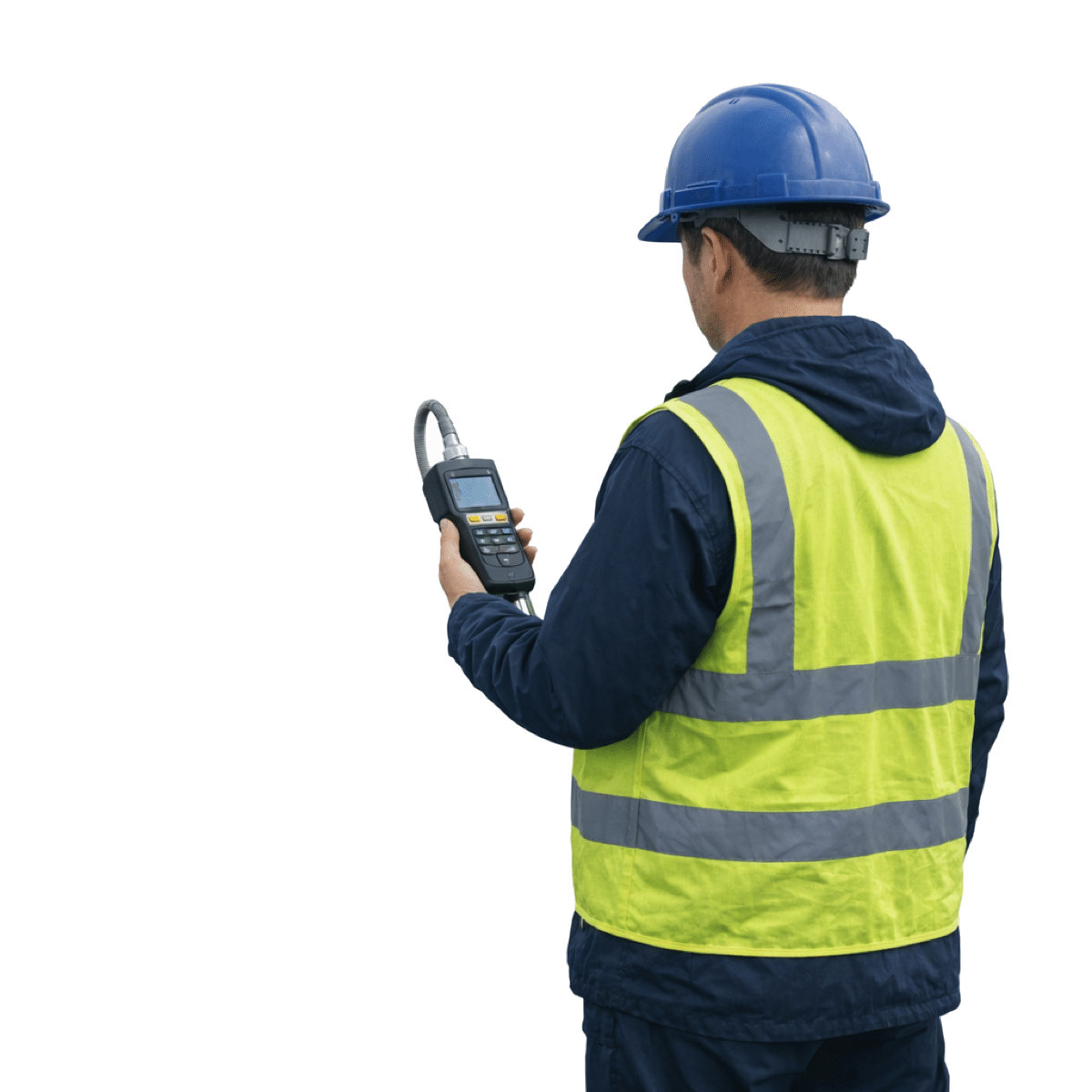
Get CO/CO₂ Expert Consultation
Our application engineers specialize in NDIR / GFC selection, sample conditioning specification, and CEMS documentation review.


