
Industrial Gas Analysis
Gas Purity Analyzer — Industrial Gas Analysis Solutions
Precision gas purity analysis using TDLAS & NDIR technology — designed for process safety, quality, and continuous monitoring in the most challenging industrial applications.
Why Inaccurate Gas Purity Readings Cost You — And How Advanced Laser Analysis Solves It
The Real Cost of Conventional Gas Analysis
Most conventional sensors fall into one of two broad categories, each suffering from the same inherent weakness: thermal conductivity or electrochemical sensing technology measures a bulk property of the gas stream rather than quantifying its true spectral fingerprint. A TCD monitoring hydrogen purity in nitrogen drifts with changes in moisture and background composition, yielding several percent of baseline inaccuracy with no alarm.
The hidden costs pile up over time: electrochemical sensors need monthly calibration with certified gas, the sensor must be replaced annually, and accurate measurement is not maintained in the presence of CO or CO₂ impurities. For a 40+ analyzer process plant, electrochemical sensor lifecycle can represent an industry-estimate roughly $3,800-$4,000 class of annual consumables and downtime per unit.
Calibration drift compounds the problem: an analyzer calibrated to 0.5% FS at commissioning can drift to 2.5% during six months of operation — still within spec for pass/fail measurement, but allowing off-spec product down the line or creating compromised safety environments in hydrogen-cooled power stations.
How TDLAS Eliminates These Failure Modes
Tunable Diode Laser Absorption Spectroscopy works at a fundamentally different physical principle. A laser beam at precisely the right wavelength scans across an absorption line confined to that molecular species — its spectral fingerprint. No other molecules absorb at that wavelength combination, enabling interferent-free measurement. You now have the direct measure of gas purity, not a surrogate indicator requiring compensation calibration.
Self-referencing optical design means the monolithic laser module continually validates its wavelength position and internal calibration level against the laser itself. An annual certification replaces the quarterly or monthly calibration routine of other technologies, and no calibration gas is consumed in the process.
Multiple gas species can be continuously monitored by configuring additional laser channels. One bench-top TDLAS measurement platform can monitor O₂, CO, CO₂, CH₄, HF, H₂O in one instrument housing, eliminating both the capital expense and the reliability failure pathway that would be present with five or six sensor types.
GESHINE Gas Purity Analyzer Series — Models & Selection Guide
Five models cover the full range from benchtop laboratory analysis to explosion-proof continuous emissions monitoring. The TDLAS family spans ±1% to ±2% FS accuracy, from ≤10s desktop/OEM response to <90s CEMS cabinet response.
Desktop Laser Gas Analyzer
- TechnologyTDLAS
- GasesO₂/CO/CO₂/CH₄/HF/H₂O
- Accuracy±1% FS
- Response T90≤10s
- Warmup5 min
- PowerAC 220V
- Form FactorBenchtop / Rack
Laser Gas Analysis Module (OEM)
- TechnologyTDLAS
- GasesO₂/CO/CO₂/CH₄/HF/H₂O
- Accuracy±1% FS
- Response T90≤10s
- Form FactorModule / OEM Board
- IntegrationSystem Integration
- Use CaseOEM / Custom Systems
In-Situ Explosion-Proof Analyzer
- TechnologyTDLAS In-Situ
- CertificationEx db IIC T6 Gb / SIL2 (per-project scope)
- ProtectionProject review
- Optical Path<5m
- Power24VDC
- Temp Range-30 ~ 60°C
- Use CaseHazardous Areas
Multi-Pass Gas Analysis System
- TechnologyTDLAS Multi-Pass
- Optical Path5m
- GasesNH₃/HCl/HF/CO₂/CO
- CabinetCEMS Enclosure
- Weight~85 kg
- Response T90<90s
- Use CaseCEMS / Stacks
Infrared (NDIR) Gas Analyzer
- TechnologyNDIR
- GasesCO/N₂O/CO₂/CH₄
- Range0.01% – 100%
- Accuracy≤2% FS
- Form FactorRack-Mount
- Weight~6 kg
- Use CaseLab / Process Control
Decision Matrix — Selecting the Right Model by Application
| Application Scenario | Recommended Model | Key Requirement | Key Spec |
|---|---|---|---|
| Lab / R&D gas purity verification | Bench-top TDLAS by project review | High accuracy, fast response | T90 ≤10s, ±1% FS, 5min warmup |
| OEM / system integration | OEM TDLAS module by project review | Compact module, direct API/signal output | Board-level TDLAS, ±1% FS |
| Refinery / chemical plant in-situ | ZS8300 | Ex-rated, no sample extraction | Hazardous-area package, ingress protection, SIL target, 24VDC (per-project scope) |
| Stack / flue gas emissions (CEMS) | ZS8600 | Multi-component, long optical path | 5m path, NH₃/HCl/HF/CO₂/CO, <90s T90 |
| Low-cost CO₂/CH₄ process monitoring | ZS6500 | Cost-effective NDIR, rack-mount | 0.01%–100% range, ≤2% FS, ~6kg |
| H₂-cooled generator hydrogen purity | Thermal-conductivity (TCD) analyzer / ZS6300-H₂ | High H₂ concentration accuracy, alarm output | ≥97% purity monitoring, relay alarm, 4–20mA |
| Semiconductor UHP gas analysis | OEM TDLAS module / bench-top TDLAS by project review | Sub-ppb detection, contaminant trace | Sub-ppb detection limit, HF/H₂O monitoring |
Please speak to a GESHINE application engineer for gas-specific range configuration and application analysis.
TDLAS vs Thermal Conductivity vs Paramagnetic — Gas Purity Measurement Technologies Compared
The selection of analytical technology for measuring gas purity is a long-term capital and operational decision. The following comparison uses quantified performance parameters and estimated maintenance costs so procurement and engineering teams can model total cost of ownership.
| Feature / Criterion | TDLAS — GESHINE | TCD (Thermal Conductivity) | Paramagnetic (O₂) | Electrochemical |
|---|---|---|---|---|
| Detection Limit | Sub-ppb | ~100 ppm | ~0.1% | ~1 ppm |
| Response Time (T90) | <10s | 10–30s | 5–15s | 30–90s |
| Cross-Interference | None — spectral fingerprint | Binary gas mixtures only | O₂ only; affected by vibration | Multiple (CO, H₂S, hydrocarbons) |
| Calibration Interval | Self-referencing — annual check | Quarterly with reference gas | Semi-annual | Monthly |
| Consumables | None | Reference gas cylinders | None | Sensor replacement (12–18mo) |
| Maintenance Cost/yr (est.) | ~$200 | ~$800–$1,500 | ~$500 | ~$1,500–$3,000 |
| Multi-Gas Capability | Yes — configurable laser channels | No — binary gas only | No — O₂ measurement only | Limited — 1–2 species |
| Hazardous Area Rating | Hazardous-area package reviewed per project (ZS8300) | Available in some models | Limited | Limited |
| In-Situ Deployment | Yes — no sample extraction | No — extractive only | No — extractive only | No — extractive only |
| Sampling System Required | Optional (in-situ or extractive) | Required | Required | Required |
Cost-of-Ownership Advantage: TDLAS vs Conventional Analysis
In industrial gas and power generation service, TDLAS systems typically carry a substantially lower annual maintenance cost than TCD analyzers, because the reference-gas system and its calibration downtime are removed from the workflow.
Operating costs are industry estimates based on typical calibration requirements, sensor maintenance schedules, and labor time. Costs vary by site, gas species, and service agreements.
Find Your Optimal Gas Purity Analyzer
The interactive selector loads four steps for gas species, installation, hazardous-area status, and sensitivity. If the tool does not load, send those details to application engineering for a configured recommendation.
Customer Results: Measurable Improvements in Gas Quality Control
Gas purity measurement failures reveal themselves differently according to the individual industry — each with its own risk profile, regulatory metric, and process consequence. The following application profiles highlight where monitoring at the appropriate level of precision impacts outcomes.
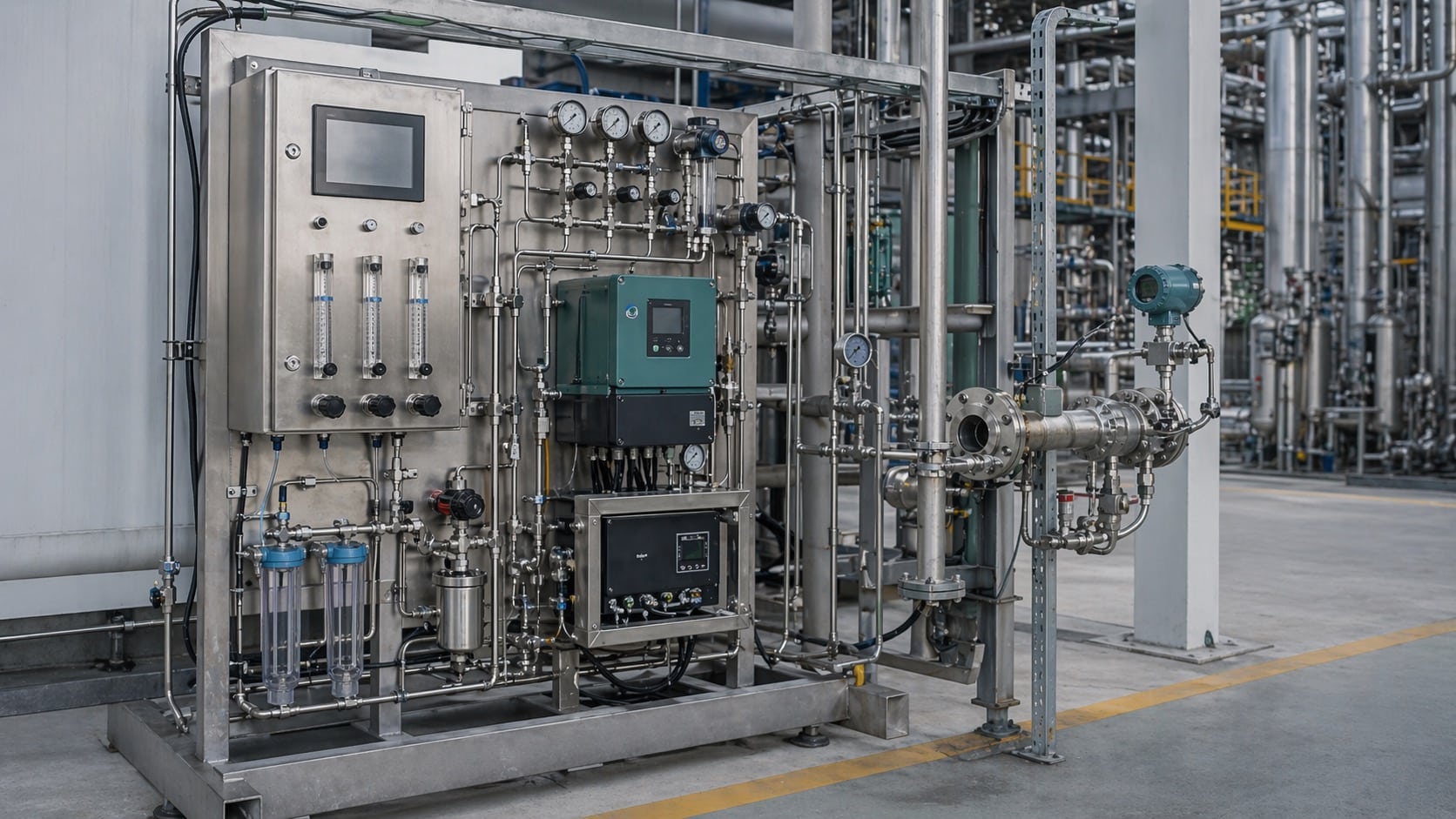
Power Generation — H₂-Cooled Generators
Hydrogen purity drops from 97% to 95% increase windage losses by 32%, reducing output and thermal efficiency.
Continuous H₂ purity monitoring with a thermal-conductivity (TCD) analyzer offering T90 ≤10s response and relay alarm for automated purge cycle or load reduction before the 95% threshold.
≥97% H₂ purity monitoring
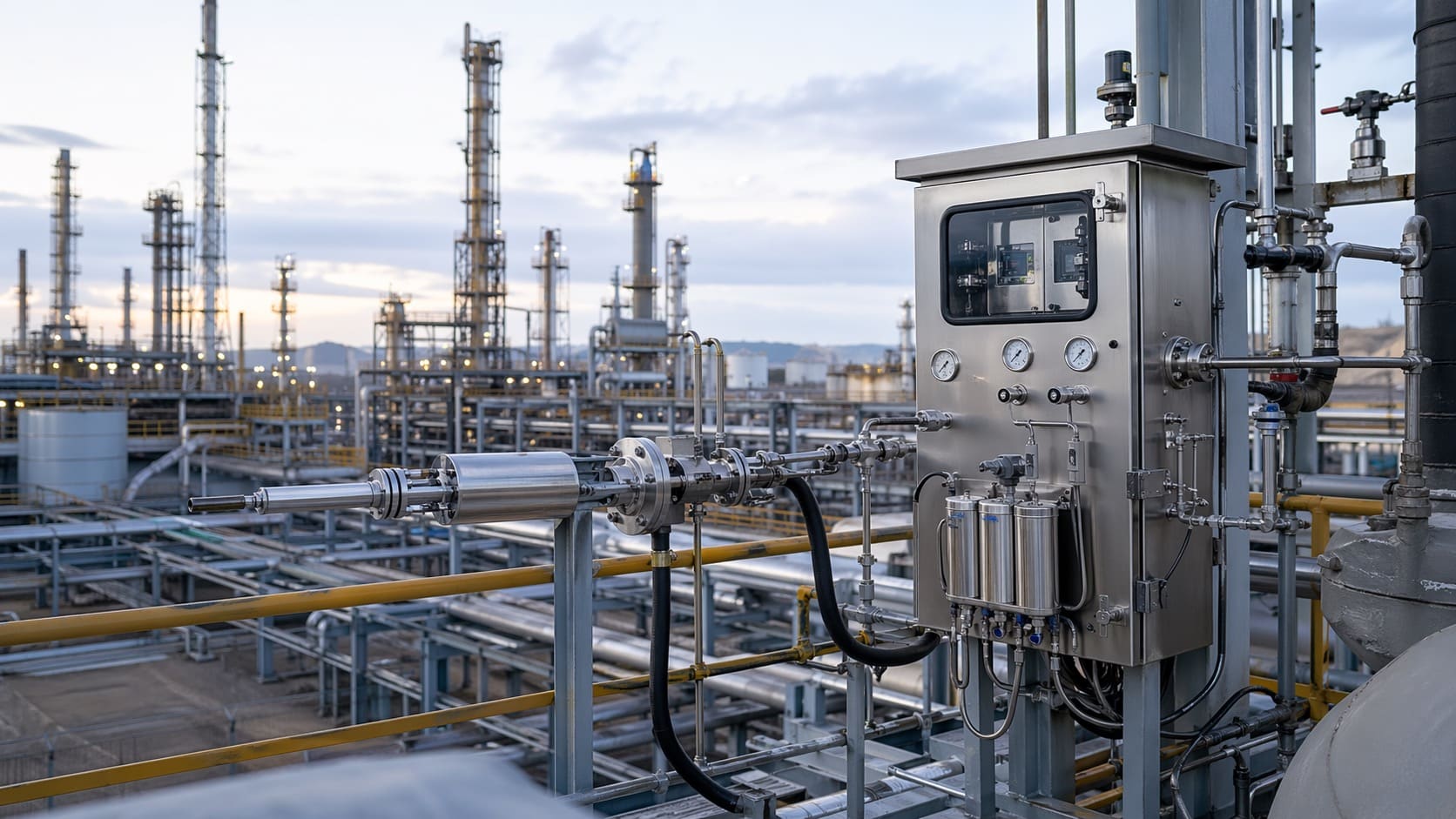
Air Separation Plants
Product gas lines require purity within 0.05% vol specification; industrial O₂ is usually specified at 99.5% purity.
TDLAS-based analyzers provide real-time isokinetic gas mixture analysis without cross-interference from Ar, CO₂, or moisture. OEM TDLAS laser modules integrate directly into DCS via 4-20mA and RS485.
99.5% O₂ purity verification
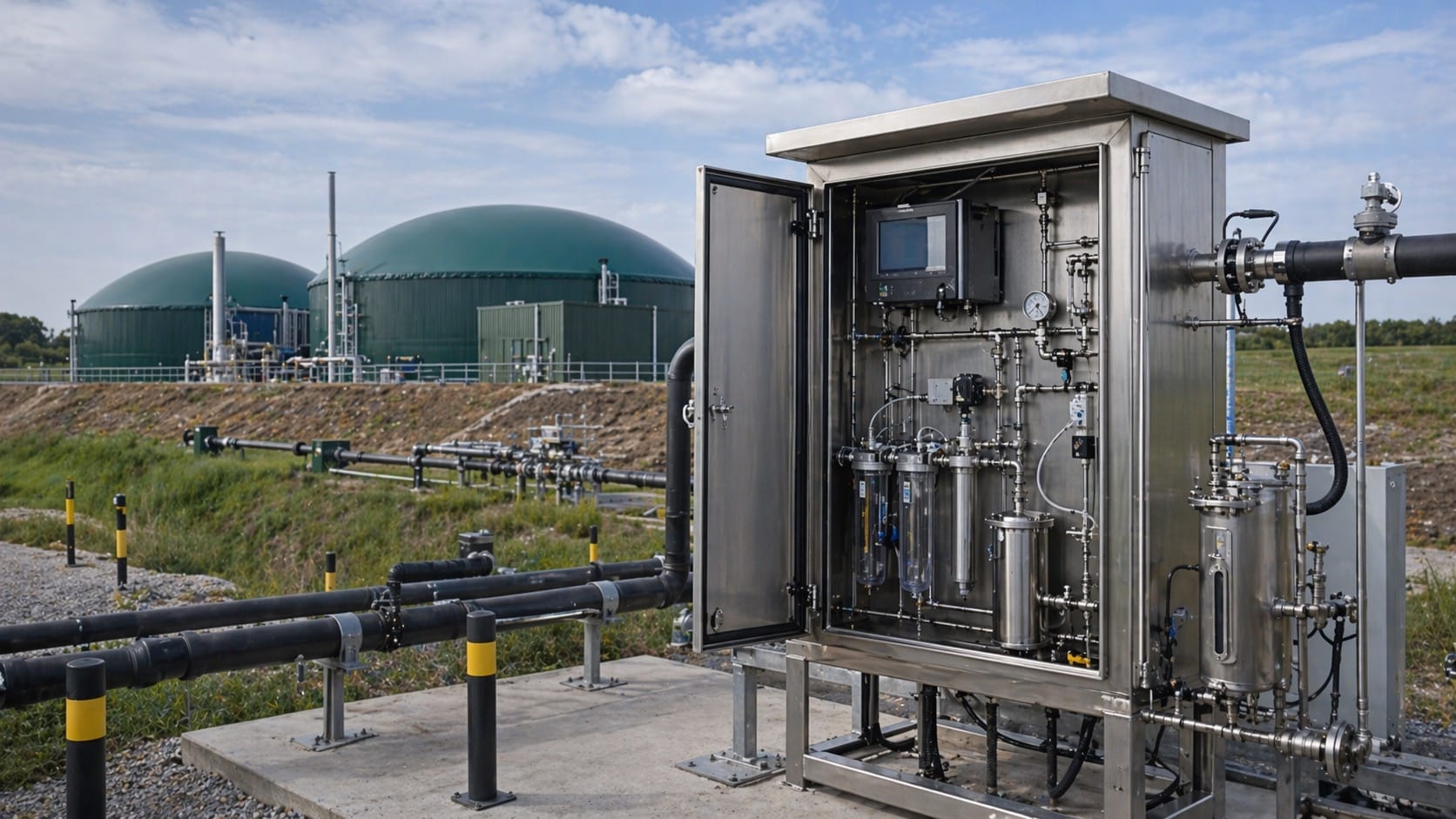
Semiconductor UHP Gas
UHP gas streams monitored at parts-per-trillion level; 500 ppt HF in process gases may cause entire wafer lot rejection.
Sub-ppb detection via multi-pass optical cell with laser line-width stability. HF and H₂O monitoring for dry etching and CVD tools with ppb-level relay alarm setpoints.
Sub-ppb point-of-use detection
Steel, Metallurgy & Chemical
Blast furnace, coke oven, and converter gas monitoring in explosive atmospheres with elevated temperatures and abrasive particulate.
ZS8300-family in-situ hazardous-area packages are designed for Ex db IIC T6 Gb duty; enclosure, ingress-protection, and certificate scope must be confirmed per project. Operating ambient: -30°C to +60°C.
Ex db IIC T6 Gb duty reviewed per project

Blast Furnace Gas Monitoring
Continuous real-time analysis of CO, CO₂, and H₂ in blast furnace gas is critical for combustion optimization and safety.
ZS8600 CEMS simultaneously monitors multiple gases from a single enclosure, reducing process vessel penetrations and system complexity.
Multi-component CEMS

H₂ Fuel Cell Quality
Hydrogen fuel quality certification per ISO 14687 sets µmol/mol (ppm-level) impurity limits — for example CO at 0.2 µmol/mol — demanding sub-ppm detection of CO (0.2 µmol/mol) and low-ppm detection of moisture and other trace impurities.
A bench-top TDLAS analyzer with multi-pass Herriott/White optical cell achieves 5–100 m effective path lengths for sub-ppm quantification in compact form factor.
ISO 14687 fuel quality
Gas purity monitoring requirements vary dramatically by industry. Our application engineers help match analyzer technology, range, and certification to your specific operating conditions.
Compare 5-Year Total Cost of Ownership
The interactive 5-year cost calculator compares TDLAS vs TCD vs electrochemical operating costs. Defaults are illustrative planning values and can be adjusted to match your operation.
Request a Site-Specific 5-Year Cost ComparisonCompare ZS-Series Analyzer Specifications Side-by-Side
Specification Comparison Tool
All five GESHINE models are expanded for side-by-side review. Differences are shown directly in the table so engineers can compare model fit without interactive controls.
| Specification | Bench-top TDLASTDLAS | OEM TDLAS moduleTDLAS OEM | ZS8300TDLAS Hazardous-Area Review | ZS8600TDLAS CEMS | ZS6500NDIR |
|---|---|---|---|---|---|
| Technology | TDLAS (Tunable Diode Laser Absorption Spectroscopy) | TDLAS (Tunable Diode Laser Absorption Spectroscopy) | TDLAS (Tunable Diode Laser Absorption Spectroscopy) | TDLAS (Tunable Diode Laser Absorption Spectroscopy) | NDIR (Non-Dispersive Infrared) |
| Measurable Gases | O₂, CO, CO₂, CH₄, HF, NH₃, HCl, H₂O | O₂, CO, CO₂, CH₄, HF, NH₃, HCl, H₂O (single-species per module) | O₂, CO, CO₂, CH₄, HF, NH₃, HCl, H₂O | O₂, CO, CO₂, NO, NO₂, SO₂, H₂O, HCl, NH₃ (up to 6 simultaneous) | CO, CO₂, CH₄, N₂O, SO₂ (IR-active gases only) |
| Measurement Range | 1 ppb – 100% | 10 ppb – 100% | 1 ppm – 100% | 0.1 ppm – 100% | 0.01% – 100% (%-level optimized) |
| Accuracy | ±1% FS | ±1% FS | ±1% FS | ±2% FS | ±1% FS |
| Response Time (T90) | ≤10s | ≤10s | <3s | <90s | <60s |
| Warm-up Time | <20 min | <15 min | <20 min | <30 min | <10 min |
| Protection Rating | Project-specific ingress review | OEM integration review | Hazardous-area and ingress scope reviewed per project | Cabinet ingress scope reviewed per project | Project-specific ingress review |
| Explosion-proof | N/A — Safe area only | N/A — OEM integration | Hazardous-area package reviewed per project; certificate scope must be confirmed before procurement | N/A — Safe area, control room | N/A — Safe area only |
| Power Supply | 100–240 VAC, 50/60 Hz | 5 VDC or 12 VDC, <3W | 24 VDC / 110–240 VAC | 220 VAC ±10%, 50/60 Hz | 110–240 VAC, 50/60 Hz |
| Output | 4–20 mA · RS485 Modbus RTU · Relay | UART / I²C / TTL / Analog 0–5V | 4–20 mA · RS485 Modbus RTU · HART · Relay | 4–20 mA ×6 · RS485 · Ethernet (Modbus TCP) · 4× Relay | 4–20 mA · RS485 Modbus RTU · Relay |
| Dimensions | 520 × 380 × 220 mm | 120 × 80 × 40 mm | 450 × 250 × 180 mm | 600 × 500 × 1200 mm (19" rack cabinet) | 350 × 280 × 160 mm |
| Weight | ~15 kg | ~0.35 kg | ~18 kg | ~85 kg | ~6 kg |
| Form Factor | Benchtop / 19" rack-mountable | PCB sensor module | Explosion-proof wall-mount enclosure | Floor-standing 19" rack enclosure | Compact benchtop / wall-mount |
| Best For | Lab QC, specialty gas purity, semiconductor process gas | OEM integration, drones, IoT, portable instruments | Hazardous areas, petrochemical, gas terminals, offshore | Stack/CEMS, emissions compliance (EPA Method 19, EN 14181) | Bulk gas monitoring, combustion analysis, greenhouse gas |
Need Help Choosing?
Get a free application assessment from a GESHINE specialist.
Project Documentation & Industry Compliance
Gas purity analyzers operating in hazardous industrial environments may need explosion-proof, functional safety, ingress-protection, and quality-management documentation. GESHINE scopes the following frameworks per model, installation type, and project certificate package.
Documentation Details
- Hazardous-area scope — IEC 60079 framework reviewed against model, enclosure, gas group, and site classification
- Functional-safety scope — IEC 61508 requirements reviewed when the analyzer is part of a safety-instrumented function
- Ingress scope — IEC 60529 documentation reviewed against selected enclosure and installation
- CE scope — EMC and LVD conformity reviewed per configuration
- Quality documentation — supplied according to the selected project package
- GB/T 3836.1 & 3836.2 — Chinese explosive atmosphere standards reviewed where applicable
Documentation requirements vary by jurisdiction and application. Our engineering team advises on the specific approvals needed for your installation site and process conditions, then confirms current certificate availability before procurement.
Procurement Guide: Pricing, Lead Times & After-Sales Support
Indicative project pricing can start around $3,000 for OEM TDLAS laser-module configurations by project review and reach the $25,000+ class for complete CEMS ZS8600 systems with sampling and data capture; final pricing depends on selected gases, documentation scope, sampling, and integration requirements.
Bench-top TDLAS by project review, ZS6500: 4–6 weeks from purchase order.
ZS8300, ZS8600: 8–12 weeks from PO and agreed technical specification.
No minimum order quantity for standard catalog models.
Wire transfer (T/T), Letter of Credit (L/C) accepted for international sales.
24 months from product delivery date. Extended contracts available to 36 or 48 months.
EXW Wuhan, FOB China, CIF available upon request.
Remote diagnostics via RS485 Modbus, on-site commissioning for CEMS and explosion-proof applications, spare parts lead time 2–5 working days.
Frequently Asked Questions — Gas Purity Analyzer
How do gas purity analyzers work?
A gas purity analyzer is used to quantify the presence and amount of one or more specific gases within a gas sample to provide purity analysis. Several core measurement techniques exist for this task. Tunable diode laser absorption spectroscopy (TDLAS) uses a variable wavelength laser beam directed through the gas phase sample, with molecular-specific laser absorption measured by the known laser wavelength and the detector intensity. Direct reading of gas components at sub-ppb levels can be obtained with no cross-interferences from other gases. Non-dispersive infrared (NDIR) analyzers use a broadband infrared source along with a set of optical filters that select for the particular gas being analyzed. Both processes provide continuous real-time measurements typically linked to 4-20mA or digital outputs for process control systems.
What is the difference between TDLAS and thermal conductivity gas analyzers?
TCD sensors determine the bulk thermal conductance of the gas stream and compare it to that of a carrier gas to determine composition. They only reliably determine composition in binary gas mixtures, because the addition of a third component results in a superimposed response that cannot be deconvolved without operating assumptions. TDLAS relies on absorbing a spectral fingerprint from only one molecule, and consequently identifies a change in composition regardless of neighboring molecules. Practically, if a TCD monitoring H₂ purity in N₂ encounters CO or moisture leakage, the reading may drift, while a TDLAS monitor remains molecule-specific. In addition, TCD calibration is often scheduled every 1–3 months with reference gas, while TDLAS uses self-referencing optics to reduce routine recalibration burden. For non-regulatory process purity duty, annual verification may be sufficient; CEMS or permit-driven applications should follow the site QA plan, including daily zero and weekly span checks where required.
How to measure gas purity accurately in industrial processes?
Correct selection of gas purity measurement in an application is often achieved by matching the type of analyzer to the process. If a low cross-interference, high-accuracy (1% FS), low detection-limit (sub-ppb) measurement of process gases in a complex mixture is desired, TDLAS offers the best option. Sampling system architecture also matters. For extractive analyzers, a sample conditioning system is needed that precisely controls temperature, pressure, and humidity so the instrument remains within its operating range. For an in-situ analyzer such as the ZS8300, the sample conditioning system is eliminated because the measurement occurs directly in the process pipe or stack. Overall factors influencing measurement accuracy include selection of the measurement range for the likely gas concentration, calibration verification at or near the deployed gas pressure, and alarm set points within a clearly characterized process window below the problem-causing condition.
What gases can GESHINE analyzers measure?
GESHINE’s TDLAS analyzers for pure gas concentrations include O₂, CO, CO₂, CH₄, HF, NH₃, HCl, and H₂O across the ZS8300 and ZS8600 models, along with bench-top TDLAS and OEM TDLAS module form factors by project review. H₂ and N₂ have no accessible infrared absorption line, so H₂ purity is measured by thermal conductivity (ZS6300-H₂) and N₂ typically by difference rather than by TDLAS. The ZS6500 NDIR analyzer covers CO, N₂O, CO₂, and CH₄ in a 0.01% – 100% (%-level) range format. Multi-gas layouts provide multiple species on a single analyzer by selecting additional laser channels when ordering. For applications with gas species not listed here, such as H₂S, SO₂, or specific hydrocarbon species, custom gas-species layouts are available for OEM and project-specific sites.
Can your systems be integrated into existing DCS/PLC systems?
Yes. All GESHINE gas purity analyzer series provide 4-20mA analog output, RS485 digital messaging (Modbus RTU protocol), and relay alarm output as standard. This analog output can connect directly to any DCS or PLC based analog input module. Digital messaging over RS485 Modbus RTU allows the instrument to be monitored by the control system for real-time gas concentration values, alarm status, instrument diagnostics, and historical data without additional gateway hardware in most cases. If your application also requires a PROFIBUS, HART, or ETHERNET/IP protocol system, notify the GESHINE engineering team at the time of purchase so the suitable protocol converter can be implemented. The OEM communication module is specifically designed for system integration, with pluggable circuit board construction and signal outputs designed to integrate into larger analytical or process control systems.
How much do gas purity analyzers cost?
Gas purity analyzer pricing depends on the technology, gas species, documentation scope, and system configuration. As an indicative planning range, standalone OEM TDLAS laser modules by project review can start around $3,000. Bench-top TDLAS analyzers by project review for laboratory and process control applications typically fall in the $5,000 to $12,000 class depending on gas species selection and output configuration. Hazardous-area in-situ packages such as the ZS8300 family carry a premium due to enclosure, documentation, and project review requirements, often fall in the $15,000-and-above class. Complete CEMS cabinet systems such as the ZS8600 with multi-component TDLAS, sample conditioning, and data monitoring can reach the $25,000+ class. Volume pricing is available for orders of 5+ units. Contact GESHINE with your gas species, measurement range, site classification, and output requirements for a firm quote.
What documentation do your analyzers have for hazardous areas?
Hazardous-area documentation is scoped by analyzer model, enclosure, gas group, temperature class, installation location, and jurisdiction. ZS8300-family projects should be reviewed against IEC 60079 / GB/T 3836 style requirements, and any functional-safety requirement should be confirmed against the selected safety lifecycle and proof-test workflow. Do not treat this page as a universal certificate claim; ask GESHINE to confirm the current certificate package for your project location before procurement.
What maintenance and calibration support do you provide?
TDLAS-based GESHINE analyzers are engineered for reduced routine maintenance burden. Their laser and optical design is self-referencing, so many non-regulatory process purity duties can use annual calibration verification instead of frequent recalibration with reference gas. CEMS or permit-driven installations should follow the site QA plan, including daily zero and weekly span checks where required. No consumable sensor cells have fixed change intervals. Remote diagnostics over RS485 Modbus protocol allow our engineers to troubleshoot status, alarm history, and measurement trends, preventing unnecessary site trips during routine operation. For scheduled annual calibration verification, the GESHINE line offers on-site service or delivery of a certified gas set for customer verification according to our detailed procedure. Extended service contracts including preventive maintenance, on-site annual calibration verification, and priority return of spare parts are available. Our experts can train your maintenance personnel on-site or at our core laboratory in Wuhan on routine verification procedures and first-level failure diagnostics.
Which analyzers are used for air separation (ASU) O₂, N₂, and Ar purity?
Air separation units (ASUs) need continuous purity measurement on the cryogenic product streams — typically trace O₂ in nitrogen, O₂ and Ar product purity, and trace moisture. An air separation gas analyzer is therefore a purity analyzer matched to each product gas: paramagnetic O₂ for percent-level O₂ product streams, dedicated trace-O₂ analyzers for O₂-in-N₂ / O₂-in-Ar duties, moisture / dew-point channels for H₂O, and further trace-impurity channels as the ASU product grade specifies. Because these specifications run to ppm and sub-ppm levels, sample handling and certified calibration matter as much as the sensor. GESHINE scopes ASU O₂ / N₂ / Ar purity duty through its gas purity analysis line; for O₂-specific process measurement see the oxygen analyzers, and for plant-wide context the chemical industry solutions.
References & Transparency
Sources & Standards Referenced
- IEC 60079 Series — Equipment standards for inherent safety, flameproof enclosure, electrical safety in explosive atmospheres (International Electrotechnical Commission)
- IEC 61508 — Functional Safety of E/E/PE Intelligent Safety-related Systems (International Electrotechnical Commission)
- Third-party hydrogen purity monitoring application references for H₂-cooled generators (engineering cross-check)
- Grand View Research — Gas Analyzers Market Report 2024–2030 (market size estimate; data are verified industry estimates)
- GB/T 3836.1-2021 & GB/T 3836.2-2021 — Explosive Atmospheres: Equipment – General Requirements & Flameproof Enclosures (Chinese National Standards Administration)
Our Engineering Perspective on Gas Purity Analysis
GESHINE’s gas purity analyzer model family is supported by laser-based dual TDLAS and NDIR technology developed and produced at our 1,500 m² facility in Wuhan, China where we have multiple invention patents pending in laser system spectroscopy and gas detection systems. Each installation is supported by an integrated installation-commissioning service philosophy — we do not separate instrument purchase from system start-up support — because analytical precision at the instrument point proves perfect measurement resolution only when combined with the sample interface design, purge management, and alarm scheme in the overall plant environment.
Ready to Upgrade Your Gas Purity Monitoring?
Provide us with your gas species, process state parameters, and site classification and we will analyze and price an analyzer configuration best suited for the application in 48 hours.
- Gas species to be measured (O₂, H₂, N₂, CO, CO₂, CH₄, HF, NH₃, HCl)
- Required concentration range (ppb, ppm, %vol)
- Installation type (benchtop, in-situ, CEMS, OEM)
- Hazardous area classification and local approval framework, if applicable
- Required accuracy and response time
- Output protocols (4-20mA, RS485, Modbus RTU)
- Documentation or approval scope needed for procurement
- Number of units and delivery timeline
Get Gas Purity Expert Consultation
Our application engineers specialize in gas purity analyzer configuration for power generation, air separation, semiconductor, and chemical applications.


