
Industrial Gas Analysis
Methane Analyzer — GESHINE TDLAS CH₄ Gas Analysis Solutions
Industrial grade CH₄ measurement from 0–100 ppm to 0–10% concentration. TDLAS laser technology provides no-crosstalk, ±1% FS accuracy, and response under 10 seconds on extractive, in-situ, and benchtop platforms.
Why Methane Measurement Fails — And How TDLAS Eliminates the Root Causes
Costly process plant inaccuracies are not only caused by plant downtime. Poor CH₄ readings on process gas analyzers open plants to safety violations, emission penalties and unreliable control system information. There are three major causes of industrial gas analysis CH₄ measurement failure.
Cross-gas crosstalk. Broadband IR analyzers beam energy across a large spectral window. When other gases such as CO₂, water vapor or other hydrocarbons are present, the instrument reports methane 2–5% absolute higher than reality. In biogas where CO₂ may be 30–45%, this crosstalk triggers false safety alarms or masks real emissions.
Drift during field operation. Conventional NDIR analyzers experience temperature-related expansion of optical components across the day-night cycle. Without operator recalibration every 3–6 months, zero and span drift can increase to 3–5% absolute.
Response lag in dynamic processes. Extractive systems with sample conditioning require 5–30 seconds to register concentration change. This time lag means a process control system responds to a changed condition when the process gas has already undergone a shift.
Tunable diode laser absorption spectroscopy (TDLAS) addresses each of these failure modes. Instead of a broadband infrared source, TDLAS uses a laser diode emitting at the precise wavelength of a methane absorption peak at approximately 1.65 µm. This single-line measurement has no crosstalk from CO₂, H₂O, CO, or any other background gas matrix.
Scanning over the methane-specific absorption peak in milliseconds yields response times of less than 1 second in in-situ configurations. Because the measurement relies on wavelength lock rather than broadband intensity, TDLAS methane analyzers are able to produce drift of around 1% FS week over week versus typical NDIR drift of 2–5% FS over the same period.
The 1.65 µm absorption band lies in the near-infrared atmospheric window where water and CO₂ absorbance is minimal. GESHINE’s DFB laser diode integrates temperature stabilization providing wavelength stability below 0.001 nm from –10 to +55°C ambient conditions — maintaining accuracy in high-humidity process gas environments (up to 30% H₂O by volume) where NDIR analyzers require pre-heated sample lines and moisture filters.
Typical reduction in annual calibration and maintenance labor when switching from NDIR to TDLAS methane analyzers.
Based on published calibration interval data: TDLAS 12+ months vs NDIR 3–6 months (ISA-TR84.00.09).
GESHINE CH₄ Analyzer Series — Models, Specs & Selection Guide
We produce four different methane analyzer configurations — all based on the same TDLAS or NDIR optical core but designed for different installation scenarios. Each delivers identical measurement performance across its entire operating envelope.
Benchtop TDLAS Analyzer
Bench-top TDLASBest for: Biogas, laboratory, high-accuracy process analysis
TDLAS Gas Analysis Module (OEM)
OEM TDLAS moduleBest for: System integrators, OEM embedding
In-Situ Hazardous-Area Analyzer
ZS8300Best for: Hazardous process areas, coal mines, fast CH₄ monitoring
NDIR Gas Analyzer
ZS6500Best for: Budget-conscious, small boiler, clean gas
Application-Based Selection: Which Methane Analyzer Fits Your Process?
| Application | Recommended Model | CH₄ Range | Key Advantage | Accuracy |
|---|---|---|---|---|
| Biogas / Landfill Gas | Bench-top TDLAS (by project review) | 0–10% (extendable) | No CO₂ interference at 30–45% levels | ±1% FS |
| Natural Gas Processing | ZS8300 (In-Situ) | Custom (%) | 1s response, Ex scope reviewed per project | 1% FS linearity |
| CEMS / Stack Emission | ZS8100 + OEM TDLAS module (by project review) | 0–100 ppm to 0–10% | Extractive system with heated sample line | ±1% FS |
| Coal Mine CH₄ Monitoring | ZS8300 (In-Situ) | 0–5% range | Hazardous-area and ingress scope per project review, 1-second response; for dedicated %LEL safety-detector purchasing see Combustible Gas Detectors | 1% FS linearity |
| Laboratory / R&D | Bench-top TDLAS (by project review) | 0–100 ppm | 5-min warm-up, high precision | ±1% FS |
| Small Boiler Optimization | ZS6500 (NDIR) | Custom | Lower cost, proven infrared platform | ≤2% FS |
| OEM System Integration | OEM TDLAS module (by project review) | 0–100 ppm to 0–10% | Compact module, RS485 integration | ±1% FS |
The bench-top TDLAS analyzer and OEM TDLAS laser module can simultaneously measure up to 6 gases (O₂, CO, CO₂, CH₄, HF, H₂O) in one sample stream. If your plant uses dedicated analyzers for methane and process gases, consolidation typically saves 2–3 analyzers per measuring point. Contact us with your current analyzer inventory for a consolidation calculation.
The measurement accuracy shortcomings of broadband infrared technology are concrete and quantifiable — which informs every GESHINE CH₄ product performance specification.
TDLAS vs NDIR vs FID — Methane Analyzer Technology Comparison
Selecting a methane analyzer technology requires balancing detection sensitivity, cross-interference immunity, maintenance overhead, and total cost of ownership. We produce both TDLAS and NDIR systems because different applications demand different specifications.
| Parameter | TDLAS | NDIR (ZS6500) | FID |
|---|---|---|---|
| Detection Principle | Single-line laser absorption at 1.65 µm | Broadband IR with optical filter at 3.3 µm | Hydrogen flame ionization |
| CH₄ Detection Limit | <1 ppm (sub-ppm capable) | ~5–10 ppm | <0.1 ppm |
| Measurement Range | 0–100 ppm to 0–10% | Typically 0–5% | 0–10,000 ppm (0–1%) |
| CO₂ Cross-Interference | None (single-line specificity) | 2–5% reading error at 30% CO₂ | None (ionization-based) |
| H₂O Cross-Interference | None (1.65 µm atmospheric window) | Requires sample drying | Minimal |
| Non-Methane Hydrocarbon Interference | None | Significant (broadband overlap) | High (responds to all HCs) |
| Response Time (T90) | ≤10 s (extractive); 1 s (in-situ) | 5–30 seconds | 2–5 seconds |
| Calibration Interval | 12+ months | 3–6 months | 1–3 months |
| Consumables Required | None (solid-state laser) | IR source replacement (2–3 years) | H₂ carrier gas (continuous supply) |
| Explosion-Proof Available | Yes — ZS8300 hazardous-area package (scope reviewed per project) | With enclosure (additional cost) | Not recommended (open flame) |
| Multi-Gas Capability | Up to 6 gases simultaneously | 2–4 gases with multiple filters | Total HC only (no speciation) |
| 5-Year Cost (typical) | Medium (high upfront cost, low operating cost) | Low (lowest upfront cost, moderate operating cost) | High (H₂ supply + frequent cal.) |
Raw biogas contains 50–65% CH₄ and 30–45% CO₂, with saturated water vapor at 35–40°C. The CO₂ absorption partially overlaps the broadband NDIR methane window, corrupting the baseline signal. Operators using NDIR analyzers on biogas digesters often see 3–8% absolute error unless additional gas-conditioning hardware is installed. A TDLAS analyzer measuring at 1.65 µm sees directly through that gas matrix without any sample conditioning beyond a particulate filter.
We manufacture both TDLAS and NDIR analyzers because specifying one technology for all applications is poor engineering. Our applications team recommends the platform most suitable to your gas matrix.
Find Your Optimal CH₄ Analyzer Model
The interactive selector loads four questions for application, concentration range, installation environment, and response speed. If the tool does not load, send those four details to application engineering for a configured recommendation.
Customer Results: Proven CH₄ Monitoring Across Industries
Methane monitoring requirements vary by industry — from ppb levels for atmospheric research to percent levels for biogas composition analysis. GESHINE analyzers span that entire range.
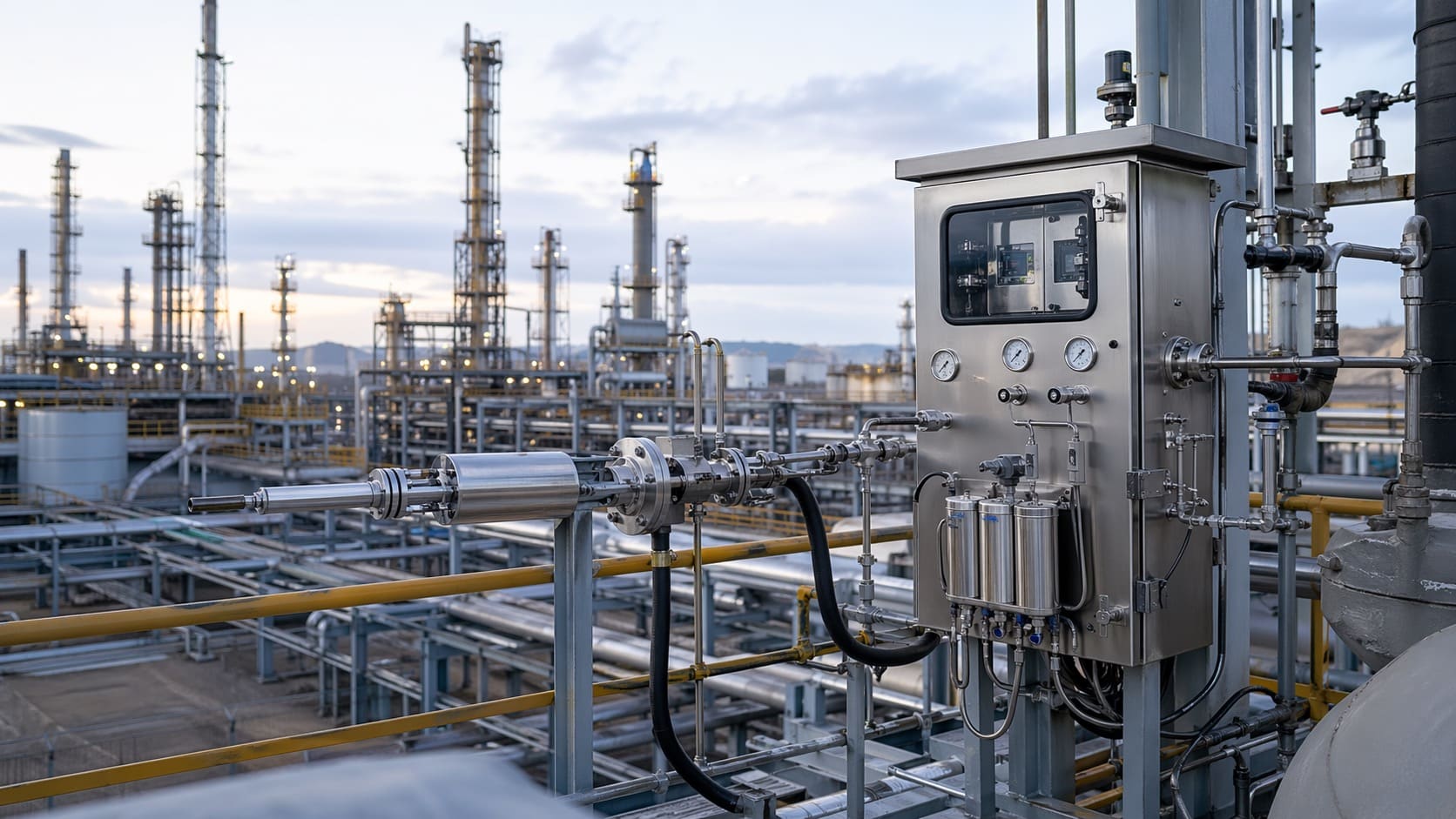
Oil & Gas — Fugitive Emission Monitoring
A midstream natural gas processing plant operated 12 perimeter methane monitors. Conventional catalytic sensors produced a 30-second response lag.
ZS8300 in-situ analyzers installed at each monitoring station. Designed for Ex db IIC T6 Gb duty (scope reviewed per project) in Zone 1 areas with 1-second response time.
Calibration interval: monthly → yearly
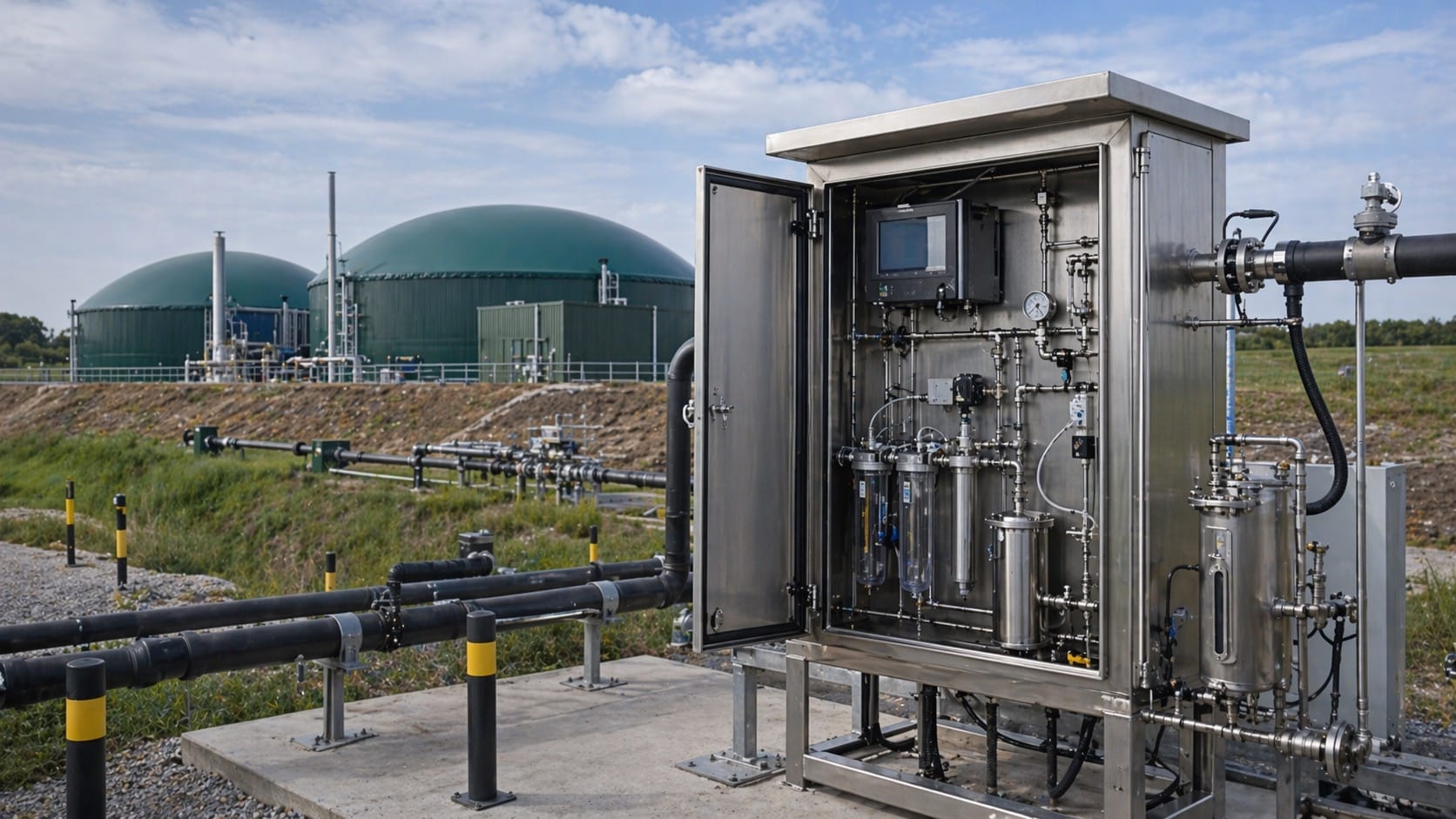
Biogas & Landfill — Composition Analysis
A municipal treatment plant with three digesters needed stable CH₄/CO₂ ratio measurement. Existing NDIR analyzers showed 4–6% drift due to CO₂ background of 38–42%.
Bench-top TDLAS analyzers on each digester gas outlet. Simultaneous CH₄ + CO₂ measurement from one sample line with no cross-interference.
CH₄ accuracy: 5% (NDIR) → 1% (TDLAS)
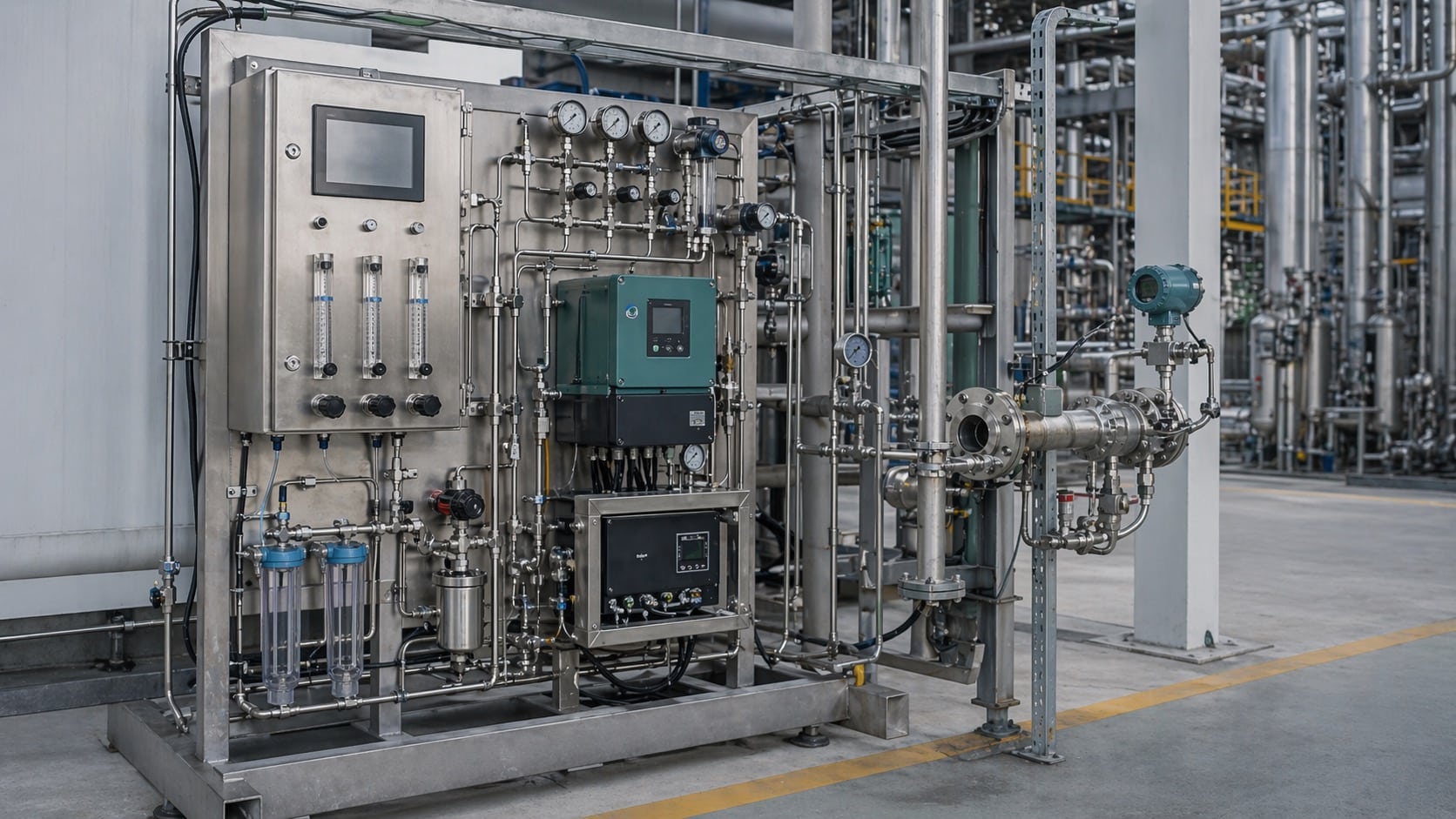
Power Generation — Combustion Optimization
A coal-fired power station required unburned CH₄ monitoring in stack gas for combustion tuning. Existing extractive system had a 45-second transport delay.
ZS8100 extractive TDLAS system with heated sample line (up to 600°C) plus an OEM TDLAS laser module. Multi-pass optical path for high sensitivity at low ppm.
Full sample-to-reading loop under 90s, including heated-line transport

Mining — Underground CH₄ Process Monitoring
CH₄ monitoring at an underground coal mine required SIL 2 functional safety rating in explosive atmosphere zones. Electrochemical sensors failed in high humidity with dust.
ZS8300 in-situ laser analyzers in hazardous-area enclosures, with ingress and Ex scope reviewed per project. Nitrogen purge system maintains optical contact. Direct cross-duct measurement. Dedicated %LEL safety-detector purchasing belongs on Combustible Gas Detectors.
1-second response for rapid CH₄ trend and alarm input

CEMS — Stack Emission Compliance
Environmental compliance required continuous methane measurement in stack emissions with certification to national emission standards.
ZS8100 extractive CEMS system with an OEM TDLAS laser module, satisfying emission standards. Multi-gas measurement with heated sample line and gas conditioning.
EN 15267-3:2023 CEMS performance framework; EPA Method 25A only as an FID total-gaseous-organic reference cross-check where applicable
Natural Gas — Pipeline Quality
Pipeline quality control for natural gas required accurate CH₄ composition analysis at processing facilities and delivery stations.
Bench-top TDLAS analyzer providing continuous CH₄ composition monitoring at gathering points. No interference from pipeline contaminants including H₂S and CO₂. For pipeline-quality sulfur, moisture, O₂, and THC routing, see Natural Gas Analyzers.
Zero CO₂ cross-interference
CH₄ monitoring requirements vary dramatically by industry. Our application engineers help match analyzer technology, range, and certification to your specific operating conditions.
Estimate Your Methane Analyzer Total Cost of Ownership
The interactive 5-year cost calculator compares TDLAS and NDIR methane analyzer operating costs, including calibration labor, source replacement, downtime, and consumables. Defaults are illustrative planning values.
Request a Custom 5-Year Cost AnalysisCertifications & Compliance for Methane Gas Analyzers
Every GESHINE gas analyzer ships with documentation traceable to relevant national and international standards. For hazardous-area installations, ZS8300-family documentation must be confirmed against the selected configuration and project jurisdiction:
Certification Details
- Ex scope — IEC 60079 / GB/T 3836 hazardous-area framework reviewed per project
- SIL 2 target review — IEC 61508 / GB/T 20438 functional-safety framework reviewed per project
- Ingress protection — IP-rating documentation reviewed per project
- CE — European conformity for health, safety, and environmental protection
- ISO 9001 — Quality management system certification for manufacturing processes
- High-Tech Enterprise — National-level certification (China)
Analyzers with CE marking ship from our Wuhan facility within 4–6 weeks. Where ATEX, IECEx, MCERTS, TÜV, or other third-party verification is required, confirm certificate scope and delivery timeline during RFQ before procurement.
Procurement Guide: Methane Analyzer Pricing, Lead Time & Support
Methane gas analyzer pricing varies based on technology (TDLAS vs NDIR), form factor (benchtop vs CEMS), number of gases monitored, and certifications required. We quote projects, not products — send us your application description for a precise quotation.
Pricing Structure
- Benchtop/module NDIR (ZS6500): entry-level pricing for single-gas CH₄ analysis in safe environments
- Bench-top TDLAS form factor (by project review): mid-range pricing for multi-gas laboratory and process environments
- In-situ hazardous-area (ZS8300): premium pricing including Ex-rated enclosure and functional-safety documentation scope (reviewed per project)
- Complete CEMS system (ZS8100): project-based pricing including sample conditioning, heated lines and control cabinet
Delivery & Lead Times
- Standard benchtop and module orders: 4–6 weeks from confirmed order
- In-situ analyzers: 6–8 weeks including explosion-proof testing
- Complete CEMS systems: 8–12 weeks including factory acceptance testing (FAT)
- OEM TDLAS laser module (by project review): 3–4 week lead time for quantities of 10+ units
After-Sales & Technical Support
- 12-month warranty standard, extendable to 24 months on request
- RS485/Modbus remote diagnostics from your control room
- Critical spares (laser modules, optical windows, sample pumps) stocked for next-day dispatch
- On-site commissioning support with calibration verification and operator training worldwide
- OEM programs: volume discounts, custom firmware, and white-label packaging
Compare TDLAS vs NDIR vs FID Side-by-Side
Compare TDLAS, NDIR, and FID measurement technologies across 14 performance parameters. The source filter controls are removed here; all rows are shown by category.
Accuracy & Sensitivity
| Parameter | TDLAS | NDIR | FID |
|---|---|---|---|
| CH₄ Detection Limit | <1 ppm Strong | 5–10 ppm Moderate | <0.1 ppm Strong |
| Measurement Range | 0–100 ppm to 0–10% Broad | Typically 0–5% Limited | 0–10,000 ppm Narrow |
| CO₂ Cross-Interference | None Immune | 2–5% error at 30% CO₂ Significant | None Immune |
| H₂O Cross-Interference | None (1.65 µm window) Immune | Requires sample drying Affected | Minimal Low |
| Hydrocarbon Selectivity | CH₄-only (single-line) Specific | Broadband overlap Poor | Responds to all HCs None |
| Response Time (T90) | ≤10 s (extractive); 1 s (in-situ) Fast | 5–30 seconds Moderate | 2–5 seconds Fast |
Operations & Maintenance
| Parameter | TDLAS | NDIR | FID |
|---|---|---|---|
| Calibration Interval | 12+ months Extended | 3–6 months Regular | 1–3 months Frequent |
| Drift (Zero/Span) | ≤1% FS/week Low | ≤2% FS/24h Moderate | Variable Moderate |
| Consumables | None (solid-state laser) Zero | IR source every 2–3 years Low | H₂ carrier gas (continuous) High |
| Multi-Gas Capability | Up to 6 gases Strong | 2–4 gases Moderate | Total HC only None |
Cost & Practicality
| Parameter | TDLAS | NDIR | FID |
|---|---|---|---|
| Explosion-Proof Available | Yes — Ex db IIC T6 scope reviewed per project Yes | With enclosure (extra cost) Optional | Not recommended No |
| Equipment Cost (Upfront) | Medium-High Medium | Low Low | High High |
| Operating Cost (Ongoing) | Low Low | Moderate Moderate | High (H₂ + cal.) High |
| Sample Conditioning Need | Particle filter only Minimal | Filter + dryer + heated line Complex | Filter + regulator Moderate |
When to Choose Each Technology
TDLAS: Wet or CO₂-rich gas streams (biogas, landfill, flue gas), process control requiring fast response, facilities that want to minimize calibration labor. Strong fit for complex gas matrices.
NDIR: Clean, dry gas streams with low CO₂ background. Budget-constrained installations where interference is not a concern. Proven and simple.
FID: Trace-level detection below 1 ppm where total hydrocarbon measurement (not methane-specific) is acceptable. Requires H₂ supply infrastructure.
Methane Analyzer FAQ — Your Questions Answered
Practical answers for CH₄ process measurement, TDLAS selection, certification, and analyzer configuration.
What device can detect methane?
Industrial methane analyzers using TDLAS (tunable diode laser absorption spectroscopy), NDIR (non-dispersive infrared), or FID (flame ionization detection) technology detect and measure CH₄ concentration. TDLAS analyzers can deliver ppb-level sensitivity and fast response; response time depends on the selected configuration, from 1-second in-situ process duty to under 10 seconds for many extractive or benchtop TDLAS configurations. They are often a strong fit for process control and continuous emission monitoring where CH₄ selectivity matters.
What is the difference between extractive and in-situ gas analyzers?
Extractive analyzers draw a gas sample through tubing to a measurement cell, offering high accuracy (±1% FS) and multi-gas capability. In-situ analyzers measure directly across the duct or stack with no sample conditioning, providing 1-second response times. GESHINE manufactures both configurations — extractive models (ZS8100 series) for emission compliance and in-situ models (ZS8300 series) for real-time process control.
How does a TDLAS methane analyzer work?
TDLAS methane analyzers emit a narrow-wavelength laser beam tuned to the specific absorption line of CH₄ at approximately 1.65 µm. As the laser scans across this absorption feature, the analyzer measures how much light the methane molecules absorb. Because each gas species has unique absorption lines, TDLAS eliminates cross-interference from CO₂, water vapor, and other background gases — a significant advantage over broadband NDIR analyzers.
How much does a methane gas analyzer cost?
Industrial methane analyzer pricing depends on technology (TDLAS or NDIR), form factor (benchtop, extractive system, or in-situ), measurement range, and required certifications. Contact GESHINE for project-specific quotations with volume pricing.
Will a CO₂ detector detect methane?
No. CO₂ detectors measure carbon dioxide at its characteristic infrared absorption wavelength (4.26 µm), which does not overlap with the methane absorption band (3.3 µm for NDIR or 1.65 µm for TDLAS). A dedicated methane analyzer with a CH₄-specific optical filter or laser source is required for accurate methane measurement.
What is the measurement range of a CH₄ analyzer?
Measurement ranges vary by application. GESHINE TDLAS analyzers cover 0–100 ppm to 0–10% CH₄ in a single platform. For trace atmospheric monitoring, ppb-level sensitivity is achievable. For biogas and landfill applications where CH₄ concentrations reach 40–60%, extended-range configurations are available on request.
What certifications are required for industrial methane analyzers?
Hazardous-area installations may require ATEX, IECEx, IEC 60079, or GB/T 3836 documentation depending on jurisdiction. Process-safety applications may require a SIL 2 target review under IEC 61508 / GB/T 20438. Do not treat this page as a universal certificate claim; ask GESHINE to confirm the current Ex and functional-safety documentation package for the selected ZS8300 configuration before procurement.
What is the difference between TDLAS and NDIR for methane detection?
TDLAS uses a narrow-linewidth laser scanning a single CH₄ absorption line, delivering high selectivity and strong resistance to CO₂ or H₂O interference when the measurement is configured for the target matrix. Response time depends on the analyzer configuration: in-situ process measurements can be around 1 second, while extractive or benchtop TDLAS configurations are commonly specified under 10 seconds. NDIR uses a broadband infrared source with an optical filter, which is lower cost but more susceptible to interference from overlapping absorption bands. NDIR response time is typically 5–30 seconds. For process control and emission monitoring where speed and specificity matter, TDLAS is often the stronger fit.
Need a methane analyzer recommendation tied to your gas matrix?
Ask a CH₄ application engineerReferences & Transparency
Sources & Standards Referenced
- ISO 6145:2019 — Gas analysis: preparation of calibration gas mixtures by the dynamic technique
- IEC 61508:2010 — Functional safety of electrical/electronic/programmable electronic safety-related systems (SIL requirements)
- GB/T 3836.1-2021 / GB/T 3836.2-2021 — Explosive atmospheres: equipment protection by flameproof enclosures
- EPA Method 25A — FID reference method for total gaseous organic concentration; not a TDLAS CH₄ certification claim
- EN 15267-3:2023 — Air quality: certification of automated measuring systems (CEMS performance requirements)
- ISA-TR84.00.09 — SIL Verification Procedures for Safety Instrumented Functions
- Werle, P. (2004). Tunable diode laser absorption spectroscopy: recent findings and novel approaches. Infrared Physics & Technology, 46(1–2), 65–73
- The Global Methane Pledge (2021) — International framework encouraging methane emission control measures
The Engineering Team Behind These Analyzers
GESHINE gas analyzers are developed and produced in our 1,500 m² facility in Wuhan’s East Lake High-Tech Development Zone — China’s Optics Valley — where we have direct access to laser diode manufacturers and optical component suppliers required by our TDLAS development program. Our R&D team holds invention patents in laser gas analysis module design, multi-pass optical cell configuration, and high-temperature sample conditioning systems. The specification data on this page corresponds to production instruments tested under the operating conditions specified, not laboratory prototypes. When we state ±1% FS accuracy and ≤1% FS/week drift, those are the values guaranteed in the certificate of conformance supplied with each instrument.
Ready to Solve Your Methane Measurement Challenge?
Send us your application details including gas matrix composition, measurement range, and certification needs. Our applications engineering team will identify the optimal analyzer configuration and provide a quotation within 2 business days.
- Application type (biogas, CEMS, mining, process control)
- CH₄ concentration range required (ppm or %)
- Gas matrix composition (CO₂, H₂O, H₂S present?)
- Installation type (benchtop, in-situ, extractive CEMS)
- Hazardous area classification (ATEX zone, if applicable)
- Required response time (T90)
- Output protocols (4–20 mA, Modbus, RS485)
- Certifications needed (Ex, SIL 2, CE, IECEx)
Get CH₄ Expert Consultation
Our application engineers specialize in methane analyzer configuration for biogas, CEMS, oil & gas, and mining process applications.


