
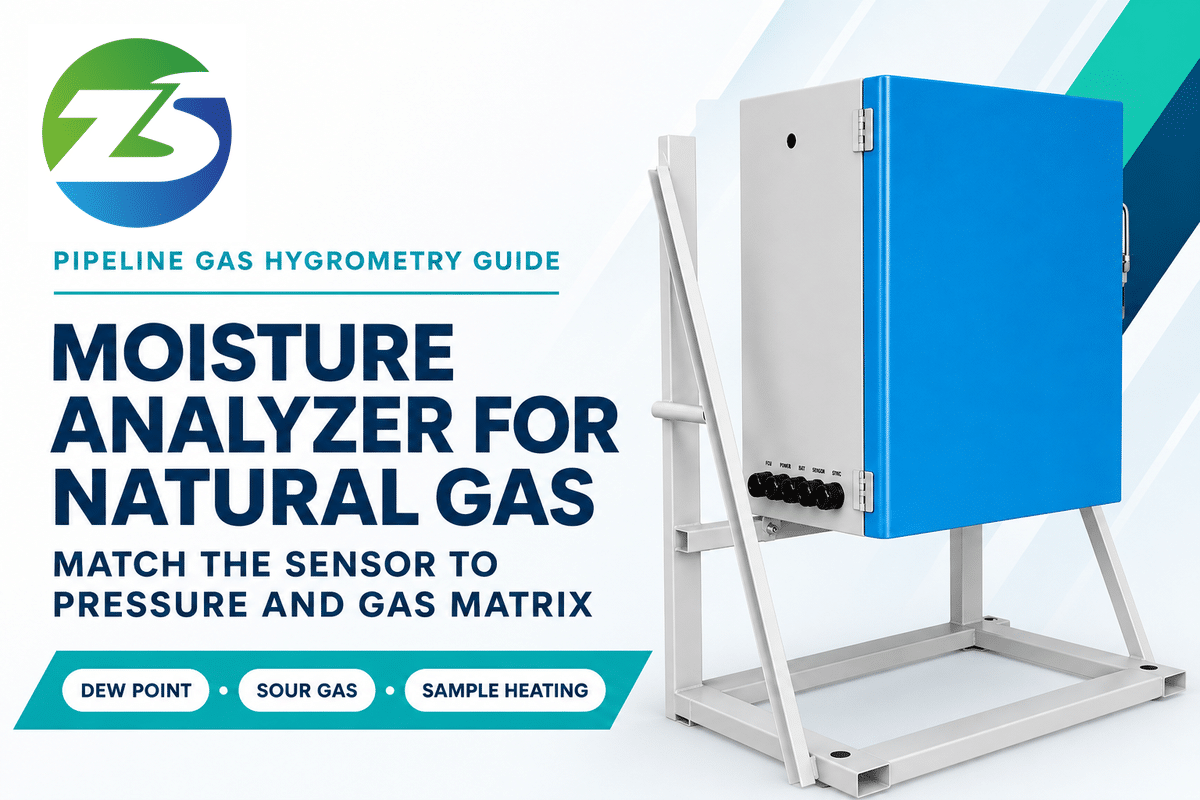
A moisture analyzer for natural gas must verify that pipeline water vapor remains less than the 4.0 to 7.0 lb/MMSCF (84.4 to 147.7 ppmv) limit across the range of 300 to 1,500 psig. Matching your sensing element to the operating pressure and the gas composition is essential to avoid measurement drift. Liquid and vapor contaminant loads must also be considered. When water vapor in natural gas condenses within the transmission line it causes carbonic and sulfidic acid corrosion. Free water in the presence of methane at high line pressure forms solid gas hydrates. Whether you monitor a triethylene glycol (TEG) contactor or a custody transfer skid, the bare hygrometer is only half of the system. Reliable moisture analysis involves conversion of tariff mass units (lb/MMSCF) to pressure dew point temperature. It involves prevention of Joule-Thomson condensation in the sample conditioning panel.
Key Engineering Takeaways
- Tariff Unit Conversion Shifts With Pressure: Under standard reference conditions (60°F, 14.696 psia), 1 lb/MMSCF equals 21.1 ppmv. The U.S. tariff limit of 7.0 lb/MMSCF equals 147.7 ppmv (~112 mg/Nm³). That fixed moisture concentration shifts from a -39°C water dew point at 30 psig to 0°C (+32°F) at 1,000 psig.
- Sensor Technology Matching: Tunable diode laser absorption spectroscopy (TDLAS) delivers a <2 s optical response for custody transfer and sour gas. Quartz crystal microbalance (QCM) sensors reach 0.02–0.1 ppmv detection limits to measure trace moisture in cryogenic LNG dryer beds.
- Co-Absorber & Sour Gas Realities: TDLAS is non-contact; however, readings can be affected by gas composition. Broadening of line shapes by CO2 greater than about 2.5% to 5% molar can occur, and in the presence of ethane can cause collisional spectral broadening.
- Joule-Thomson Sample Heating: Natural gas cools by 0.45–0.55°C per bar (3.1–3.8°C per 100 psi) during pressure letdown. Dropping 1,000 psig gas to 30 psig creates a 31–37°C temperature drop. This drop requires a heated regulator (+60°C to +80°C) directly at the tap.
- 2026 System Cost & TCO Parity: Bare explosion-proof aluminum oxide transmitters cost approximately $4,300 to $18,000. Complete TDLAS or QCM analyzer cabinets with heated sample systems cost around $25,000 to $75,000 with a 6–14 weeks lead time.
Pipeline Moisture Units Explained: Converting lb/MMscf, ppmv, and Pressure Dew Point
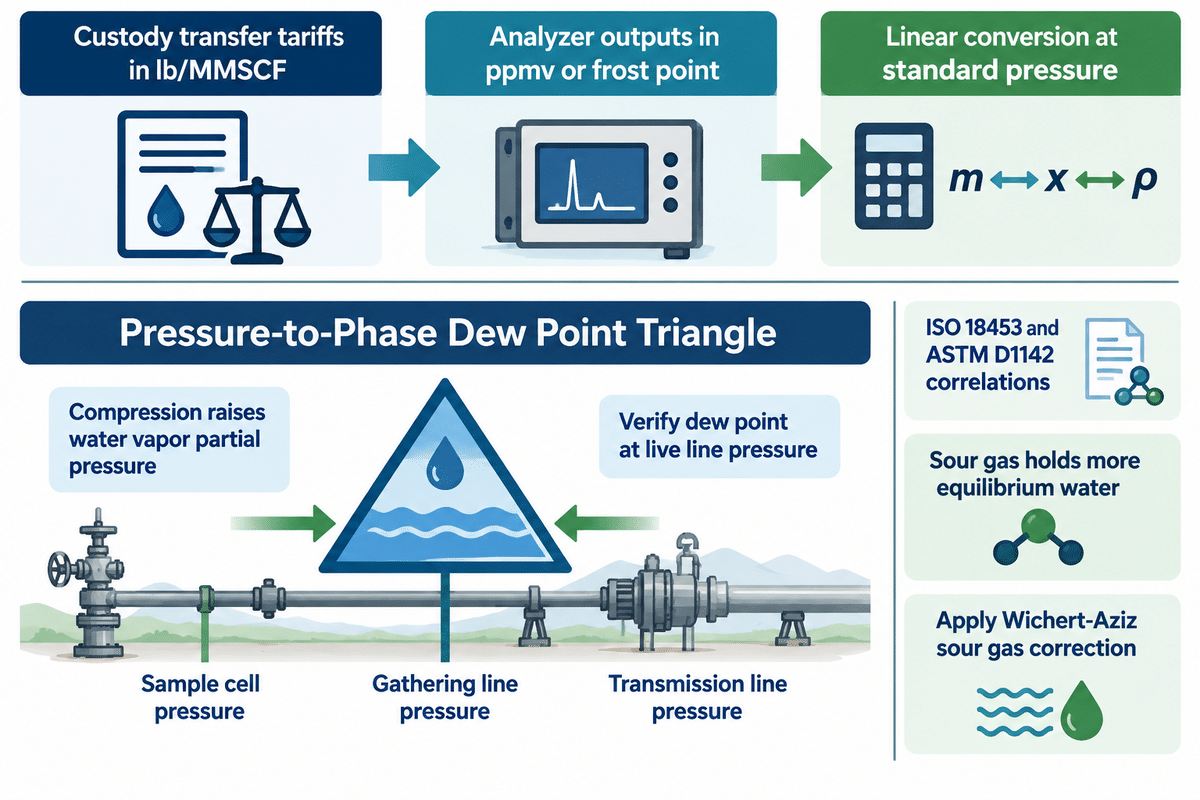
One pound of water per million standard cubic feet (1 lb/MMSCF) equals 21.1 ppmv at 60°F and 14.696 psia. Consequently, the standard 7.0 lb/MMSCF pipeline tariff limit equals 147.7 ppmv (112.1 mg/Nm³). Converting that molar water concentration to a pressure dew point needs non-ideal hydrocarbon compressibility equations at live line pressure.
In the gas industry, commercial contracts and analyzer outputs rarely use the same engineering units. When natural gas is sold across North American grids, custody transfer tariffs define moisture content in the gas in lb/MMSCF. European transmission system operators define pipeline gas quality in mg/Nm³ or dew point at operating pressure. On the other hand, an online industrial moisture analyzer states molar fraction in ppmv or frost point in °Cdp. Thorough control of moisture in natural gas and strict trace moisture levels protect pipeline gas quality from source to city gate.
Why do natural gas pipeline tariffs specify water vapor in lb/MMscf while online analyzers measure in ppmv or dew point?
Pipeline tariffs define water vapor in lb/MMSCF because custody transfer accounting defines the heating value in terms of mass and volume. Online moisture analysers measure ppmv or dew point temperature because sensors respond to molecular density or vapor partial pressure.
U.S. pipeline monitoring data from the U.S. EPA Environmental Technology Verification (ETV) program and the GRI-02/0057 corrosion standard, suggest tariff ceilings of 4.0 to 7.0 lb/MMSCF. At standard conditions (60°F / 15.56°C, 14.696 psia), one pound-mole of ideal gas occupies 379.48 scf. Water has a molar mass of 18.015 lb/lbmol. Using these constants provides the following conversion factors for measurement of moisture:
- The baseline standard unit is 1.0 lb/MMSCF, which is equivalent to 21.10 ppmv or 16.02 mg/Nm³ (at 0°C and 101.325 kPa normal reference).
- In the Northern climates, a tariff ceiling of 4.0 lb/MMSCF corresponds to a concentration of 84.4 ppmv or a mass of 64.1 mg/Nm³.
- A standard FERC tariff ceiling of 7.0 lb/MMSCF is equivalent to a concentration of 147.7 ppmv or a mass of 112.1 mg/Nm³.
The Pressure-to-Phase Dew Point Triangle
Converting between mass concentration (lb/MMSCF) and molar fraction (ppmv) is linear because both reference standard pressure. Converting either figure into a physical dew point temperature is highly non-linear. We call this thermodynamic relationship the Pressure-to-Phase Dew Point Triangle. Original worked thermodynamic and Joule-Thomson engineering synthesis: Pressure-to-Phase Dew Point Triangle converting 7.0 lb/MMscf (147.7 ppmv) across 30 psig (-39°C) vs 1,000 psig (0°C) coupled with 67-bar Joule-Thomson cooling (31–37°C drop) to specify heated pressure regulators. As line pressure rises, the amount of water molecules per unit of compressed volume increases. This compression raises water vapor partial pressure and triggers liquid condensation at much warmer temperatures. Above 500 psia, non-ideal attraction between methane and water increases equilibrium vapor solubility compared to Dalton’s law.
The standard ISO 18453:2004 (Correlation between water content and water dew point) and ASTM D1142 (IGT Research Bulletin #8) govern these calculations. Standard sweet-gas McKetta-Wehe charts are not always valid when gas composition shifts. High-pressure studies from Rice University and field calculations on the Cheresources engineering forum prove this effect. Sour gas with high H2S and CO2 holds larger amounts of water in equilibrium than sweet methane. Using sweet-gas tables on sour streams underestimates the actual amount of moisture unless Wichert-Aziz or ISO 18453 corrections are applied.
| Pipeline Service Tier & Category | Tariff Water Content (lb/MMSCF) | Molar Moisture Concentration (ppmv) | Mass Concentration (mg/Nm³) | Dew Point at 30 psig (Sample Cell) | Dew Point at 300 psig (Gathering Line) | Dew Point at 1,000 psig (Transmission Line) |
|---|---|---|---|---|---|---|
| Cryogenic LNG Feed Trim | 0.005 lb/MMSCF | 0.10 ppmv | 0.08 mg/Nm³ | -98°C (-144°F) | -85°C (-121°F) | -76°C (-105°F) |
| Turbo-Expander NGL Recovery | 0.5 lb/MMSCF | 10.6 ppmv | 8.0 mg/Nm³ | -61°C (-78°F) | -43°C (-45°F) | -30°C (-22°F) |
| Ultra-Dry Instrument Gas | 1.0 lb/MMSCF | 21.1 ppmv | 16.0 mg/Nm³ | -55°C (-67°F) | -36°C (-33°F) | -23°C (-9°F) |
| Arctic Sub-Zero Pipeline Tier | 2.0 lb/MMSCF | 42.2 ppmv | 32.0 mg/Nm³ | -49°C (-56°F) | -29°C (-20°F) | -15°C (+5°F) |
| European Cross-Border Grid Tier | 3.0 lb/MMSCF | 63.3 ppmv | 48.1 mg/Nm³ | -46°C (-51°F) | -25°C (-13°F) | -10°C (+14°F) |
| Canadian & Northern US Tariff | 4.0 lb/MMSCF | 84.4 ppmv | 64.1 mg/Nm³ | -44°C (-47°F) | -22°C (-8°F) | -7°C (+19°F) |
| Midstream Dehydration Target | 5.0 lb/MMSCF | 105.5 ppmv | 80.1 mg/Nm³ | -42°C (-44°F) | -19°C (-2°F) | -4°C (+25°F) |
| Standard US FERC Tariff Limit | 7.0 lb/MMSCF | 147.7 ppmv | 112.1 mg/Nm³ | -39°C (-38°F) | -15°C (+5°F) | 0°C (+32°F) |
| Wet Contactor Upset Alarm | 10.0 lb/MMSCF | 211.0 ppmv | 160.2 mg/Nm³ | -35°C (-31°F) | -11°C (+12°F) | +4°C (+39°F) |
Comparing Natural Gas Moisture Analyzer Technologies: TDLAS vs. QCM vs. Chilled Mirror vs. Aluminum Oxide
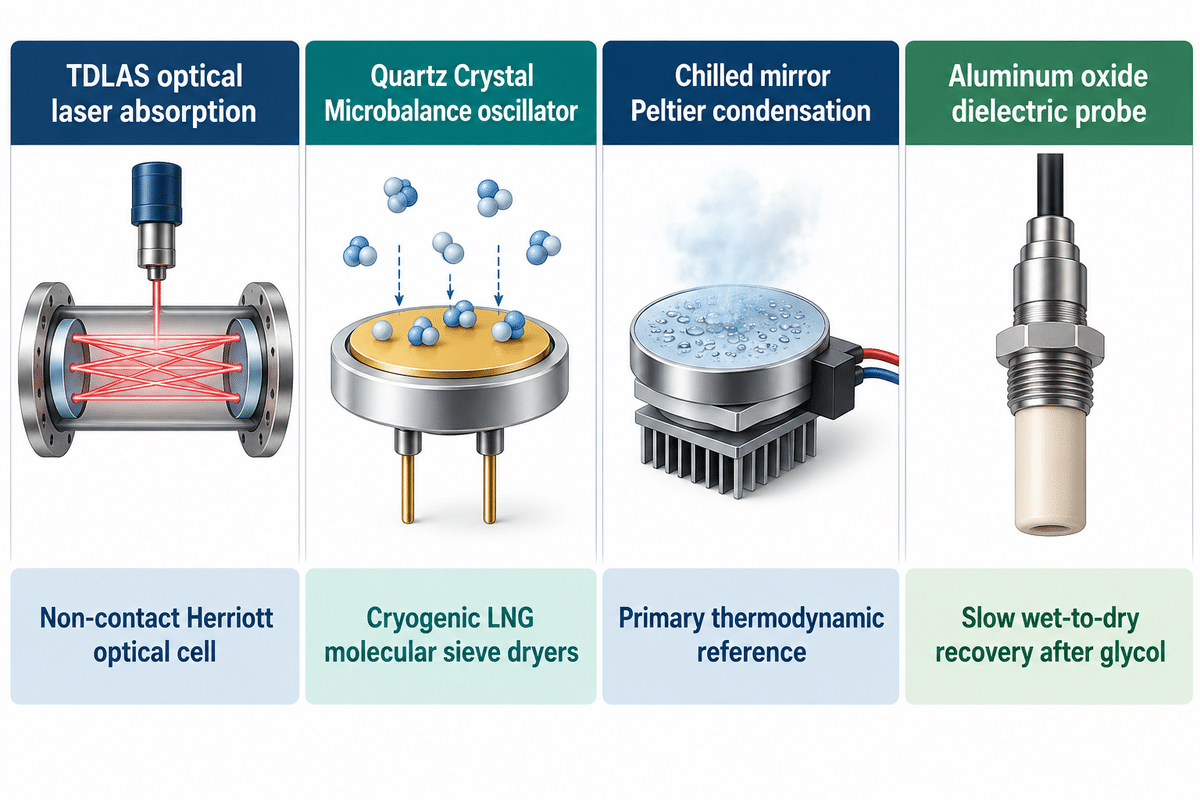
Four moisture measurement technologies serve natural gas pipelines: tunable diode laser absorption spectroscopy (TDLAS), quartz crystal microbalance (QCM), chilled mirror hygrometers, and aluminum oxide (Al2O3) probes. Engineers adapt these measurement techniques to the required lower detection limit, optical response speed and maintenance interval.
Optical gas analysis usage is increasing globally, especially in midstream markets. This is evidenced in several reports by Future Market Insights and data collected by the US EIA. The global market size for TDLAS analyzer for natural gas market is projected to rise from approximately USD 134.7 million in 2025 to USD 142.3 million in 2026. Future Market Insights reports that oil and gas pipelines make up roughly 35% of the total installations in wide range of applications. That said, a single sensor technology does not always correlate to every point on transportation of natural gas.
How the Four Primary Analysis Technologies Work
- Tunable Diode Laser Absorption Spectroscopy (TDLAS): A narrow-linewidth diode laser scans across a near-infrared water absorption peak (1,368 nm, 1,854 nm, or 2,682 nm). The laser beam passes through an optical Herriott cell without contacting the gas stream with an electrode. Consequently, TDLAS technology achieves a <2 second T90 optical response to rapid moisture changes. Specifications for the GESHINE ZS8100-H2O and benchmarks from Panametrics Aurora and Hydrocarbon Processing show a range of moisture measurement from 0.1–2 ppmv to 5,000 ppmv (with ±1% accuracy).
- Quartz Crystal Microbalance (QCM): A hygroscopic polymer coated quartz crystal oscillator alternates between a wet sample gas and a dry reference gas. Adsorption of water onto the quartz crystal shifts its resonant frequency (ΔHz). According to the Michell QMA601 datasheet, a quartz crystal microbalance has a detection limit of 0.02 to 0.1 ppmv (~±0.1 ppmv accuracy below 1 ppmv). This makes QCM the best choice for cryogenic LNG molecular sieve dryers.
- Chilled Mirror Hygrometer: A thermoelectric Peltier cooler chills a polished metal mirror until water vapor condenses on the surface. An optical photodiode bridge detects scattered light and locks the mirror at the exact frost or dew point temperature (±0.1°C to ±0.2°C across -100°C to +20°C). It serves as the primary thermodynamic reference under ASTM D1142.
- Aluminum Oxide (Al2O3) & Silicon Oxide Sensor: An oxide layer between metal electrodes absorbs water vapor molecules in proportion to the partial pressure of water vapor. An aluminum oxide sensor or silicon oxide sensor allows direct insertion up to 450 bar down to -110°Cdp (see the Chemical Engineering inline reports). However, the porous sensor head exhibits slow wet-to-dry recovery (10 to 30 minutes) and drifts after glycol exposure.
| Parameter & Category | TDLAS Analyzer (Optical Laser) | Quartz Crystal Microbalance (QCM) | Chilled Mirror Hygrometer | Aluminum Oxide (Al2O3) / Capacitive |
|---|---|---|---|---|
| Sensing Principle | Near-IR laser Beer-Lambert absorption | Hygroscopic quartz frequency shift (ΔHz) | Peltier optical condensation equilibrium | Dielectric capacitance / impedance shift |
| Measurement Range | 0.1–2 ppmv to 5,000 ppmv (up to 30%vol) | 0.02 ppmv to 2,000 ppmv | -100°C to +20°C dew/frost point | -110°C to +20°C dew point |
| Typical Accuracy | Approximately ±1% or ±1–2 ppmv | ±0.1 ppmv (<1 ppmv) / roughly ±10% | ±0.1°C to ±0.2°C dew point | ±1.0°C to ±2.0°C dew point |
| T90 Response Time | <2 seconds (optical) / 15–30 s (system) | 1 to 3 minutes (switching cycle) | 3 to 15 minutes (thermal stabilization) | 30 s (dry-to-wet) / 10–30 min (wet-to-dry) |
| Calibration Interval | 2 to 5+ years (factory optical lock) | 3 years (built-in permeation verifier) | 6 to 12 months (mirror cleaning required) | 6 to 12 months (sensor exchange program) |
| Best Natural Gas Application | Custody transfer, TEG contactors, sour gas | Cryogenic LNG dryer beds (<0.1 ppmv) | Spot-check referee & calibration validation | Budget fuel gas skids & dry sweet gas |
Selecting a Moisture Analyzer for Sour Gas (H2S), High CO2, Glycol, and Methanol Streams
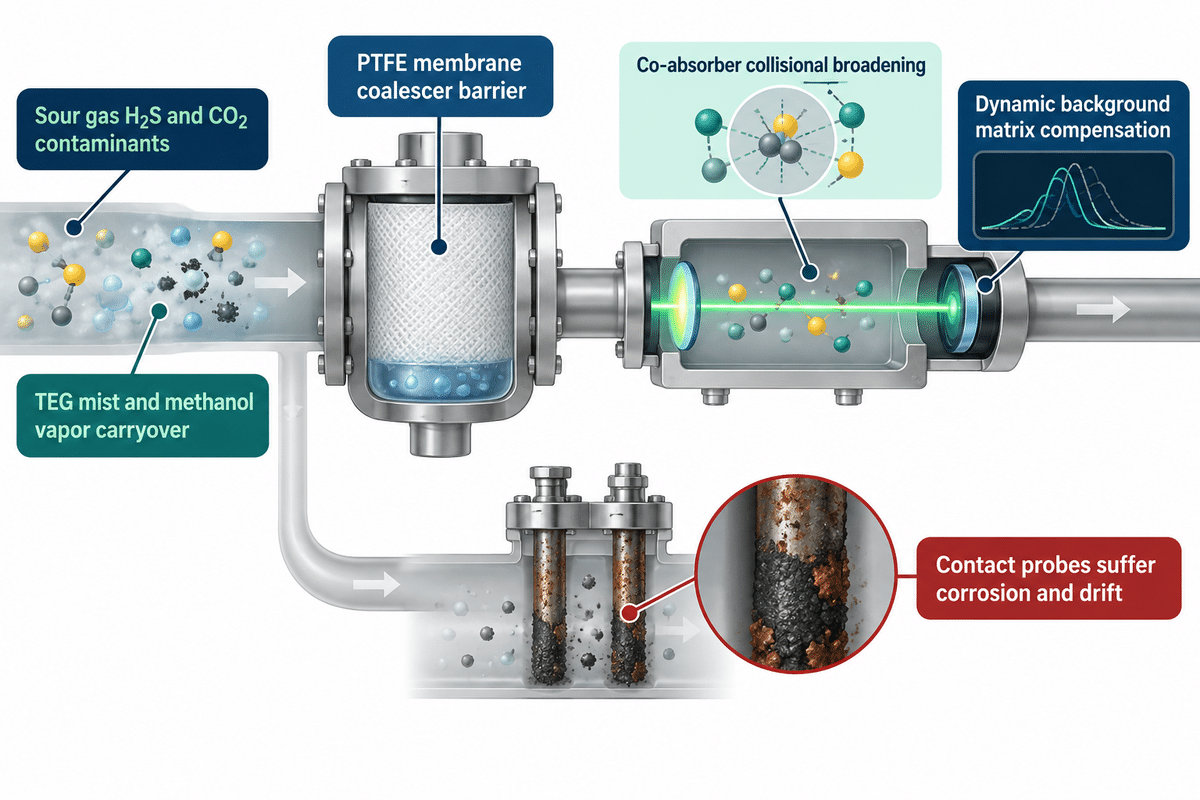
Raw and dehydrated natural gas streams carry hydrogen sulfide (H2S), carbon dioxide (CO2), TEG, and methanol that poison contact moisture sensors. Delivering accurate and reliable moisture readings in these harsh gas mixtures requires non-contact optical TDLAS with matrix compensation and membrane coalescers.
Failure studies from the American School of Gas Measurement Technology (ASGMT) and ChemEurope highlight this risk. Chemical contamination is the top cause of false alarms when operators measure moisture in the midstream gas applications. Specifying a ppm moisture analyzer without auditing background contaminants often ruins contact sensor heads within weeks.
How do you select a moisture analyzer for natural gas when the stream contains sour gas (H2S), high CO2, TEG carryover, or methanol?
Select a non-contact TDLAS moisture analyzer with multi-component differential spectroscopy and a PTFE membrane coalescer. Avoid bare aluminum oxide probes, electrolytic phosphorus pentoxide (P2O5) cells, and uncompensated single wavelength lasers if sour gas, methanol vapor, or glycol mist is present.
A critical spectroscopic detail documented in patent filings (WO2007120931A1 / EP3563138B1) is co-absorber collisional broadening. Vendor brochures often claim that tunable diode laser analyzers ignore gas composition completely. In practice, while tunable diode laser absorption avoids chemical electrode corrosion, neighboring absorbers (CH4, C2H6, and CO2 above roughly 2.5% to 5%) broaden the water absorption peak. When biomethane (RNG) injection or shale blending alters CO2 or H2S levels, uncompensated single-wavelength TDLAS units drift. Specifying dynamic background matrix compensation eliminates this co-absorber bias and tracks real changes in moisture.
The Contaminant Survival & Interference Grid
Use the Contaminant Survival & Interference Grid below to audit how five common pipeline contaminants affect each moisture sensor family across industrial applications.
| Stream Contaminant Category | Typical Pipeline Source | Aluminum Oxide (Al2O3) & Polymer | Chilled Mirror Hygrometer | Quartz Crystal Microbalance (QCM) | TDLAS (With Matrix Compensation) |
|---|---|---|---|---|---|
| Hydrogen Sulfide (H2S) (roughly 10 ppm to 5%) | Sour wellhead gas & amine contactor inlet | Corrodes aluminum/gold pores; permanent span drift | Tarnishes copper/gold mirror unless rhodium/platinum plated | Tolerates low H2S; high sour gas degrades polymer over time | Excellent: Non-contact optical path; wetted 316L/Hastelloy cell |
| High Carbon Dioxide (above roughly 5% CO2) | Acid gas, EOR recycle, biomethane (RNG) | Forms carbonic acid in wet gas; slow response | No spectral error, but alters pressure dew point curve | Requires CO2-specific calibration curve for density shift | Good with Compensation: Requires CO2 collisional broadening firmware |
| Triethylene Glycol (TEG) & Amine Mist | Glycol dehydration tower carryover | Coats porous dielectric layer; requires sensor replacement | Blinds optical detector; requires manual alcohol mirror wipe | Liquid aerosol fouls crystal; requires coalescing membrane filter | High Survival: Tolerates vapor; liquid mist blocked by membrane filter |
| Methanol Vapor (50–1,000 ppmv) | Cold-weather hydrate inhibition injection | Severe Error: High dielectric constant causes false high reading | Co-condenses on mirror, depressed frost point error | Partial polymer co-adsorption spike during methanol slugs | Immune (At Selected Line): Laser tuned to methanol-free water peak |
| Black Powder (FeS / Fe3O4) & Compressor Oil | Pipeline pigging & reciprocating compressors | Clogs sintered guard filter; blinds capacitive pore structure | Scratches mirror surface and blocks optical scatter bridge | Sub-micron particles shift crystal mass if unfiltered | Good: Requires 0.3 µm particulate + coalescing pre-filter |
Sample Conditioning System Design: Heated Pressure Reduction and Joule-Thomson Protection
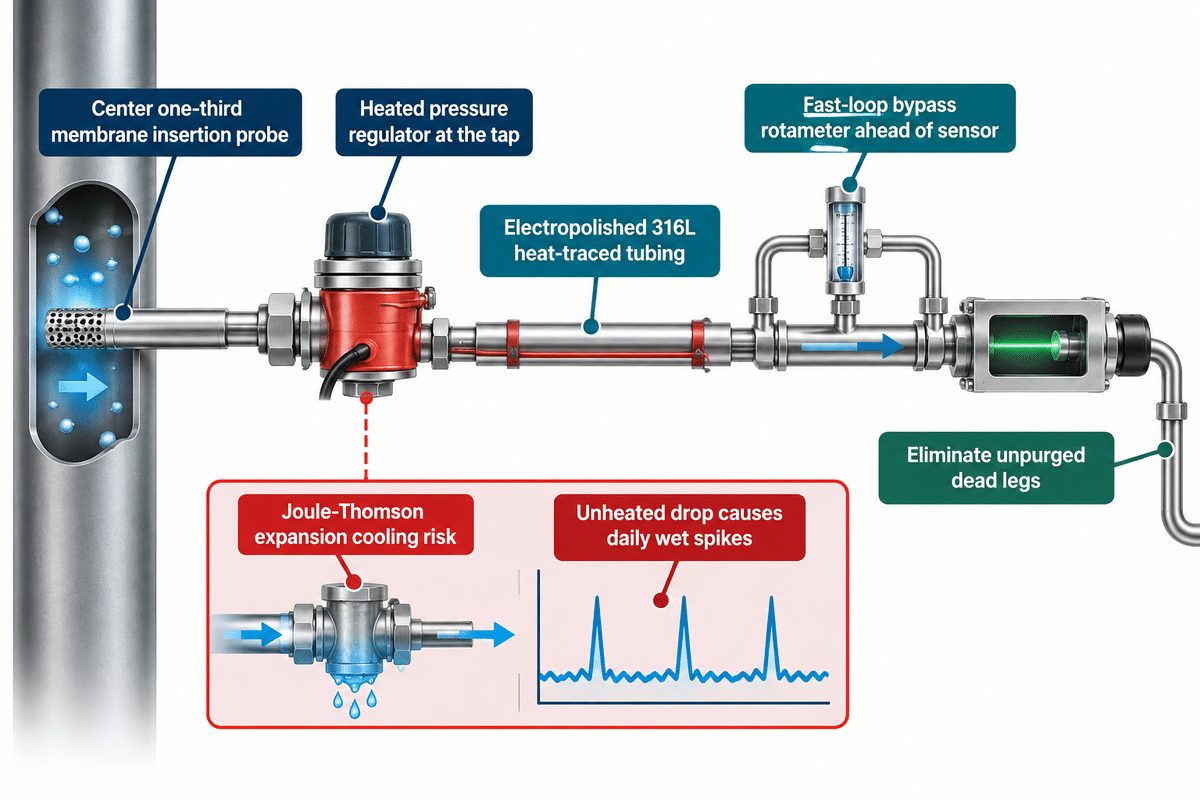
Most field moisture measurement errors – typically estimated to be over 80% by sampling engineers – occur in the sample conditioning system rather than the analyzer electronics. Because natural gas cools sharply during pressure reduction, dropping pipeline pressure causes moisture to condense within the regulator and results in false wet spikes.
The finest process moisture analyzer only measures the gas sample that reaches its optical cell. In high-pressure natural gas pipelines (500 to 1,500 psig), two physical effects corrupt online measurement: Joule-Thomson expansion cooling and wall adsorption.
Why does a 1,000 psig natural gas sample line need a heated pressure regulator at the tap instead of unheated tubing to the analyzer shelter?
Natural gas cools by 0.45°C to 0.55°C per 1 bar (3.1°C to 3.8°C per 100 psi) of pressure drop due to the Joule-Thomson effect. Stepping down 1,000 psig gas to 30 psig without heat drops the gas temperature by 31°C to 37°C, condensing water inside the regulator.
Follow this three-step worked example from ASGMT sampling guidelines and gas sampling patents (US7728978B2):
- Calculate Pressure Drop (ΔP): Pipeline pressure is 1,000 psig (68.9 barg) and the cell runs at 20 psig (1.4 barg). Total pressure drop is ΔP = 67.5 bar (980 psi).
- Calculate Joule-Thomson Cooling (ΔT): With a methane Joule-Thomson coefficient of μJT = 0.50°C/bar, adiabatic cooling equals 67.5 bar × 0.50°C/bar = 33.8°C (60.8°F).
- Compare Against Dew Point: At +5°C (+41°F) winter ambient temperature, unheated gas plunges to -28.8°C (-20°F). Water condenses in the regulator at night and boils off at noon, creating false daily wet spikes.
Four Mandatory Sample System Design Rules
- Install A Membrane Probe + Heated Regulator at the Tap: With a 316L insertion probe, extract the natural gas stream from the center one-third of the pipe. Step pressure down at the nozzle with an electric or steam-heated regulator at +60°C to +80°C. Maintain a gas temperature at least 15°C to 20°C over the water or hydrocarbon dew point.
- Use Electropolished 316L Stainless Steel Tubing Only: Standard drawn stainless steel contains micro-crevices that trap water molecules. Use 1/8-inch or 1/4-inch 316L tubing that’s electropolished to Ra ≤ 0.4 to 0.8 µm, and trace heated to +60°C. For trace moisture detection below 50 ppmv, keep the whole sample path in this electropolished 316L tubing rather than substituting other tubing materials.
- Maintain High Fast-Loop Bypass Velocity: Size the sample system with a 1 to 5 SLPM fast-loop bypass rotameter ahead of the sensor head. This flow keeps residence time through the fast loop under 10 seconds.
- Eliminate Dead Legs & Coalescer Drains: All unpurged gauge tees or stagnant filter bowl bleeds trap moisture in dry gas for days.
Online Process Transmitters vs. Portable Trace Moisture Analyzers for Field Spot-Checking
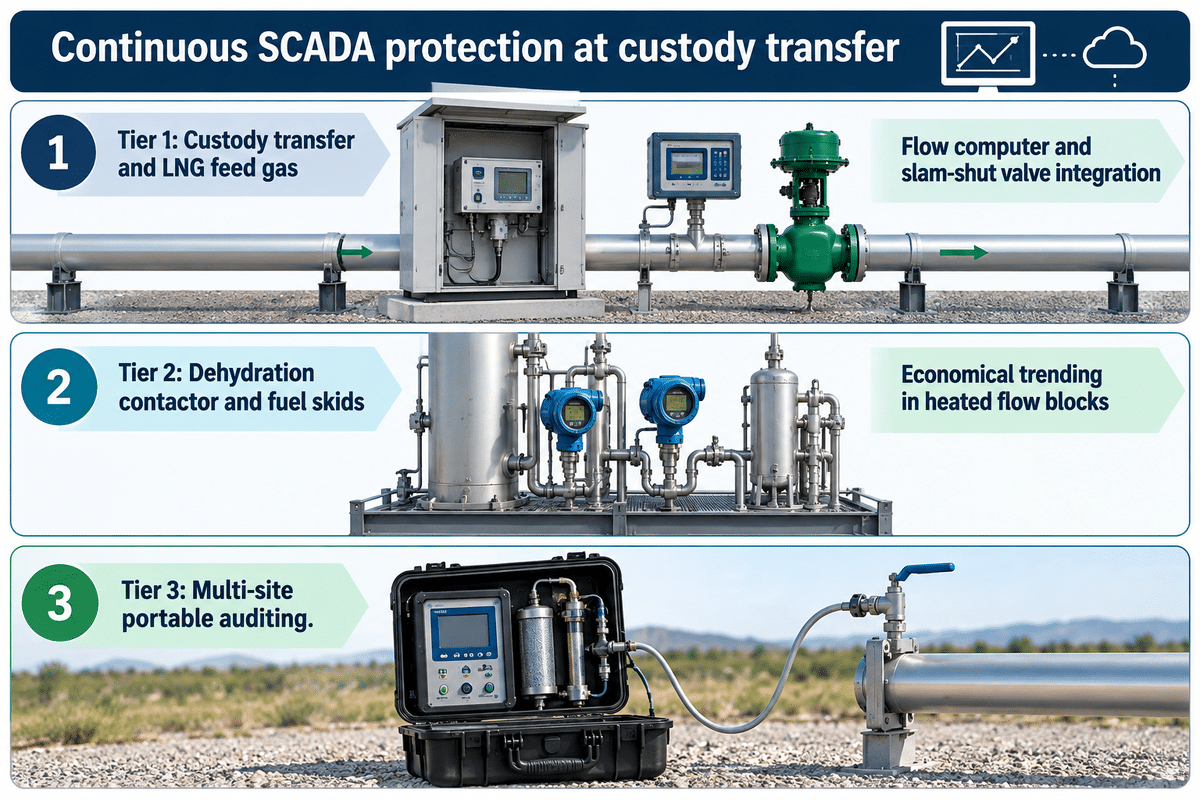
Fixed online moisture analyzers provide continuous 24/7 SCADA protection at custody transfer stations and portable trace moisture analyzers verify remote meter runs and audit transmitters. Most midstream operators run a hybrid fleet with permanent TDLAS cabinets combined with battery powered portable spot checkers.
The 2025 metrology compliance study in MDPI Applied Sciences (2025, 15, 2482) presents operational constraints. Continuous real-time moisture monitoring, with documented uncertainty budgets, is required for custody transfer interconnect stations. Periodic portable spot checks are sufficient for gathering laterals and wellhead separators (ASTM D5454-11 (2020)). Comparing GESHINE online and portable moisture analyzers across TDLAS, P2O5 electrolytic, chilled mirror, and capacitance platforms confirms a -110°C to +20°C dew point range, ≤3 min response, and 4–20 mA / RS-485 Modbus RTU integration.
Matching Stationary vs. Portable Architectures to Pipeline Operations
Engineering teams standardizing industrial gas analyzers across a natural gas pipeline network divide equipment into three deployment tiers:
- Tier 1, Custody Transfer & LNG Feed Gas (Continuous Online TDLAS / QCM): Installed inside a climate-controlled shelter or sunshade rack. The GESHINE ZS8100-H2O online TDLAS analyzer covers a 0.1 ppm to 30 %vol span with a <2 s T90 optical response. It transmits 4–20 mA, RS-485 Modbus RTU, and HART signals to the flow computer for automatic slam-shut valve control.
- Tier 2, Dehydration Contactor & Fuel Gas Skids (Online Explosion-Proof Transmitters): Compact loop-powered Al2O3 dew point transmitters mounted in heated flow blocks. These probes provide economical trending where ±1°C to ±2°C accuracy is sufficient.
- Tier 3 – Multi-Site Auditing & Commissioning (Portable Trace Moisture Analyzer): Technicians use a self-contained portable hygrometer with an internal desiccant to dry down, and an 8-12 hour battery, to audit 10-30 remote taps. GESHINE’S portable series covers -110°C to +20°C, dew point and stabilizes in ≤3 minutes per test point.
Calibration Traceability, Mirror Contamination, and Dry-Down Troubleshooting
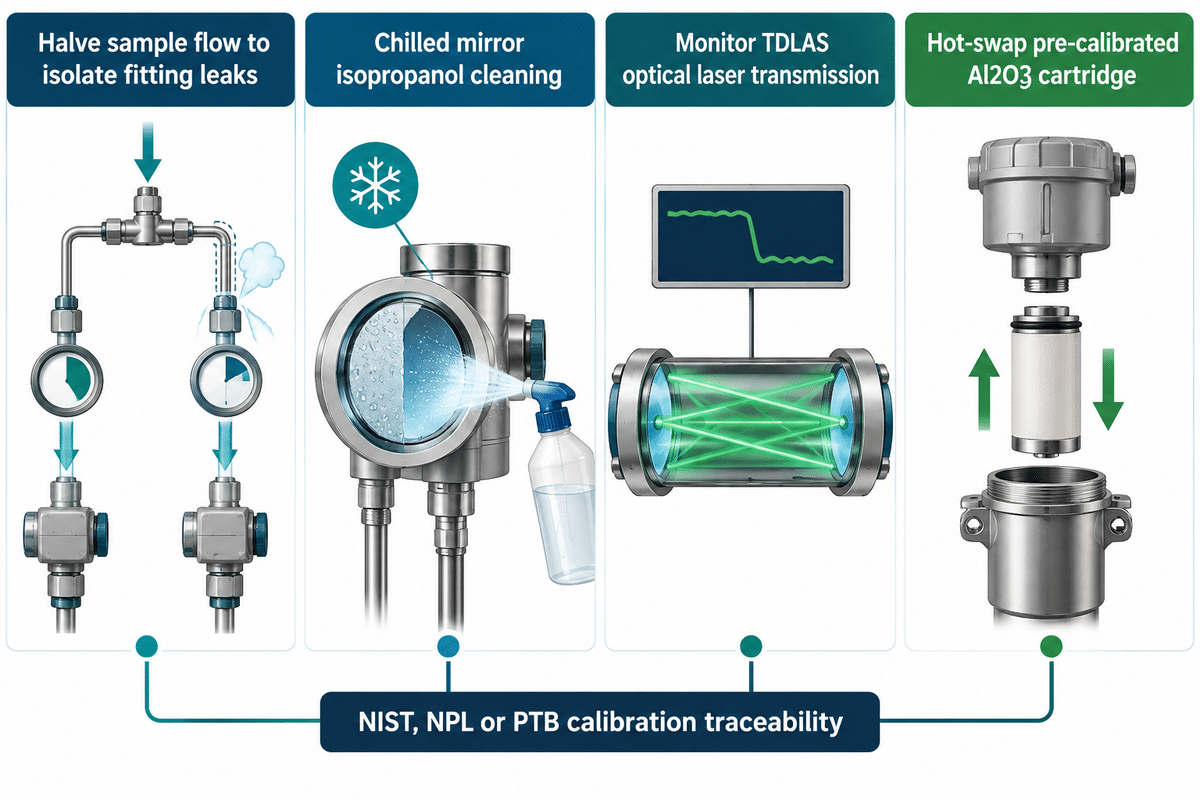
Even a NIST-traceable moisture analyzer will report false wet readings if atmospheric air enters the manifold during maintenance or if glycol coats the sensor. Mastering dry-down purge diagnostics and two-point permeation verification prevents needless sensor swaps and costly pipeline shut-ins.
Under ASTM D5454 and ISO 18453 uncertainty guidelines, every custody transfer hygrometer must maintain unbroken calibration traceability to NIST, NPL, or PTB humidity standards. However, fast optical or capacitive sensors do not always stabilize quickly if the upstream tubing was exposed to ambient humidity.
Step-by-Step Field Dry-Down & Troubleshooting Protocol
- Real Pipeline Wet Gas: Water molecules cling to stainless steel walls via physical adsorption. Opening a fitting in roughly 60% RH ambient air ( ~18,000 ppmv water) requires 4 to 12 hours to purge a 10-meter line down to 5 ppmv . Real wet process gas can be separated from a fitting leak by decreasing the sample flow to approximately 50%. If the ppmv reading doubles when the flow is decreased by 50%, then moisture is leaking through a ferrule or O-ring.
- Resolving Chilled Mirror Hydrocarbon & Glycol Fouling: When a chilled mirror displays unstable hunting or fails its optical balance check, mirror surface hydrocarbon or fouling is likely. Wipe mirror surface with analytical isopropanol on a cotton swab and polish with distilled water.
- Checking TDLAS Optical Transmission (% Laser Power): TDLAS analyzers monitor laser transmission. If transmission drops below roughly 20% – 30% of nominal power, glycol or black powder has bypassed the coalescer. Clean the Herriott cell windows per the hazardous area procedure; factory wavelength lock requires zero field span adjustment.
- Aluminum Oxide Sensor Exchange vs. Permeation Generators: Probes made with Al2O3 experience hydration aging. Keep a pre-calibrated sensor cartridge on site for a hot-swap exchange every 12 months.
Natural Gas Moisture Analyzer Price, Heated Sample Panel Cost, and 5-Year TCO
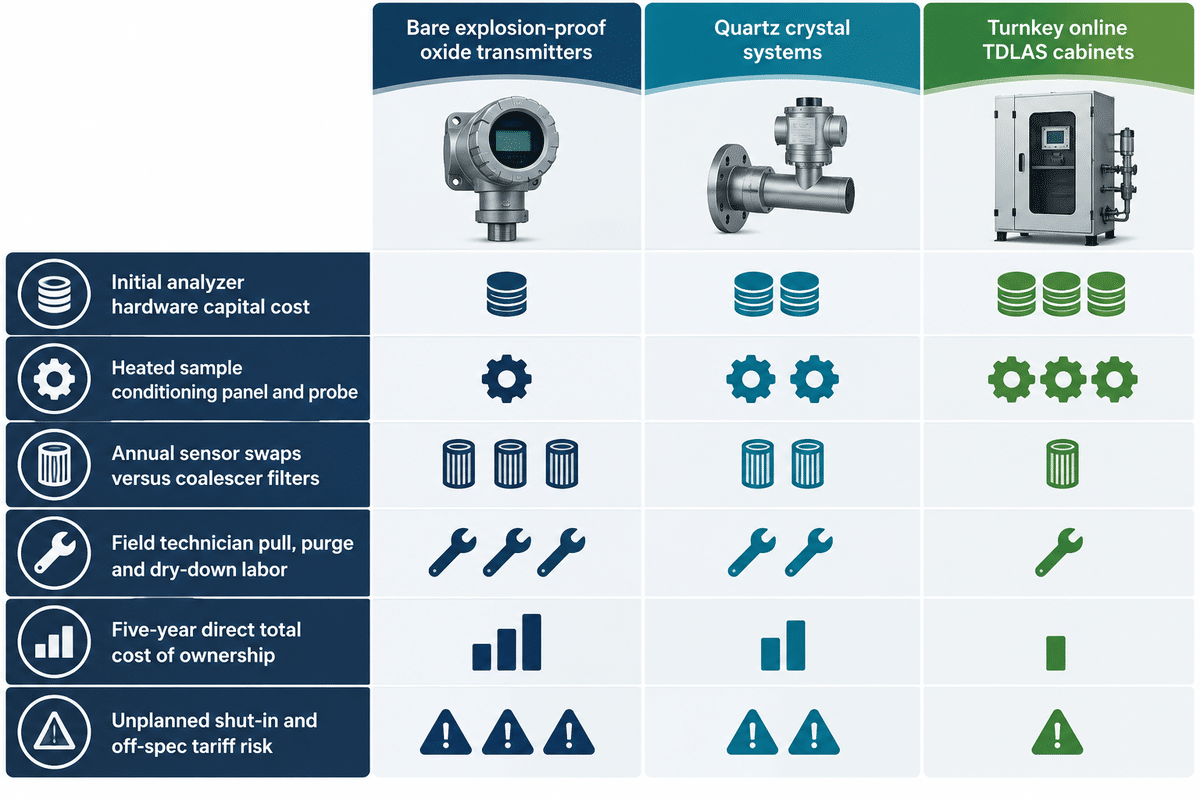
In 2026, a bare explosion-proof aluminum oxide moisture transmitter costs approximately $4,300 to $18,000, while a complete online TDLAS or QCM moisture analyzer with a heated sample cabinet costs around $25,000 to $75,000. Over a 5-year lifecycle, non-contact TDLAS systems often achieve a lower total cost of ownership than low-cost contact probes.
Procurement engineers often notice a large difference between the cost of a bare probe and a turnkey custody-transfer package when reviewing vendor quotes. It has been noted by Process Sensing Technologies and verified by pipeline compliance studies that the process moisture analyzer systems aren’t always quoted with the heated sample conditioning hardware required for 1,000 psig sour gas.
How much does an industrial natural gas moisture analyzer with a heated sample conditioning panel cost, and what is the typical lead time?
A complete industrial natural gas moisture analyzer package including a heated pressure reduction panel and ATEX/IECEx or Class I Div 1 enclosure costs approximately $25,000 to $75,000 in 2026. Factory lead times are approximately 2 to 4 weeks for bare transmitters and 6 to 14 weeks for custom analyzer panels.
Market distributor benchmarks show this hardware split clearly. Entry-level explosion-proof Al2O3 transmitter kits start around $4,300 to $6,100. Portable TDLAS field analyzers list near $35,200, while turnkey online TDLAS systems with sample panels list around $41,551 (and up to roughly $75,000 for dual-channel shelters). On high-pressure dirty gas, the heated regulator, membrane coalescer, heat-traced 316L bundle, and enclosure frequently match the bare analyzer price.
5-Year Total Cost of Ownership (TCO) Comparison Model
These modeled 5-year cost estimates reflect order-of-magnitude North American midstream pricing and will vary with sour gas metallurgy and shelter options:
| Cost Component & Category | Explosion-Proof Al2O3 Transmitter Package | Quartz Crystal Microbalance (QCM) System | Online TDLAS Analyzer + Heated Sample Panel |
|---|---|---|---|
| Initial Analyzer Hardware CapEx | Approximately $4,300 – $12,000 | Approximately $24,000 – $38,000 | Approximately $22,000 – $42,000 |
| Heated Sample Conditioning Panel & Probe | Around $6,500 – $11,000 (often omitted in base quote) | Around $10,000 – $18,000 | Around $10,000 – $20,000 |
| 5-Year Calibration & Consumables (10x / 5x) | Estimated $14,000 – $22,000 (annual sensor swap) | Estimated $6,500 – $11,000 (3-year crystal service) | Estimated $1,500 – $3,000 (coalescer filters only) |
| Field Technician Labor (5 Years @ ~$150/hr) | Roughly $9,000 (60 hrs pull, purge & dry-down) | Roughly $3,000 (20 hrs routine check) | Roughly $1,500 (10 hrs optical inspection) |
| Estimated 5-Year Direct TCO | Approximately $33,800 – $54,000 | Approximately $43,500 – $70,000 | Approximately $35,000 – $66,500 |
| Unplanned Shut-In / Off-Spec Tariff Risk | High (unannounced drift during TEG/methanol slugs) | Low (internal permeation verifier flags drift) | Lowest (<2 s response + optical transmission diagnostics) |
Hazardous Area Certifications (ATEX / IECEx / Class I Div 1) and Manufacturer Shortlist
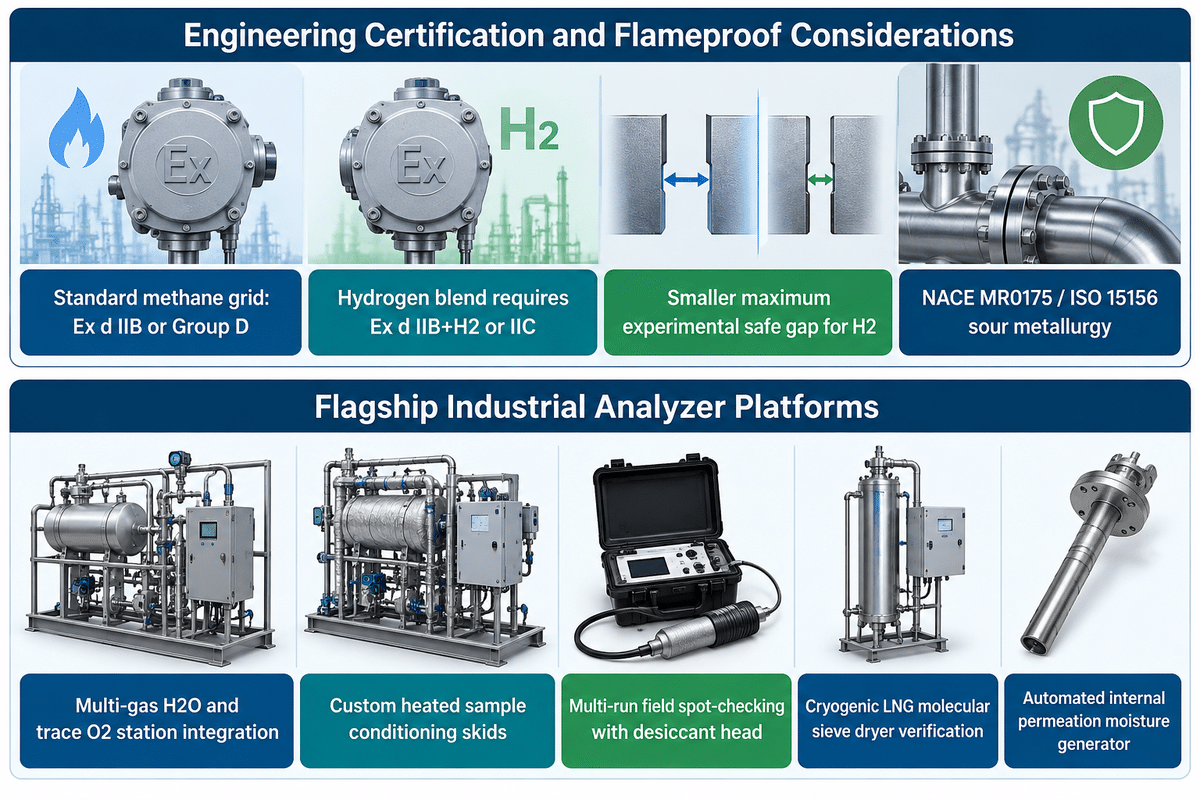
Natural gas moisture analyzers require explosion-proof or flameproof hazardous area ratings, commonly ATEX / IECEx Ex d IIB T4 Gb or NEC Class I, Division 1, Groups C & D. However, pipelines blending roughly 5% to 20% green hydrogen must upgrade enclosures to Ex d IIB+H2 or Ex d IIC (Group B).
Midstream utilities are starting to introduce biomethane and hydrogen into their transmission lines (documented in EIA grid outlook reports and laser spectroscopy patents). As such, engineers need to assess flamepath gaps and multi-gas cross-interference in three areas:
- Standard Methane Natural Gas Grids: Available in IEC 60079-1 Ex d IIB or North American Class I, Div 1, Group D. Loop-powered Al2O3 probes can use Ex ia IIC T4 Ga barriers.
- Hydrogen-Blended Natural Gas (up to 5–20 mol% H2): Hydrogen has a smaller maximum experimental safe gap (0.29 mm) than methane (1.14 mm). Analyzers on hydrogen-blended lines require Ex d IIB+H2 or Ex d IIC (Class I, Div 1, Group B) ratings and NACE MR0175 / ISO 15156 sour-service metallurgy.
- Multi-Gas Station Integration: At biomethane and custody-transfer stations, operators pair their moisture sensor with a trace oxygen analyzer to prevent O2 + H2S + H2O elemental sulfur corrosion. Compressor stations also install a continuous emissions monitoring system (CEMS) analyzer on turbine exhaust stacks.
| Manufacturer | Analyzer Model & Platform | Sensor Type & Category | Primary Pipeline Application Strength |
|---|---|---|---|
| GESHINE | ZS8100-H2O Online Laser Analyzer | TDLAS (0.1 ppm – 30%vol, <2 s T90) | Custom heated sample conditioning skids, fast factory lead time, multi-gas H2O/O2 integration |
| GESHINE | Portable Dew Point & Trace Moisture Series | Chilled Mirror, P2O5 & Capacitive (-110°C to +20°C) | Rapid ≤3 min multi-run field spot-checking with built-in desiccant dry-down head |
| Michell Instruments (PST) | OptiPEAK TDL600 | D-MET TDLAS (1 ppmv lower detection limit) | Shale/biomethane D-MET dynamic compensation & up to 20% H2 blend certification |
| Michell Instruments (PST) | QMA601 & QMA601-LR | Quartz Crystal Microbalance (0.02–2,000 ppmv) | Ultra-trace cryogenic LNG molecular sieve dryer outlet verification |
| Michell Instruments (PST) | Promet EExd & Easidew PRO I.S. | Ceramic Metal-Oxide Capacitive (-110°C to +20°Cdp) | High-pressure insertion up to 450 bar with sensor exchange program |
| AMETEK Process Instruments | 5100 HD / 9900 RM | All-Digital Sealed-Optics TDLAS | Midstream custody transfer & sour gas dehydration tower control |
| AMETEK Process Instruments | 3050-OLV & 3050-TE | Quartz Crystal Microbalance (with internal dryer) | Automated internal permeation moisture generator for field span verification |
| Panametrics (Baker Hughes) | Aurora & Aurora TransPort | Online & Transportable TDLAS (0–5,000 ppmv) | Fast optical response in pipeline transmission and mobile truck-mounted audits |
| Endress+Hauser (SpectraSensors) | J22 TDLAS & SS2100i-1 | Differential TDLAS with Heartbeat Diagnostics | Turnkey glycol contactor & LNG molecular sieve dryer packages |
Flow Computer Integration, Modbus / 4–20 mA Signals, and RFQ Specification Checklist
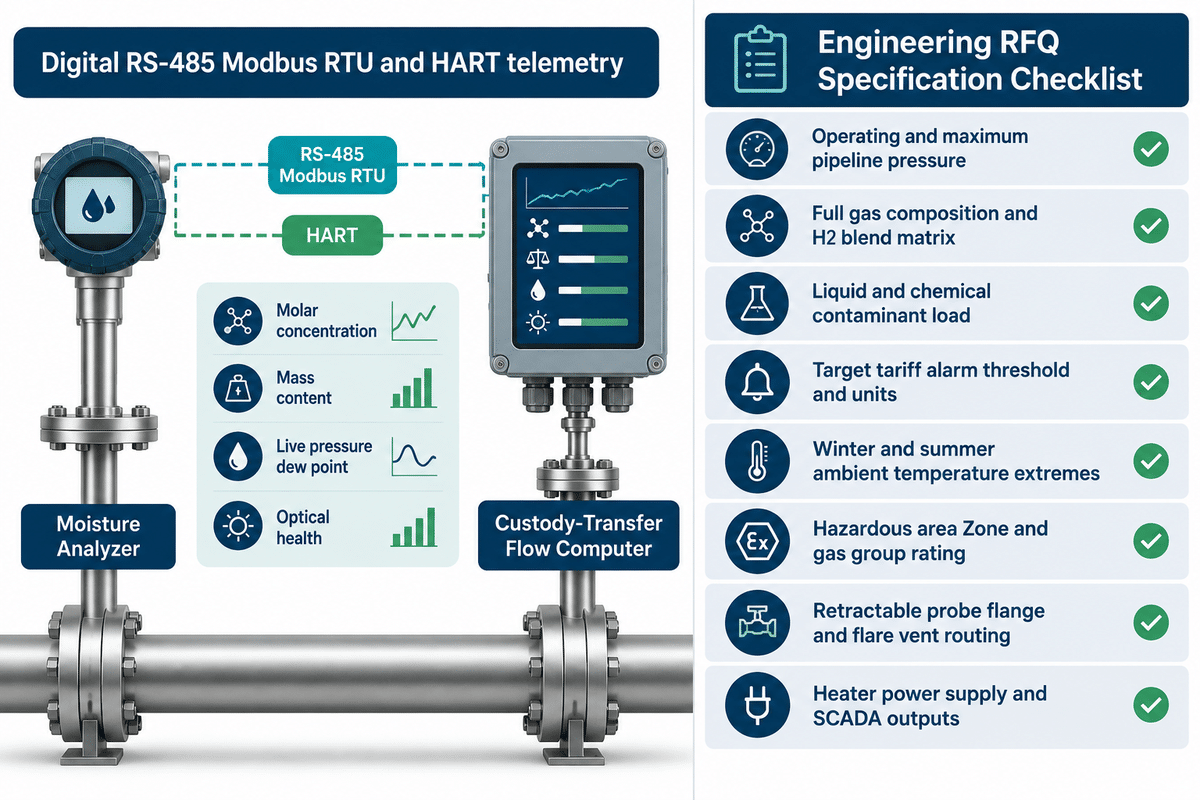
Modern custody-transfer flow computers use digital RS-485 Modbus RTU or HART registers in conjunction with isolated 4-20 mA loops to log ppmv and dew point, and optical health alarms. Including a complete engineering RFQ specification sheet avoids unexpected change orders and undersized sample heaters.
As emphasized in ISO 18453 and 2025 custody-transfer uncertainty studies, analog 4–20 mA loops transmit only one variable and add D/A conversion uncertainty. Polling the analyzer via RS-485 Modbus RTU or Modbus TCP/IP lets the flow computer read molar water concentration (ppmv) and mass content (lb/MMSCF). The SCADA host also logs live pressure dew point (°Cdp), cell temperature, and laser transmission health simultaneously.
Natural Gas Moisture Analyzer RFQ Specification Checklist
Provide the information in the following 8 parameters when requesting a proposal for pipeline moisture analyzer and sample conditioning unit:
- Operating & Maximum Line Pressure: Normal operating pressure ( psig / barg ), shut-in design pressure, and sample cell outlet pressure ( 15–30 psig ).
- Full Gas Composition Matrix (mol%): Normal and upset ranges for CH4, C2H6, C3+, CO2, N2, H2S, and H2 blend percent.
- Liquid & Chemical Contaminant Load: TEG, Amine Mist, Methanol Inhibitor (ppmv), Compressor Oil, and Black Powder.
- Measurement Range & Reporting Units: Target tariff alarm threshold ( 4.0 or 7.0 lb/MMSCF , ppmv , mg/Nm³ , or °Cdp ) and lower detection limit.
- Ambient Temperature Extremes: Minimum winter ambient temperature and maximum summer solar load at the sample tap and analyzer shelter.
- Hazardous Area Classification: ATEX / IECEx Zone 1 or Zone 2 (Ex d IIB, IIB+H2, or IIC) or NEC Class I, Div 1 / Div 2.
- Sample Extraction & Vent Routing: Nozzle flange (1-inch Class 600 RF retractable probe) and sample vent (safe vent vs. flare header).
- Power Supply & Telemetry Interface: Available power (24 VDC vs. 110/230 VAC heaters) and outputs (dual 4-20 mA, HART 7, RS-485 Modbus RTU).
Frequently Asked Questions
What is the maximum allowable water content in pipeline natural gas?
North American transmission tariffs cap water vapor at 4.0 to 7.0 lb/MMSCF (84.4 to 147.7 ppmv). At 1,000 psig line pressure, 7.0 lb/MMSCF corresponds to a water dew point near 0°C (+32°F) under ASTM D1142 and ISO 18453 correlations. Cold-climate Canadian pipelines and European cross-border grids enforce stricter limits of 4.0 lb/MMSCF or -8°C water dew point at 70 bar. Cryogenic LNG feed gas requires dehydration below 0.1 ppmv to prevent ice blockage in heat exchangers.
How often does a natural gas moisture analyzer need calibration?
Calibration intervals are 6 months for aluminum oxide probes, but 3 to 5 years for quartz and TDLAS systems. Aluminum oxides and some polymeric capacitance sensors are impacted by dielectric drift and require an annual exchange of the sensor. Continuous, lock-in wavelength, TDLAS moisture analyzers use an internal reference gas to eliminate wear and consumables. QCM analyzers use an integrated moisture permeator to perform an automated span verification between 3-year factory service intervals.
Can triethylene glycol (TEG) or methanol damage a natural gas moisture sensor?
Yes, liquid TEG coats contact sensors and methanol vapor skews dielectric capacitance probes. Aerosol glycol from a dehydration contactor blinds chilled mirrors and clogs aluminum oxides, requiring either a solvent wash or probe replacement. Methanol injected for winter hydrate inhibition has a high dielectric constant ( εr ≈ 33 ) that mimics water molecules ( εr ≈ 80 ) on oxide sensors, triggering severe false wet alarms. A wavelength-selective TDLAS analyzer paired with a hydrophobic PTFE coalescer protects the system.
What sample tubing material is required for trace moisture analysis in natural gas?
Use 1/8-inch or 1/4-inch electropolished 316L stainless steel tubing with an internal surface Ra of 0.4 to 0.8 µm. Avoid using copper, carbon steel, and nylon tubing because metal oxides trap moisture.
How do you distinguish water dew point from hydrocarbon dew point in natural gas?
Separate water condensation from heavy hydrocarbon condensation by pairing a water-specific analyzer with a dark-spot optical chilled mirror. A basic single-stage chilled mirror reflects light off any liquid film that forms on its cooled surface, whether that liquid is water or C6+ natural gas liquids. Because heavy hydrocarbons condense between 0°C and +15°C and water frosts at -15°C, the unselective chilled mirror will report the hydrocarbon dew point first. A hydrocarbon dew point analyzer uses a conical dark-spot optical trap to capture iridescent films of hydrocarbon. TDLAS and QCM sensors respond to water dew point only. By using these two instruments in conjunction, pipeline operators can isolate heavy hydrocarbon liquids and report water dew point only.
What is the difference between ASTM D5454 and ASTM D1142 for natural gas moisture measurement?
ASTM D5454 governs electronic moisture analyzers using capacitance, QCM, or laser spectroscopy to measure water vapor concentration. ASTM D1142, on the other hand, covers manual Bureau of Mines and automatic chilled mirror condensation hygrometers that measure physical dew or frost point temperature directly. In addition, ASTM D1142 also publishes the empirical IGT Research Bulletin #8 tables that are used in North America to convert measured pressure dew points into lb/MMSCF water content.
Can the same natural gas moisture analyzer be used after hydrogen blending?
Yes, the same natural gas moisture analyzer can be used after hydrogen blending if the enclosure is certified Ex d IIB+H2 or Ex d IIC. Standard Ex d IIB or Class I Div 1 Group D housings violate hazardous area flame path regulations once hydrogen exceeds roughly 5% to 10%.
References & Sources
- International Organization for Standardization (ISO/TC 193). Available at: ISO 18453:2004, Natural gas: Correlation between water content and water dew point.
- U.S. Environmental Protection Agency (EPA). Available at: Environmental Technology Verification (ETV) Report: Pipeline Natural Gas Moisture Monitoring (7.00 lb/MMSCF Tariff Standard).
- Rice University Department of Chemical and Biomolecular Engineering. Available at: High-Pressure Water Content and Thermodynamic Phase Behavior of Sweet and Sour Natural Gas.
- Gas Research Institute (GRI). Available at: GRI-02/0057: Internal Corrosion Direct Assessment of Gas Transmission Pipelines.
- American School of Gas Measurement Technology (ASGMT). Available at: Devices for Field Determination of Water in Natural Gas & Sample Conditioning Practices.
- “Applied Sciences” (MDPI, 2025). Measurement Uncertainty and Compliance Evaluation Applied to Natural Gas Moisture (ASTM D5454, ASTM D1142 & ISO 18453).
- ASTM International. “ASTM D5454-11(2020), Standard Test Method for Water Vapor Content of Gaseous Fuels Using Electronic Moisture Analyzers”.”
- U.S. Energy Information Administration (EIA). Short-Term Energy Outlook: Natural Gas Pipeline Transmission & Market Report (2025–2026).
- World Intellectual Property Organization/ Google Patents. “WO2007120931A1, Laser-Based Spectroscopy Method for Measuring Trace Water Vapor in Hydrocarbon Streams”.
- United States Patent and Trademark Office (USPTO). “US7728978B2, Trace Moisture Analyzer Instrument and Heated Gas Sampling System”.
- Hydrocarbon Processing. “Measuring Water Vapor in Hydrocarbon Streams Using TDLAS and Quartz Crystal Analyzers”.
- Chemical Engineering. “Inline Moisture Measurement Systems for High-Pressure Natural Gas Pipelines”.