
Note: Apart from GESHINE, the companies in this list are presented in no particular order.
Research updated August 2026
Industrial oxygen analyzer manufacturers are companies that design, build, or supply instruments and systems for measuring oxygen in process, combustion, purity, trace-contamination, and workplace-safety applications.
Industrial oxygen analyzer manufacturers do not all sell the same type of equipment. Some design complete online oxygen analyzers, some build trace-oxygen sensors and transmitters, some supply combustion probes or laser instruments, and others integrate several brands into a gas-analysis cabinet. A useful shortlist therefore starts with the measurement duty and supplier type—not with brand recognition alone.
This guide compares 20 manufacturers and suppliers using a consistent industrial-procurement framework. Each profile covers company history, location, supplier identity, principal products, oxygen-measurement technology, advantages, limitations, and an official website shown as plain text. Public information changes, particularly ownership, product availability, certifications, delivery time, and regional service coverage. When a field cannot be supported by reliable current public material, it is marked as not publicly disclosed or as something to confirm directly.
How We Classify Industrial Oxygen Analyzer Suppliers
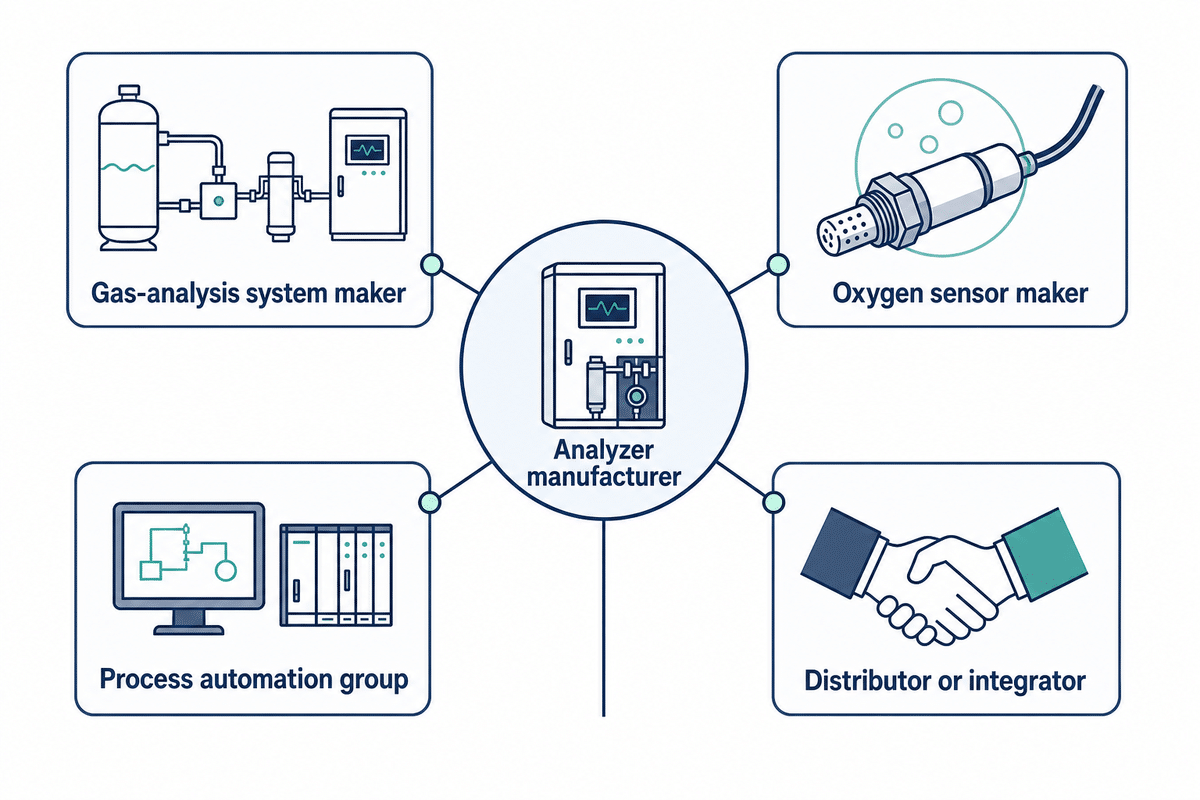
The Analyzer-Origin Taxonomy asks who designs the sensing cell, who builds the analyzer, who engineers the sample-conditioning system, and who carries the warranty. Those answers separate an original analyzer manufacturer from a sensor company, a gas-analysis system house, a broad automation group, or a distributor and integrator.
- Original industrial oxygen analyzer manufacturer: designs complete instruments that measure oxygen concentration under its own brand.
- Gas-analysis system manufacturer: builds multi-gas cabinets, shelters, sample systems, and controls; individual analyzer modules may be made in-house or sourced.
- Oxygen sensor manufacturer: owns the sensing-cell technology and may also package it into transmitters or finished analyzers.
- Process-instrumentation and automation company: offers oxygen analysis inside a much wider control, emissions, and plant-instrumentation portfolio.
- Distributor or system integrator: sells or combines third-party brands. This can simplify a turnkey purchase, but it changes the route for factory support, spares, and warranty escalation.
A group-owned brand is not automatically a distributor. Michell Instruments, Ntron, Systech, Panametrics, and Alpha Omega Instruments have current parent or portfolio relationships yet still represent established analyzer product lines. Conversely, a high Google result can be a multi-brand category page rather than a factory. Ask every bidder to identify the legal contracting entity, original manufacturer, sensor owner, sample-system designer, and warranty provider.
An oxygen deficiency monitor is an ambient safety instrument; it should not be treated as interchangeable with a process oxygen analyzer that measures a controlled sample or an in-situ process stream. For workplace-safety context, OSHA defines an oxygen-deficient atmosphere as less than 19.5% oxygen by volume. That ambient threshold is not a process-analyzer specification.
The 20 Companies at a Glance
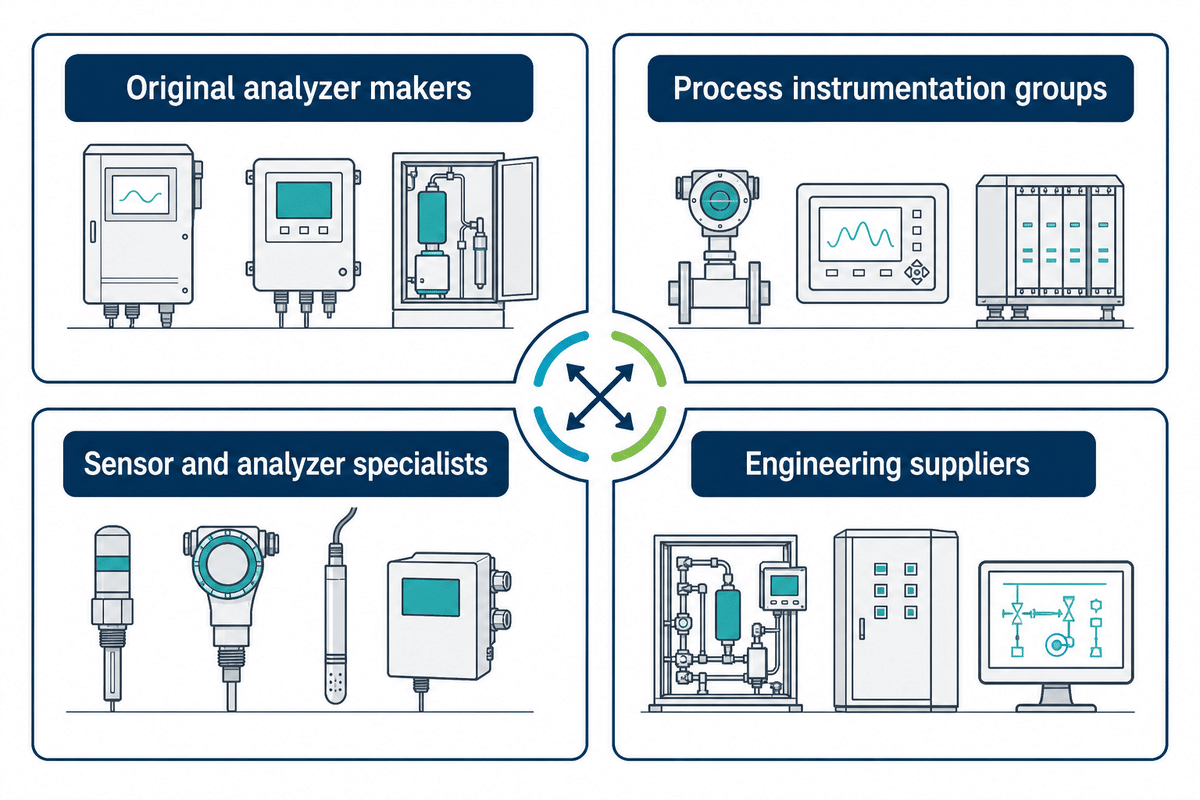
The main procurement risk in a quick comparison is treating unlike suppliers as interchangeable, because a sensor maker, an analyzer manufacturer, and a system integrator carry different responsibilities for the measurement chain.
| No. | Company | Founded / country | Supplier type | Principal oxygen methods | Typical fit | Official website |
|---|---|---|---|---|---|---|
| 1 | Geshine | 2022 / China | Analyzer manufacturer / engineering supplier | Paramagnetic, zirconia, electrochemical; TDLAS feasibility | Online, portable, percent and process O2 | https://geshine.com/ |
| 2 | Servomex | 1952 / UK | Original gas-analyzer manufacturer | Paramagnetic, zirconia, coulometric, TDL | Trace, purity, process and combustion | https://www.servomex.com/ |
| 3 | Yokogawa | 1915 / Japan | Process automation company | Zirconia, paramagnetic, limiting-current, TDLS | Combustion, process and in-situ laser | https://www.yokogawa.com/ |
| 4 | ABB | 1988 / Switzerland | Process instrumentation company | Zirconia, paramagnetic | Combustion and multi-gas process systems | https://global.abb/ |
| 5 | AMETEK Process Instruments | 1979 origins / USA | Analyzer business within AMETEK | Zirconia, TDLAS | Combustion and harsh process gas | https://www.ametekpi.com/ |
| 6 | Teledyne Analytical Instruments | 1946 origins / USA | Sensor and analyzer manufacturer | Micro-fuel-cell, zirconia, paramagnetic | Trace, percent and portable analysis | https://www.teledyne-ai.com/ |
| 7 | Panametrics | Not reliably disclosed | Original analyzer brand; Crane transition | Paramagnetic, coulometric / electrochemical | Process, trace and sample-system projects | https://panametrics.com/ |
| 8 | Michell Instruments | 1974 / UK | Original analyzer brand within PST | Thermo-paramagnetic, zirconia | Process, purity and hazardous-area duties | https://www.processsensing.com/ |
| 9 | Ntron Gas Measurement | 1987 / Ireland | Sensor and analyzer manufacturer within PST | Zirconia, electrochemical | Safety, inerting and process control | https://www.ntron.com/ |
| 10 | Analytical Industries Inc. | 1990 / USA | Oxygen sensor and analyzer manufacturer; DwyerOmega brand | Galvanic electrochemical | Trace, portable and hazardous-area O2 | https://www.aii1.com/ |
| 11 | Nova Analytical Systems | Not publicly disclosed / Canada | Gas-analysis system manufacturer | Electrochemical, paramagnetic, thermal conductivity | Custom cabinets and multi-gas systems | https://www.nova-gas.com/ |
| 12 | Systech | 1983 / HQ not disclosed | Analyzer brand within Industrial Physics | Zirconia, electrochemical / optical by model | Trace, percent and packaging/process analysis | https://industrialphysics.com/brands/systech/ |
| 13 | Southland Sensing | Not publicly disclosed / USA | Sensor and analyzer manufacturer | Electrochemical | Trace, percent, portable and purity | https://sso2.com/ |
| 14 | Advanced Micro Instruments | 1995 / USA | Original analyzer and sensor manufacturer; Enpro company | Electrochemical, zirconia | Trace, percent, deficiency and portable | https://www.amio2.com/ |
| 15 | METTLER TOLEDO | 1945 roots / Switzerland | Process instrumentation company | TDLAS; optical dissolved O2 in adjacent line | In-situ process gas and hygienic analytics | https://www.mt.com/ |
| 16 | Emerson / Rosemount | 1890 group / USA | Process automation company | Zirconia | Combustion and flue-gas oxygen | https://www.emerson.com/ |
| 17 | SICK | 1946 / Germany | Process instrumentation company | Zirconia, laser by product | Emissions, combustion and low-O2 process | https://www.sick.com/ |
| 18 | Siemens | 1847 / Germany | Automation and process analytics company | Paramagnetic, zirconia, laser | Process, multi-gas and plant integration | https://www.siemens.com/ |
| 19 | Fuji Electric | 1923 / Japan | Process instrumentation company | Zirconia, paramagnetic, galvanic, laser | Combustion and process gas systems | https://www.fujielectric.com/ |
| 20 | Alpha Omega Instruments | 1990 / USA | Original analyzer brand within Process Insights | Zirconia, electrochemical | Trace, percent, portable and deficiency | https://www.process-insights.com/alpha-omega-instruments/ |
Companies 1–7: Broad Process and Online Analyzer Portfolios
The selection risk here is overbuying a global platform or under-specifying an analyzer package, because probes, converters, sample conditioning, commissioning, and regional certification may be quoted by different entities.
1. Geshine
Founded: 2022, according to Geshine’s current public site. Country / operating location: Wuhan, China, which the site identifies as its R&D and manufacturing location; the legal headquarters should be confirmed with the supplier. Supplier type: industrial gas-analyzer manufacturer and engineering supplier. Geshine’s current oxygen-analyzer category presents fixed, portable, benchtop, in-situ, and extractive configurations. The public range includes the ZS8100-O2 line and electrochemical, paramagnetic, and zirconia paths, with TDLAS positioned as a project-specific engineering feasibility route rather than a default oxygen SKU.
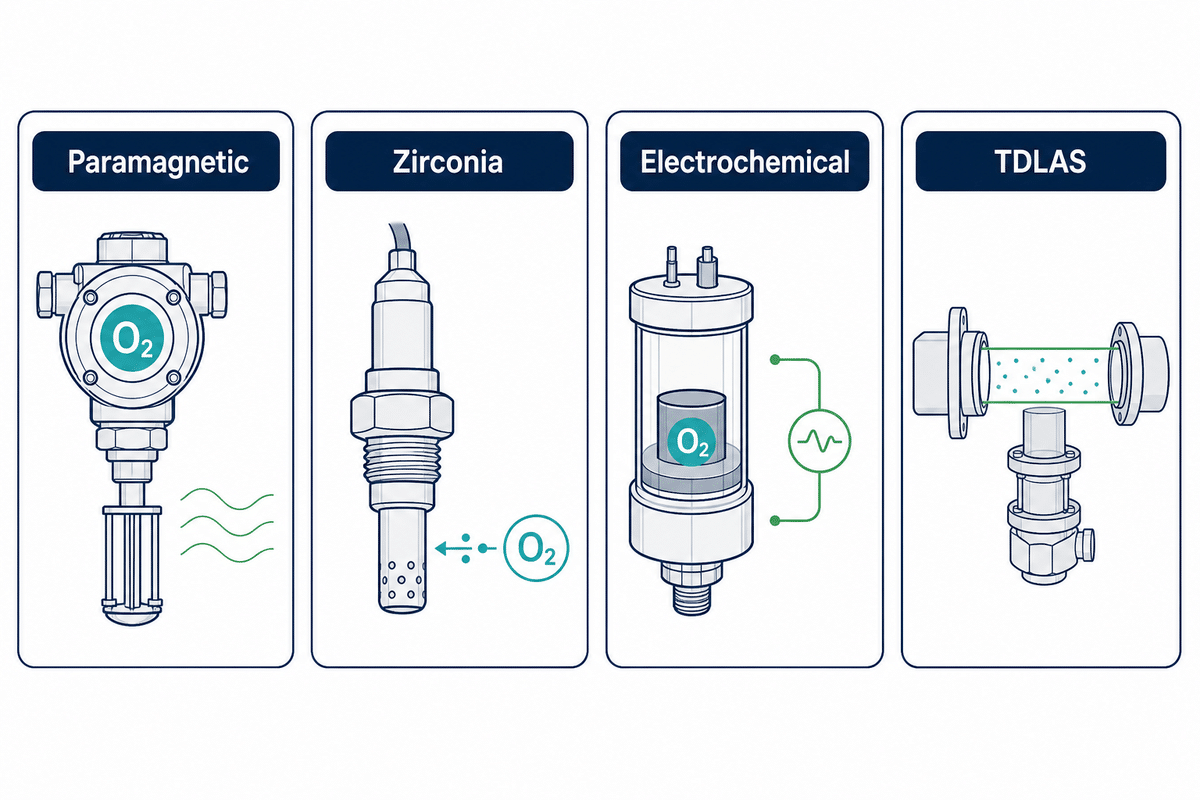
Main products: industrial oxygen analyzers, portable electrochemical O2 analyzers, paramagnetic analyzers, zirconia process instruments, sampling and conditioning systems, and wider gas analysis systems. Technology: paramagnetic measurement uses oxygen’s magnetic susceptibility; zirconia uses oxygen-ion conduction across a heated ceramic cell; electrochemical cells generate a signal from an oxygen reaction; TDLAS is reviewed for suitable project conditions. Advantages: multi-method coverage, application engineering, configurable communications, and potential system-integration flexibility. Limitations / buying considerations: standard MOQ, current lead time, export record by destination, universal warranty terms, service radius, and exact model-level hazardous-area certificates require confirmation. Buyers should also confirm process pressure/temperature/humidity limits, calibration plan, sampling scope, and which published company or product certifications apply to the quoted model. Use the gas analyzer selector for an initial shortlist, then send the application conditions to Geshine for written confirmation.
Geshine official website: https://geshine.com/
2. Servomex
Founded: 1952. Headquarters / country: United Kingdom. Supplier type: original gas-analyzer manufacturer and a Spectris business. Servomex is one of the most specialized companies in the list, with oxygen analysis spanning trace contamination, high-purity gas, combustion, safety, and general process measurement. Representative families include SERVOPRO, SERVOFLEX, and combustion-focused analyzers.
Main products: trace and ultra-trace oxygen analyzers, portable instruments, paramagnetic process analyzers, zirconia combustion units, and tunable-diode-laser systems. Technology: paramagnetic, zirconia, coulometric/electrochemical, and laser absorption methods, depending on the duty. Advantages: deep oxygen-specific application knowledge, multiple principles, and an established international support structure. Limitations / buying considerations: a broad portfolio makes model selection and sample-system definition essential; not every instrument carries the same hazardous-area approvals or communications. Public standard MOQ, live production lead time, and a universal warranty for all regions are not disclosed; confirm the contracting entity, certificate, commissioning scope, spares, and calibration gases for the selected model.
Servomex official website: https://www.servomex.com/
3. Yokogawa Electric Corporation
Founded: 1915. Headquarters: Tokyo, Japan. Supplier type: process instrumentation and automation company that manufactures its own analyzer lines. Yokogawa supplies oxygen instruments as part of a much larger plant measurement, control-system, and digital-operations portfolio. Common product families include zirconia combustion analyzers, compact oxygen analyzers, and TDLS in-situ laser instruments.
Main products: ZR-series zirconia probes and converters, OX-series analyzers, TDLS analyzers, and multi-gas/process analysis solutions. Technology: zirconia, paramagnetic, limiting-current, and tunable-diode-laser absorption. Advantages: strong control-system integration, global project experience, and a route to combine analyzers with distributed control systems and plant service. Limitations / buying considerations: the best-fit product may sit in a regional business unit, and accessories, probes, purge gas, optical path, and validation scope vary substantially. Confirm whether the quote is point in-situ, path in-situ, or extractive; wet/dry basis; SIL or hazardous-area certificate; outputs; local commissioning; lead time; and warranty entity.
Official website: https://www.yokogawa.com/
4. ABB
Founded: ABB was formed in 1988 through the merger of ASEA and Brown, Boveri & Cie. Headquarters: Zurich, Switzerland. Supplier type: process instrumentation and automation company. ABB’s oxygen products sit within Measurement & Analytics and include combustion probes, paramagnetic modules, and modular multi-gas analyzer systems.
Main products: Endura zirconia combustion analyzers, Magnos paramagnetic analyzers, and oxygen modules within EL3000 and Advance Optima systems. Technology: heated zirconia cells for combustion/flue gas and paramagnetic measurement for selective percent oxygen analysis. Advantages: broad automation integration, international service, and the ability to combine oxygen with other gas components in a modular system. Limitations / buying considerations: a group-level corporate capability does not mean every regional office stocks every analyzer or certificate variant. Define the exact module, enclosure, sampling panel, environmental range, approvals, analog/digital interfaces, calibration responsibilities, service SLA, lead time, and warranty. MOQ and current delivery time are quotation-specific rather than reliably public.
Official website: https://global.abb/
5. AMETEK Process Instruments
Founded: AMETEK Process Instruments traces its origins to AMETEK’s 1979 acquisition of Thermox Instruments. Headquarters: Pittsburgh, Pennsylvania, USA, with additional facilities identified by AMETEK in Newark, Delaware, and Calgary, Alberta. Supplier type: original analyzer business and manufacturer within AMETEK. The company is known for combustion and process analyzers used in fired heaters, power generation, refining, and demanding industrial gas applications.
Main products: WDG-series zirconia combustion analyzers, oxygen probes, and TDLAS process instruments. Technology: zirconia electrochemical cells at elevated temperature and wavelength-selective laser absorption. Advantages: strong fit for harsh combustion service, engineered probes, and integration with process-heater optimization. Limitations / buying considerations: installation location, flue-gas temperature, ash, combustibles, insertion length, purge arrangement, and access for probe maintenance can dominate performance. Verify whether the proposal includes a complete probe/controller package, hazardous-area scope, response at the installed path, controls interface, commissioning, spare-cell strategy, current lead time, and regional service. Standard MOQ and a single universal warranty were not publicly disclosed.
Official website: https://www.ametekpi.com/
6. Teledyne Analytical Instruments
Founded: 1946 as Research Instrument Corporation; the Teledyne Analytical Instruments name followed Teledyne’s 1964 acquisition. Operating location: City of Industry, California, USA. Teledyne Technologies’ corporate headquarters is in Thousand Oaks, which should not be substituted for the analyzer business’s operating address. Supplier type: oxygen sensor and analyzer manufacturer within Teledyne Technologies. Teledyne Analytical Instruments is closely associated with proprietary micro-fuel-cell oxygen sensors packaged into trace, percent, portable, and process analyzers.
Main products: portable oxygen analyzers, trace and percent rack/bench instruments, process analyzers, and replacement oxygen sensors. Technology: the selected model may use galvanic micro-fuel-cell electrochemical, zirconia, or paramagnetic measurement. Advantages: sensor-to-instrument ownership, multiple oxygen technologies, and practical portable options. Limitations / buying considerations: electrochemical cells are consumables whose life depends on concentration exposure, contaminants, storage, flow, and temperature, while zirconia and paramagnetic models have different process limits. Never generalize a published sensor life or method limit across models or gas matrices. Confirm the selected method, expected life where applicable, cross-sensitivities, pressure/flow, calibration interval, spare-cell storage, hazardous-area certificate, output options, MOQ, lead time, warranty, and local service.
Official website: https://www.teledyne-ai.com/
7. Panametrics
Founded: not reliably disclosed on the current reviewed transition page. Headquarters: confirm the current business and contracting location. Supplier type: original process-analyzer brand in a corporate transition. Panametrics’ current page identifies the business as part of Crane Company, while legacy Baker Hughes product pages remain online. Buyers should not assume the old parent is the current warranty entity without confirmation.
Main products: XMO2pro paramagnetic analyzers, oxy.IQ and O2.IQ transmitters/analyzers, Delta F trace oxygen products, and engineered sampling/conditioning solutions. Technology: paramagnetic measurement for percent oxygen and coulometric/electrochemical approaches for trace duties. Advantages: process-analysis breadth, trace-to-percent options, and sample-system engineering around the analyzer. Limitations / buying considerations: transition-era web pages can obscure which legal entity quotes, services, and warrants a unit. Confirm the current contracting name, manufacturing location, certificate holder, installed sample-system scope, hazardous-area approval, communications, spares route, delivery schedule, and warranty. MOQ and current regional lead times require a direct quotation.
Official website: https://panametrics.com/
Companies 8–13: Trace-Oxygen and Specialist Analyzer Brands
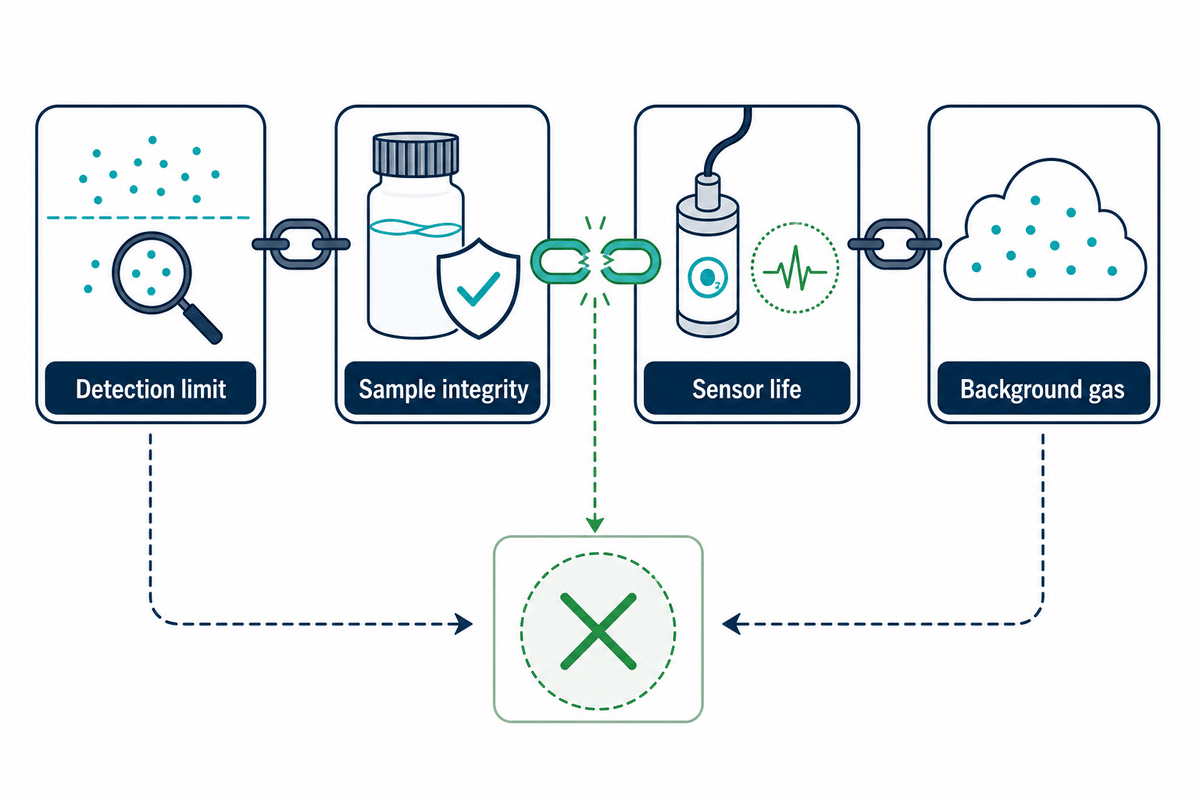
The main trace-oxygen procurement risk is sensor damage or a detection-limit mismatch, because prior oxygen exposure, pressure, flow, moisture, and contaminants can determine both response and cell life.
8. Michell Instruments
Founded: 1974. Headquarters / country: Cambridgeshire, United Kingdom. Supplier type: original analyzer brand within Process Sensing Technologies. Michell is widely associated with moisture measurement, but its process portfolio also includes oxygen analyzers for purity, safety, and industrial control.
Main products: XTP601 process oxygen analyzers, XZR zirconia instruments, and oxygen solutions offered through the wider Process Sensing Technologies portfolio. Technology: selected models use thermo-paramagnetic or zirconia sensing. Advantages: useful combination of oxygen and moisture expertise, hazardous-area capable options, and international channels. Limitations / buying considerations: corporate portfolio pages may route products through different brands, and a hazardous-area certificate can contain counterintuitive exclusions. Confirm enriched-oxygen limitations, zone/gas group/temperature class, sample pressure and flow, moisture tolerance, wet/dry basis, SIL claim, regional calibration/service route, lead time, and warranty. Public standard MOQ is not disclosed.
Official website: https://www.processsensing.com/
9. Ntron Gas Measurement
Founded: 1987. Headquarters: Navan, Ireland. Supplier type: original oxygen sensor and analyzer manufacturer within Process Sensing Technologies. Ntron focuses on oxygen measurement for inerting, gas generation, safety, additive manufacturing, and process control rather than trying to cover every analytical parameter.
Main products: zirconia oxygen analyzers, electrochemical oxygen transmitters and analyzers, SIL-capable products, and process safety monitors. Technology: zirconia and electrochemical sensing. Advantages: concentrated oxygen specialization, compact transmitters, and options aimed at safety and inert-gas applications. Limitations / buying considerations: oxygen-deficiency monitoring, process inerting, and trace contamination are different duties even when the brand serves all three. Confirm measurement range, alarm versus control function, response time at the installed sampling point, sensor life, enriched-oxygen compatibility, exact ATEX/IECEx/SIL documentation, outputs, commissioning, lead time, and replacement-cell availability. MOQ, export terms, and universal warranty require supplier confirmation.
Official website: https://www.ntron.com/
10. Analytical Industries Inc. (AII)
Founded: 1990. Headquarters: Pomona, California, USA. Supplier type: oxygen sensor and analyzer manufacturer and a DwyerOmega brand. AII develops galvanic oxygen sensors and packages them into portable, trace, percent, and hazardous-area analyzers, giving buyers a comparatively direct sensor-to-instrument supply chain.
Main products: GPR-series trace and percent oxygen analyzers, portable units, loop-powered transmitters, hazardous-area analyzers, and replacement sensors. Technology: galvanic electrochemical sensing. Advantages: wide electrochemical range, portable and intrinsically safe/explosion-protected options, and model documentation that exposes practical flow, pressure, calibration, and sensor-life requirements. Limitations / buying considerations: those specifications are model-specific. A GPR-1100 manual cannot define every AII sensor or every competitor’s electrochemical performance. Confirm sample conditioning, allowable pressure, flow control, recovery after air exposure, sensor life in the actual matrix, certificate revision, output, MOQ, lead time, export support, warranty, and calibration service.
Official website: https://www.aii1.com/
11. Nova Analytical Systems
Founded: not publicly disclosed in the reviewed current sources. Headquarters: Hamilton, Ontario, Canada. Supplier type: gas-analysis system manufacturer and a unit of Tenova Goodfellow. Nova’s scope is broader than a single oxygen sensor: it supplies instruments and integrated systems for combustion, industrial gas, heat treatment, steel, and other process applications.
Main products: continuous and portable oxygen analyzers, multi-gas analyzers, cabinets, probes, pumps, coolers, filters, and custom sample-conditioning systems. Technology: electrochemical and paramagnetic oxygen measurement, with thermal-conductivity and other methods in multi-gas projects. Advantages: system-level customization and the ability to combine oxygen with other gases and sampling hardware. Limitations / buying considerations: buyers must identify which modules are Nova-manufactured and which may be integrated third-party components. Request a bill of materials, original manufacturer for each analyzer, responsibility matrix, wet/dry basis, sample-system design conditions, certifications, controls interface, factory acceptance test, commissioning, lead time, export scope, warranty split, and spare-parts route. Standard MOQ is not publicly disclosed.
Official website: https://www.nova-gas.com/
12. Systech
Founded: 1983. Headquarters: not publicly disclosed on the reviewed current brand page. Supplier type: original analyzer brand within Industrial Physics, formerly presented as Systech Illinois. The brand serves trace and percent oxygen applications in process gas, packaging, permeation, and quality-control environments.
Main products: EC900 process oxygen analyzers, ZR800 zirconia analyzers, trace/percent instruments, and adjacent package/permeation analysis equipment. Technology: zirconia and electrochemical or optical approaches depending on the selected line. Advantages: trace-to-percent coverage and useful overlap with packaging and laboratory quality applications. Limitations / buying considerations: distinguish a fixed process instrument from a laboratory or package-testing system, and confirm whether the current product is sold, serviced, and warranted by Industrial Physics or a regional channel. Verify range, detection limit, gas compatibility, flow/pressure, response, calibration, sensor replacement, communications, certificates, MOQ, lead time, export support, and after-sales coverage.
Official website: https://industrialphysics.com/brands/systech/
13. Southland Sensing
Founded: not publicly disclosed in the reviewed current sources. Headquarters: Ontario, California, USA. Supplier type: oxygen sensor and analyzer manufacturer. Southland Sensing specializes in electrochemical oxygen measurement and sells both replacement sensing cells and instruments for trace, percent, purity, and portable duties.
Main products: OMD-series trace and percent analyzers, portable oxygen units, oxygen sensors, and application accessories. Technology: electrochemical/galvanic cells. Advantages: direct sensor and instrument focus, relatively clear application segmentation, and options for industrial gas and inerting work. Limitations / buying considerations: consumable-cell life depends heavily on oxygen exposure, contaminants, sample pressure, temperature, and storage; a low purchase price can be offset by cell and conditioning costs. Confirm cross-sensitivity, cell warranty, expected life in the actual process, calibration-gas requirement, pressure/flow, hazardous-area suitability, analog/digital outputs, MOQ, lead time, export handling, and regional service.
Official website: https://sso2.com/
Companies 14–17: Sensors, Safety and Process-Instrumentation Specialists
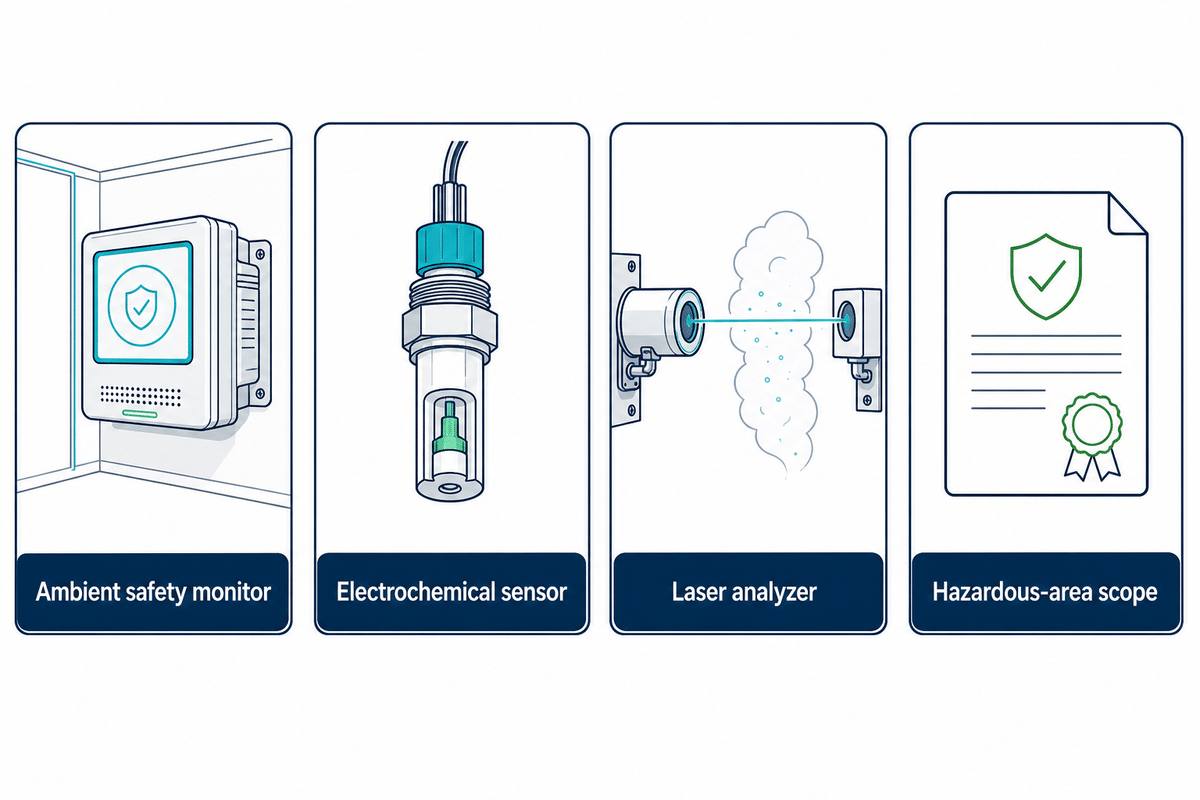
A common risk in this group is confusing ambient safety, process control, and product-quality duties, because each calls for a different sampling arrangement, alarm philosophy, range, response time, and certificate set.
14. Advanced Micro Instruments (AMI)
Founded: 1995. Headquarters: Tustin, California, USA. Supplier type: original oxygen analyzer and sensor manufacturer and an Enpro company following Enpro’s 2024 acquisition. AMI offers one of the clearest publicly organized ranges in this list, separating trace, percent, portable, and oxygen-deficiency products and publishing extensive selection guidance.
Main products: trace oxygen analyzers, percent analyzers, portable units, oxygen-deficiency monitors, and associated sensors. Technology: electrochemical and zirconia methods. Advantages: oxygen specialization, straightforward duty segmentation, and practical educational material for method selection and maintenance. Limitations / buying considerations: first-party sensor-life, calibration, or performance figures still apply to specific AMI models and conditions; do not generalize them across the market. Separate ambient safety monitoring from process-stream analysis. Confirm range, detection limit, cross-sensitivity, sample conditions, alarm/control outputs, certificate scope, replacement-cell plan, MOQ, lead time, export support, warranty, and service location for the exact model.
Official website: https://www.amio2.com/
15. METTLER TOLEDO
Founded: 1945 for Mettler’s roots; the present METTLER TOLEDO corporate combination came later, so buyers should not treat 1945 as the founding date of every current business unit. Headquarters: Greifensee, Switzerland. Supplier type: process instrumentation and analytical company. Its oxygen offering spans process-gas laser analysis and adjacent dissolved-oxygen measurement.
Main products: GPro 500 tunable-diode-laser oxygen analyzers and process-analytics platforms; optical dissolved-oxygen sensors are a separate liquid-analysis category. Technology: TDLAS for process gas and optical fluorescence in the separate dissolved-oxygen line. Advantages: strong hygienic/process analytics background, in-situ or close-coupled laser measurement, and established multinational support. Limitations / buying considerations: do not mix dissolved-oxygen and gas-phase specifications. TDLAS fit depends on optical path, pressure, temperature, background gas, dust, line broadening, purge, and target range. Confirm architecture, wet/dry basis, insertion or path arrangement, hazardous-area approval, communications, commissioning, lead time, regional warranty, and service capability. MOQ is not publicly standardized.
Official website: https://www.mt.com/
16. Emerson / Rosemount
Founded: Emerson group founded in 1890; this is not the founding date of the Rosemount analyzer brand. Headquarters: St. Louis, Missouri, USA. Supplier type: process instrumentation and automation company that markets Rosemount oxygen analyzers. The principal industrial focus is zirconia combustion and flue-gas oxygen measurement integrated with wider plant controls.
Main products: Rosemount 6888A in-situ oxygen analyzers, Oxymitter products, probes, electronics, and combustion-analysis accessories. Technology: heated zirconia oxygen cells. Advantages: strong automation ecosystem, field-repairable probe concepts, and broad plant-service channels. Limitations / buying considerations: group scale does not eliminate application engineering. Probe length, insertion point, fly ash, combustibles, temperature, reference air, calibration hardware, and access determine installed performance. Confirm exact model and accessory bundle, hazardous-area certificate, analog/digital protocol, spare-cell availability, field service response, production lead time, export route, and warranty entity. Public standard MOQ is not disclosed.
Official website: https://www.emerson.com/
17. SICK
Founded: 1946. Headquarters / country: Waldkirch, Germany. Supplier type: process instrumentation and automation company. SICK combines gas analyzers, dust measurement, flow, and emissions-monitoring products, making it relevant where oxygen is one part of a larger process or environmental system.
Main products: ZIRKOR zirconia oxygen analyzers, TRANSIC laser oxygen transmitters, and oxygen modules within broader process/emissions systems. Technology: zirconia and laser absorption, depending on product. Advantages: broad sensing and emissions expertise, integrated systems, and hazardous-area/SIL-capable options in selected lines. Limitations / buying considerations: a combustion probe and a low-oxygen laser transmitter are not substitutes. Confirm target range, architecture, process pressure/temperature, dust and moisture, optical path, wet/dry basis, exact certification, safety integrity claim, integration protocol, local commissioning, maintenance access, lead time, warranty, and spare-parts route. MOQ and universal delivery times require a regional quote.
Official website: https://www.sick.com/
Companies 18–20: Global Automation and Analytical-Instrument Groups
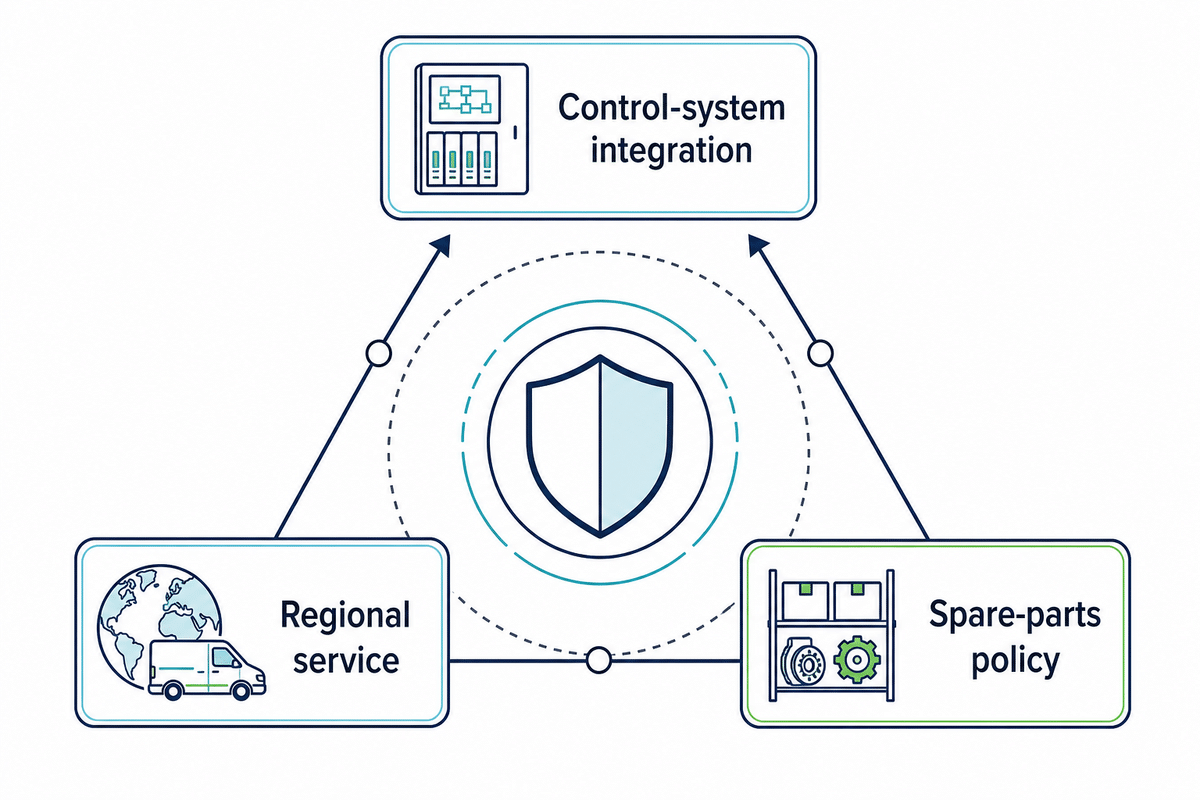
The integration risk is assuming portfolio breadth guarantees local lifecycle support, because product generation, spare-part policy, service responsibility, and hazardous-area options can differ by country and contracting entity.
18. Siemens
Founded: 1847. Headquarters: Munich and Berlin, Germany. Supplier type: global automation and process-analytics company. Siemens offers oxygen measurement through dedicated analyzers and modules within broader extractive and laser gas-analysis systems, with natural integration into plant automation.
Main products: OXYMAT paramagnetic analyzers, Series 6 process analyzers, LDS laser systems, and modular multi-gas solutions. Technology: paramagnetic, zirconia, and diode-laser approaches across the wider portfolio. Advantages: plant-scale controls integration, international engineering channels, and multi-gas system capability. Limitations / buying considerations: portfolio availability and lifecycle status can vary by country and generation. Confirm that the quoted model is current, supported in the destination market, and matched to the required range and architecture. Specify sample panel, shelter, wet/dry basis, certification, communications, cybersecurity/interface requirements, calibration, commissioning, spares, lead time, warranty, and local service. MOQ is not publicly standardized.
Official website: https://www.siemens.com/
19. Fuji Electric
Founded: 1923. Headquarters: Tokyo, Japan. Supplier type: process instrumentation and automation company that manufactures oxygen and gas analyzers. Fuji Electric covers combustion, general process, and multi-component gas analysis and also publishes a useful first-party comparison of oxygen-measurement principles and limitations.
Main products: ZFK8 zirconia detectors, ZKM converters, ZTA analyzers, paramagnetic and laser oxygen instruments, and NDIR multi-gas analyzers with oxygen measurement. Technology: zirconia, paramagnetic, laser absorption, and an optional galvanic electrochemical oxygen sensor in selected current multi-gas analyzers. Advantages: method breadth, combustion expertise, and the ability to combine O2 with other gas components. Limitations / buying considerations: each method has different reference-gas, purge, combustible-gas, consumable-cell, and installation constraints. Confirm the exact principle, target/interference gases, sampling architecture, wet/dry basis, response path, certificates, communications, calibration traceability, lead time, export documentation, warranty, and service. Public MOQ is not reliably disclosed.
Official website: https://www.fujielectric.com/
20. Alpha Omega Instruments
Founded: 1990 by Richard Buonauito and Stanley Hayes. Headquarters: Lincoln, Rhode Island, USA. Supplier type: original analyzer brand and manufacturer within Process Insights. Alpha Omega has a focused portfolio covering trace, percent, portable, transmitter, and oxygen-deficiency duties, making it a better-documented industrial fit than a generic oxygen-principle source without a current process product line.
Main products: ZRO 2000 zirconia analyzers, Series 3000 and 3500/3510 trace instruments/transmitters, Series 2000 percent analyzers, Series 2520 and 3520 portable units, OXY-SEN, and Series 1300 deficiency monitors. Technology: zirconia and electrochemical sensing across different models. Advantages: broad trace-to-100% product segmentation and safety-monitor options within one specialist brand. Limitations / buying considerations: keep ambient deficiency monitoring separate from process-stream analysis and confirm whether the quotation comes from Alpha Omega, Process Insights, or a regional channel. Verify sensor life, gas compatibility, pressure/flow, calibration, certificate, outputs, MOQ, current lead time, export support, warranty, and after-sales service; these commercial fields are not universally disclosed on the reviewed brand page.
Official website: https://www.process-insights.com/alpha-omega-instruments/
Match the Oxygen Measurement Method to the Duty
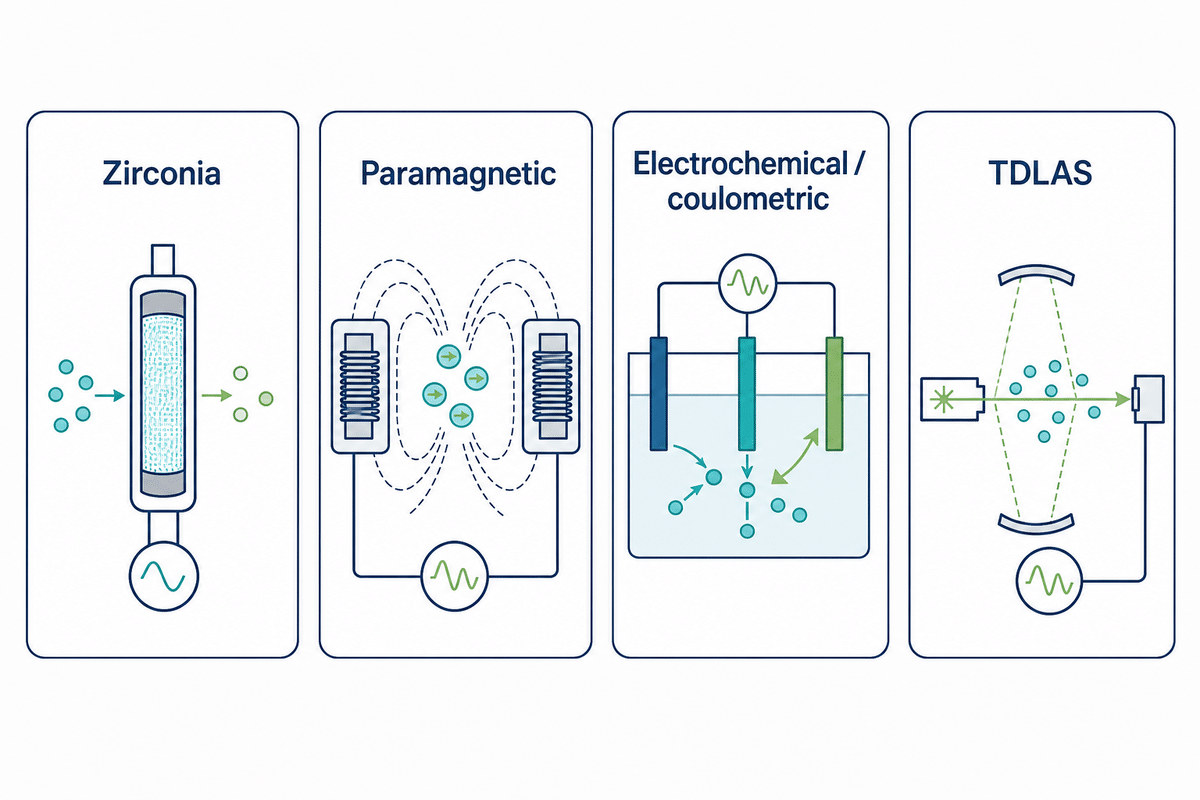
The best oxygen analyzer depends on concentration range, background gas, process temperature and pressure, humidity and particulates, response target, calibration system, maintenance tolerance, and sampling architecture. Sensing principle alone cannot decide fitness: an extractive system, point in-situ probe, and path in-situ laser may behave differently even when all report oxygen accurately under their specified conditions.
For a general explanation of analyzer types, see Geshine’s industrial oxygen analyzers. This section is limited to translating measurement principles into supplier-verification questions for a manufacturer shortlist.
| Method | Useful duty | Strength | Main limitations | RFQ questions |
|---|---|---|---|---|
| Zirconia | Combustion, flue gas, percent O2; some trace designs | Fast, durable, suitable for direct probes | A heated zirconium dioxide ceramic cell; combustible gases and reference conditions can affect interpretation | Cell temperature, reference air, fuel-gas limits, probe material, calibration access? |
| Paramagnetic | Stable percent O2, purity, process control | Selective physical property; no consumable electrochemical cell | Sensitive to pressure, flow, vibration and some matrix effects by design | Pressure compensation, flow control, mounting vibration, sample conditioning? |
| Electrochemical / coulometric | Trace, percent, portable and safety instruments | Compact, sensitive, often cost-effective | Finite cell life, cross-sensitivity, exposure and storage effects | Expected life in this matrix, recovery after air, interference, spare-cell warranty? |
| TDLAS | Fast selective in-situ or close-coupled process analysis | No extracted sample in many configurations; selective wavelength | Optical path, dust, pressure/temperature broadening, purge and alignment | Path length, line selected, pressure/temperature compensation, purge, validation? |
Architecture matters: extractive analyzers transport gas through a probe, line, pressure control, filter, cooler or other conditioning before it reaches the cell. That creates leak, plugging, condensation, delay, and sample-alteration risks; an industrial measurement reference on analyzer sample systems treats this hardware as a separate measurement layer. Point in-situ probes avoid much of that transport path but still face insertion location, dust, temperature, calibration access, and material compatibility. Path in-situ lasers add alignment, optical-path averaging, and purge questions. Specify whether reported oxygen is on a wet or dry basis.
Safety duty matters too: an ambient oxygen-deficiency monitor protects personnel in a room, while a trace analyzer checks contamination in a process stream and a combustion analyzer controls excess air. They may share an electrochemical or zirconia principle but not range, alarm logic, certification, sampling, uncertainty, or response requirements. Never compare them as interchangeable products.
Write the required units into the inquiry. One project may need a 0–1 ppm trace range, another a 0–25% process range, and another a 4–20 mA output with gas below 40°C and sample pressure below 2 bar. Those figures are examples, not universal limits; their purpose is to show why a supplier cannot select a model from the phrase “oxygen analyzer” alone.
Translate Search Language into Measurable Requirements
Search phrases such as oxygen level, levels of oxygen, oxygen content, concentration of oxygen, amount of oxygen, level oxygen, and oxygen levels within describe a quantity but not a complete duty. In an RFQ, replace them with the normal, minimum, maximum, and upset oxygen gas concentration in ppm or percent oxygen, state whether the instrument is used to measure a wet or dry sample gas, and define the gas stream, background gas concentrations, pressure, temperature, and response target for continuous oxygen measurement.
At the low end, phrases such as trace levels of oxygen, ppm oxygen, low parts per million, parts per billion, and measurements down to low levels are incomplete unless they include a detection limit, quantification basis, recovery after air exposure, and test conditions. Searches for an instrument that “measures oxygen in ten ppm” or works with “oxygen in ten ppm ranges” should be converted into a numeric normal range, alarm point, accuracy, repeatability, drift, and response requirement.
At the percent level, percent levels of oxygen still require a defined span. A phrase such as “0 to 25 percent” does not say whether the buyer needs an oxygen transmitter, oxygen detector, portable oxygen unit, or process analyzer. State what must measure oxygen concentration, where monitoring of oxygen levels occurs, whether the device is capable of measuring an upset condition, and which analog, relay, or digital outputs the control system needs.
The measurement technology must follow the matrix and duty. A zirconia oxygen analyzer uses a heated zirconium oxide electrolyte and a zirconia sensor; a paramagnetic oxygen instrument uses oxygen’s magnetic susceptibility; an electrochemical sensor produces a reaction-based signal; and a laser analyzer uses wavelength-specific absorption. These types of oxygen analysis have different pressure, temperature, interference, calibration, and maintenance questions. Marketing phrases such as accurate oxygen, reliable oxygen, highly reliable, accurate and reliable, highly accurate oxygen measurements, accuracy and reliability, “oxygen analyzers provide,” or “analyzers offer” are not substitutes for model-level test conditions.
Industrial applications include combustion and flue gas at a boiler, natural gas and other gas mixtures, inerting, gas plants, product quality, and process control across many industrial processes. The relevant industrial oxygen or process oxygen method may need high temperatures, while portable oxygen and other gas applications may use a conditioned extractive sample. Phrases such as oxygen and combustion, combustion efficiency, wide range of applications, or wide range of industries identify a topic, not a specification. Medical gas equipment appears in some search results but sits outside the industrial process scope of this list.
Some search results also contain vague or truncated claims such as “accurate oxygen measurements for widespread,” “oxygen measurements for widespread use,” “use in harsh environment industrial,” “harsh environment industrial and oil,” and “widespread use in harsh environment.” Do not copy those fragments into a purchase specification. To choose the right analyzer, state the actual harsh-environment limits, enclosure and hazardous area, installation conditions, gas measurement basis, required product certification, and how the analyzer must be installed and maintained.
Send a Comparable RFQ with the O2 Bid-Scope Normalizer
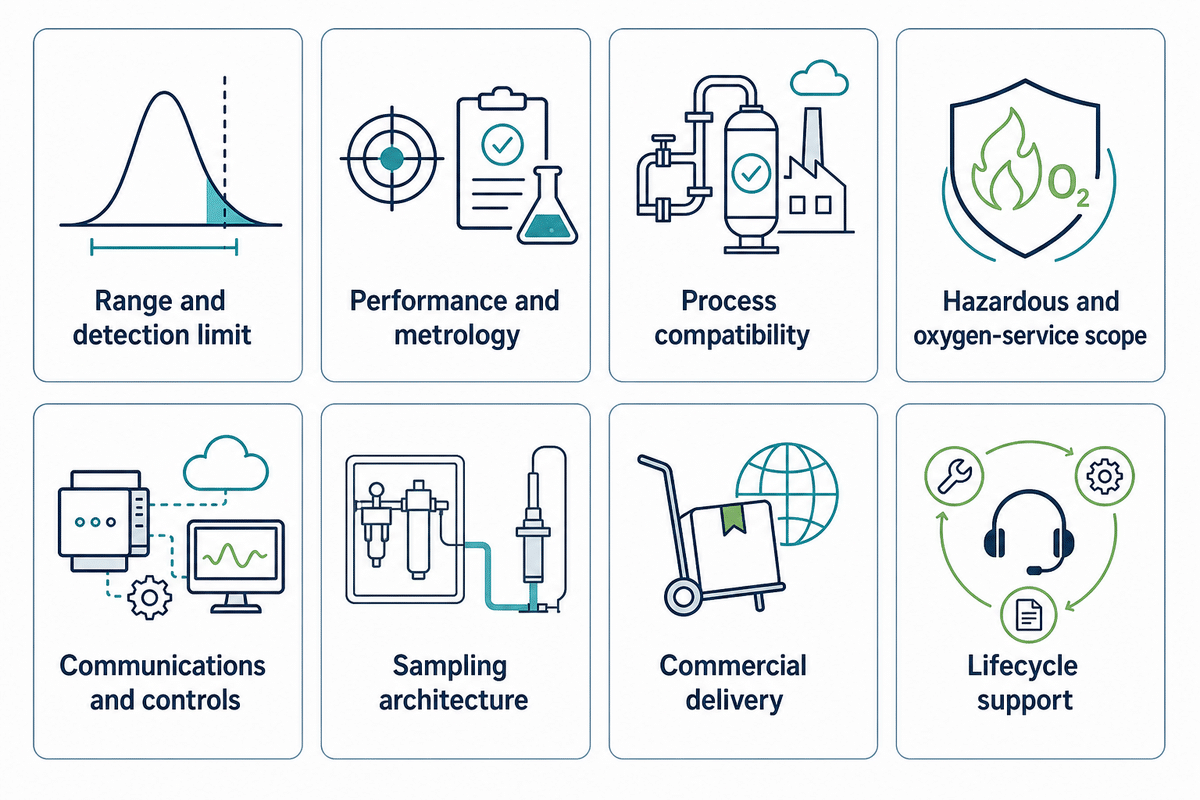
A comparable oxygen-analyzer RFQ defines the range, performance, process conditions, safety scope, communications, sampling architecture, commercial delivery, and lifecycle service. Suppliers can answer through a proposal, datasheet, certificate, or written exception; the point is to compare complete scope, not to force every procurement system into one template.
| Field | What to state | Evidence to request | Common hidden scope |
|---|---|---|---|
| 1. Range and detection limit | Normal, minimum, maximum and upset O2; ppm or %; wet/dry basis | Model datasheet and selected range code | Autoranging, recovery after air, dilution |
| 2. Performance and metrology | Accuracy, repeatability, response, drift, allowable uncertainty | Test conditions, calibration-gas composition/traceability, acceptance criteria | Sample transport delay and system uncertainty |
| 3. Process compatibility | Temperature, pressure, humidity, particulates, condensables, corrosives and background gases | Written suitability statement and wetted-material list | Pressure regulation, heated line, filter, cooler, purge |
| 4. Hazardous and oxygen-service scope | Zone/division, gas group, temperature class, market and installation method | Current model certificate and schedule | Barriers, enclosure purge, enriched-oxygen material limits |
| 5. Communications and controls | 4–20 mA, relays, Modbus, Ethernet, HART or other required protocol | I/O map and integration responsibility | Gateway, PLC/DCS programming and alarm testing |
| 6. Sampling architecture | Extractive, close-coupled, point in-situ or path in-situ | Flow diagram, response calculation and responsibility matrix | Probe, line, pump, condensate handling, alignment, shelter |
| 7. Commercial delivery | Quantity, MOQ, price basis, Incoterm, lead time, documentation, FAT, commissioning and training | Line-item quotation and delivery milestone plan | Export packing, certificates, site labor and travel |
| 8. Lifecycle support | Calibration interval, sensor life, spares, warranty, service radius and response SLA | Recommended spare list, warranty terms and named service contact | Consumable cells, calibration gases, obsolete parts and return-to-factory time |
Calibration evidence should identify the reference chain, not merely say that an instrument is “calibrated.” The NIST policy on metrological traceability explains that traceability belongs to a measurement result and depends on a documented, unbroken calibration chain in which each step contributes to measurement uncertainty. For a bid, ask who owns that chain, which standards and gases are used, and what uncertainty applies at the stated range.
The official IECEx standards index reinforces why selection, installation, use, maintenance, and analyzer-house protection must be considered separately. A company-level statement such as “ATEX available” or “explosion-proof analyzer” is not enough. Match the certificate to the exact model, zone, gas group, temperature class, accessories, and destination market.
What a Manufacturer List Cannot Decide for You
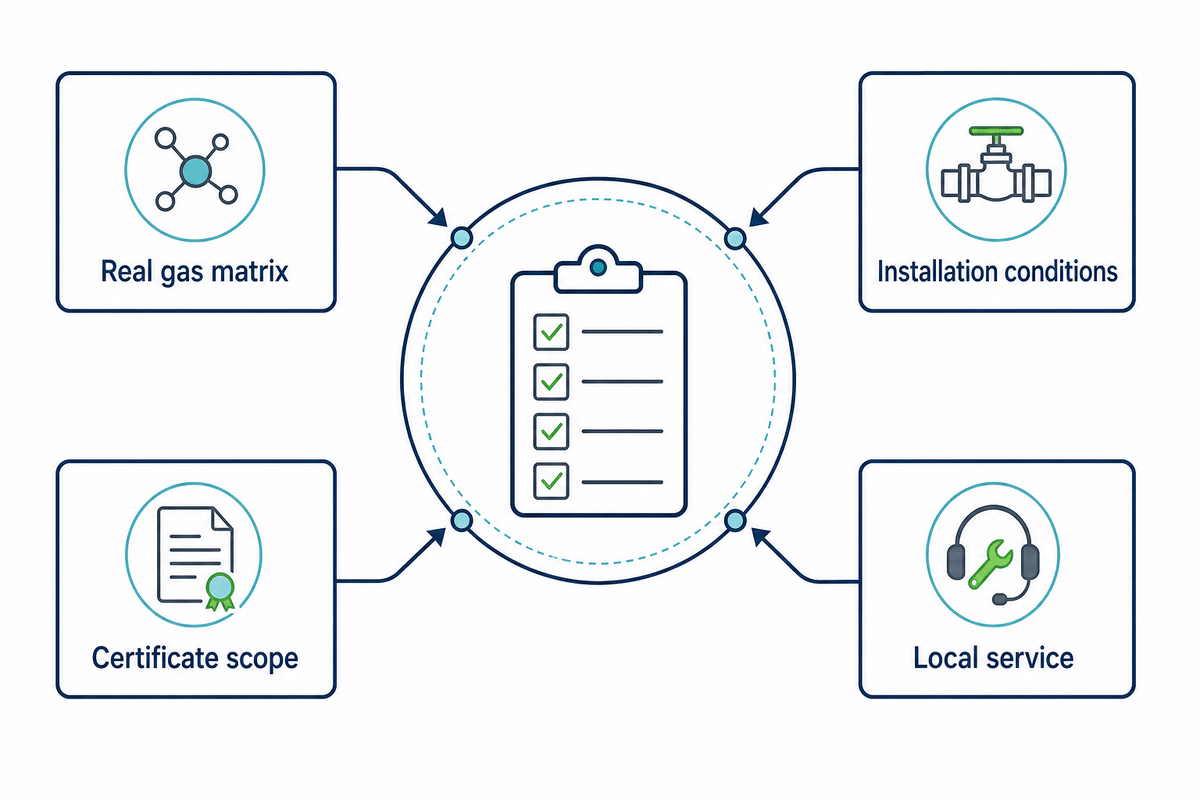
A manufacturer list can narrow the market, but it cannot qualify an analyzer against an undisclosed process. Stop and request an application review when the sample is wet, dirty, corrosive, pressurized, oxygen-enriched, combustible, or compositionally variable. Require current certificate copies when the analyzer or sample system enters a hazardous area. Require a responsibility matrix when an integrator, analyzer OEM, sensor company, and controls contractor share the project.
For trace work, request recovery behavior after air exposure and a written interference review. For combustion, define insertion location, ash, reference air, and access. For laser systems, define path length, pressure, temperature, purge, and alignment. For electrochemical instruments, define cell chemistry, expected exposure, storage, and replacement plan. Finally, compare total installed scope—not just the analyzer price. If you are also procuring multi-component emission systems, use a separate CEMS supplier evaluation because certification, data acquisition, and stack-testing responsibilities extend beyond a single oxygen channel.
Frequently Asked Questions
What technology evidence should an industrial oxygen analyzer manufacturer provide?
Ask for a selected-model datasheet that names the sensing principle and architecture, plus test conditions for range, accuracy, repeatability, response, interference, calibration, sensor life, and certificate scope.
The manufacturer should identify whether the selected model uses zirconia, paramagnetic, electrochemical or coulometric, or tunable-diode-laser measurement and whether the installed architecture is extractive, point in-situ, path in-situ, portable, or ambient safety. Request model-specific evidence for the stated range, detection limit, background gases, wet or dry basis, pressure, temperature, humidity, particulates, corrosives, response, calibration uncertainty, maintenance access, and certification. The evidence should name important background components such as carbon dioxide, hydrocarbons, hydrogen, or solvent vapor when they are present, because the gas matrix can change interference and material-compatibility limits. It should also distinguish analyzer response from total system response and identify who supplies the probe, pressure control, filtration, cooler, purge, optical alignment, or other conditioning. General method descriptions help with screening, but they do not prove that a specific configuration fits the process.
How can buyers verify a manufacturer’s claimed method fit?
Require the supplier to map the selected model to the real gas matrix and installation, then document exceptions instead of claiming one method is universally best.
A supplier should map the selected analyzer to the process range, background gas, wet or dry basis, sampling architecture, uncertainty, safety classification, maintenance plan, and response target. Ask for test conditions, an interference review, a sample-system responsibility statement, and written exceptions. A zirconia probe, paramagnetic analyzer, electrochemical cell, and laser instrument can each be the correct choice, but only when the selected configuration is supported for the actual duty.
How much does an oxygen analyser cost?
Industrial oxygen analyzer cost depends on range, detection limit, measurement method, sample conditioning, certification, communications, commissioning, and service, so a reliable market-wide price cannot be stated without application scope.
Cost changes with detection limit, measurement principle, hazardous-area approval, probe or optical arrangement, sampling and gas conditioning, enclosure, communications, validation, commissioning, spares, calibration gases, and service. A portable electrochemical unit and an explosion-protected trace system are not comparable purchases. Request a line-item quotation separating analyzer, sensor or probe, sample system, controls integration, documentation, training, warranty, and delivery.
How should buyers compare industrial oxygen analyzer manufacturers?
Compare supplier identity and complete installed scope before comparing brand names, then evaluate method fit, performance, process compatibility, certificate scope, controls integration, lifecycle cost, delivery, warranty, and local service.
Identify who designs the sensor, manufactures the analyzer, engineers the sample system, integrates the controls, and signs the warranty. Then compare method fit, range, detection limit, accuracy, repeatability, response, process compatibility, certificate scope, communications, calibration, sensor life, lead time, spares, and service. Mark every undisclosed field for written confirmation rather than assuming a multinational brand or distributor covers it.
What calibration evidence should an oxygen analyzer manufacturer provide?
Request the selected-model procedure, initial interval recommendation, calibration-gas composition and traceability, allowable uncertainty, acceptance criteria, drift limits, sample-path checks, and the records needed to revise the interval.
The evidence should identify calibration-gas composition and traceability, flow, pressure, wet or dry basis, procedure, allowable uncertainty, acceptance criteria, and the supplier’s initial interval recommendation. The final interval is model-, process-, risk-, and quality-system-specific and should be adjusted using documented drift and quality-control history. Dirty extractive systems may need sample-path checks as well as analyzer calibration; consumable electrochemical cells also require replacement and recovery planning.
References & Sources: Research Boundaries
- IECEx — standards used for explosive-atmosphere equipment and analyzer installations
- Control.com textbook — analyzer sample-system architecture and failure modes
- U.S. EPA — oxygen-related performance specification material
Profiles use current official company, ownership, brand, product, or manual pages where suitable first-party material was available; unsupported commercial fields are marked for supplier confirmation. Company URLs above are deliberately shown as plain text. Product ranges, ownership, certificates, prices, lead times, and service arrangements can change; confirm the current model and contracting entity before purchase.