
Updated August 2026
Continuous emission monitoring system cost is the installed, accepted, and supportable project cost that belongs in a capital request, not the analyzer price on its own. Pollutants, measuring ranges, sample handling, data reporting, stack access, certification tests, and service coverage can all move the final number.
There’s no defensible public price band for every CEMS sold in the United States. One recent official reference is narrower: a 2024 U.S. Environmental Protection Agency analysis for total hydrocarbon monitoring at rubber mixers estimated one CEMS at less than $145,000 initial cost and less than $50,000 annualized cost. That figure is useful for scale, but it isn’t a 2026 supplier quote for another pollutant or plant.
CEMS measures a source stream for an air emission duty. It differs from ambient air quality monitoring around a site boundary, even though both may use continuous monitoring systems. Keep ambient stations outside the CEMS quotation unless the permit specifically calls for both measurement systems. Use this 2026 continuous emission monitoring system price breakdown to define scope, not to replace supplier quotations.
Direct answer
Combine equipment, installation, compliance acceptance, and recurring ownership in the CEMS budget. Public component figures can help with early planning, but a permit-to-price scope and site survey are required before one number becomes a usable project budget.
Key budget facts
- Analyzer price isn’t system price; the U.S. Environmental Protection Agency defines CEMS as the total equipment required to produce reportable results.
- ESC Spectrum’s October 2022 seller estimate lists common single-gas analyzers at $12,000–$22,000, before the rest of the project scope.
- Alterations after commissioning can initiate new testing or recertification for some regulated sources.
- A five-year comparison helps procurement, but it shouldn’t be presented as the universal service life of the asset.
Quick Specs
| Planning currency | U.S. dollars |
| Budget boundary | Equipment through acceptance and annual support |
| Official scale reference | Under $145,000 initial cost for one scoped THC CEMS in a 2024 EPA analysis |
| Comparison horizon | 5 years, plus a longer-horizon sensitivity check |
| Price validity | Site-specific quotation and stated exclusions |
How Much Does a CEMS Cost in 2026?

A 2026 CEMS price cannot be reduced to one reliable market range. Allocate the project through four tiers: measurement equipment, engineering and installation, compliance acceptance, and ongoing ownership. Any price without its pollutant list, site boundary, reporting duty, and acceptance plan is incomplete.
This research found the closest recent public benchmark in the Environmental Protection Agency’s 2024 rubber-tire manufacturing analysis. It estimated a total hydrocarbon CEMS at less than $145,000 initially and less than $50,000 on an annualized basis. That record projected 97 systems at $14.0 million in capital and $4.2 million annually in equipment and operation-and-maintenance costs. Treat those numbers as one regulatory case, not a published price list.
The 4-Layer CEMS Budget Stack
Use The 4-Layer CEMS Budget Stack to separate the purchase from the work needed to make the measurements report-ready.
- Equipment: analyzers, probe, heated sample line, filters, pumps, cooler or conditioner, calibration hardware, data acquisition and handling system, cabinet, and optional additional measurements.
- Engineering and installation: application design, drawings, stack access, cable and tubing pathways, utilities, civil construction, integration, and commissioning labor.
- Compliance acceptance: factory and site tests, calibration gases, protocol preparation, third-party testing, reporting, and authority review when required.
- Recurring ownership: preventive service, consumables, audits, software and data support, spares, travel, and the financial effect of unavailable or invalid data.
ESC Spectrum’s October 2022 seller estimate includes $5,000-$7,500 for a probe, $55-$70 per foot for an umbilical, $8,600-$14,000 for a sample conditioner, and $12,000-$22,000 for a typical single-gas analyzer. These figures come from a CEMS supplier, don’t include much of the stack above, and require updated quotes.
What Is Included in a Complete CEMS Quote?
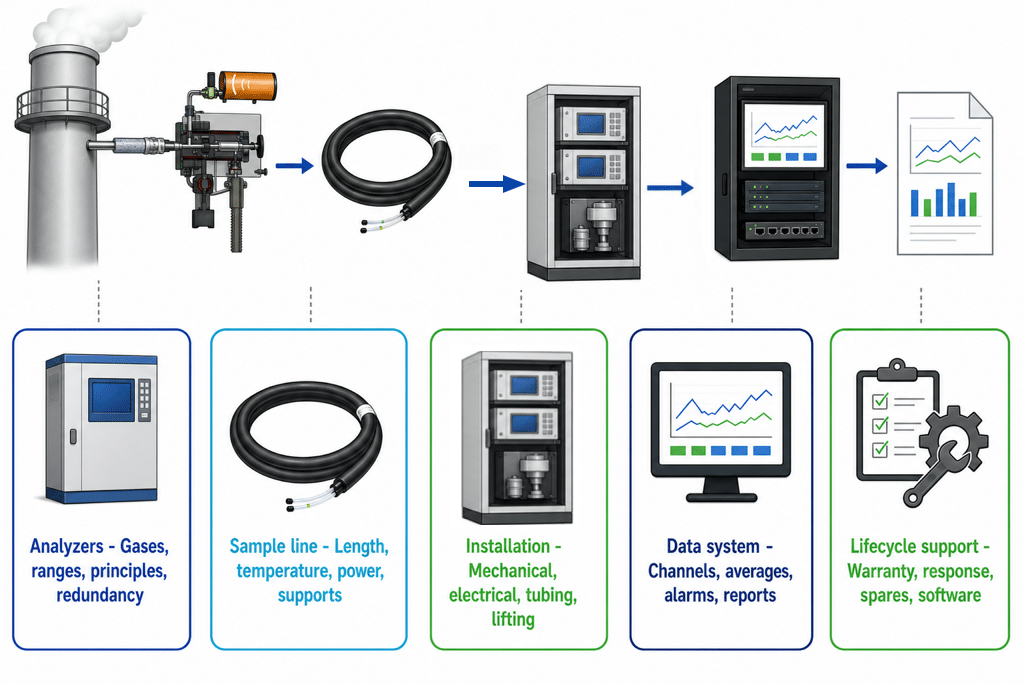
Complete CEMS quotes define the whole measurement path and every handoff: pollutant analyzers, sample extraction or in-situ hardware, conditioning, calibration, data handling, enclosure, utilities, field connections, documentation, testing, training, warranty, service, and explicit exclusions. Missing boundaries produce bids that cannot be compared.
“A continuous emission monitoring system (CEMS) is the total equipment necessary” to determine the reportable result.
| Quote line | Minimum scope to state | Common exclusion to expose | Acceptance evidence |
|---|---|---|---|
| Analyzers | Gases, ranges, principles, redundancy | Unlisted channels | Datasheet and configured range list |
| Probe | Material, filter, heater, insertion length | Stack flange work | Drawing and material list |
| Sample line | Length, temperature, power, supports | Long route or cable tray | Route survey and heat test |
| Conditioning | Cooler, filters, pumps, drains | Condensate disposal | Flow and dew-point check |
| Calibration | Valves, regulator, cylinders, lines | Reference gases | Zero/span sequence test |
| Data system | Channels, averages, alarms, reports | Plant historian changes | Point list and report sample |
| Cabinet or shelter | Climate control, lighting, layout | Foundation or room | General arrangement drawing |
| Installation | Mechanical, electrical, tubing, lifting | Scaffold and outage labor | Installed-work checklist |
| Acceptance | Factory test, site test, required audit | Third-party test team | Signed test protocol |
| Lifecycle support | Warranty, response, spares, software | Travel and after-hours work | Service-level schedule |
What Is Included in a Complete CEMS?
Complete systems include whatever is needed to acquire a representative sample or in-situ measurement, convert it into the required units, check measurement quality, store or transmit data, and pass the applicable acceptance process. Exact equipment changes with the rule and site. Ask each bidder to mark every table row as included, optional, by others, or not applicable.
Name the sample probe, sample gas path, data acquisition system, and data logger rather than grouping them as monitoring equipment. Separate names expose missing channels, unsupported interfaces, and items supplied by the plant.
Why Parameter Count and Sampling Design Change the Price
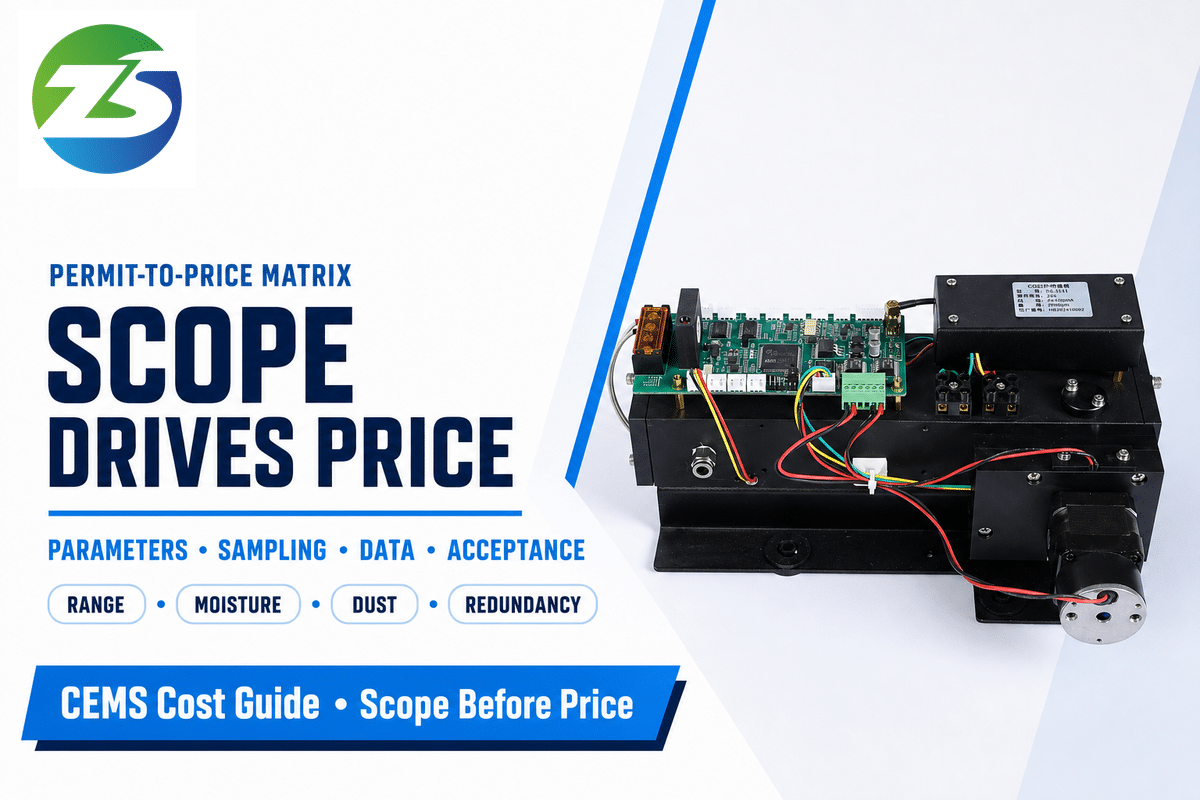
Parameter count changes the number and type of analyzers, while sampling design changes the hardware that protects the measurement. Moisture, dust, corrosive gases, stack pressure, line length, redundancy, and reporting architecture can add equipment and engineering even when two projects list the same pollutants.
The Permit-to-Price Matrix
Each permit duty enters The Permit-to-Price Matrix as a cost-bearing engineering decision and an acceptance record. This prevents the bill of materials from expanding without a defined need.
| Equipment type or design input | Lower-scope case | Higher-scope case | Cost path | Limitations / Not suitable for |
|---|---|---|---|---|
| Pollutants | One gas | Multi-gas plus O2 | More channels and calibration points | One-gas scope cannot satisfy a multi-pollutant permit |
| Range | Single stable range | Wide turndown | Optics, calibration, or dual-range design | Narrow range may overrange during upset conditions |
| Sampling | Short extractive run | Long heated run | Probe, line, supports, power, controls | Unheated transport can lose soluble or condensable species |
| Moisture | Dry sample | High dew point | Conditioner, drains, heat tracing | Dry-basis designs need a defined moisture correction |
| Particulate | Clean gas | Heavy dust loading | Filtration, blowback, access, spares | Small filters may plug before the service interval |
| Corrosion | Benign matrix | Acid-forming matrix | Materials, temperature control, drain design | Standard wetted parts may fail early in acid condensate |
| Availability | Single train | Redundant train | Backup analyzer, valves, DAHS logic | Single train leaves no live backup during repair |
| Data | Local display | Regulatory DAHS | Averaging, validation, reports, interfaces | Local displays alone cannot create compliant reports |
| Environment | Indoor cabinet | Outdoor shelter | HVAC, lighting, foundation, safety | Indoor enclosure is unsuitable for exposed weather |
| Acceptance | Functional check | Rule-specific field test | Protocol, reference method, witness, report | Factory checks do not replace a required site test |
This component-by-component configuration crosswalk begins with GESHINE’s ZS-CEMS-100 CO/CO2 module, which lists 2 gases—CO and CO2—and uses NDIR with gas-filter correlation. Its ZS-CEMS-200 SO2/NOx module lists UV-DOAS and CLD technologies. GESHINE presents the ZS-CEMS-300 multi-gas CEMS as a turnkey cabinet with optional dust, flow, temperature, and pressure inputs. These are GESHINE’s first-party descriptions; exact range, approvals, and project scope must be confirmed in the quotation.
Permit language may describe gas concentration, mass rate, opacity, a diluent channel, or both gas and particulate monitoring. Types of gases can include nitrogen oxides measured by chemiluminescence, volatile organic compounds, or listed hazardous air pollutants. Power plants, coal-fired power units, petrochemical operations, pharmaceutical industry sources, and other combustion-based industrial processes do not share one configuration. Match each channel to the governing environmental regulations, federal emission standards, and any 40 CFR Part 60 subpart cited by the permit.
Engineering, DAHS, Installation and Commissioning Costs
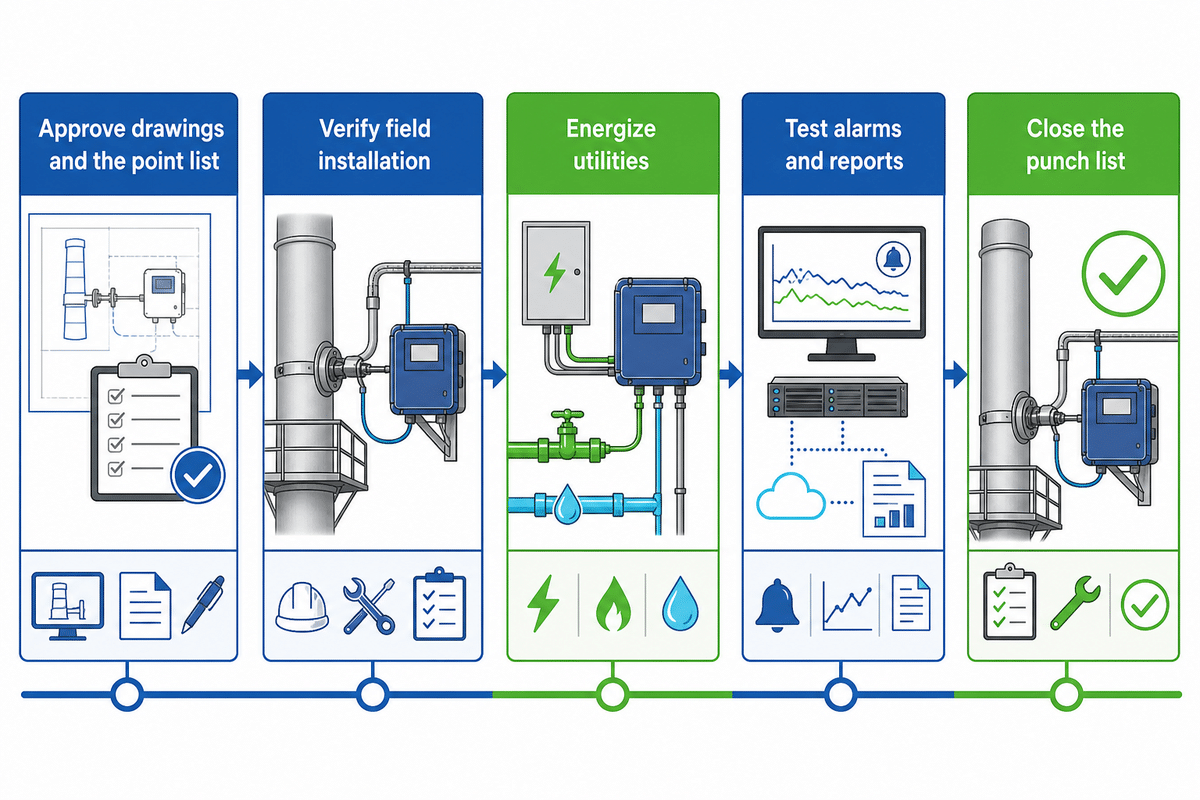
Installed CEMS cost rises when the supplier must design stack access, route heated lines, provide utilities, integrate plant controls and reporting, manage an outage window, or prove performance on site. Site surveys and responsibility matrices assign owners to these tasks before the purchase order is placed.
Consider two plants buying the same analyzer. Plant A has a nearby conditioned room, spare power, an existing stack port, and a data system that accepts the required protocol. Plant B needs a shelter, 150 feet of heated line, scaffold access, cable tray, condensate handling, new data tags, and night-shift commissioning. The analyzer price may match; installed cost will not.
One useful commissioning sequence is: approve drawings and the point list, complete a factory acceptance test, verify field installation, energize utilities, leak-check the sample path, confirm zero and span functions, test alarms and reports, train operators, and close the punch list. Put factory acceptance testing and site acceptance testing in separate quote lines so a passed factory test is not mistaken for field acceptance.
Review a boiler stack CEMS package against actual stack conditions and reporting duties, not channel count alone.
Calibration, RATA and Quality-Assurance Budget
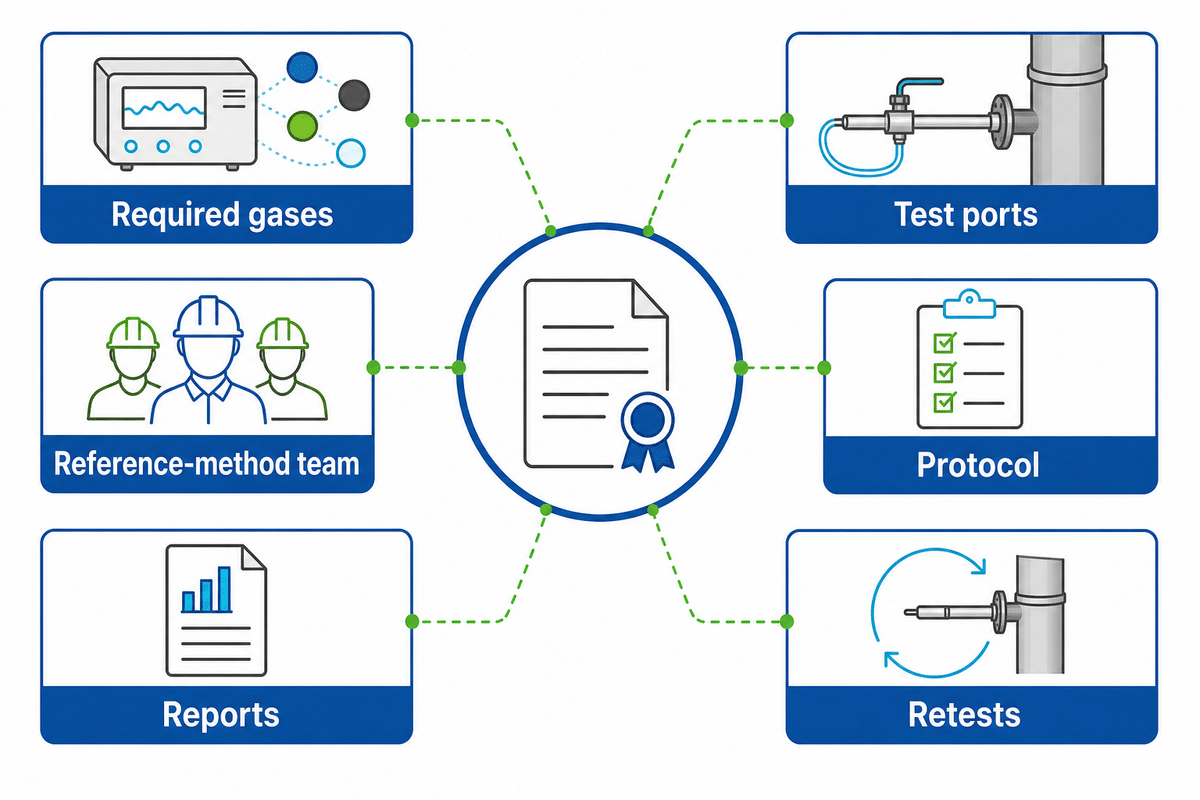
Calibration and quality-assurance cost depends on the applicable rule, permit, pollutant, monitor type, and testing schedule. Budget the required gases, test ports, reference-method team, protocol, site support, reports, retests, and regulator coordination only after the governing requirement has been identified.
The Environmental Protection Agency states that performance specifications evaluate CEMS acceptability at or soon after installation and when a regulation requires it. Part 75 has its own monitoring and quality-control duties for covered power-sector programs. Other sources may work under different subparts, state rules, permits, or European quality-assurance structures. Using one universal relative accuracy test audit frequency or fee would erase these differences.
Does Replacing One CEMS Analyzer Require Re-Certification?
For a covered Part 75 source, it can. 40 CFR 75.20 identifies analyzer replacement, probe location or orientation changes, full system replacement, and process changes that materially affect the flow or concentration profile as possible recertification events. That section distinguishes some diagnostic tests that don’t count as recertification.
That distinction belongs in the financial model. Create an event-driven contingency for modifications, retesting, reference gases, test-team mobilization, and data review. Don’t hide it inside a routine annual maintenance percentage. Confirm the actual obligation with the permit authority before ordering a change.
US EPA quality assurance procedures protect the quality of data used for compliance decisions. State how the DAHS treats emissions data, data availability, an exceedance, and missing hours. Keep CEMS data treatment tied to the exact United States Environmental Protection Agency or state rule in the acceptance plan instead of relying on a broad “United States environmental protection” label.
Annual Maintenance, Consumables and Downtime Cost
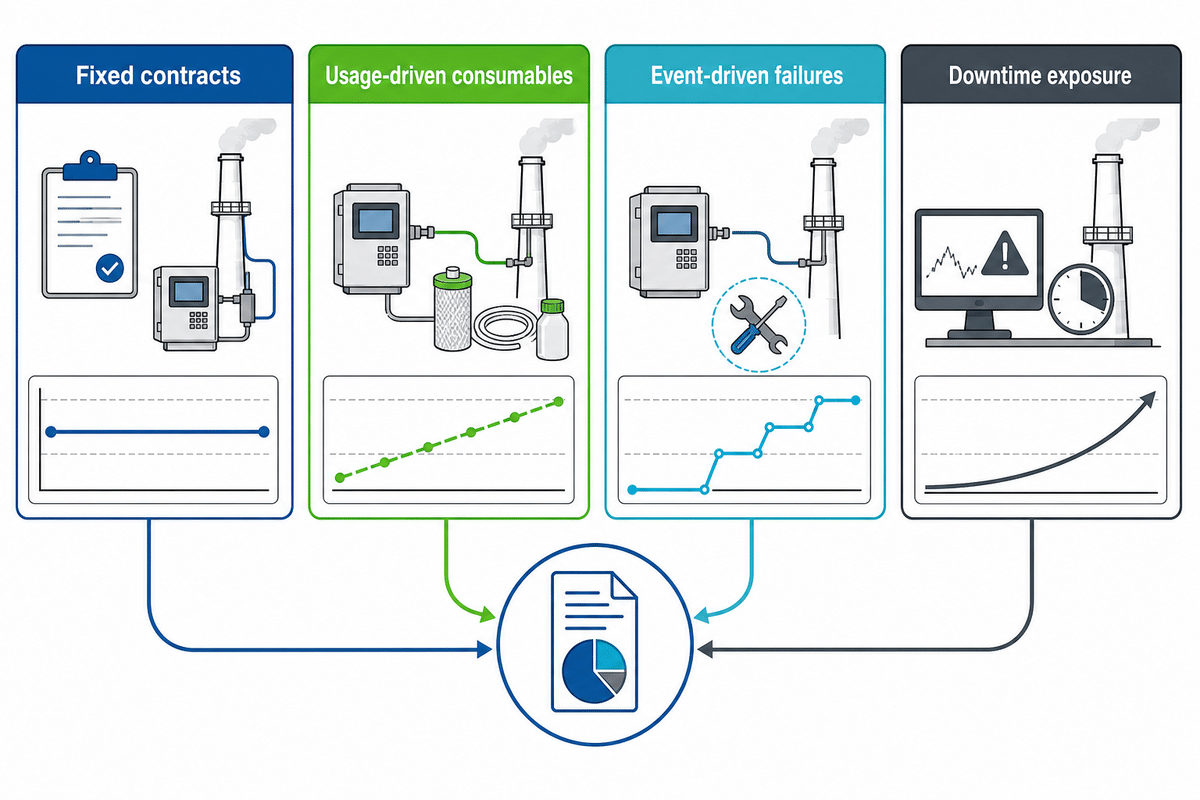
Annual CEMS ownership combines planned service, calibration gases, filters, pump and cooler parts, probe and line cleaning, software and data support, quality audits, travel, spares, and downtime exposure. Separate fixed contracts, usage-driven consumables, and event-driven failures instead of applying one unexplained percentage.
Vendor examples reviewed for this guide separate monthly support, emergency callouts, and consumables or spares. Public figures don’t form a neutral annual average, and our source check found a scope mismatch in one published comparison. Use those categories to structure the RFQ, then replace them with a current service proposal tied to the installed configuration and site location.
Supplier service examples reviewed for this guide identify blocked probe filters, moisture that reaches the analyzer, dirty instrument air, sample-line leaks, and acid condensate as recurring maintenance issues. An inexpensive configuration that needs frequent intervention can cost more to own than a better-protected sample system. Ask for task intervals, consumable quantities, access time, and the labor skill required for each service action.
Preventative maintenance records should connect filter, pump, and chiller work to uptime. Data management should also price backups, alarm review, report changes, and any data analytics service. Mobile CEMS equipment may solve a short temporary duty, while turnkey solutions can reduce handoffs on permanent installations; neither choice removes site integration.
Downtime also has a regulatory dimension. For Part 75 sources, a change that triggers recertification can require substitute data until testing succeeds. Failed certification can invalidate conditionally accepted measurements. Budget separately for repair labor, production effects, retesting, data substitution work, and resubmission. One “downtime” line hides who carries each exposure.
A Five-Year CEMS Cost Model With Useful-Life Sensitivity
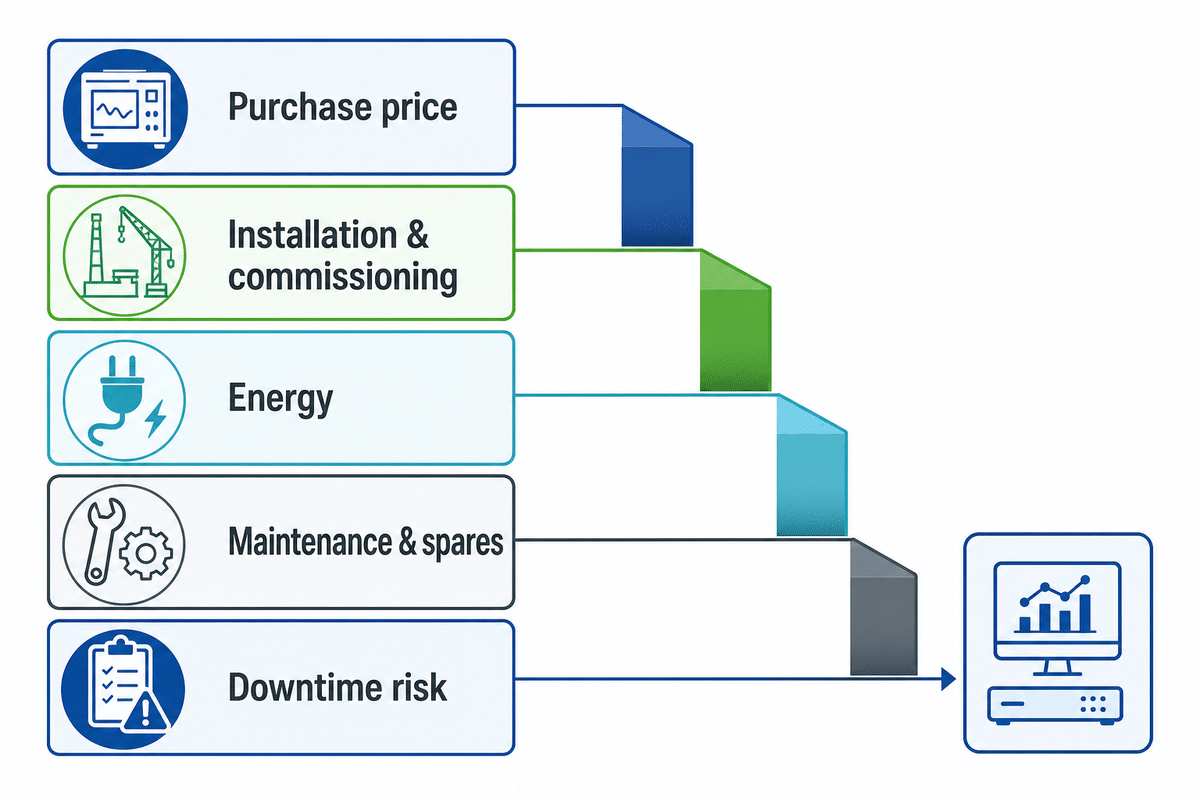
Five-year CEMS models compare bids over one common budgeting period; they don’t declare that every system lasts only five years. Add capital, installation, five years of fixed and variable ownership, and risk reserves, then subtract residual value. Repeat the calculation over a longer horizon before approval.
The Five-Year CEMS Cost Ledger
Use The Five-Year CEMS Cost Ledger as a normalized finance worksheet: comparison cost = purchase + installation + five years of energy + five years of maintenance and spares + five years of quantified downtime risk − residual value. Keep compliance acceptance and event-driven recertification visible if they are not already included.
Illustrative 5-year comparison; replace every input with quoted or site data:
| Cost item | Quote A | Quote B |
|---|---|---|
| Purchase price | $180,000 assumption | $235,000 assumption |
| Installation & commissioning | $45,000 assumption | $55,000 assumption |
| Energy (5-yr) | $20,000 assumption | $15,000 assumption |
| Maintenance & spares (5-yr) | $140,000 assumption | $90,000 assumption |
| Downtime risk (5-yr) | $50,000 assumption | $20,000 assumption |
Worked arithmetic: Quote A = $180,000 + $45,000 + $20,000 + $140,000 + $50,000 − $20,000 residual value = $415,000. Quote B = $235,000 + $55,000 + $15,000 + $90,000 + $20,000 − $50,000 residual value = $365,000. Under these assumptions, the higher purchase price reduces the five-year comparison by $50,000.
This example validates the process, not the market value. Classify each actual input as a supplier quote, site measurement, regulatory-test proposal, historical work order, or finance assumption. If a supplier’s yearly cost already includes capital recovery, then don’t double-count it into the purchase price.
Run at least one sensitivity case. Extend the maintenance, software, spares, major-overhaul, and residual-value assumptions to the site’s expected service horizon. Use discounted cash flow when the finance team requires it. Five-year winners can lose over ten years if proprietary parts, energy demand, or service escalation changes the later years.
When Upgrade, Rental or PEMS Costs Less
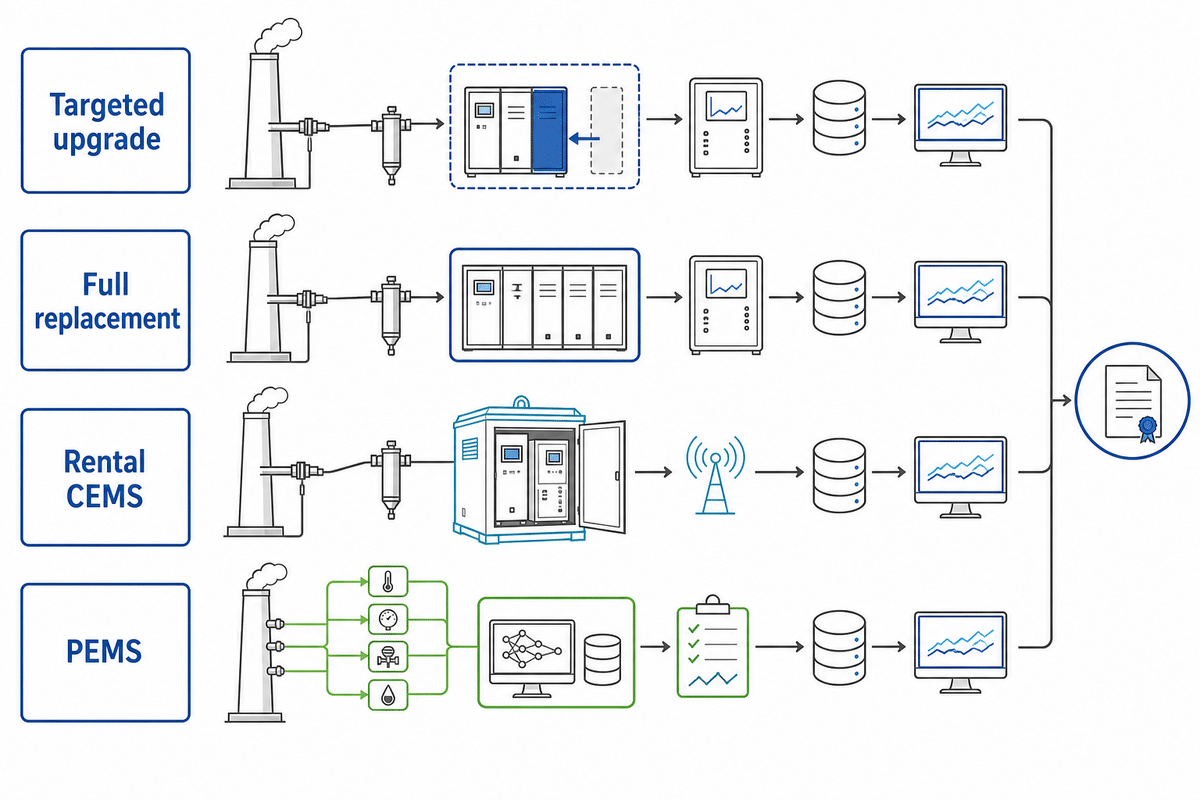
An upgrade, rental unit, or predictive emissions monitoring system can cost less when existing infrastructure remains usable, the monitoring period is temporary, or the applicable authority accepts a validated alternative. Lower equipment cost doesn’t remove integration, testing, data-quality, approval, and ongoing validation obligations.
| Path | Best fit | Cost advantage | Hidden work | Do not choose when |
|---|---|---|---|---|
| Targeted upgrade | Sound sample system and cabinet | Reuses field assets | Compatibility, DAHS changes, retesting | Obsolete infrastructure carries high failure risk |
| Full replacement | Aged or mismatched system | One integrated responsibility | New installation and acceptance | Reusable assets have been proven and valued |
| Rental CEMS | Temporary duty or outage bridge | Avoids full ownership | Mobilization, interfaces, gases, testing | Long duration makes rental charges dominant |
| PEMS | Stable process with accepted model route | Less direct analyzer hardware | Model development, sensors, validation, approval | Process changes often or acceptance is uncertain |
In 2025, a peer-reviewed, industry-supported review reported potential PEMS capital and operating savings while also documenting adaptation and validation gaps. Three authors were affiliated with VL Energy, one with Petroleum Technology Alliance Canada, and the work acknowledged support or funding from industry and public innovation programs. Its savings estimates shouldn’t be applied to a plant without a source-specific study. Performance Specification 16 also makes clear that PEMS has testing and quality-assurance duties; it isn’t simply software installed on a server.
One 2026 Environmental Protection Agency rulemaking provides a useful counterexample. For a defined group of electric generating units, the agency said up to two-thirds of owners would face higher costs under a PM-CEMS-only approach than with quarterly stack testing or particulate-matter parametric monitoring. Compare only methods the applicable rule or permit accepts.
How to Build a Quote-Ready CEMS Budget
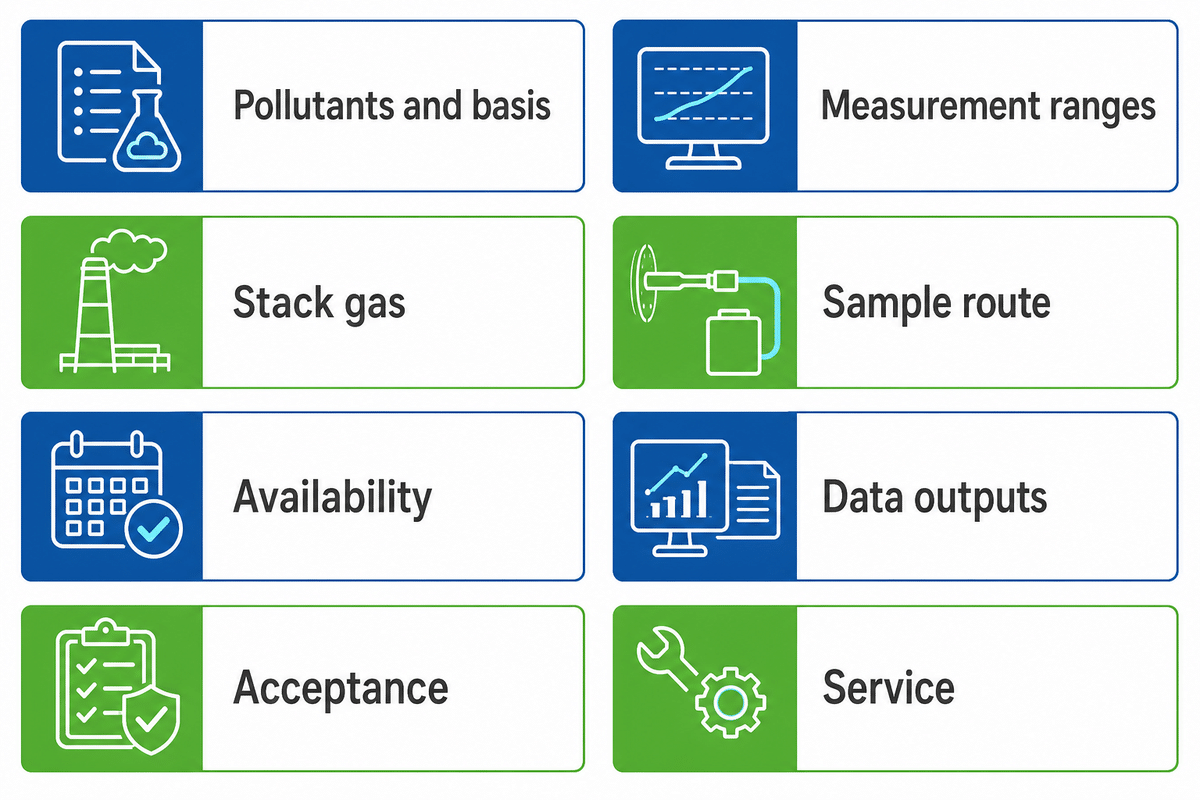
Quote-ready CEMS budgets begin with the permit and convert each measurement duty into a common bidder worksheet. Supply pollutant ranges, stack conditions, sample route, utilities, availability target, data outputs, acceptance tests, service boundary, schedule, and exclusions so every supplier prices the same project.
Copy the following table into the RFQ. Replace “project value” with a measured value or a bounded range; don’t ask the supplier to guess site conditions. Attach the permit extracts, stack drawing, available utility schedule, and required reporting format.
RFQ checklist: copy these into your quote request
| Parameter | Recommended range | Why it matters | How to verify |
|---|---|---|---|
| Pollutants and basis | Project list; wet or dry basis | Sets analyzer and correction scope | Permit extract |
| Measurement ranges | Normal, startup, and upset values | Prevents overrange and poor resolution | Historical stack data |
| Stack gas | Temperature, pressure, moisture, dust | Sizes probe and conditioning | Stack survey and lab data |
| Sample route | Measured length in ft or m | Sets heated line, power, supports | Marked route drawing |
| Availability | Permit or site target in % | Defines redundancy and spares | Monitoring plan |
| Data outputs | Signals, averages, reports, retention | Defines DAHS and interfaces | Point list and report sample |
| Acceptance | Named test and responsible party | Prices gases, crew, and reporting | Approved test protocol |
| Service | Response time in h; coverage period | Defines labor, travel, and spares | Service-level schedule |
Issue a clarification log before bid normalization. Every bidder should answer the same open questions and revise the commercial schedule when scope changes. Compare the five-year ledger only after equipment, installation, testing, support, taxes, freight, travel, and exclusions have been aligned.
GESHINE buyers can send the completed worksheet through the contact page. Include the process gas, required ranges, sample temperature, pressure, moisture, particulate loading, reporting program, site utilities, and desired acceptance boundary. Its purpose is a configuration and pricing enquiry, not a generic analyzer-price request.
Frequently Asked Questions
How much does a CEMS system cost?
Answer
No single public range covers every complete CEMS. One 2024 EPA analysis estimated a scoped total hydrocarbon CEMS below $145,000 initially, while ESC Spectrum’s October 2022 seller estimate listed common single-gas analyzer hardware at $12,000–$22,000. Neither number replaces a site-specific installed, accepted, and supported quotation that includes sampling, DAHS, installation, required field tests, training, and lifecycle service.
What drives the price of a continuous emission monitoring system?
Answer
Key cost drivers include total pollutant count, measuring ranges, analyzer technology, extractive or in-situ architecture, moisture and particulate control, heated line length, redundancy, enclosure, utilities, DAHS functions, control-system interfaces, installation access, field testing, documentation, and lifecycle service. Stack conditions and the governing permit determine which drivers belong in the final scope.
How much should I budget for annual CEMS maintenance?
Answer
Build the annual budget from tasks and quantities instead of one generic percentage. Include preventive visits, travel, calibration gas, filters, pumps, cooler parts, probe and line cleaning, required audits, DAHS support, emergency labor, spares, retesting, and downtime exposure. Obtain a service schedule with each quotation, then separate fixed contract cost from usage-driven consumables and event-driven failures. Add a contingency for regulatory data work when the applicable program requires it. Keep software renewals, after-hours travel, and major spare modules visible as separate finance lines.
What should a complete CEMS quote include?
Answer
Every quote should list analyzers, sample handling, calibration hardware, DAHS, cabinet or shelter, field connections, installation, factory and site tests, training, documentation, warranty, service, schedule, commercial terms, and every exclusion. A battery-limit drawing should show where supplier responsibility ends.
What is the difference between CEMS and PEMS?
Answer
CEMS uses pollutant analyzer measurements to determine concentration or emission rate. PEMS uses process-control operating parameters and a model. PEMS may reduce direct analyzer hardware, but model development, relative-accuracy testing, sensor checks, periodic validation, process-change management, and regulatory acceptance can remain material costs.
Should I upgrade an existing CEMS or replace it?
Answer
Upgrade when the probe, sample system, cabinet, utilities, and data infrastructure are serviceable and compatible with the new measurement duty. Replace when obsolescence, repeated failures, unavailable parts, incompatible reporting, or multiple aging subsystems make retained equipment a liability. Price engineering, integration, field tests, recertification, downtime, spare-part support, and residual value for both paths before comparing their five-year totals.
Turn the permit into a comparable CEMS quotation
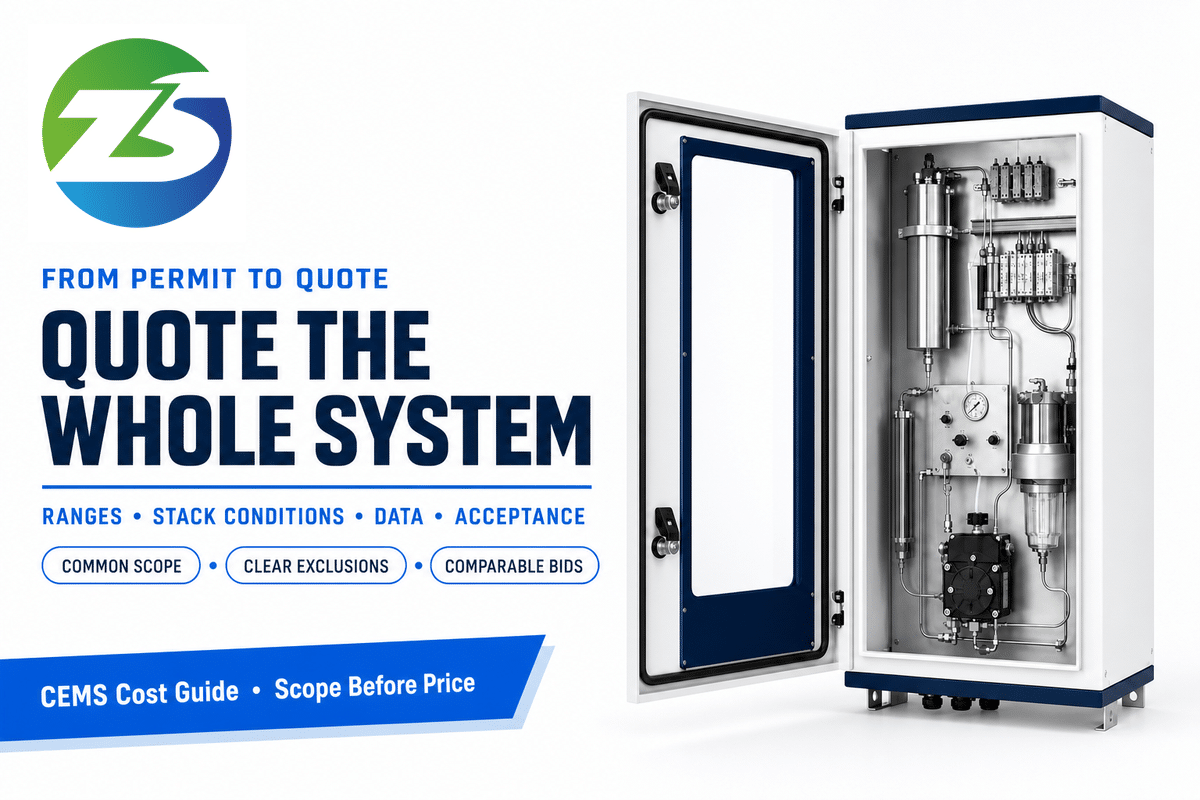
Send your pollutant list, measuring ranges, stack conditions, reporting duty, utilities, and acceptance boundary for a configuration and pricing enquiry.
How This Cost Guide Was Built
The analysis in this CEMS cost guide separates public regulatory estimates, dated seller component figures, and buyer-supplied quote inputs. GESHINE product descriptions are identified as first-party specifications and aren’t treated as independent certification evidence. The five-year ledger is a transparent comparison method, not a claim about universal equipment life.
References & Sources
- Performance Specifications and Other Monitoring Information — U.S. Environmental Protection Agency
- 2024 Rubber Tire Manufacturing Rulemaking Cost Analysis — U.S. Environmental Protection Agency and U.S. Government Publishing Office
- Part 75 Policy — U.S. Environmental Protection Agency
- 40 CFR 75.20: Initial Certification and Recertification Procedures — Electronic Code of Federal Regulations
- 2025 Review of Predictive Emissions Monitoring Systems — Springer Nature
- 2026 EGU Particulate-Matter Monitoring Rulemaking — U.S. Environmental Protection Agency and U.S. Government Publishing Office