
Updated August 2026
CEMS suppliers are companies that provide the full monitoring package, not just an analyzer, so evaluating them means judging a lot more than a datasheet. A CEMS supplier isn’t selling you a single instrument. Its deliverable spans hardware, a data acquisition system, installation support, calibration commitments, and an ongoing service relationship, and treating it as a one-line purchase is the single fastest way to blow a compliance deadline. This checklist breaks supplier evaluation into 12 concrete points across technology fit, certification scope, calibration support, transparency, budget, and lifecycle: the questions a procurement engineer should be asking before a quote is even requested, not after installation exposes the gap.
What a CEMS Supplier Actually Sells You
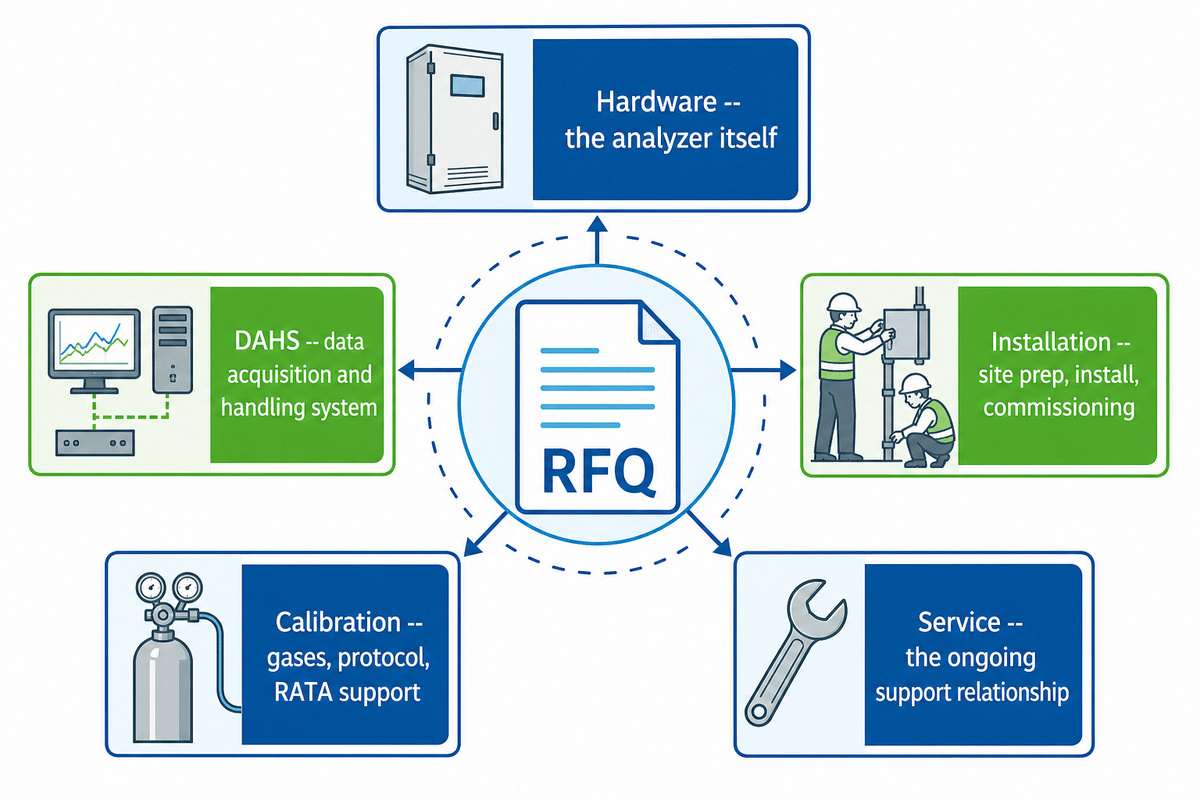
A continuous emission monitoring system supplier delivers analyzer hardware, a data acquisition and handling system, installation and commissioning support, calibration and RATA-support commitments, and ongoing service, not just an analyzer. Scoping an RFQ around the analyzer alone routinely leaves the sampling, data-reporting, and service budget lines unfunded until after the equipment ships.
“A continuous emission monitoring system (CEMS) is the total equipment necessary for the determination of a gas or particulate matter concentration or emission rate using pollutant analyzer measurements and a conversion equation, graph, or computer program to produce results in units of the applicable emission limitation or standard.”
That definition matters at RFQ time. If internal approval is only budgeted for “one analyzer,” the DAHS, sample conditioning, installation labor, and the first year of calibration support routinely arrive as change orders, the exact mid-project budget fight this checklist is built to prevent. Write the deliverable scope into the RFQ line by line: hardware, DAHS, installation, calibration protocol, and service term, each with a named owner. CEMS is also a different environmental monitoring program from ambient air quality monitoring, which tracks conditions at a site boundary rather than emissions of pollutants leaving a stack; keep ambient air stations out of a CEMS RFQ unless your permit explicitly names both as emission monitoring needs, and confirm each candidate’s monitoring solutions are scoped to the stack, not the surrounding air quality.
Points 1-3: Technology & Measurement Principle Fit

Which Measurement Principle Should a Supplier Propose for Your Stack?
A CEMS analyzer is one measurement module inside a larger system, built around a specific principle — non-dispersive infrared (NDIR), gas filter correlation (GFC), ultraviolet differential optical absorption spectroscopy (UV-DOAS), or tunable diode laser absorption spectroscopy (TDLAS) — paired with an extractive sampling path or an in-situ stack mounting. The right principle depends on regulated gases, concentration range, and flue-gas moisture and particulate load, not on which brand a competitor runs.
GESHINE’s product lines offer examples of how those three technology choices get manifested in real products, and how different the choices can be even within one manufacturer’s own lineup. The ZS-CEMS-100 pairs NDIR with gas filter correlation for CO/CO2 monitoring in a 28 kg, 120 W rack module. The ZS-CEMS-200 combines UV-DOAS with chemiluminescence detection (CLD) for SO2/NOx inside a 185 kg, 800 W cabinet.
The ZS-CEMS-300 is a 380 kg, 2,500 W turnkey cabinet stacking NDIR, UV-DOAS, and paramagnetic detection to cover five gases (SO2, NOx, CO, CO2, O2) in one enclosure, with a heated sample line running at 180°C into a stack rated up to 400°C. Three real product lines, three different power, weight, and DAHS-retention profiles (2/3/5 years respectively) — evidence that “the right analyzer” is a fit question, not a brand preference.
| Principle | Sampling mode | Fits well when | Weak point to check |
|---|---|---|---|
| NDIR + GFC | Extractive | CO/CO2, moderate flue-gas moisture | Sample conditioning failure is the top field fault, not the analyzer itself |
| UV-DOAS + CLD | Extractive or in-situ | SO2/NOx at low-to-mid ppm ranges | Optical path fouling drifts accuracy over months, not days |
| TDLAS | In-situ, cross-stack or probe | Single-gas duty, minimal cross-interference | Fewer gases per unit than a multi-parameter extractive cabinet |
| Extractive multi-gas cabinet | Extractive | 3+ regulated pollutants in one enclosure | Sample line length and heat-tracing add a real maintenance line item |
On a dry, low-particulate stack, an in-situ TDLAS unit can outperform an extractive cabinet on uptime simply by removing the sample-conditioning failure point, but once particulate loading or moisture climbs, that same simplicity becomes a limitation the extractive path was built to handle. Ask each candidate supplier to map their proposed principle against your actual gas list and stack conditions, not their default catalog configuration, and use GESHINE’s own gas analyzer selector tool as a quick way to see which principle a given pollutant/range combination typically calls for before you compare candidate proposals.
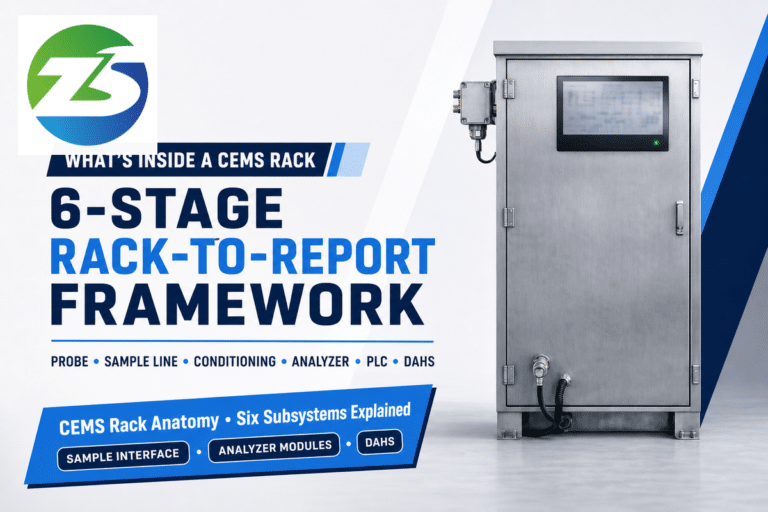
Every measurement system pairs a sensor or detection cell with a specific gas analysis principle, and the result depends on how well that instrumentation handles your actual gas streams. Gas sampling starts when a probe draws a gas sample from the stack; the sample gas then moves through conditioning before reaching the detection cell, where the composition and concentration of each regulated gas component gets resolved. Combustion-heavy processes push more particulate and moisture through that path than a clean-burning gas turbine does, which is why process control engineers size sample conditioning around the dirtiest expected stream, not the average one. FTIR-based gas analysers use software and FTIR technology to resolve multiple gas components, including nitrogen oxides, from a single optical path, a genuinely advanced technology approach when the pollutant list is long, though it adds cost most single-gas duties don’t need. Ask each supplier for real gas concentrations data from a comparable installation rather than a datasheet accuracy figure alone; measuring devices that perform well in a lab don’t always match your actual gas measurement conditions in the field. For a closer look at what sits inside the cabinet once a principle is chosen, sample conditioning path, detection cell, PLC control and all, see our companion guide on what’s inside a CEMS analyzer rack.
Points 4-5: Regulatory & Certification Fit
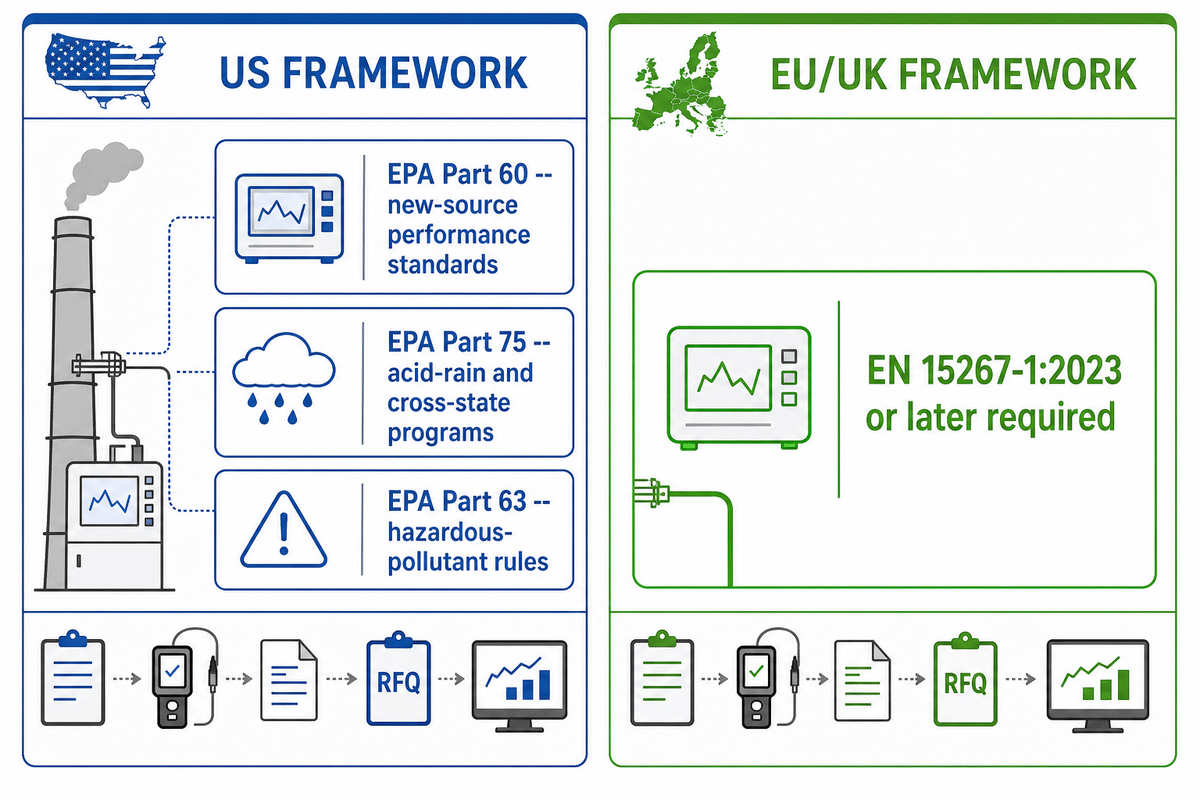
A supplier’s certificate only matters if its scope addresses your specific pollutants, measuring ranges, and regulatory jurisdiction — certification alone isn’t enough. For U.S. buyers, confirm which EPA program the certificate addresses (Part 60 new-source performance standards, Part 75 acid-rain and cross-state programs, or Part 63 hazardous-pollutant rules), since those are different compliance baselines, not one shared set. EU buyers should confirm EN 15267 certification is current: the underlying EN 15267-1 standard was updated in 2023, with a corresponding shift in Germany’s QAL1 accredited scheme. Even where a national certifying body’s own published guidance hasn’t yet flagged the specific edition, a supplier whose paperwork lists only pre-2023 approval deserves a direct follow-up question.
This point should carry the most weight when scoring a supplier, and it’s the one buyers most often skip in favor of an abbreviated “certified” checkbox. A certificate only proves the instrument passed a specific test against a specific pollutant at a specific range, under specific conditions. It doesn’t prove that your local regulator recognizes the certificate, and it doesn’t prove that the certified range covers your actual emission concentrations. CEMS compliance engineering begins with scope matching, not certificate collecting.
| Framework | Covers | Ask the supplier |
|---|---|---|
| EPA Part 60 (Appendix B Performance Specifications) | New, modified, or reconstructed stationary sources by category | Which PS number (PS-2, PS-3, PS-11, etc.) applies to each of your pollutants? |
| EPA Part 75 | Acid Rain Program and cross-state programs, primarily fossil-fuel power generation | Does your facility actually fall under Part 75, or is Part 60/63 the correct baseline? |
| EN 15267 / EN 14181 (QAL1-QAL3, AST) | EU/UK stationary-source CEMS quality assurance | Is the certificate issued under the current EN 15267-1:2023 edition? |
| MCERTS (UK) | UK-specific stack-emissions equipment certification | Does the MCERTS certificate range match your permitted emission limits? |
EPA’s Part 60 and EN 15267’s QAL1 process are structurally independent certification regimes. One runs through site-specific performance testing under Appendix B, performed on the installed system by a qualified air emission testing body and reviewed by the permitting agency; the other through an EN ISO/IEC 17065-accredited third-party certification body (a UK analyser certified under MCERTS follows the same underlying logic). Neither automatically ensures regulatory compliance in the other jurisdiction. A supplier’s U.S. EPA credentials do not transfer to a European facility, and vice versa; if your project spans both regulatory environments, budget for separate certification tracks rather than assuming one certificate travels. Regulatory compliance here means matching certification scope to your specific emission limits, not collecting a generic “complies with environmental regulations” claim. Ask each candidate to show, in writing, how their certification scope meets regulatory requirements per pollutant, with compliance documented individually rather than asserted as a blanket line.
Points 6-7: Calibration, QAL & RATA Support Capability
What Is Involved in CEMS Stack Testing and RATA Support?
Relative Accuracy Test Audit (RATA) support means a supplier commits to the calibration gases, technical presence, and documentation a facility needs to pass its acceptance and ongoing quality-assurance tests, and RATA certifies the entire installed system, including sample handling and conditioning, not the analyzer alone. Even a brand-new, factory-tested, fully certified analyzer hasn’t automatically passed a RATA; that only happens after the complete system is tested in place.
“Just because an analyzer is new, factory tested and certified, it hasn’t passed a RATA… This audit is intended to certify the entire system, including sample handling and conditioning.”
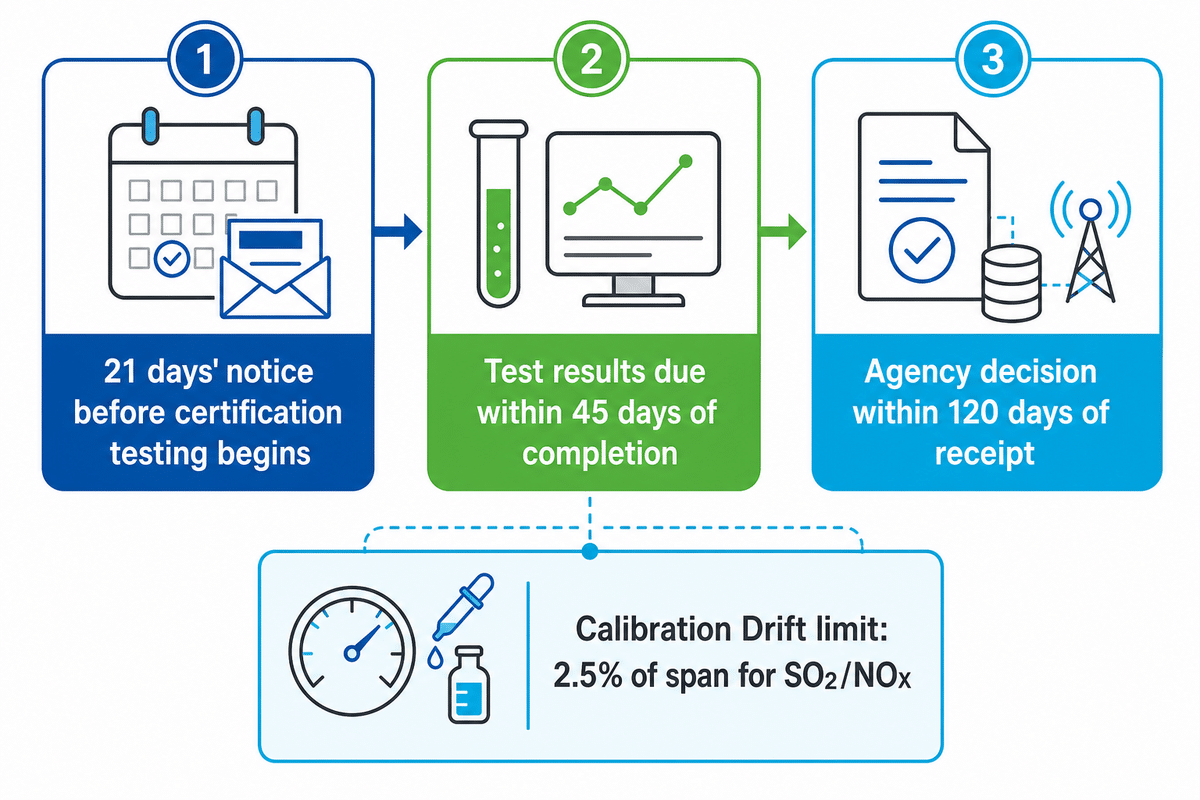
There’s no single published timeline for how long RATA or QAL2 acceptance testing takes end to end; that variable depends on the site, the testing body’s schedule, and the number of pollutants under test. What EPA does fix under Part 75 are the procedural milestones around it: at least 21 days’ notice before certification testing begins, test results due within 45 days of completion, and an agency decision on a complete certification application within 120 days of receipt. Ask a candidate supplier to commit contractually to supporting those windows (gas supply, technician availability, and documentation turnaround) rather than accepting a vague “we’ll be there” assurance.
Also confirm who performs the RATA itself. RATA testing and the calibration gases used in it are independently verified functions, distinct from the supplier’s job of keeping the system in a condition that can pass. Treat “who signs off on the test” and “who built the system” as two separate lines on your evaluation sheet, not one bundled assurance from the same vendor.
Regulatory drift limits are tighter than field maintenance guides sometimes suggest, and the gap matters when scoring a supplier’s calibration protocol. EPA’s Performance Specification 2 sets a Calibration Drift limit of 2.5% of span value for SO2/NOx CEMS, while some field maintenance checklists only grade a daily calibration error of 5-10% as a “bad” check rather than an immediate failure. Calibration protocols exist to ensure compliance and to ensure accurate, reliable readings over the system’s service life, not just at commissioning. Ask what quality control checks run automatically between scheduled RATAs, and ask which drift limit (regulatory or vendor-internal) a candidate supplier is actually designing to. Ask each supplier what their standard daily zero/span protocol looks like and how automated it is. GESHINE’s three product lines, for example, all run daily zero and weekly span auto-checks as standard; the ZS-CEMS-100 and ZS-CEMS-200 are specified to within 1.5% of certified range, the ZS-CEMS-100 to under 1% drift per month, and the ZS-CEMS-300 adds a quarterly automatic linearity check on top, an accurate and reliable baseline a candidate supplier’s own protocol can be measured against.
Point 8: Data Acquisition & System Integration
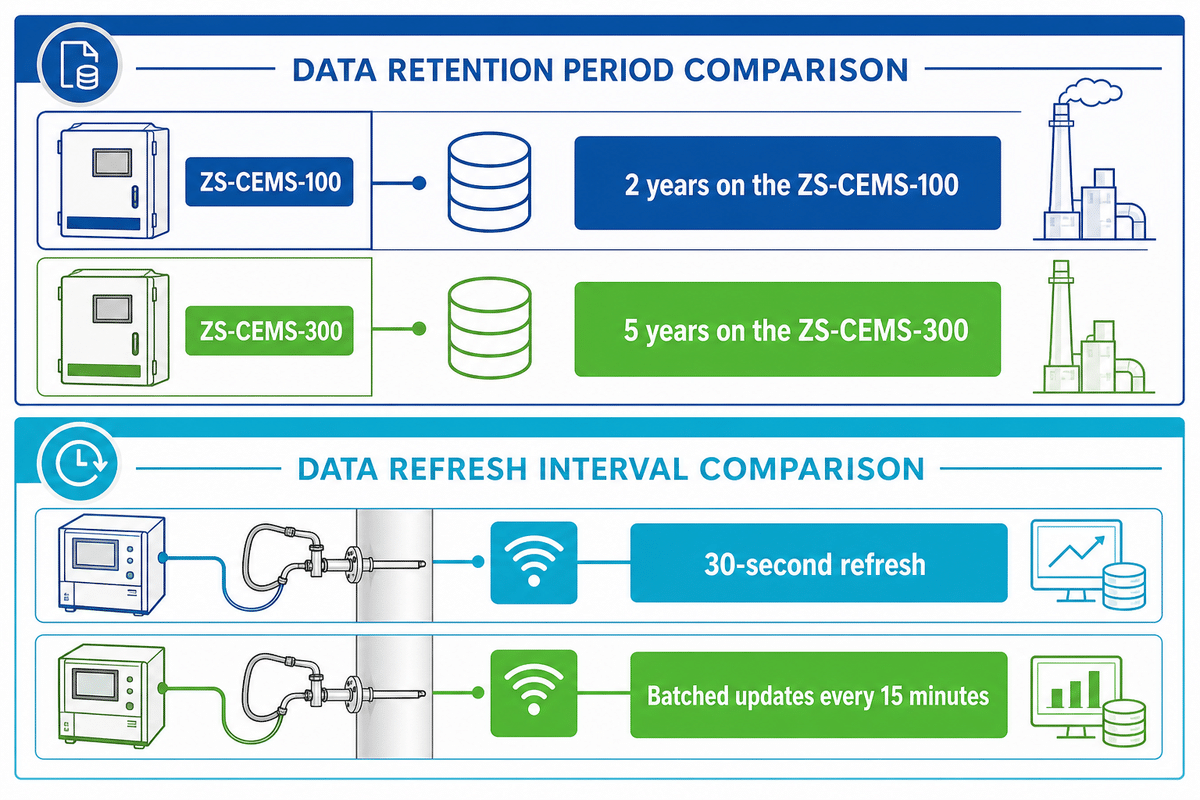
A CEMS data acquisition and handling system (DAHS) needs to store data long enough to survive an audit cycle and output it in the format your regulator actually accepts. In the U.S., that means data structured for submission through EPA’s Emissions Collection and Monitoring Plan System (ECMPS), the electronic reporting system used under Part 75, or an EN 14181-aligned equivalent in Europe. Storing data for only two years isn’t automatically wrong, but it’s a real constraint if your program requires records to be produced on demand for a longer retention window.
Retention periods vary by supplier and product tier, and this is a spec worth settling before signing rather than discovering during an audit. GESHINE’s own DAHS retention runs from 2 years on the ZS-CEMS-100 up to 5 years on the ZS-CEMS-300, showing how much this single spec can move across one manufacturer’s own product line, never mind across competing suppliers. Confirm two things in writing: the retention period itself, and whether the reporting format matches your permit’s electronic-submission requirement without a third-party conversion step. DAHS functions as the CEMS software layer: automation that turns raw analyzer output into real-time data for your control room and your regulator alike. Continuous real-time monitoring only has value if that emission data reaches the right dashboard fast enough to act on it. Providing real-time data on emissions with a 30-second refresh is a very different DAHS than one that batches updates every 15 minutes, and real-time monitoring claims are worth confirming against an actual refresh-interval spec, not a marketing label, when comparing any two CEMS systems.
Point 9: The CEMS Supplier Transparency Test
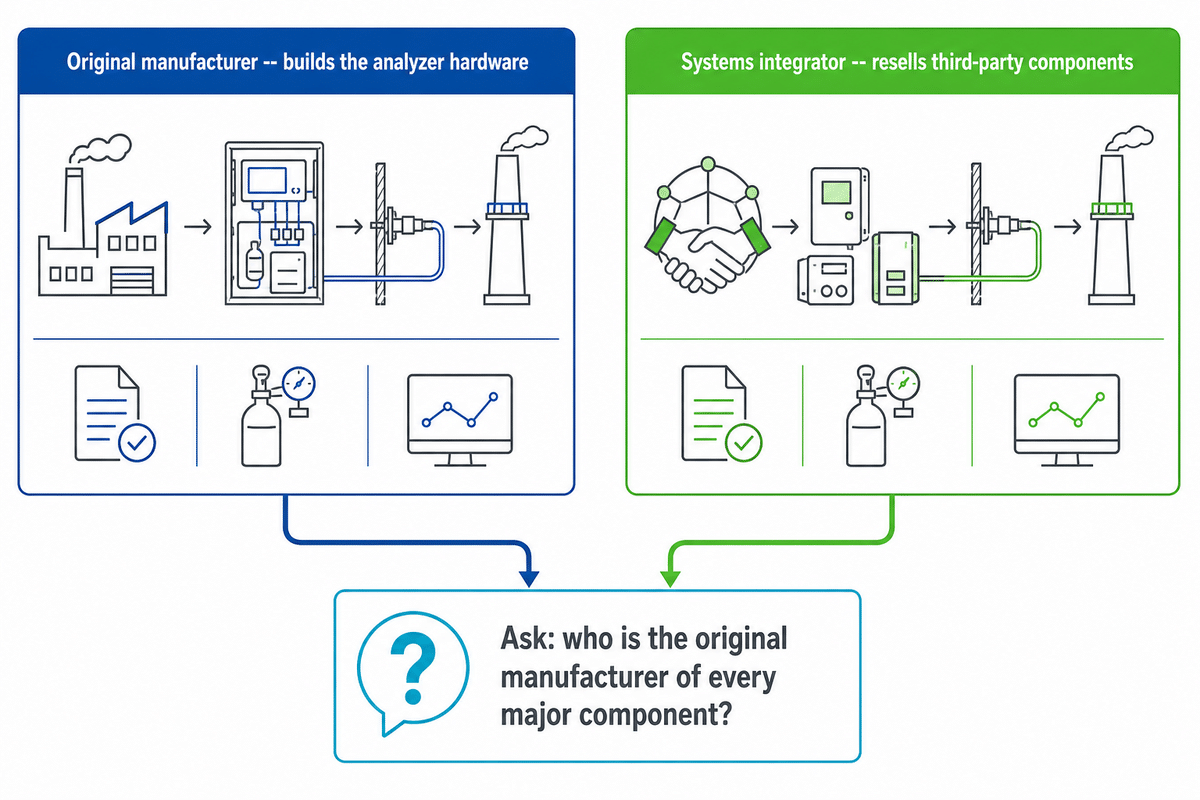
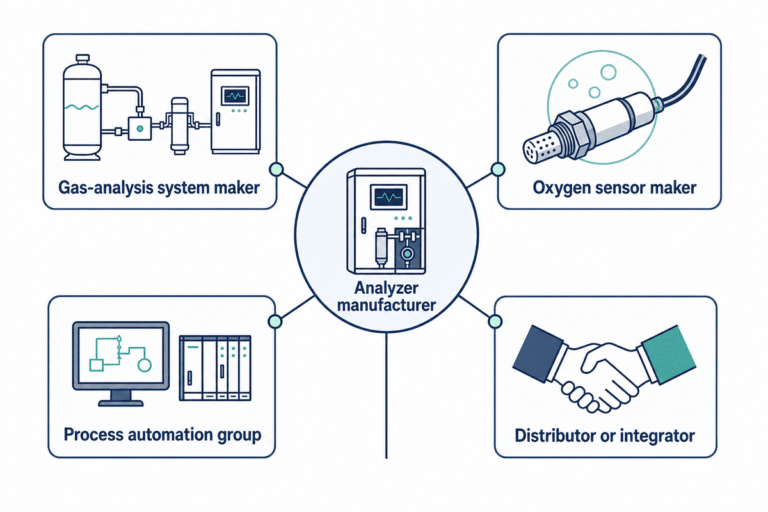
A CEMS supplier is either the original manufacturer of the analyzer hardware or a systems integrator reselling third-party components under a service relationship, and the two roles carry different spare-parts and support supply chains. Marketing language alone rarely tells you which one you’re talking to, so the transparency test is a direct question: ask the supplier to name the original manufacturer of every major component in the proposed system, not just the brand on the cabinet door. This isn’t just a courtesy question, either: EPA Appendix B performance specifications are demonstrated on the installed system at your own stack, not on a catalog model, so knowing the true original manufacturer tells you whose analyzer the demonstration and the spare-parts chain will actually depend on.
The named vendors that surface for a “CEMS suppliers” search illustrate the mix directly. Some of them (DURAG, Gasmet, ABB, Siemens, Teledyne API/Monitor Labs, Thermo Fisher Scientific) build their own analyzer hardware in-house, and GESHINE, the manufacturer publishing this checklist, does the same: the ZS-CEMS-100/200/300 lines used as first-party examples throughout this guide are designed, built, and calibrated in-house. Others operate as integrators, reselling and servicing multiple third-party analyzer brands under a single support contract; that model is a legitimate way to buy CEMS solutions, but it changes who you call when a component fails and where the spare-parts queue actually sits. When using CEMS from any named vendor, ask directly whether their standard CEMS maintenance program includes preventive visits or only emergency response, since that line item drives most of the ongoing maintenance costs, and treat any CEMS performance claim as provisional until the service commitment behind it is in writing. Some suppliers also position themselves as full process and environmental monitoring providers, bundling solutions for environmental compliance with solutions for process and environmental control needs in one contract, a legitimate model, but a different evaluation question from a CEMS-only specialist, and worth naming explicitly in your notes. Industry consolidation adds a second layer to the same question: at least one acquirer’s own corporate-history page lists eight-plus environmental-testing and CEMS monitoring service firms brought under a single parent since 2017, so two “independent” suppliers that appear side by side in a search can, in practice, share a parent company. Neither fact makes a supplier a worse choice, but a buyer who can’t answer “who actually built this and who owns the company I’m signing with” can’t evaluate the support chain they’re buying into. Transparency here helps a facility avoid exactly this kind of dispute later, which is the entire point of running this transparency test before signing rather than after a component fails.
Point 10: Budget Planning Without a Fake Price Tag
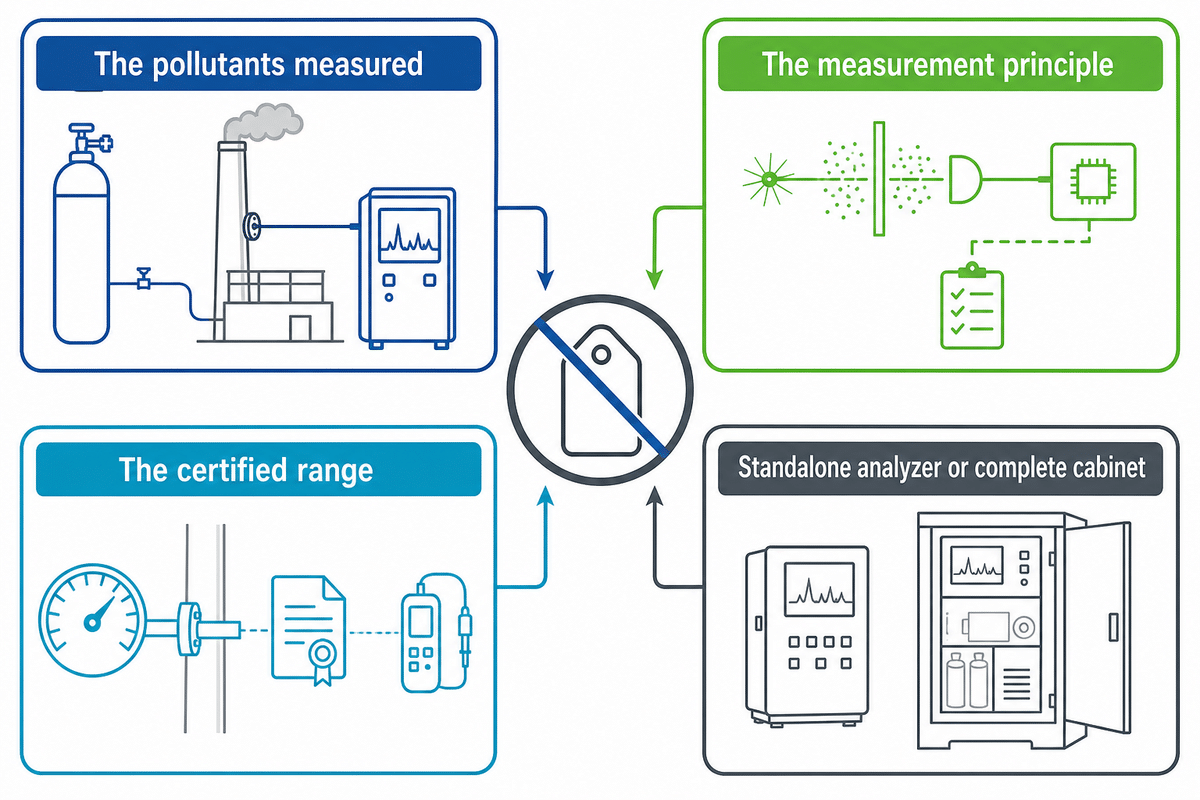
No single turnkey CEMS price band applies market-wide, because cost depends on the pollutants measured, the measurement principle, the certified range, and whether the system is a standalone analyzer or a complete cabinet with sampling, heated lines, and a data acquisition system. A supplier, or an article, that quotes one flat number for “a CEMS” without asking about your gas list and stack conditions is skipping a scoping step that materially changes the price.
Rather than anchoring internal budget approval to a single figure, treat this as an evaluation dimension: does the candidate supplier walk through a scoping conversation before quoting, or do they lead with a number before knowing your pollutant list? The first behavior is a good sign for how the rest of the relationship will run. For a full breakdown of what belongs in a CEMS capital and five-year ownership budget, see our companion CEMS cost guide rather than relying on a single quoted figure here.
Points 11-12: Lifecycle Support, Service Radius, Spares & the Upgrade-Path Lock-In Check
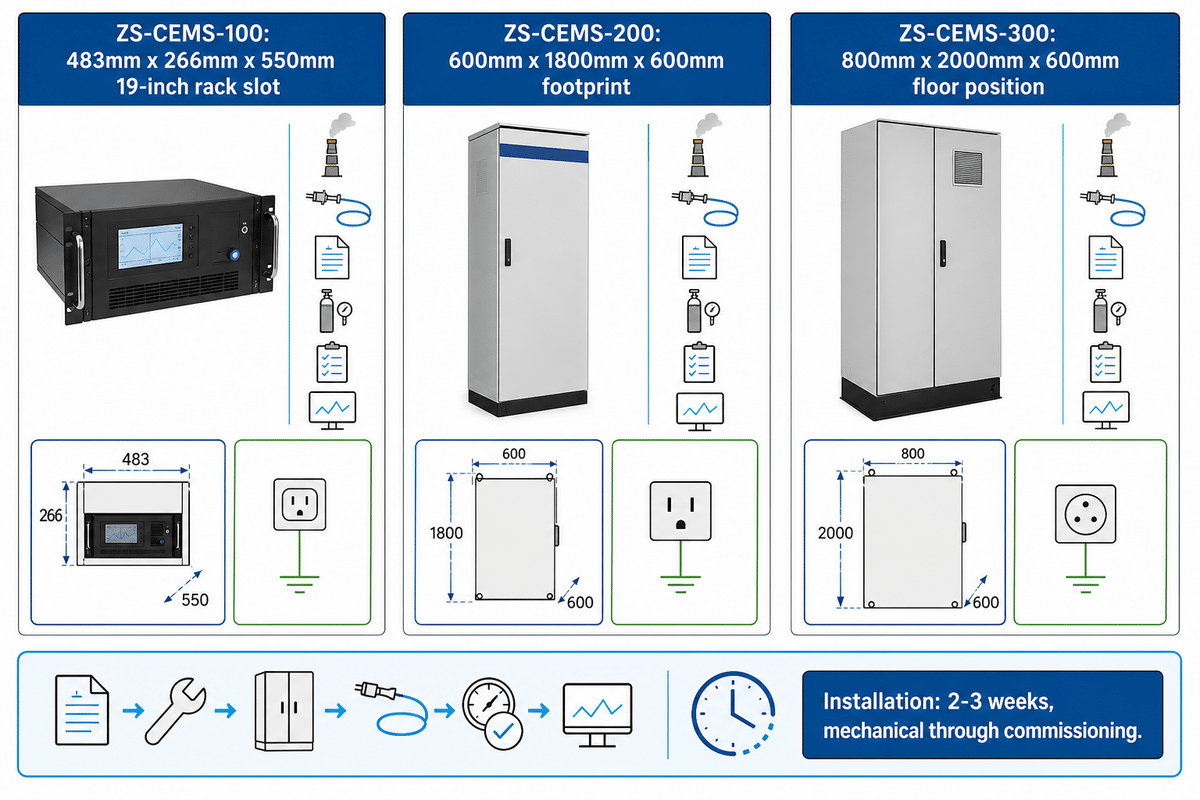
Lifecycle support means a supplier’s service radius reaches your facility within a workable response window and its spare-parts and upgrade path don’t force a full system replacement when a single component reaches end of life. Run the Upgrade-Path Lock-In Check before signing: ask directly whether individual analyzers, probes, or DAHS modules can be swapped without replacing the rest of the cabinet, and get the answer in writing rather than inferring it from a glossy modular-design claim. Regulatory stakes sit behind that question too: under 40 CFR 75.20, recertification is triggered only by a replacement or change that may significantly affect measurement accuracy, so a supplier who can’t say in advance which swaps cross that line is leaving you to find out during an unplanned recertification test. Installation timelines are also worth pinning down up front: a turnkey cabinet like the ZS-CEMS-300 typically runs 2-3 weeks from mechanical and electrical work through commissioning and QAL2 acceptance, with stated availability above 99.5% once commissioned. Any quote that can’t commit to a comparable window deserves a direct follow-up question. Rack, footprint, and circuit numbers belong in that same pre-installation conversation, not a post-delivery surprise: GESHINE’s own ZS-CEMS-100 module needs only a 483mm × 266mm × 550mm 19-inch rack slot on a 100-240V, 50/60Hz circuit, the ZS-CEMS-200 cabinet needs a 600mm × 600mm floor footprint at 1800mm tall on 230V, 50/60Hz power, and the ZS-CEMS-300 turnkey cabinet needs an 800mm × 2000mm × 600mm floor position on a 230V single-phase, 50/60Hz circuit. Ask each candidate supplier for the equivalent rack, footprint, and circuit numbers before the site survey, not after a crate that doesn’t fit the panel shows up.
Analyzer obsolescence is a documented real-world risk, not a hypothetical one. One named industry contributing editor recently described a facility that learned its NOx analyzer parts would stop shipping at year’s end, with only a brief permitted maintenance window before the site would fall out of compliance, and switching to a newer measurement technology mid-life carried its own risk of breaking continuity with the facility’s existing RATA testing provider. That’s precisely the scenario the Upgrade-Path Lock-In Check is designed to catch before it becomes an emergency: confirm parts-availability commitments and technology-swap continuity as contract terms, not as an assumption baked into a “modular design” brochure claim.
The 12-Point CEMS Procurement Checklist
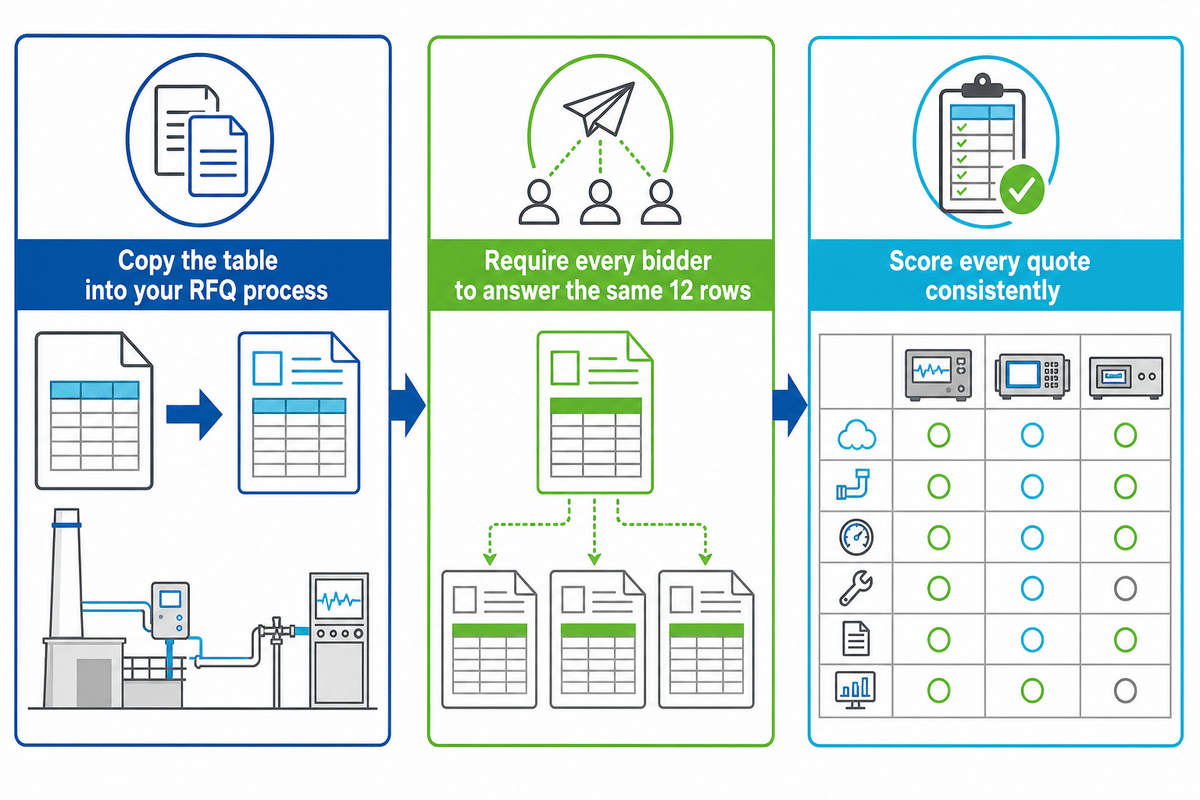
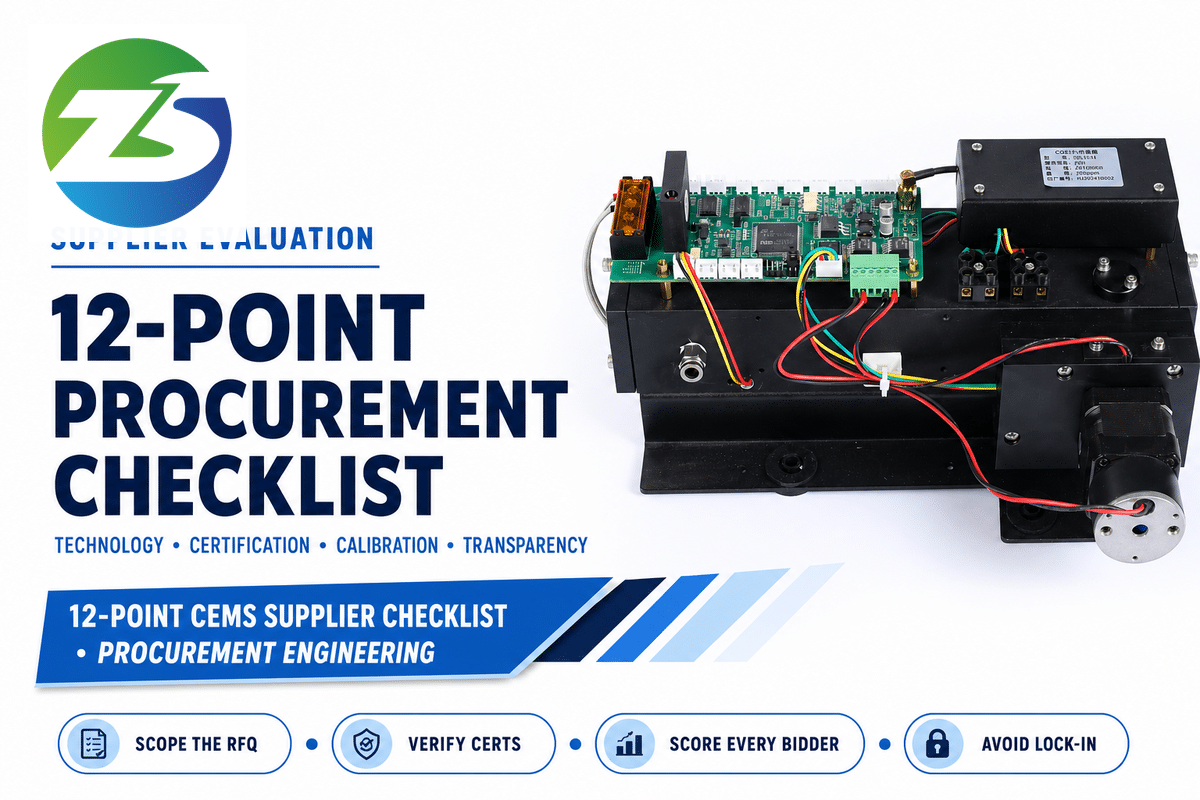
The 12-Point CEMS Procurement Checklist consolidates every evaluation point above into one scoring table you can hand to each candidate supplier and score consistently, rather than comparing quotes that scoped the project differently. Copy the table into your RFQ process and require every bidder to answer against the same 12 rows. Rows 4 and 5 are worth double-checking against the primary source rather than taking a supplier’s word for it, an EPA Part 75 provision number is verifiable on the regulator’s own site, and an EN 15267-1 certificate is only current if it references the 2023 edition or later.
The 12-Point CEMS Procurement Checklist — copy into your RFQ
| Evaluation category | Key question | Pass criterion | Red flag |
|---|---|---|---|
| 1. Deliverable scope | Does the quote name hardware, DAHS, installation, calibration, and service separately? | All five line items priced individually | Single lump-sum “system” price with no breakdown |
| 2. Measurement principle | Does the proposed technology match your gas list and stack conditions? | Supplier maps principle to your actual permit data | Default catalog configuration offered before conditions are discussed |
| 3. Sampling architecture | Is extractive vs. in-situ justified by your moisture/particulate load? | Written rationale tied to your stack survey | No mention of moisture or particulate handling |
| 4. Certification scope (US) | Which Part 60 PS number or Part 75 provision covers each pollutant? | Named PS/Part number per pollutant | Generic “EPA certified” claim with no PS number |
| 5. Certification scope (EU/UK) | Is the EN 15267-1 certificate current (2023 edition)? | Certificate references EN 15267-1:2023 or later | Certificate date or edition not disclosed |
| 6. RATA support commitment | Will the supplier contractually commit to the 21/45/120-day Part 75 windows? | Written commitment to notification, results, and decision timelines | Vague “we’ll coordinate” without dates |
| 7. Calibration protocol | What is the standard zero/span/linearity auto-check schedule? | Daily zero, weekly span, or better documented as standard | Manual-only calibration with no automated schedule |
| 8. Data retention & format | Does DAHS retention and export format match your permit’s reporting requirement? | Retention period and format confirmed in writing | Format requires a third-party conversion step |
| 9. Manufacturer transparency | Who is the original manufacturer of each major component? | Supplier names manufacturer for every component | Deflects the question or names only the cabinet brand |
| 10. Budget scoping | Does the supplier scope before quoting a number? | Scoping conversation precedes any price figure | Flat price quoted before your gas list is discussed |
| 11. Service radius | What is the documented response-time SLA to your facility? | Response time in hours, in writing | “Nationwide coverage” with no time commitment |
| 12. Upgrade path | Can individual components be swapped without full cabinet replacement? | Written confirmation of modular parts availability | Only “modular design” marketing claim, no parts-availability commitment |
Frequently Asked Questions
What does CEMS stand for?
CEMS stands for Continuous Emissions Monitoring System.
CEMS stands for Continuous Emissions Monitoring System. Per the US EPA, a CEMS is the total equipment required to determine a pollutant concentration or emission rate on a continuous basis, combining sample interface, gas analyzers, and a data acquisition and handling system (DAHS) that converts raw signals into the units a facility must report to its regulator.
What is a CEMS for boilers?
A CEMS for boilers continuously measures the pollutants a boiler’s stack emits, typically NOx, SO2, CO, CO2 and O2, so the facility can demonstrate ongoing permit compliance.
A CEMS for boilers continuously measures the pollutants a boiler’s stack emits, typically NOx, SO2, CO, CO2 and O2, monitoring emissions continuously so the facility can demonstrate ongoing compliance with its permit limits instead of relying on periodic stack testing alone. Boiler CEMS packages are usually engineered around EPA Part 60 or Part 75 performance specifications, depending on whether the unit falls under New Source Performance Standards or the Acid Rain Program.
What should a CEMS quote include before you compare prices?
A comparable CEMS quote should break out hardware, the data acquisition and handling system, installation and commissioning, calibration protocol, and the service term as five separate line items, not one lump-sum figure, so competing bids can actually be compared side by side.
Rather than asking for a single number, a comparable CEMS quote should break out hardware, DAHS, installation and commissioning, calibration protocol, and the service term as separate line items, each tied to the pollutants and certified range a candidate supplier proposes. A quote that leads with one flat figure before discussing your gas list and stack conditions is skipping the scoping step that materially changes the price, exactly the pattern Point 10 of this checklist is built to catch.
Who are the manufacturers of CEMS analyzers?
Names that surface consistently in “CEMS suppliers” searches include DURAG GROUP, Gasmet, ABB, Siemens, Teledyne API/Monitor Labs, Envea and CiSCO, alongside integrators such as ESC Spectrum.
Names that surface consistently in “CEMS suppliers” searches include DURAG GROUP, Gasmet, ABB, Siemens, Teledyne API/Monitor Labs, Envea and CiSCO, all original analyzer manufacturers, alongside integrators such as ESC Spectrum, which resells and supports multiple third-party analyzer brands rather than building its own hardware. GESHINE, the manufacturer publishing this checklist, also designs and builds its own ZS-CEMS-100/200/300 lines in-house. This list isn’t a ranking; verify current certification and support scope directly with each vendor using Point 9 of this checklist.
What DAHS retention period should you require from a CEMS supplier?
Confirm your CEMS supplier’s data acquisition and handling system (DAHS) retention period and export format in writing before signing, since both vary by product tier.
As Point 8 above covers, a data acquisition and handling system (DAHS) converts raw analyzer signals into the reportable units your permit requires and stores them for audit purposes. Retention periods vary by supplier and product tier, so confirm the retention window and reporting-format compatibility in writing rather than assuming a supplier’s standard configuration matches your permit’s requirement; discovering a two-year retention window during an audit that requires five is a costly place to learn the gap exists.
Compare a supplier’s technology fit against your gas list
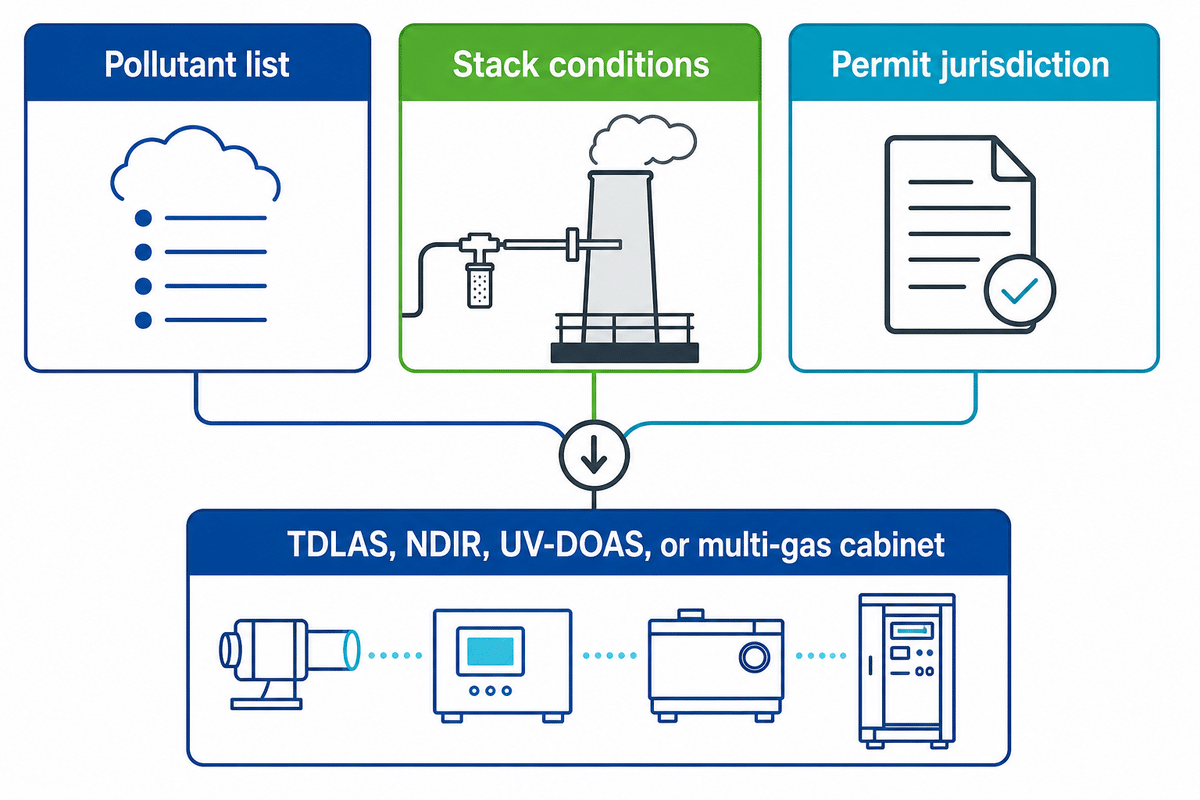
Send your pollutant list, stack conditions, and permit jurisdiction, and GESHINE’s technical team can walk through where a TDLAS, NDIR, UV-DOAS, or multi-gas cabinet fits before you score any supplier’s proposal.
Our Perspective
This checklist separates regulatory milestones we could verify directly against EPA, EN 15267, and eCFR source pages from industry practice we could only source from vendor marketing or a single trade-press account, and it flags the latter as illustrative rather than authoritative. We didn’t construct a market-wide CEMS price figure because none exists publicly; our own ZS-CEMS-100/200/300 specifications are identified as first-party data, not independent verification. Reviewed by the GESHINE technical team.
Where Each Checklist Point Traces Back To
Rows 4-6 above rest on regulatory text and certification-body pages rather than on a supplier’s own claim; row 7’s calibration-cadence benchmark is first-party GESHINE data, listed as such below. This table maps each source we cite to the specific checklist point it backs, so a buyer can pull the primary source directly instead of taking our summary on faith.
| Source | Standard / provision cited | Verifies checklist point(s) |
|---|---|---|
| EPA, Air Emission Measurement Center | CEMS total-equipment definition | Intro: what a CEMS supplier actually sells you |
| EPA, Summary of Part 75 Administrative Processes | 21/45/120-day certification windows | Point 6: RATA support commitment |
| EPA, Part 75 Policy and Technical Resources | Part 75 electronic-reporting policy resources | Point 8: data retention & reporting |
| Electronic Code of Federal Regulations, 40 CFR 75.20 | Recertification trigger scope | Point 12: upgrade-path recertification risk |
| UK Environment Agency, M20 Quality Assurance | EN 14181 QAL framework | Point 5: certification scope (EU/UK) |
| TUV Rheinland, QAL1 Certification Body | EN 15267-1:2023 edition | Point 5: certification scope (EU/UK) |
| CSA Group, MCERTS Certified Product listing | MCERTS certification scope | Point 5: certification scope (EU/UK) |
| Control (Endeavor Business Media), Rezabek | RATA scope, analyzer obsolescence risk | Points 6 & 12: RATA support, upgrade path |
| GESHINE ZS-CEMS-100/200/300 product pages (first-party) | Hardware specifications (power, weight, footprint, data retention, calibration cadence) | Points 1-3, 7 & 8: technology fit, calibration cadence, data retention |
References & Sources
- Performance Specifications and Other Monitoring Information — U.S. Environmental Protection Agency
- Summary of Part 75 Administrative Processes — U.S. Environmental Protection Agency
- Part 75 Policy and Technical Resources — U.S. Environmental Protection Agency
- 40 CFR 75.20: Initial Certification and Recertification Procedures — Electronic Code of Federal Regulations
- Monitoring Stack Emissions: Quality Assurance of Continuous Monitoring — UK Environment Agency
- QAL1 Certification Body of TUV Rheinland Energy & Environment GmbH — TUV Rheinland
- MCERTS Certified Product: Transportable CEMS — CSA Group
- Grim Reaper of Tech: Obsolescence Is Inevitable, Even for Reliable Instruments — Control (Endeavor Business Media)