
Chemical Process Gas Analysis Solutions
HCl / HF / Cl₂ / NH₃ reactor feeds, VAM / 1,4-BDO synthesis, VOC process vents, and reactor off-gas monitoring.
Primary buyer: Process / reaction engineer + HSE manager + instrumentation lead
How Chemical Process Buyers Think About Gas Analysis
Chemical buyers operate at the edge of corrosive, reactive, and sometimes toxic process streams where both process yield and personnel safety depend on accurate gas measurement. HCl / HF / Cl₂ reactor feeds require heated Monel or Hastelloy sampling; ammonia and acetylene feeds in vinyl-acetate and 1,4-butanediol synthesis need process-grade TDLAS control; VOC process vents and reactor off-gas run on heated FID for compliance-grade total-hydrocarbon reporting. GESHINE aligns here with TDLAS-heavy process analyzers for corrosive gases plus FID for VOC / THC duty.
Industry Challenges
- HCl / HF reactor and scrubber monitoring at ppm to %vol range — heated Monel / Hastelloy sample path mandatory above the acid dew point
- Chlorine (Cl₂) process and safety monitoring around chlor-alkali, chloromethanes, PVC / VCM, and water-treatment chemistry
- Ammonia (NH₃) reactor feed and vent monitoring in fertilizer, urea, and nitric-acid trains
- Acetylene (C₂H₂) feed composition for VAM (vinyl-acetate monomer) and 1,4-BDO synthesis loops — TDLAS process-grade control
- VOC process vents and reactor off-gas — heated FID for total-hydrocarbon compliance reporting, PID for walk-around screening
- Oxygen monitoring on inerted reactors and storage tanks for runaway-reaction / explosion prevention
- Multi-component reaction off-gas composition for process yield tracking and catalyst performance assessment
Key Gases for Chemical Process
Tap any gas to see the analyzer family, technology options, and selection guide for that measurement target.
HCl
Hydrogen Chloride
Chlor-alkali, VCM / PVC, chloromethanes, and incineration abatement — TDLAS with heated Hastelloy sampling is the default.
View HCl analyzersHF
Hydrogen Fluoride
Alkylation, fluorochemicals, fertilizer by-product, and aluminum smelter — TDLAS with Monel / PFA sampling, UV-DOAS as alternative.
View HF analyzersCl₂
Chlorine
Chlor-alkali cell gas, PVC / VCM production, water-treatment dosing, and perimeter safety — UV-DOAS is the primary technology.
View Chlorine analyzersNH₃
Ammonia
Ammonia synthesis purge gas, nitric-acid plant reactor feed, urea process loops — TDLAS and UV-DOAS both deployed.
View Ammonia analyzersC₂H₂
Acetylene
VAM and 1,4-BDO synthesis feed composition tracking — TDLAS process analyzer for feed-window control.
View Acetylene analyzersVOC / THC
Total Hydrocarbons
Reactor vent and off-gas compliance (EPA Method 25A, EN 12619) — heated FID is the regulatory reference method.
View Total Hydrocarbon analyzersH₂O
Trace Moisture
Trace water in Cl₂ (chlor-alkali cell gas) and EDC (ethylene dichloride) — TDLAS near-IR ppm / ppb moisture analysis protects downstream catalysts and product quality.
View Moisture analyzersO₂
Oxygen
Pure-O₂ loops across chemical process duty — PE / PP / PTA oxidation reactor control, ethylene oxychlorination (EDC process), coal gasification, H₂O₂ synthesis, sulfuric-acid oxidation, TDI water-gas, VCM recovery tail-gas — paramagnetic or zirconia process O₂.
View Oxygen analyzersSKUs for Chemical Process Duty
Analyzers frequently selected for Chemical Process duty — chosen for the gases, process conditions, and compliance targets typical of this vertical.
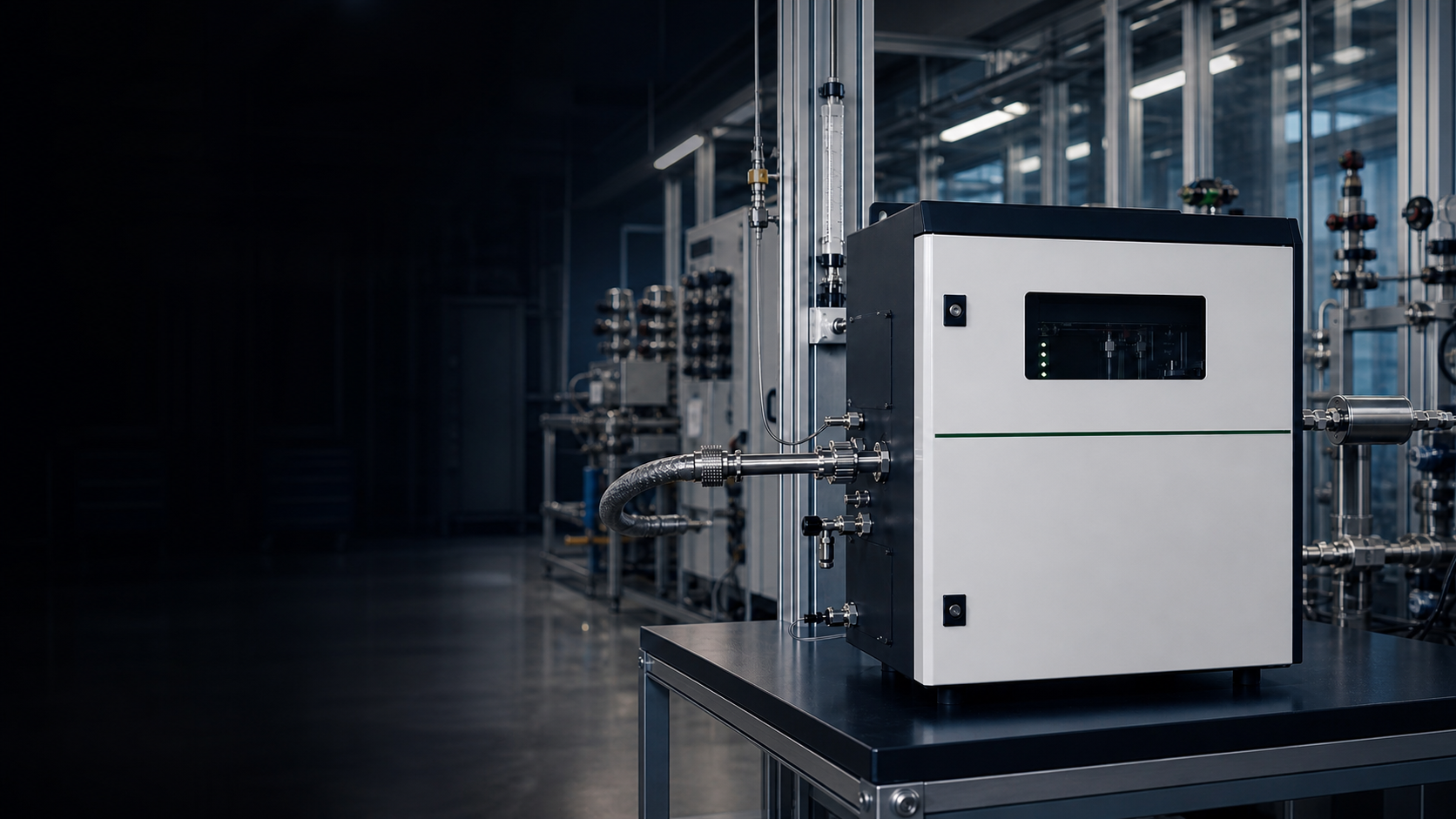 ZS-UVDOAS-CL2
Process Chlorine Analyzer
UV-DOAS chlorine analyzer for continuous process monitoring in chlor-alkali and chemical plants.
UV-DOAS process chlorine analyzer for chlor-alkali, PVC / VCM, and water-treatment Cl₂ measurement — no consumable cells, zero drift.
ZS8100-HClZS8100-HCl Process Hydrogen Chloride Analyzer
TDLAS diode-laser hydrogen chloride analyzer with heated Hastelloy sampling for ppm-level HCl in chlor-alkali, PVC / VCM / EDC, and incineration process gas.
TDLAS HCl process and CEMS analyzer with heated Hastelloy sampling for chlor-alkali / VCM / incineration duty.
ZS8100-HFZS8100-HF Process Hydrogen Fluoride Analyzer
TDLAS diode-laser hydrogen fluoride analyzer with heated Monel / PFA sampling for ppm-level HF in alkylation and fluorochemical process gas.
TDLAS HF process analyzer with heated Monel / PFA sampling for alkylation and fluorochemical duty.
ZS8100-NH3Process Ammonia Analyzer
TDLAS tunable diode laser analyzer for ppm-level NH₃ in process gas.
TDLAS ammonia analyzer for ammonia synthesis purge and nitric-acid feed monitoring.
ZS8100-O2ZS8100-O2 Process Oxygen Analyzer
High-accuracy paramagnetic O₂ measurement for process optimization.
Paramagnetic / zirconia process O₂ for PE / PP / PTA oxidation, ethylene oxychlorination, coal gasification, H₂O₂ / sulfuric-acid synthesis, TDI water-gas, and VCM recovery tail-gas loops.
ZS8100-H2OProcess Moisture Analyzer
TDLAS near-IR trace moisture analyzer for ppm / ppb H₂O in corrosive process gas.
TDLAS trace moisture analyzer for Cl₂ (chlor-alkali cell gas) and EDC (ethylene dichloride) — protects downstream catalysts and product quality.
ZS6200-CO/CO2ZS6200-CO/CO₂ Process Analyzer
Dual-channel NDIR for simultaneous CO and CO₂ measurement.
NDIR process CO / CO₂ analyzer for reactor off-gas composition and yield tracking.
Regulatory Framework for Chemical Process
Standards that typically govern Chemical Process monitoring specifications. Per-SKU certification details are listed on each product page.
- OSHA 29 CFR 1910.119 — Process Safety Management of Highly Hazardous Chemicals (PSM)
- US EPA 40 CFR Part 68 — Risk Management Program for Chemical Accidental Release Prevention
- US EPA 40 CFR Part 63 — NESHAP for various chemical process MACT categories (HON, MON)
- US EPA Method 25A — Total Gaseous Organic Concentration by Flame Ionization Analyzer
- EU REACH — Registration, Evaluation, Authorisation and Restriction of Chemicals
- EU IED BAT — BREFs for large volume organic / inorganic chemicals
- API 934 / API 941 — Materials requirements for process equipment in high-pressure hydrogen service
Chemical Process Field Experience
Deployments and typical profiles from chemical process operations.
Fine-Chemical Industrial Park — Integrated VOC Monitoring and Source Attribution
A representative park-wide VOC monitoring and control programme for a multi-tenant fine-chemical park — fence-line stations, point-source analyzers, and characteristic-species monitoring feeding a central scheduling platform — built to drive down peak VOC concentrations and compress source attribution from days to hours. GESHINE instruments serve the analyzer layer; aerial patrols and AI scheduling platforms are typically delivered with ecosystem partners.
Challenge
Parks of this type host twenty or more fine-chemical producers with diffuse VOC sources and a complex characteristic-species profile. Before a programme like this, monitoring coverage is typically thin — recurring hourly-average exceedances, weak standing in provincial environmental assessments, and source-attribution response times measured in days rather than hours.
Solution
- Fence-line VOC monitoring stations, fixed-source analyzers, and characteristic-species stations sized to the park layout, covering priority target species such as 1,3-butadiene, benzene, and chlorinated VOCs
- Aerial patrol sweeps (delivered with ecosystem partners) complementing the fixed network for daytime and night-time coverage of the park footprint
- Centralised scheduling platform aggregating the monitoring data streams into a tiered response workflow (reminder → consultation → enforcement)
- Heated-FID and PID analyzers deployed at high-duty point sources; ZS-SCS heated sample conditioning on the corrosive streams to preserve VOC integrity from stack to analyzer
Outcome
- Sustained year-on-year reduction in daily-maximum and mean hourly VOC concentrations
- Materially improved standing in provincial park-level environmental assessments
- Source-attribution time compressed from days to hours, with a closed-loop alarm-to-closure workflow
- High-emission operations identified for upgrade or phase-out through combined fixed and aerial screening
- Environmental compliance and production growth aligned rather than traded off
Cross-Links Into the Main Catalogue
Explore the broader GESHINE catalogue by gas type or measurement technology.
Gas Categories
Need Engineering Support Around This Project?
Beyond analyzer selection, GESHINE supports system design, site delivery, and lifecycle service for installations like this.
Chemical Process Gas Analysis FAQ
Questions commonly raised during procurement and specification for this industry.
What sample system materials are mandatory for HCl / HF corrosive service?
HCl service uses Hastelloy C-276 or PFA-lined Hastelloy for all wetted parts and a heated sample line above the HCl dew point (typically 120–180 °C depending on water content). HF service is stricter — Monel 400 or nickel alloys with PFA internal tubing; stainless steel is unacceptable on HF because fluoride attacks chromium. The GESHINE HCl / HF analyzer families specify these materials by default; the sampling skid must match.
Why is UV-DOAS the dominant technology for chlorine process analyzers?
Chlorine absorbs strongly in the 260–360 nm UV band where water vapor does not, which means UV-DOAS handles wet and humid Cl₂ streams without drying and avoids the consumable-cell lifetime that constrains electrochemical chlorine analyzers. ZS-UVDOAS-CL2 uses this technology with zero drift and no cell replacement — a material operating-cost advantage in 24/7 chlor-alkali service.
Can one analyzer cover both process control and CEMS compliance duty?
Usually not. Process control prioritizes fast response and %vol-range dynamic range; CEMS compliance prioritizes ppm / sub-ppm accuracy and reference-method defensibility. Most chemical sites run a process analyzer on the reactor loop and a CEMS rack on the stack outlet, connected by the same sampling-conditioning family (ZS-SCS series) but with distinct analyzer heads and distinct calibration discipline.
How is VOC process-vent compliance handled under EPA Method 25A?
Method 25A calls for a heated Flame Ionization Detector (FID) with heated sample line above 191 °C and traceable propane-in-air span gas. Our in-house heated-FID total-hydrocarbon platform is built for this duty; paired with a heated extractive sample system it delivers total-hydrocarbon ppm-C output compatible with MACT HON / MON programs.
Don’t see your scenario? Send the plant, duty, and regulatory framework and application engineering will respond within 48 hours.
Scope a Chemical Process Gas Analysis Project
Share the process unit (chlor-alkali, VCM / PVC, fluorochemicals, ammonia synthesis, VAM / 1,4-BDO, reactor vent compliance), the target gas (HCl / HF / Cl₂ / NH₃ / C₂H₂ / VOC / O₂), the expected concentration range, and the sample-conditioning envelope (dew point, aromatic loading, corrosion class). GESHINE application engineers will scope the analyzer + sampling skid and return an RFQ within 48 hours.
- Plant type and process unit (Chemical Process)
- Target species and concentration envelope
- Regulatory framework (see standards list above)
- CEMS vs process duty / safety path
- Sample conditioning envelope (temperature, dust, dew point, corrosives)
- Quantity, project timeline, and integration partner
Chemical Process Application Consultation
Application engineering will scope the analyzer stack, sampling skid, and certification pathway for your chemical process duty.


