
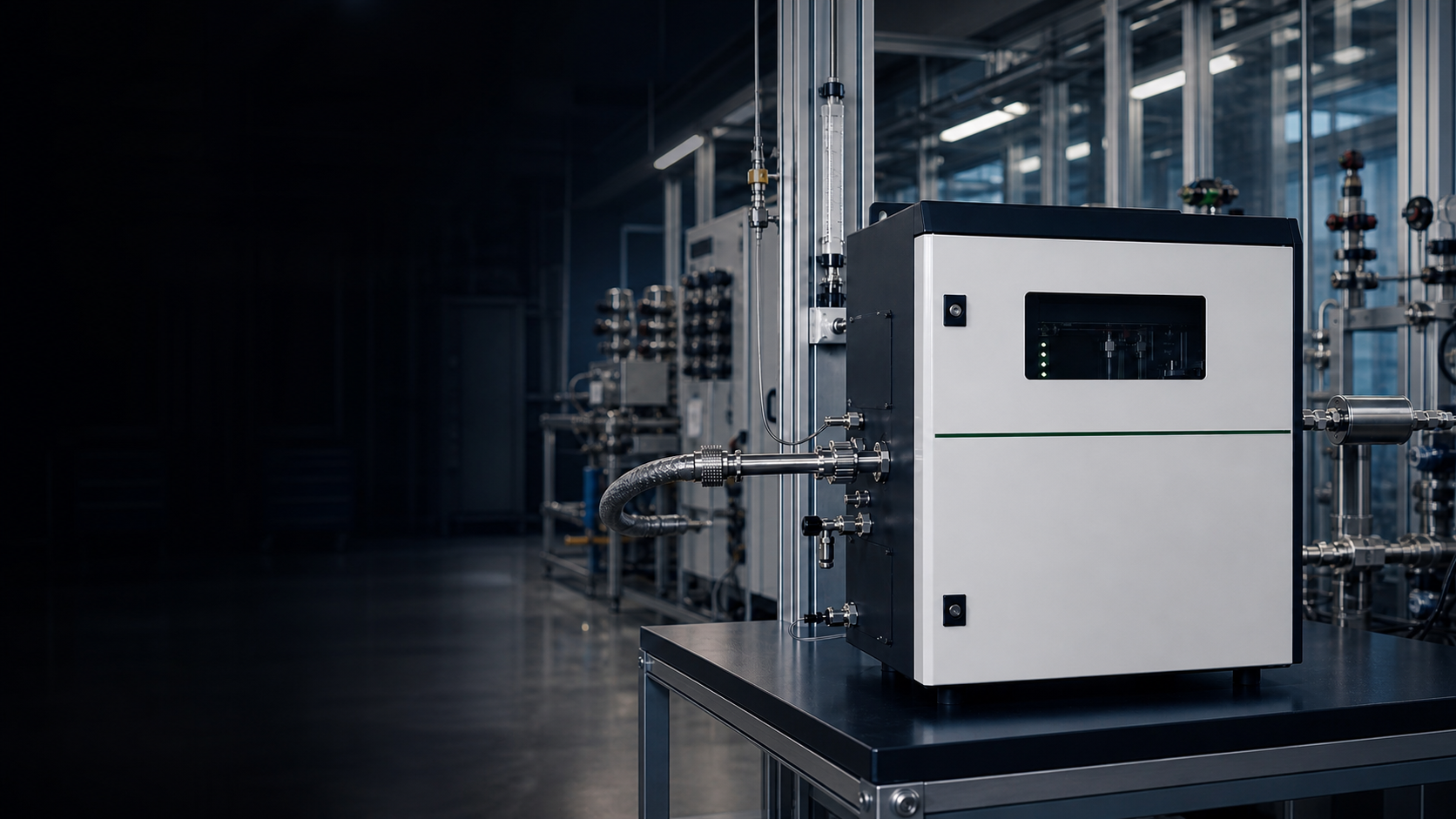
TDLAS Gas Analyzers
Tunable Diode Laser Absorption Spectroscopy for fast, selective gas measurement in harsh industrial environments.
Single-line laser absorption analyzers for NH₃, HF, HCl, CO, CO₂, O₂, H₂O, CH₄, H₂S and C₂H₂ — available in both in-situ cross-stack and extractive configurations, from ppb-level trace detection to percent-range combustion monitoring.
What Is a TDLAS Gas Analyzer?
A TDLAS (Tunable Diode Laser Absorption Spectroscopy) gas analyzer uses a semiconductor laser tuned to a specific gas absorption wavelength to measure gas concentration with high selectivity and speed. Unlike broadband methods, TDLAS targets individual absorption lines — enabling interference-free measurement in complex industrial gas streams.
In industrial environments — from power plant stacks to chemical reactors — process gas streams contain dozens of compounds at extreme temperatures. Traditional broadband analyzers often suffer from cross-interference between overlapping absorption spectra. TDLAS eliminates this problem by using a narrow-linewidth laser that scans across a single, molecule-specific absorption line, achieving selectivity that no filter-based or dispersive method can match.
GESHINE has built its gas analysis platform around TDLAS technology because it delivers the combination of speed, selectivity, and durability that heavy industry demands — from ppb-level trace detection to percent-range combustion monitoring, in both in-situ and extractive configurations.
TDLAS Measurement Principle
How TDLAS Technology Works
Single-Pass vs Multi-Pass Optics
Laser beam crosses the process duct once. Path length equals duct diameter. Best for high-concentration gases (O₂, CO₂, H₂O) where long optical paths are not needed. Simpler alignment, lower maintenance.
Beam reflects multiple times between mirrors to achieve effective path lengths of 5–100 meters in a compact cell. Essential for trace gases (NH₃, HF, HCl, H₂S) where ppb-level sensitivity demands maximum absorption signal.
In-Situ vs Extractive Configuration
Laser and detector mount directly on the process duct — no sample extraction needed. Sub-second response, zero sample transport lag. Ideal for combustion control, safety interlocks, and real-time process feedback.
Gas sample is conditioned and drawn into a measurement cell. Enables multi-component analysis, calibration verification, and compliance-grade reporting. Required when in-situ mounting is impractical or regulated protocols demand sample conditioning.
Why Use TDLAS for Industrial Gas Analysis
Fast Response
Direct absorption measurement with no chemical reaction or diffusion delay — the laser scans the absorption line at kilohertz rates, enabling T90 response times under 1 second in suitable configurations.
Enables real-time closed-loop process control, reducing reagent waste in DeNOx systems and preventing off-spec product in fast-changing process streams.
High Selectivity
The laser linewidth (< 0.001 nm) is much narrower than the target gas absorption line, so only the target molecule contributes to the measured signal. Background gases and spectral neighbors are effectively excluded.
Accurate measurement in complex gas matrices without cross-interference corrections — reducing measurement uncertainty and false alarms in safety-critical applications.
Low Maintenance
No consumable sensing elements, reagent solutions, or optical filters to replace. Laser diode lifetime typically exceeds 10 years. In-situ configurations eliminate sample conditioning equipment entirely.
Lower total cost of ownership and reduced unplanned downtime — particularly valuable in remote installations or facilities with limited instrument technician staffing.
High Sensitivity
Multi-pass optical cell designs extend the effective absorption path length to several meters within a compact enclosure, boosting signal-to-noise ratio for trace-level detection down to ppb concentrations when properly configured.
Meets stringent purity specifications in semiconductor UHP gas, air separation, and specialty chemical applications where conventional analyzers lack the required detection limits.
Harsh Environment Capability
In-situ TDLAS probes are designed for direct installation on high-temperature stacks and ducts (process gas up to 500 °C or higher). The optical measurement principle is inherently resistant to poisoning by corrosive species such as HF and HCl.
Reliable continuous measurement in applications where conventional electrochemical or catalytic sensors degrade rapidly — reducing sensor replacement frequency and associated maintenance costs.
Gases Measurable by TDLAS
GESHINE TDLAS analyzers measure 10+ gases across acid/corrosive, combustion/process, and moisture/specialty categories.
Acid & Corrosive Gases
- Detection Range
- 0–100 ppm
- Typical Application
- DeNOx SCR/SNCR ammonia slip monitoring
- Detection Range
- 0–50 ppm
- Typical Application
- Aluminum smelting pot-room emission control
- Detection Range
- 0–200 ppm
- Typical Application
- Waste incineration flue gas monitoring
Combustion & Process Gases
- Detection Range
- 0–100% LEL / 0–5% vol
- Typical Application
- Natural gas pipeline leak detection and custody transfer
- Detection Range
- 0–30% vol
- Typical Application
- Combustion flue gas analysis and carbon emission monitoring
- Detection Range
- 0–5000 ppm
- Typical Application
- Combustion efficiency control at boiler and furnace outlets
- Detection Range
- 0–25% vol
- Typical Application
- Process control and combustion excess-air optimization
- Detection Range
- 0–1000 ppm
- Typical Application
- Natural gas processing and SRU tail gas monitoring
Moisture & Specialty Gases
- Detection Range
- 0.1 ppm – 30% vol
- Typical Application
- Natural gas dehydration and pipeline moisture monitoring
- Detection Range
- 0–100 ppm
- Typical Application
- Transformer oil dissolved gas analysis (DGA)
TDLAS Applications in Industry
From CEMS stacks to ammonia slip, waste incineration, petrochemical process, steel metallurgy, and air separation — where TDLAS measurement lives in the plant.
CEMS Emission Monitoring
- Process Point
- Stack and duct measurement points downstream of pollution control equipment (SCR, scrubber, ESP).
- Why TDLAS
- TDLAS provides the fast response and high selectivity needed to measure reactive and corrosive gases (NH₃, HCl, HF) in hot, wet flue gas — conditions where conventional IR analyzers may suffer from spectral interference and condensation issues.
- Recommended
- ZS8100-NH3 (in-situ) or ZS8100 (extractive)
DeNOx / Ammonia Slip
- Process Point
- Measurement downstream of the SCR/SNCR catalyst bed to quantify unreacted ammonia passing through the reactor.
- Why TDLAS
- Sub-second response enables real-time feedback to the reagent injection system, preventing both ammonia over-dosing (which causes ammonium bisulfate fouling) and under-dosing (which results in NOx permit exceedances).
- Recommended
- ZS8100-NH3 In-Situ Analyzer
Waste Incineration
- Process Point
- Post-combustion flue gas path, including measurement after semi-dry scrubber and fabric filter.
- Why TDLAS
- Waste feed composition varies continuously, creating rapid fluctuations in acid gas concentrations. TDLAS handles this variability with fast T90 response and reliable measurement even in high-dust, high-moisture conditions when properly configured.
- Recommended
- ZS8100 Extractive or ZS8100-NH3 In-Situ
Petrochemical Process
- Process Point
- Process gas streams in reformers, crackers, sulfur recovery units, and pipeline custody transfer points.
- Why TDLAS
- TDLAS delivers interference-free measurement of target gases in complex hydrocarbon matrices. The absence of consumable sensors reduces total cost of ownership in facilities with hundreds of measurement points.
- Recommended
- ZS8100 Single-Pass Extractive
Steel & Metallurgy
- Process Point
- Blast furnace top gas, BOF converter off-gas, coke oven gas, and continuous casting atmosphere control.
- Why TDLAS
- High-temperature and dust-laden steel plant gases challenge conventional analyzers. TDLAS in-situ probes tolerate process temperatures exceeding 500 °C and provide the fast response needed for converter blow optimization.
- Recommended
- ZS8100-NH3 In-Situ or ZS8100 Extractive
Air Separation
- Process Point
- Front-end purification system inlet/outlet, and product gas purity verification at cryogenic column exits.
- Why TDLAS
- Air separation plants require trace-level moisture and impurity detection (ppb to low-ppm) to protect cryogenic equipment from ice formation. The multi-pass TDLAS platform achieves the sensitivity needed without consumable desiccant or coulometric cells.
- Recommended
- ZS8600 Multi-Pass Trace Analyzer
TDLAS vs NDIR — Which Technology Fits?
Compare TDLAS with NDIR, UV-DOAS, and GFC across key performance dimensions to find the right technology for your application.
| Dimension | TDLAS | NDIR | UV-DOAS | GFC |
|---|---|---|---|---|
| Principle | Tunable laser scanned across a single gas absorption line at a specific wavelength | Broadband IR source with narrow-band optical filters to isolate target gas absorption bands | UV differential optical absorption — measures differential absorption structure to reject broadband interference | IR absorption with gas-filled reference cell acting as a molecular-specific optical filter |
| Response Time | <1–10 s | 15–60 s | 10–30 s | 30–60 s |
| Cross-Interference | Very low — wavelength-specific absorption eliminates most spectral overlap | Moderate — optical filter bandwidth may overlap with adjacent bands | Low — differential technique subtracts broadband absorption | Very low — gas-filled reference cell provides molecular-specific filtering |
| Sample Conditioning | Minimal for in-situ; standard heated line for extractive | Required — extractive with filtration, cooling, and drying | Required — extractive with heated lines to prevent condensation | Required — extractive with particulate and moisture removal |
| Maintenance | Low — no consumable sensors; laser diode lifetime >10 years | Moderate — optical filters and IR sources degrade over time | Low to moderate — no consumable sensors; periodic UV source validation | Moderate — reference cell and rotating filter wheel require scheduled service |
| Calibration | 6+ month stability; some models with automatic zero-reference | Monthly zero/span check recommended; drift from optical aging | Quarterly validation; factory-calibrated absorption cross-sections | Quarterly span check; reference cell provides inherent zero stability |
| Best-Fit Gases | NH₃, HF, HCl, H₂O, O₂, CO | CO, CO₂, CH₄, SO₂, NO | SO₂, NO₂, Cl₂, NH₃, BTX | CO, CO₂, SO₂, NO |
| Best-Fit Applications | Harsh, high-temperature, corrosive environments requiring fast response | Standard CEMS, ambient monitoring, moderate-speed process applications | Multi-component CEMS for acidic and corrosive gas species | High-accuracy regulatory CEMS requiring superior interference rejection |
Choose TDLAS When…
- Fast response (<1s) is critical for process control or safety
- Harsh environment with high dust, moisture, or corrosive gases
- Low cross-interference needed in complex gas matrices
- Trace-level (ppb) detection of NH₃, HF, HCl, or H₂S required
- In-situ measurement preferred to eliminate sample transport
Consider NDIR / GFC When…
- Standard CEMS with proven regulatory track record needed
- Budget-conscious project with moderate accuracy requirements
- Multi-component measurement where broadband range is acceptable
- Established calibration protocols and spare parts infrastructure
- Application-specific certification already proven for NDIR
GESHINE TDLAS Analyzer Product Lines
Three product series covering in-situ cross-duct, extractive multi-pass, and multi-component TDLAS applications.
Single-Pass Extractive TDLAS Platform
Extractive
- Process gas analysis
- Pipeline gas monitoring
- Quality control and purity verification
Multi-Pass Extractive TDLAS Platform
Extractive
- Trace moisture measurement
- Semiconductor ultra-high-purity (UHP) gas analysis
- Low-ppb specialty gas applications
In-Situ Cross-Stack TDLAS Platform
In-situ
- DeNOx SCR/SNCR ammonia slip monitoring
- Stack emission compliance
- Combustion optimization feedback control
Why Choose GESHINE for TDLAS Gas Analysis
In-House TDLAS Development
Proprietary laser source, optical design, and signal processing developed at GESHINE’s Wuhan R&D center. Full control over core technology means faster iteration and deeper application expertise.
10+ Measurable Gases
Single TDLAS platform covering NH₃, HF, HCl, H₂O, CO, CO₂, O₂, CH₄, H₂S, C₂H₂ — reducing multi-vendor complexity and standardizing your analyzer fleet.
Application Engineering Support
From gas selection to installation design — GESHINE engineers support the full project lifecycle including feasibility studies, optical path design, and commissioning assistance.
Manufacturing & Quality Control
GESHINE applies documented manufacturing, calibration, and quality-control procedures to TDLAS analyzer projects. Safety, CE, hazardous-area, and customer-specific certificate packages are scoped by model and installation type during engineering review.
Certification availability depends on analyzer model, installation type, and project requirements.
TDLAS Gas Analyzer FAQ
Answers to common questions about TDLAS technology, applications, and GESHINE analyzers.
What is a TDLAS gas analyzer?
A TDLAS (Tunable Diode Laser Absorption Spectroscopy) gas analyzer uses a semiconductor laser diode that is precisely tuned to a specific absorption wavelength of the target gas molecule. By scanning across this narrow absorption line, the analyzer determines gas concentration from the measured absorption depth according to the Beer–Lambert law.
Unlike broadband techniques such as NDIR, the laser linewidth in a TDLAS system is much narrower than the gas absorption feature — typically less than 0.001 nm. This narrow tuning range means the measurement is inherently selective to the target molecule, and cross-interference from other gas species is minimized. TDLAS analyzers are available in both extractive and in-situ configurations, covering applications from trace-level moisture detection to cross-stack ammonia slip monitoring.
What gases can a TDLAS analyzer measure?
TDLAS analyzers can measure any gas molecule that has discrete, well-resolved absorption lines in the near-infrared or mid-infrared wavelength region. Common measurable gases include NH₃, HF, HCl, CO, CO₂, CH₄, O₂, H₂O, H₂S, and C₂H₂ — each addressed by selecting a laser diode matched to a specific absorption transition.
The GESHINE TDLAS platform covers over 10 target gases across three product lines. Each laser module is optimized for a single gas species, which is what gives TDLAS its superior selectivity. For applications requiring multiple gas measurements simultaneously, systems can be configured with multiple laser channels or combined with complementary technologies such as NDIR or UV-DOAS.
How does TDLAS compare to NDIR for gas analysis?
The key difference is selectivity: TDLAS uses a narrow-linewidth laser to probe a single absorption line, while NDIR uses broadband infrared light filtered through optical bandpass filters that cover a wider spectral window. This gives TDLAS significantly better cross-interference rejection and faster response time (typically <1 s in-situ vs. 15–60 s for NDIR).
However, NDIR remains a proven and cost-effective choice for many applications — particularly multi-component measurements of common gases like CO, CO₂, and CH₄ where spectral overlap is manageable. TDLAS is generally preferred when measuring reactive or corrosive gases (NH₃, HF, HCl), when fast response is critical for process control, or when the sample matrix contains interfering species that would affect broadband measurements.
Does a TDLAS analyzer need frequent calibration?
TDLAS analyzers are generally recognized for their long-term calibration stability, with many installations maintaining specification for 6 months or longer between calibration checks. This stability stems from the fundamental measurement principle — the laser wavelength is locked to a specific molecular absorption line, which does not drift over time.
Calibration intervals depend on the specific application, regulatory requirements, and site conditions. Some GESHINE TDLAS models include a built-in reference cell that provides automatic zero validation without manual intervention. For regulatory CEMS applications, site-specific QAL2/QAL3 or RATA protocols typically define mandatory calibration intervals regardless of the analyzer technology.
What is the detection limit of a TDLAS gas analyzer?
Detection limits vary by gas species, optical path length, and system configuration. In suitable applications, single-pass extractive TDLAS systems typically achieve detection limits in the low-ppm range, while multi-pass configurations with extended optical paths can reach sub-ppm or even ppb-level sensitivity for gases like H₂O and C₂H₂.
For example, the GESHINE ZS8600 multi-pass platform is designed for trace moisture measurement down to 0.1 ppm in high-purity gas applications. The ZS8100-NH3 in-situ platform typically achieves detection limits of 0.5–2 ppm for NH₃ depending on the stack diameter and optical alignment. Real-world detection limits are influenced by factors such as optical window contamination, vibration, temperature stability, and the presence of interfering species.
What is the difference between in-situ and extractive TDLAS?
In-situ TDLAS analyzers mount directly on the process duct or stack, passing the laser beam across the full diameter of the gas path — no sample is extracted. Extractive TDLAS systems draw a gas sample through a heated line to an external measurement cell where the laser analysis is performed under controlled conditions.
In-situ installation eliminates sample conditioning entirely, which means faster response, lower maintenance, and no risk of sample alteration during transport. This makes in-situ TDLAS the preferred choice for reactive gases like NH₃ and HCl that can be lost to adsorption in sample lines. Extractive systems offer advantages when the process environment is too harsh for direct optical access (extreme dust loading, very high temperatures, or small duct diameters), or when a conditioned sample is needed for regulatory reference method validation.
Can TDLAS measure multiple gases simultaneously?
A single TDLAS laser module measures one gas species at a time, since each laser diode is tuned to a specific absorption wavelength. However, multi-channel TDLAS systems can incorporate two or more laser modules in the same measurement cell, each operating at a different wavelength, to measure multiple gases simultaneously from a single sample stream.
For applications requiring a large number of gas components (e.g., full CEMS suites with SO₂, NOₓ, CO, CO₂, O₂, and NH₃), it is common practice to combine TDLAS with complementary technologies — for example, using TDLAS for NH₃ and HCl where its selectivity advantage is greatest, and NDIR or UV-DOAS for the remaining components. This hybrid approach optimizes both performance and total system cost.
What information do I need to provide for a TDLAS analyzer quotation?
To configure the optimal TDLAS solution, our application engineers typically need: the target gas and expected concentration range, the process gas composition (background matrix), process temperature and pressure at the measurement point, duct/pipe diameter, required certifications (ATEX, SIL, etc.), and the preferred installation type (in-situ or extractive).
Additional details that help refine the recommendation include: the purpose of the measurement (process control, safety, or regulatory compliance), required response time, ambient environmental conditions, communication protocol preferences (4–20 mA, Modbus, HART), and any site-specific constraints such as access limitations or hazardous area classification.
What is the difference between TDLAS and a generic ‘diode laser’ or ‘tunable laser’ gas analyzer?
They are the same measurement under different names — TDLAS, TDL and “tunable diode laser” gas analyzer all refer to tunable diode laser absorption spectroscopy. TDLAS is the full term; TDL is simply the abbreviation of “tunable diode laser,” and vendors who write “diode laser” or “tunable laser gas analyzer” are almost always describing the same technique: a semiconductor laser tuned across a single molecular absorption line, with concentration read from the absorption depth by Beer-Lambert. The distinctions that actually matter are not the name but the implementation — near-IR versus mid-IR laser, single-pass versus multi-pass cell, in-situ versus extractive, and which absorption line is chosen for the target in your matrix. Watch only for “tunable laser” used loosely for unrelated techniques (some CRDS or QCL-based systems); confirm it is single-line direct-absorption diode laser spectroscopy. When comparing quotes, match on line selection, path length and matrix handling, not on the marketing label.
How does TDLAS reject background interference that biases NDIR / EC — and where can co-absorbers still fool it?
TDLAS rejects most background interference by probing a single, narrow absorption line instead of a broad band — but it is not immune, and co-absorbers can still bias it in the wrong matrix. Because the laser linewidth is far narrower than the absorption feature, TDLAS scans one isolated line of the target molecule, so the broadband cross-sensitivity and continuum absorption that drift an NDIR reading, and the cross-gas response and consumable drift that affect an electrochemical (EC) cell, are largely sidestepped. Where TDLAS can still be fooled is pressure and collisional line broadening: when the background composition changes — methane (C1), ethane (C2) or CO₂ shifting in the matrix — the wings of those neighbouring absorptions broaden or overlap the target line, biasing the result even though the target concentration has not moved. The honest fix is matrix-specific calibration and a broadening model sized to the expected composition envelope, not an assumption of perfect selectivity. Give the application engineer the real background range so the line selection and correction are matched to it.
Request a Quote for TDLAS Gas Analyzers
To configure the optimal TDLAS analyzer for your process, please have these details ready:
- Target gas & concentration range
- Process temperature & pressure
- Corrosive or high-dust conditions
- In-situ vs extractive preference
- Hazardous area classification and local approval framework
- Required certifications (CE, SIL, etc.)
- Output protocols (4-20mA, Modbus, HART)
- Installation constraints & duct dimensions
Get TDLAS Expert Consultation
Our application engineers specialize in TDLAS analyzer configuration for challenging industrial environments.


